A Singaporean tycoon has run into serious trouble, why did Wavelength Opto-Electronic, a firm with a valuation of 7 billion yuan, smuggle germanium-containing lenses worth 20 million yuan?
On August 23, 2023, Wavelength Opto-Electronic rang the bell for its listing on the ChiNext board of the Shenzhen Stock Exchange, with an issue price of 29.38 yuan per share. Its share price rose by more than 110% in half an hour after opening, pushing its market value to 7.151 billion yuan. The guests and hosts on and off the stage were all in high spirits, and they probably had no time to think that 22 days earlier, on August 1, the export control on gallium and germanium-related items officially came into effect as announced by the Ministry of Commerce and the General Administration of Customs — unlicensed export of metallic germanium, zone-refined germanium ingots, germanium dioxide and other related items is strictly prohibited. They could never have imagined that this boomerang would send the chairman of the board and three other responsible persons to prison three years later.
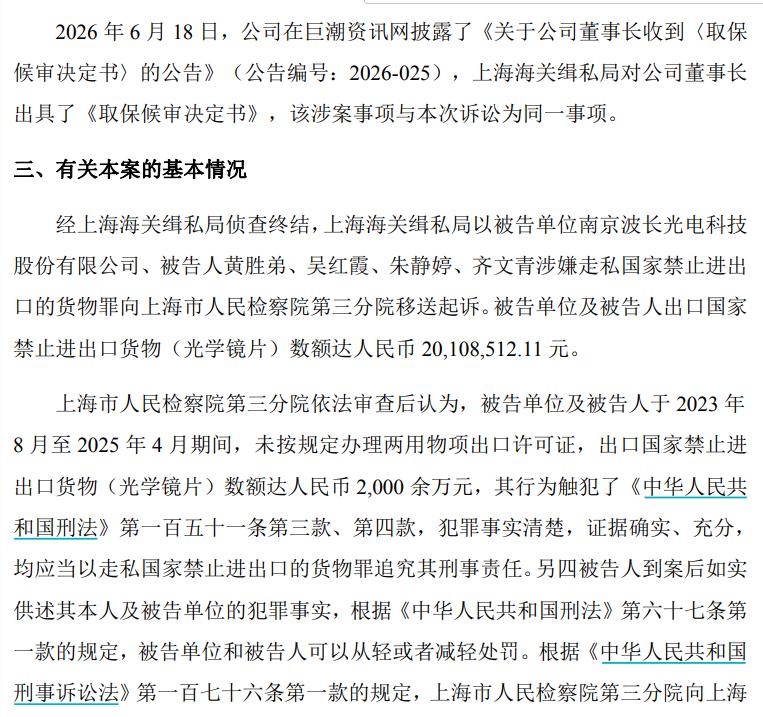
On the evening of October 8, 2026, Wavelength Opto-Electronic announced that it had received the Indictment from the Third Branch of the Shanghai Municipal People's Procuratorate. The procuratorial organ determined that the defendant unit Wavelength Opto-Electronic and the defendants Huang Shengdi, Wu Hongxia, Zhu Jingting and Qi Wenqing failed to apply for the export license for dual-use items in accordance with regulations between August 2023 and April 2025, and exported goods (optical lenses) whose import and export are prohibited by the state, with the amount reaching 20.1085 million yuan. The starting point of the involved period is exactly the same month when the control came into effect.
On October 9, Wavelength Opto-Electronic closed at 63.63 yuan per share, down 6.5%, with an intraday low of 59.8 yuan per share, and its total market value stood at 7.363 billion yuan, which is not much different from the figure on the bell-ringing day.

Source: Canstock Photo
20 Months of Smuggling Germanium-Containing Lenses Worth 20.11 Million Yuan
The disaster did not come out of nowhere. On April 10, 2025, the company received the Inspection Notice from Shanghai Wusong Customs; on July 11, the Inspection Conclusion was issued, confirming that the company was suspected of exporting germanium-containing lenses under state control by falsely declaring the material of goods, and the case was transferred to the anti-smuggling department. On June 17, 2026, the Anti-Smuggling Bureau of Shanghai Customs issued the Decision on Bail Pending Trial to Huang Shengdi. It took 18 months to complete the whole judicial process before the Indictment was served on October 8.
The list of defendants is thought-provoking: the defendant unit is a listed company, and the defendants include not only the chairman Huang Shengdi, but also Wu Hongxia, then director of the International Business Department (Nanjing), as well as Zhu Jingting and Qi Wenqing, employees of the International Business Department, all listed from the director to front-line employees. The fact that the chairman is listed as a defendant also means that the procuratorial organ does not consider this an unauthorized act by individual employees.
Source: Official Announcement
Huang Shengdi has a special status: he was born in April 1967, holds Singaporean nationality, graduated from the Optical Instrument Engineering major of Zhejiang University in 1989, and has served as chairman of the board since 2008. He is one of the actual controllers of the company; he does not hold shares directly, but he is married to Zhu Min, the controlling shareholder. After the company went public, Zhu Min holds 37.78% of the shares directly.
The severity of the criminal consequences depends on which range the involved amount falls into. Paragraph 3 of Article 151 of the Criminal Law stipulates that those who smuggle goods and articles whose import and export are prohibited by the state shall be sentenced to fixed-term imprisonment of not more than five years, criminal detention and a fine; if the circumstances are serious, they shall be sentenced to fixed-term imprisonment of not less than five years and a fine. Paragraph 4 clarifies that where a unit commits the crime stipulated in this Article, the unit shall be sentenced to a fine, and the persons in charge directly responsible and other persons directly responsible shall be punished in accordance with the provisions of each paragraph. Lawyers including Chen Yu from Han Kun Law Offices and other legal professionals pointed out that according to relevant judicial interpretations, smuggling of this type with an amount of more than 200,000 yuan but less than 1 million yuan shall be convicted, and the amount exceeding the above standard shall be deemed as "serious circumstances". The involved amount of 20.1085 million yuan in this case is 20 times of this threshold.
The indictment also states that the four defendants truthfully confessed their crimes after being brought to the case, and may be given a lighter or mitigated punishment in accordance with Article 67 of the Criminal Law; the case has not yet been heard in court.
The company stated that it expects the incident will not affect its ability to continue operations, but the outcome of the judgment remains uncertain; in the research in June, it also stated that it had not learned the specific involved amount for the time being, and no estimated liabilities have been accrued so far.
There is already a reference case. On December 16, 2025, the Shanghai Third Intermediate People's Court handed down the first-instance judgment on the smuggling case involving Chang Yongsheng and others: the main offender, who smuggled more than 325 tons of metal ingots and compounds including gallium, germanium and antimony worth more than 146 million yuan, was sentenced to 14 years in prison and a fine of 5 million yuan.
In another case, the holding subsidiary of A-share listed company Guangzhi Technology (300489.SZ) itself has export qualifications, but forged materials to defraud licenses from the first day the control took effect. It smuggled more than 9377 kilograms of germanium and gallium with a total value of more than 56.76 million yuan, which were transported to Japan. In the end, Anhui Guangzhi Technology was sentenced to a fine of 8 million yuan, included in the list of customs enterprises with serious dishonesty, and permanently lost the relevant export qualifications for dual-use items; Liu Liu, then legal representative and general manager, was sentenced to 10 years in prison and a fine of 1 million yuan; sales manager Cao Yan was sentenced to 8 years in prison and a fine of 800,000 yuan; customs declarant Zhu Bangfu was sentenced to 3 years in prison, suspended for 5 years, and a fine of 200,000 yuan.

Source: Canstock Photo
Why Did They Take the Risk?
The answer lies in the metal germanium (Ge). The global annual output of germanium is only about 200 tons. There are almost no independent deposits of germanium, most of which are associated with lead and zinc, or recovered from germanium-rich lignite ash slag, so it is not easy to expand production. However, its uses are extremely important — infrared lenses, optical fiber preforms, and aerospace solar cell substrates, which have distinct dual-use attributes for military and civilian purposes. Although germanium is not a resource that "everyone understands" like gold or oil, it is a typical "small metal with major bottleneck restricting development" in modern military industry, semiconductor and optical communication, and is known as a "strategic metal". Because germanium can be used not only for civilian telecommunications and photovoltaic products, but also for missile infrared seekers, military night vision and satellite reconnaissance. For metals with such dual-use attributes for military and civilian purposes, control is also a common international practice.
Due to its scarcity, the price of germanium has been rising in recent years. Data from Shanghai Steel Union shows that as of September 29, 2026, the domestic germanium ingot was quoted at 27,000 yuan per kilogram, with an increase of 98.53% within the year; while at the end of 2025, the price was still around 13,600 yuan per kilogram, almost doubling in less than a year.
Closely related to the price is the policy. Starting from August 1, 2023, germanium-related items must apply to the Ministry of Commerce for export licenses for dual-use items and technologies, and submit proof of end users and end uses. On December 3, 2024, the Ministry of Commerce announced that in principle, the export of dual-use items related to gallium, germanium, antimony and superhard materials to the United States will not be approved.
And the overseas business line is precisely in the hands of Huang Shengdi. According to the prospectus, this Singaporean chairman once served as the general manager of Wavelength Opto-Electronic USA, and has served as the president of Wavelength Opto-Electronic Korea Co., Ltd. since May 2012. The person most familiar with the overseas market in the company became the first defendant on the indictment.

Source: Canstock Photo
Strategic metals that are closely related to policies are banned, why did the company still take the risk? The first reason is "reluctance to give up": infrared optics is its original business, overseas customers have long certification cycles and high stickiness. Once contracts are torn up due to policy restrictions, the company may face the risk of license supply interruption in the future, and it will be difficult to retrieve the lost orders and customer relationships. The second reason is that although domestic revenue has become the main source of revenue, accounting for 79.31% of the total revenue in the first half of the year, the 20% overseas revenue is exactly the highland of gross profit and brand premium. The third reason is the thought that "it will not be detected": batches of goods were exported in 20 months, and fluke mentality always existed until the inspection notice was served.
There is another background: Wavelength Opto-Electronic has not had an easy time after its listing. From 2022 to 2025, the attributable net profits were 61.4818 million yuan, 54.1264 million yuan, 36.9593 million yuan and 35.4914 million yuan respectively, declining for three consecutive years. In 2025, the deducted non-recurring profit net profit was 26.5904 million yuan, down 14.34% year on year. Until the first half of 2026, the revenue was 243 million yuan, up 8.89% year on year, and the attributable net profit was 28.8468 million yuan, up 102.65% year on year, and the performance was significantly repaired.
Internal Control Failure of the Listed Company
How did germanium-containing lenses "become" ordinary optical lenses? It has not been clarified yet. However, Wavelength Opto-Electronic has repeatedly publicized that its self-developed infrared chalcogenide glass has low cost and light weight, and is replacing germanium-containing materials. Both are infrared materials with similar appearances. On the customs declaration form, the material column only contains a few words. As long as the word "germanium" is not written, the goods may be released as ordinary lenses.
Chu Weishu, partner of Shanghai Office of DeHeng Law Offices, and lawyer Guo Lili reminded that deliberately concealing the nature of goods can be presumed as "knowingly" in subjective intent, and claims like "do not understand the policy" or "required by customers" cannot be used as defenses for exemption from liability. Article 39 of the Export Control Law also stipulates that export operators who have received criminal penalties will be permanently prohibited from engaging in relevant export business activities.
Source: Canstock Photo
How much is this business worth? The involved amount of 20.1085 million yuan spans 20 months, with an average monthly amount of about 1 million yuan, while the company's revenue in 2025 was 465 million yuan. For the sake of orders worth tens of millions of yuan per year, betting on criminal records, export qualifications and the compliance record of a listed company is not worth the loss at all. The company itself also admitted that the involved business accounts for a limited proportion of the revenue in the corresponding years.
However, for a listed company, making profits through smuggling, not to mention the inherent legal and moral risks, also makes the corporate governance and risk control arrangements of the entire listed company completely useless. It is really surprising that no one gave a reminder until the police showed up at the door.
The governance structure may explain "Why no one stepped on the brake?". After the company's public listing, Zhu Min, the spouse of chairman Huang Shengdi, directly holds 37.78% of the shares, and Wu Yutang, director and general manager, holds 18.73% of the shares. The couple Wu Yutang and Huang Yumei are the concerted actors of Huang Shengdi and Zhu Min. The structure of couple holding controlling shares, concerted actors working together, and the chairman personally in charge of overseas business is a typical family enterprise structure, with short decision-making chain and insufficient checks and balances.
Uncertainty of Fines and Qualifications
The judgment of the market is written on the market trend. On October 9, Wavelength Opto-Electronic fell 6.5%, closing at 63.63 yuan per share, with a total market value of 7.4 billion yuan. From a longer-term perspective, starting from the year's high of 135.68 yuan per share on May 25, 2026, the share price has nearly halved by the close of October 8, and the market value has evaporated by half.
In the first half of 2026, the company's overseas revenue was 50.3122 million yuan, accounting for 20.69% of the total revenue, mainly from customers in Singapore, South Korea and the United States. Analysts Wu Wenji and Zhai Yimeng from China Post Securities pointed out in the research report in June that the company's overseas business revenue declined in 2025 due to the impact of the international trade environment, and the company had set up a wholly-owned subsidiary Ruisi Optics in Malaysia in October 2025, aiming to continue its overseas layout with the "front store and back factory" model.
At present, three layers of risks have not landed. The first is the judgment itself: if the company is convicted, it will face a fine, and the persons in charge directly responsible and other directly responsible persons will also bear criminal liabilities. The final