Where are we in the current PCB cycle? You might as well refer to the latest developments of this leading player in the industry.
The most straightforward way to judge where the current PCB cycle stands is to look at the leading players in the sector.
With the explosive surge in demand for AI hardware, the PCB industry has reached a boom peak. As the global leader in copper clad laminates (CCL), Kingboard Holdings and its subsidiary Kingboard Laminates have seen a sharp rise in market attention.
Yet there is an interesting phenomenon: when calculating backwards based on the market value corresponding to the equity stake Kingboard Holdings holds in Kingboard Laminates, the market value of the group itself is at a deep discount.
Is Kingboard Holdings being mispriced, or has the PCB cycle been fully priced in?
High Industry Boom and Deep Discount of the Group
1. AI Computing Power Pushes the PCB Industry to a High Boom Level
The AI boom has prompted global tech giants to collectively bet on the computing power track. In 2026, the total capital expenditure of the world's nine major cloud vendors exceeded 886.7 billion US dollars, with a year-on-year increase of nearly 90%; the total annual capital expenditure of four domestic companies including ByteDance, Tencent, Alibaba and Baidu grew by more than 80%, with the focus falling on the construction and implementation of large-scale data centers, self-developed chip platforms and domestic AI computing power solutions.
PCB is the fundamental link of AI computing power hardware. The industry boom index hovered around 1000 points for many years, and it rose to the current 4800 points in less than three years.
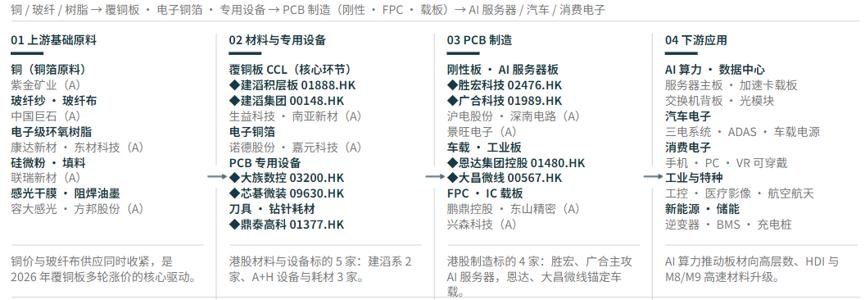
Figure: PCB industrial chain and AI computing power hardware map
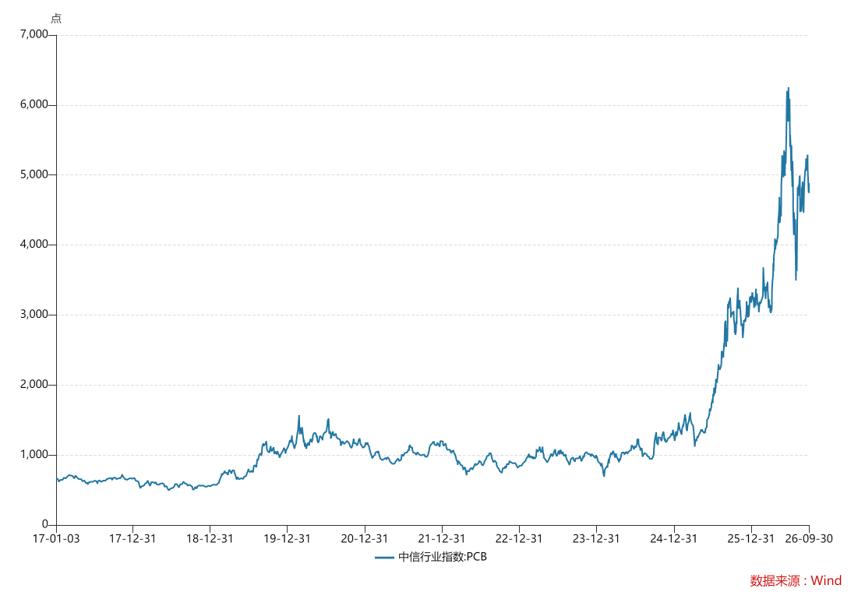
Figure: The PCB industry boom index remained at around 1000 points for a long time, accelerated to rise in 2025, and currently stands at 4800 points
2. The Deep Discount Mainly Occurred in 2026
As of October 8, the share price of Kingboard Holdings is HK$57.7, with a total market value of HK$64.7 billion; the market value of its subsidiary Kingboard Laminates is HK$158 billion. The group holds a total of 61.69% equity stake in Kingboard Laminates through Kingboard Investments and Jamplan, corresponding to a market value of HK$97.47 billion.
Calculated on this basis, the value of the group's businesses other than CCL is negative, with a discount of at least 34% (Group market value / corresponding market value of the subsidiary).
Since 2026, Kingboard Laminates' share price has risen by 287%, while Kingboard Holdings' share price has risen by 101.75%, and the discount mainly occurred in 2026: the subsidiary, as an upstream supplier of AI, has obtained a high valuation for its growth attributes. From the perspective of absolute valuation, Kingboard Holdings currently has a PE of 14.4 times, the estimated PE in 2026 is only 8.1 times, and the PB is only 0.82 times.
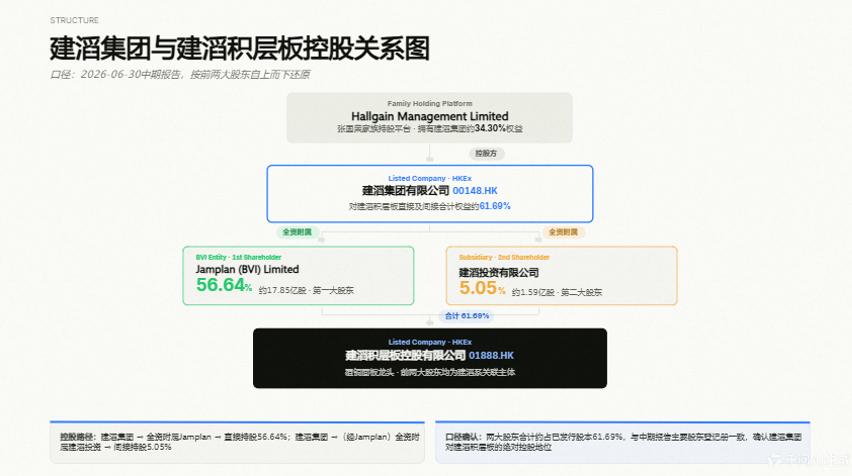
Figure: Kingboard Holdings holds a total of 61.69% equity stake in Kingboard Laminates through Kingboard Investments and Jamplan
Is Kingboard Holdings Being Mispriced?
Kingboard Holdings started its business in Shenzhen in 1988, and later expanded its layout to many places including Guangdong, Hengyang of Hunan, Xingtai of Hebei, Beihai of Guangxi, etc. In recent years, in response to the industrial chain relocation trend, it has increased investment in Vietnam, Thailand and other regions. With nearly 40 years of in-depth cultivation in the industry, it has built a complete vertical industrial chain from raw materials to PCB.
The chemical business segment centers on the main businesses of CCL and PCB, and extends to the basic chemical field at the same time. Caustic soda, acetic acid, phenol and acetone (and its downstream bisphenol A) are its three main product lines.
These names may not sound attractive to investors. From another perspective: the company covers all three core raw materials of CCL, namely electronic fabric, copper foil and epoxy resin. Zhang Guangjun, the executive director, said in an interview: "If we can't buy electronic fabric, we will weave it ourselves; if we can't buy fiberglass yarn, we will draw the silk ourselves; for copper foil and resin, we will make up for whatever we lack." In the first half of 2026, the segment's revenue reached HK$6.951 billion, with EBITDA of HK$772 million, a year-on-year increase of 68%.
The CCL business is operated by Kingboard Laminates, which is the segment with the fastest revenue growth. In the first half of 2026, its revenue reached HK$12.474 billion, a year-on-year increase of 61.63%; its EBITDA reached HK$4.459 billion, a year-on-year increase of 172%, delivering the most outstanding performance.
Following the industry boom, the PCB business has also seen recovery. In the first half of 2026, its revenue reached HK$7.943 billion, a year-on-year increase of 23.13%, and the full-year revenue is expected to exceed the previous peak recorded in 2021; its EBITDA reached HK$1.224 billion, a year-on-year increase of 1%.
The property segment is mainly engaged in leasing, with a significant contraction in development business, and its focus has shifted to existing property sales and leasing operations. Most of the properties are located in mainland China, concentrated in East China and South China, with a small number of investment properties in Hong Kong and the UK. In terms of strategy, the company operates prudently: no new land reserves will be added, all developments are funded by self-owned capital, sales are mainly based on completed properties, and the "sale via lease" model is adopted.
According to the 2025 annual report, the company has not added any new land reserves in the past 7 years, and the land reserve cost is controllable; some unsold projects adopt the "sale via lease" model to revitalize existing properties. In the past three years, except for the impairment provision of about HK$1.321 billion made for unsold residential properties in East China in 2025, which led to the EBITDA of the property segment being -HK$285 million, all other years were profitable; in the first half of 2026, the impairment provision was HK$324 million, and the EBITDA reached HK$471 million.
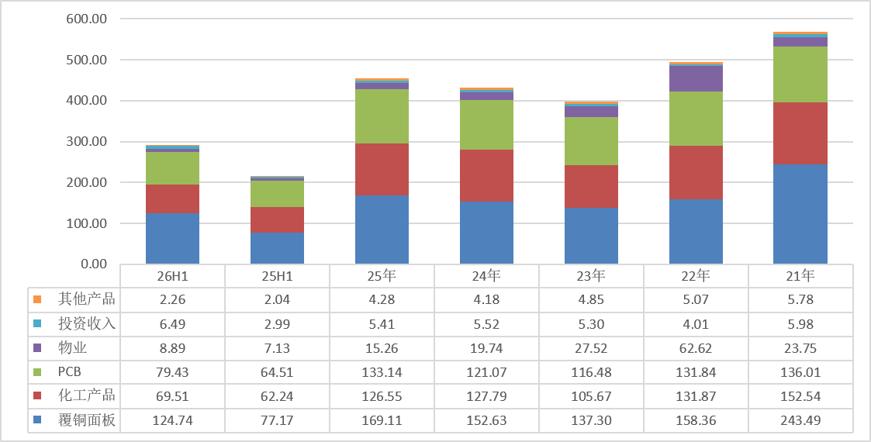
Figure: The group's main businesses include CCL, chemicals, PCB and real estate, etc. (Unit: 100 million HKD)
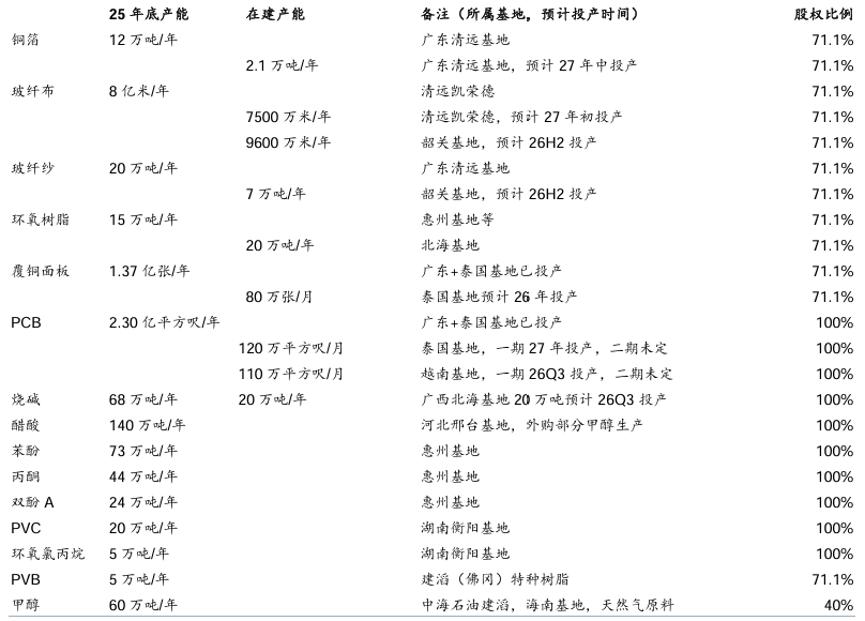
Figure: The production capacity of the company's main products (as of the end of 2025)
In terms of market position, Kingboard Holdings ranks first in the world in terms of rigid CCL sales all year round. The property and chemical segments reduce the technology perception of the company, but the chemical business is mainly laid out along the PCB industrial chain, and electronic fabric, copper foil and epoxy resin are all links with short-term demand surge and supply shortage. The only real drag is the property segment.
With the high boom of the CCL business, the proportion of Kingboard Laminates in the group's revenue, especially in its profit, continues to rise.
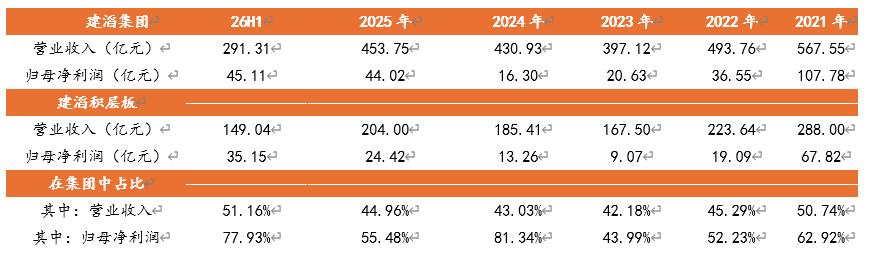
Figure: The profit proportion of Kingboard Laminates in the group is getting higher and higher
At the valuation level, segment valuation is carried out for the four business lines of CCL, PCB, chemicals and property: the CCL segment takes 10-15 times EV/EBITDA, PCB takes 15-25 times, chemicals takes 6-10 times, and property takes 8-12 times. Under conservative estimation, the company's EV is about HK$127.9 billion (excluding the investment business, whose investment balance in the first half of 2026 was HK$22.722 billion, mainly consisting of H shares and bonds of Hong Kong listed companies).
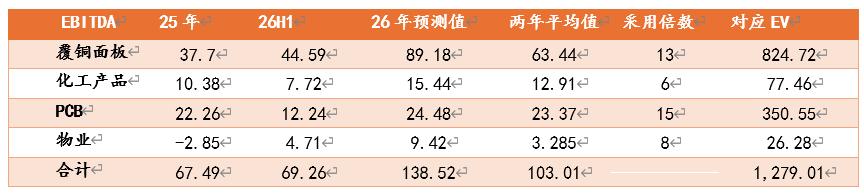
Figure: The EV of Kingboard Holdings under segment valuation is about HK$127.9 billion (Unit: 100 million HKD) Note: Assuming that the boom of each segment does not change much, the full-year 2026 business performance is calculated by multiplying the first half 2026 performance by 2.
The net debt based on the 2026 interim report data is HK$19.52 billion (HK$30.854 billion in bank loans minus HK$11.334 billion in cash). Equity value = EV + investment portfolio - net debt, which is about HK$131.1 billion; if the holding company discount is considered and estimated at 30%, the equity value is about HK$91.8 billion.
But there is a premise for this model to hold: can the current boom continue in the future? At the end of the day, it is still a matter of the cycle position.
What Exactly Is the Market Worried About?
Kingboard Holdings currently has a PE of 14.4 times, the estimated 2026 PE is 8.1 times, and the dividend yield is 3.85%. There is still a 34% discount between its market value and that of its subsidiary. What exactly is the market worried about?
1. Good Business Will Not Fall into Low Profitability
From 2021 to now, Kingboard Holdings' gross sales margin ranges from 17.47% to 33.16%, its net sales margin ranges from 4.88% to 22.12%, the net sales margin in the first half of 2026 is 12.73%, and its ROE has been in single digits all year round.
Kingboard Laminates' profit figures are better than those of the group: its ROE in 2025 was 15.42%, and 16.65% in the first half of 2026. But in the long run, the historical data shows obvious cyclical characteristics, and its ROE at the trough is also only in single digits, which is lower than Shengyi Technology in the same track. The essence lies in the difference in technology content — Shengyi Technology has entered NVIDIA's supply chain, while Kingboard's AI-specific CCL and HVLP4 copper foil have not yet obtained NVIDIA certification.
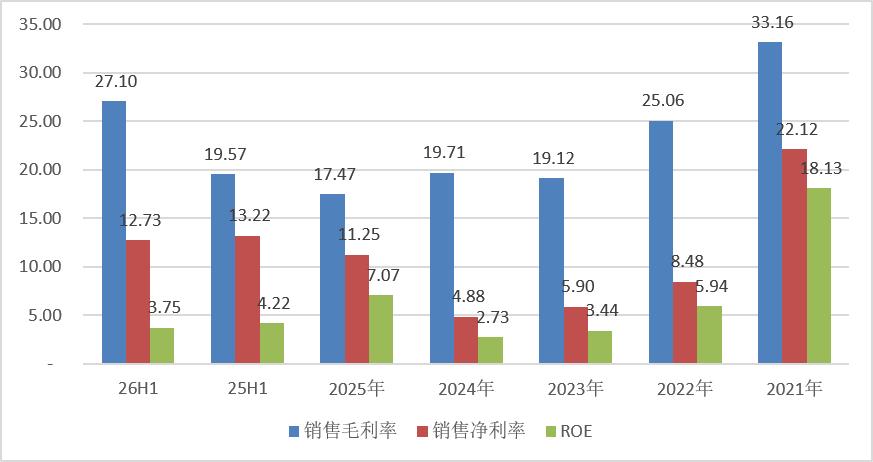
Figure: Kingboard Holdings' gross sales margin, net sales margin and ROE (Unit: %)
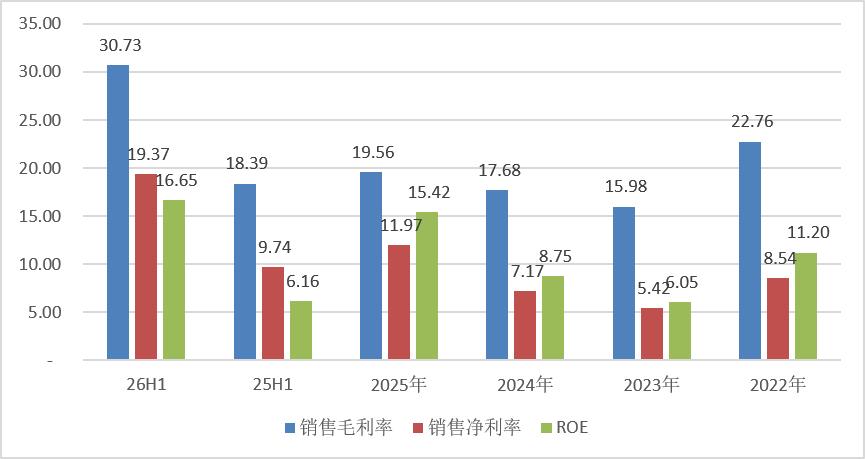
Figure: Kingboard Laminates' gross sales margin, net sales margin and ROE (Unit: %)
2. Tight Supply in the Near Term, Massive Capacity Expansion in the Long Run
Since 2025, driven by the AI computing power wave, the core driving force of CCL has shifted from traditional consumer electronics to the rigid demand of computing infrastructure such as AI servers and high-speed switches.
This demand is not only huge in volume, but also has greatly improved requirements for material grades, upgrading from ordinary FR-4 to M6/M8 and even M9 ultra-low loss systems. For the first time, high-end CCL has obtained a growth engine independent of the consumer electronics cycle, and the industry presents a situation of "high-end driving, overall shortage".
High profitability is attracting new entrants and existing players to expand their production capacity on a large scale. Multiple companies including Shengyi Technology, Kingboard Laminates, Nanya New Material, Jin'an Guiji have all announced capacity expansion plans. According to incomplete statistics, the total capacity expansion scale accounts for about 70% of the existing capacity; if we only count the projects with clear production schedules (excluding those still under review or long-term plans), the recent effective capacity expansion ratio is about 40%-50%, and the pace is highly concentrated in 2027-2029.
The capital expenditure spree driven by high profits will most likely end up with overcapacity. Will this time be different?