With a valuation exceeding 100 billion yuan, Keling is set to launch its IPO next year. Have BAT jointly successfully realized the commercialization of video generation?
Keling is one step closer to going public.
Recently, according to Bloomberg reports, Keling AI, the video generation business under Kuaishou, plans to launch an IPO on the Hong Kong Stock Exchange as early as 2027, raising at least 1 billion US dollars. China International Capital Corporation, Goldman Sachs, and UBS are the three institutions providing underwriting services for Keling's Hong Kong listing.
In May this year, news broke that Keling was being spun off for a separate listing. In July, Keling officially announced its restructuring and launched the independent financing process. This round of financing is as high as 3 billion US dollars, with investors including Tencent, Alibaba Cloud, Baidu, the National Artificial Intelligence Industry Investment Fund, and Chia Tai Robotics joining in one after another.
Calculated based on the public data of capital increase and share expansion at the end of August, Keling has an estimated valuation of about 1228 billion yuan, exceeding the current market value of its parent company Kuaishou (the latest market value is 1.104 trillion yuan as of the close on October 9). It seems that the era of video-generating AI large models has truly arrived.
The Explosion of AI Micro Dramas: Video Generation Moves Beyond the "Demo Show"
The commercialization model of video generation AI is very clear. For the C-end market facing the public, it enables everyone to become a director, screenwriter, and actor through video generation models, materializing the ideas in their minds; for the B-end market facing video producers, it is used to generate films, micro dramas, and advertising videos.
Obviously, video generation AI in the C-end market is not very successful. Most ordinary users do not have professional knowledge, nor do they have the patience to repeatedly adjust and redraw partial frames, resulting in low user retention rates. In the B-end market, video generation models have become an important driving force for the development of micro dramas.
The Micro Drama Creation Guidelines released by the China Netcasting Services Association show that in the first quarter of this year, about 128,000 micro dramas were launched across the industry, of which 122,000 were AI-generated micro dramas, accounting for as high as 95.3%.
Data from the National Radio and Television Administration shows that about 33,000 micro dramas were launched and broadcast in 2025. That is to say, the number of micro dramas launched in the first quarter of this year is nearly 4 times that of the whole of last year.

(Image source: AI-generated)
According to the calculation of DataEye Research Institute, the average production cost of a high-quality paid live-action micro drama is about 1.5 million yuan, while the cost of vertical screen information flow AI quasi-real-person micro drama can be controlled within 200,000 yuan.
Yao Guoli, director of AI manhua dramas, revealed in an interview with China Newsweek that the industry is rapidly reducing the production cost of AI manhua dramas. In the mass production mode in the past three months, the cost of a 60-episode AI manhua drama has been compressed to 20,000 yuan. The huge cost gap has led many companies to shift from shooting live-action micro dramas to embracing video generation AI.
Not only them, the entire film and television industry is actively using AI to reduce video production costs. For example, Hollywood blockbusters have widely used AI to produce video storyboards, backgrounds, and special effect drafts. In July this year, Neill Blomkamp, the director of District 9, also released a 13-minute sci-fi AI short film NIGHTBORNE created manually with the video generation model Seedance 2.0.
At the same time, well-known actors such as You Benchang, Lawrence Ng, Joey Wong, and Qi Wei have also licensed their portraits to producers of AI film, television and game works. Among them, Lawrence Ng and Joey Wong licensed their portraits from their younger days, allowing AI to bring their images in the most beautiful period back to the stage.
For the aforementioned NIGHTBORNE, the actors also signed project-specific license agreements, only authorizing their personal images to this film and television work.
From the explosion in the number of AI micro dramas to the portrait authorization of actors, it can be seen that the commercialization and standardization of AI video generation are proceeding simultaneously. The compliant authorization of star portrait rights solves the long-standing IP and portrait infringement pain points faced by video generation AI, clearing a major obstacle for commercialization.
At the technical level, video generation models have evolved from the early stage of generating static images from text, distorted human limbs and shaky camera shots, to supporting long video generation, motion control, character image locking, and multi-camera narrative.
For example, the Keling 3.0 large model launched earlier this year supports multi-modal input and output of text, images, audio and video, which can automatically split shots, control camera movement, keep character images stable, and greatly reduce the probability of "continuity errors" in AI videos. Competitors such as ByteDance's Jimeng AI (Seedance), Shengshu Technology, and PixVerse are also continuing to make efforts, forming a pattern of fierce competition among domestic video generation large models.
However, under the prosperous appearance, there are hidden crises in the field of video generation models.
Burning Money Continues, 90% of AI Micro Drama Companies Are Eliminated
Video generation large models and AI micro drama companies complement each other, but currently both sides are in a somewhat difficult situation.
Keling, whose valuation has exceeded 100 billion yuan, is still in a loss-making stage to this day. According to the data disclosed by National Business Daily, from the whole year of 2025 to the first quarter of this year, Keling's cumulative loss exceeded 2 billion yuan. Jimeng AI also raised prices for multiple rounds since March this year due to long-term substantial losses.
It should be noted that even Sora, which made the video generation large model track popular, was shut down because it burned up to 15 million US dollars per day and could not afford the huge cost expenditure.
The reason why Keling is in a hurry to go public is that Kuaishou can no longer afford to wait. In the first half of 2026, Kuaishou's profit attributable to shareholders was only 6.049 billion yuan, plummeting 32.03% year-on-year. Although Keling generated 650 million yuan in revenue in the first quarter, its revenue proportion was still less than 1%, which could not cover the high training and reasoning costs. Without more capital investment, it is really hard to say how far Keling can go.
Fortunately, Keling ranks among the top in the world in terms of technical strength, and enterprises that are optimistic about video generation models are still willing to invest in Keling. Even Tencent, Baidu, and Alibaba (BAT), which were once collectively known as the three giants of the Chinese Internet, have all participated in Keling's financing.
(Image source: AI-generated)
Compared with video generation models, AI micro drama companies are in a more difficult situation. Yao Guoli, the AI manhua drama director, said that according to the hit rate judgment, the cost of a single micro drama must be controlled within 20,000 yuan to maintain overall profitability.
Therefore, each production team needs to produce 7 micro dramas per month on average. Since it takes half a day to read the script, the actual production cycle of each micro drama is only two days, and there is no time to polish the script at all. Even so, whether a manhua drama can make a profit is still like a lottery. Usually, the money earned from a few hits is used to offset the losses of most works.
Sun Shuche, founder of Yilian Technology, said that more than 90% of AI micro drama companies have been eliminated. Among the 221,900 AI micro dramas launched in the first half of this year, only 1,055 have exceeded 100 million views, with a hit rate of 0.47%. At present, the break-even view count of micro dramas is around 50 million, and less than 1.3% of enterprises can recover their costs.
More critically, while AI micro dramas are exploding, the problem of "no sense of real human presence" has also received a lot of complaints. Data released by the Micro Drama Creation Guidelines shows that the number of live-action micro dramas launched during the Spring Festival schedule is about 1/50 of that of AI micro dramas, but the total view count is 25 times that of AI micro dramas.
Although the acting skills of live-action micro drama actors vary, the subtle changes in their expressions and limbs are difficult for AI to match in the short term. In interviews with China Newsweek, some netizens said that AI micro dramas lack the vividness of real actors, the protagonist's face looks like a template, and the themes are highly similar, with the same routines used repeatedly, which easily leads to aesthetic fatigue.
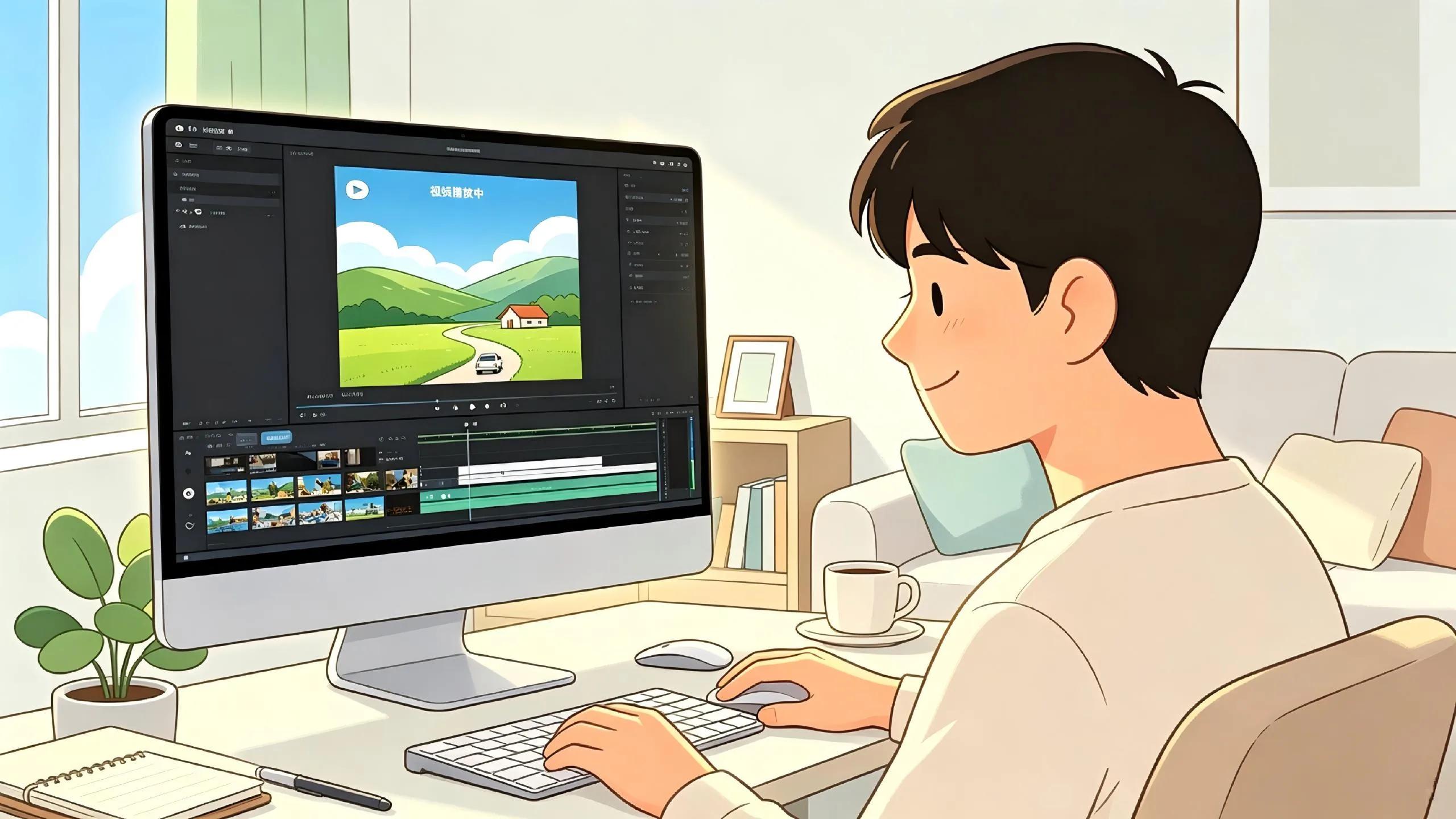
In response to this, Lei Technology (ID: Leitech) noticed that many AI micro dramas are increasingly close to the animation style, actively reducing the sense of realism to reduce the impact of "no sense of real human presence".
(Image source: AI-generated)
The video generation large model and AI micro drama industry are in the early stage of growing pains characterized by high investment and high elimination rate. Short-term losses, low hit rate, and picture quality defects are the inevitable costs in the stage of technology implementation and industry adaptation, and do not represent the ceiling of the track. The collective investment of BAT in Keling proves that the capital market is long-term optimistic about the value of video generation as the next-generation content infrastructure.
The downstream AI micro drama industry is undergoing brutal reshuffling, with an extremely low hit rate and relying on a few hits to cover the losses of a large number of works. A large number of enterprises will still be eliminated in the next stage.
After the Pain Period, the Real Glory Will Come
AI can only complete image generation, and it is difficult to independently complete complex narrative and character shaping. A large number of practitioners simply regard AI as a cost reduction tool rather than a content upgrading tool, and do not carefully polish scripts and images, resulting in only low-cost, low-value assembly line content, and it is difficult to produce high-quality works with long-term influence.
In the future, AI will not completely replace real human film and television creators, and it is more likely to move towards a mode of human-AI collaborative work. In long video creation, AI can undertake a large number of repetitive image generation, editing, and special effect work, while humans focus on script creation, character shaping, aesthetic control and emotional expression.
The AI micro drama track will also go through a round of in-depth reshuffling, a large number of low-quality assembly line works will be eliminated, and only teams that can polish narrative, character texture and IP operation capabilities can continue to obtain traffic revenue. This is very similar to the new energy vehicle industry. There were countless entrants in the early stage. After rounds of competition, new power brands such as NIO, Li Auto, XPeng and Leapmotor have already obtained the qualification to challenge the established giants.
For leading video generation large model enterprises like Keling, IPO fundraising will provide more capital for computing power investment and model iteration, but the capital market will pay more and more attention to real profitability.
Video generation models have moved from laboratory demos to the stage of industrialized material production tools. AI micro dramas have proved their commercial value, but the three major problems of long-sequence narrative, cross-shot consistency, and physical realism have not been truly solved. Both commercialization and technology iteration need to be continuously promoted by enterprises such as Keling and Jimeng.