National Day Travel Observation: NFC, which is 10 times faster than code scanning, still lost to the transit ride codes of WeChat and Alipay.
Every holiday, the subway and buses will be crowded with people, and this year's National Day is certainly no exception. During the National Day holiday, Lei Technology noticed a phenomenon that no matter which city it is, a large number of passengers still pass through the gates by scanning QR codes. Compared with NFC card swiping, the QR code gate passing efficiency is lower, and many people must have witnessed the congestion caused by passengers getting stuck when scanning QR codes.
Today in 2026, the NFC function on smartphones has long been popularized, and even thousand-yuan smartphones are basically equipped with NFC chips. Moreover, NFC public transport cards have been widely launched across the country. iPhone is compatible with public transport cards in more than 30 cities, and through the "Transportation Union", it can be used to take subways and buses in more than 300 cities nationwide.
NFC public transport cards have strong compatibility, convenient operation and high card-swiping efficiency. But why are so many people still preferring QR codes? During the National Day holiday, we talked with our relatives and friends around us with this question, trying to find the answer.
In the pre-mobile Internet era, how did people go out by public transport? There were only two ways - paying cash by coins / buying tickets or swiping a physical public transport card. Both the travel QR code and NFC public transport card were widely launched during the mature period of mobile Internet. In our opinion, NFC public transport cards inherit the advantages of physical public transport cards: no need to open apps, no need to light up the screen, no need to aim at the scanning port, which is efficient and fast. Moreover, compared with physical cards, NFC cards are integrated into mobile phones, so you don't need to carry an extra card when going out, avoiding the risk of loss. But obviously, people who are still using travel QR codes now also have their own reasons.
NFC cards are still a bit troublesome to activate
When I went back to my hometown for the National Day holiday and talked about NFC cards with my aunt, she looked completely confused. For her, NFC card is a concept that is hard to understand. My aunt uses a domestic Android phone and has never opened the wallet App. When she goes out to take public transport daily, she mainly uses the WeChat travel QR code, and even used cash as the main payment method in earlier times. In fact, my aunt is not very good at using the travel QR code, and she doesn't know how to call the mini-program she used before. Fortunately, the entrances of WeChat and Alipay travel QR codes are pasted on the buses in her hometown, so she can just scan the code directly every time she takes a bus.
At present, the steps to activate NFC public transport cards on smartphones are basically similar: open the system's wallet App — bind the bank card — activate and recharge the virtual transport card. This process is not complicated, but I soon found the problem.
First of all, many domestic mobile phone systems have a lot of built-in advertisements, and the wallet App is no exception, once opened, there are dense marketing and advertisement information, including small loans, insurance, video memberships and so on. A system App with originally simple functions has become extremely bloated and laggy, and you may click the wrong button accidentally. It is very difficult for my aunt to activate the NFC card smoothly by herself.
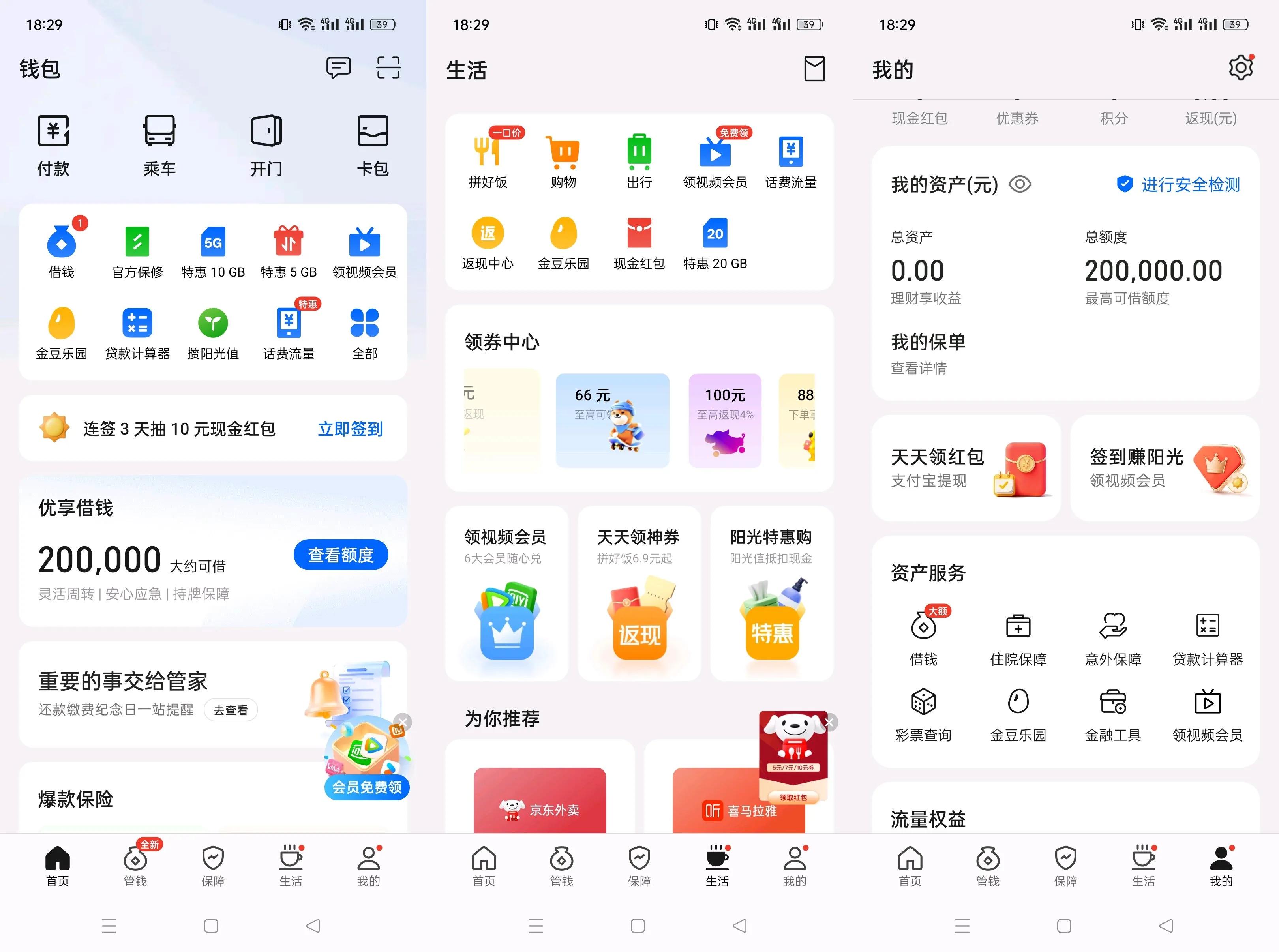
(Source: Lei Technology)
Secondly, most wallet Apps require users to register, log in and bind bank cards first to activate NFC public transport cards, and you also need to recharge manually when the card balance is insufficient. For elderly people like my aunt, it is really too troublesome.
In comparison, travel QR codes are basically integrated in national Apps such as WeChat, Alipay and Douyin, no extra card binding or real-name authentication is required. The activation is a fool-proof operation, and no extra recharge is needed, so the learning cost is indeed much lower.
Travel QR codes are convenient and can also get discounts
My cousin Xiaolin is a college student who just graduated not long ago. He is very familiar with NFC cards and has activated public transport cards of several cities in his mobile phone. However, he said that he still uses travel QR codes more in daily life. The reason why he uses travel QR codes instead of NFC public transport cards is very simple and straightforward — it saves more money.
Xiaolin introduced that using travel QR codes daily is more cost-effective than NFC cards. He said that payment Apps such as UnionPay QuickPass and Alipay often have preferential activities. For example, Alipay can buy commuter coupons, which can get a small discount every day, saving more than ten or twenty yuan a month. The preferential activities of UnionPay QuickPass are often bound to UnionPay cards, and there are often 50% or even 10% discount for bus rides.
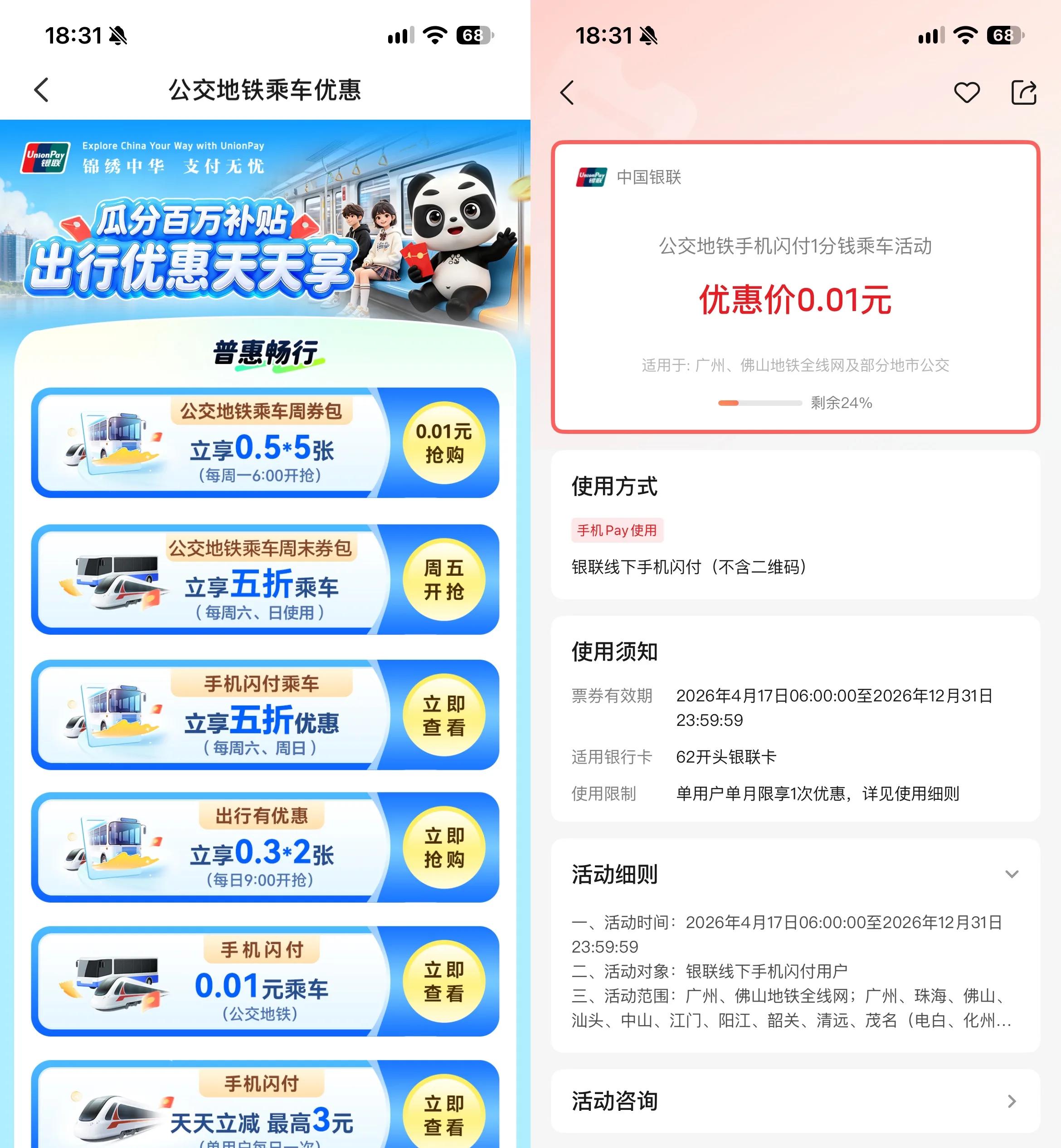
(Source: UnionPay QuickPass)
More importantly, the preferential treatments that used to be exclusive to physical and NFC public transport cards are now also available for travel QR codes. Taking Guangzhou as an example, the preferential rule of Yangchengtong is that after the monthly accumulated consumption reaches 80 yuan, all rides get 20% off, and after reaching 200 yuan, all rides get 50% off. In addition to Yangchengtong public transport cards, travel QR codes in channels such as Alipay, WeChat, UnionPay QuickPass, Douyin and bank Apps can also enjoy this preferential treatment.
Xiaolin also said that although most of the current NFC public transport cards support Transportation Union, which means they can be swiped all over the country, there are often no preferential treatments in different cities. For example, only the local Shenzhen Tong card can get 20% discount on Shenzhen buses, and Yangchengtong can be swiped but charged at the original price. At this time, no matter traveling or on business, activating a local travel QR code directly in a foreign city is the most convenient and cost-effective choice. NFC public transport cards need to be recharged, and some even require card opening fees or deposits.
The payment scenarios of NFC cards are too limited
In the early days, many physical public transport cards tried multi-scenario payment, such as being used in convenience stores, taxis and other scenarios. But now, with the popularization of mobile payment, NFC cards have taken the initiative to give up the task of expanding payment scenarios. I clearly remember that the first batch of NFC Yangchengtong cards could be swiped for payment in Guangzhou convenience stores, but the currently activated versions no longer have this function, and the usage scenarios are limited to subways and buses.
Although the travel QR code is essentially a dedicated service for taking public transport, in users' perception, it is often bound to the payment software itself, as an affiliated function of QR code payment. The wide popularization of travel QR codes is closely related to the huge ownership of mobile payment Apps.
Aming, who has been working in Shenzhen for many years, has activated an Octopus card on his iPhone. He said that Octopus is very convenient to use in Hong Kong, China. In addition to being used on buses and subways, most restaurants and small shops support Octopus payment, which is more popular than QR code payment, and its covered scenarios are much richer than public transport cards in the Chinese mainland.
The popularization of NFC payment still depends on Tencent and Ant Group?
A while ago, when using the travel QR code function of Alipay, I suddenly found that a new "NFC Transport Card" function was added to the page. Specifically, users can directly activate the NFC public transport card in the Alipay App. After activation, the NFC card will directly appear in the wallet App, and there is no need to open the Alipay App when using it. Moreover, users can directly recharge the public transport card in Alipay, and can also set automatic recharge when the balance is low to avoid the situation that the card cannot be swiped due to insufficient balance.
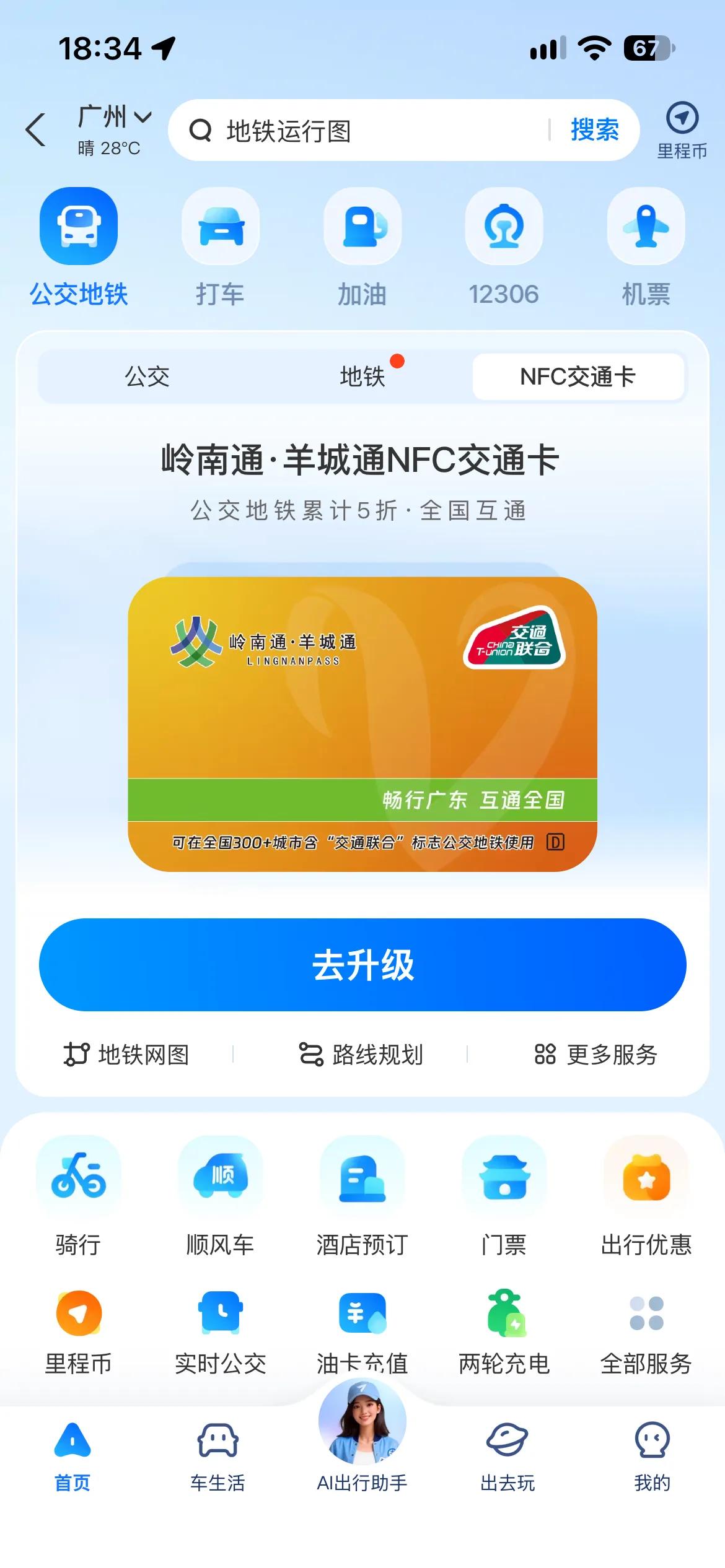
(Source: Alipay)
If we don't limit ourselves to NFC public transport cards and turn to the NFC payment scenario, we can find that Tencent and Ant Group have taken many actions in this field. In offline payment scenarios, many people have noticed that Alipay's "Tap to Pay" function is being vigorously promoted, and many convenience stores, supermarkets and restaurants are equipped with such cash registers. This payment method is essentially realized based on NFC, which is more convenient than QR code payment.
WeChat's NFC payment function is currently mainly used in overseas scenarios. It cooperates with VISA to generate a virtual bank card for users, providing a function close to Apple Pay's contactless flash payment when shopping overseas. When making payment, the money will be deducted directly from the change in WeChat wallet, converted according to the exchange rate at that time.
In general, the penetration rate of NFC public transport cards is relatively low, and the core problem lies in the fragmented ecosystem. Mobile phone manufacturers provide NFC interfaces and wallet entrances, local public transport groups are responsible for card issuance, banks and payment institutions are responsible for fund collection. The three parties act independently, failing to optimize the experience of card activation, recharge and card swiping.
But in the view of Lei Technology (ID: leitech), now Internet giants such as Tencent and Ant Group have made efforts in the NFC track, bringing a huge user base to seize the market. When Alipay and WeChat fully connect the steps of NFC card binding, recharge and password-free deduction in their own Apps, they can greatly reduce the learning cost and improve user experience. Novice users do not need to find the wallet App full of advertisements in the mobile phone system, nor do they need to understand what "Transportation Union" is. They only need to click twice in the most familiar payment software to activate the card.
QR codes will still be the mainstream form
So what will the domestic payment and travel forms look like in the future?
To be honest, QR codes will remain the mainstream form in the domestic payment market for a long time in the future. After all, it has extremely strong compatibility. No matter the user uses a tens of thousands yuan foldable screen phone or a few hundred yuan entry-level phone, no matter whether there is an NFC chip or not, as long as the screen can light up and the camera is not broken, you can scan the code to pass the gate. This almost zero-threshold universality determines that travel QR codes will still be the first choice for many people.
But for users who pursue high efficiency, NFC payment is being gradually activated. As national-level Apps integrate the NFC payment capability into their own ecosystem from the underlying system, the payment scenarios of NFC will no longer be limited to a single public transport subway gate. From convenience stores to supermarkets, restaurants and small shops, NFC payment has become the main path for payment giants to seek offline incremental traffic.
To put it bluntly, there is no absolutely perfect solution for offline public transport and payment services, and all are trade-offs between cost and experience. QR codes win with low learning cost and high universality, while NFC wins with fast and contactless experience, and they will coexist for a long time.