20 AI giants are dragged into a patent war by Vicor
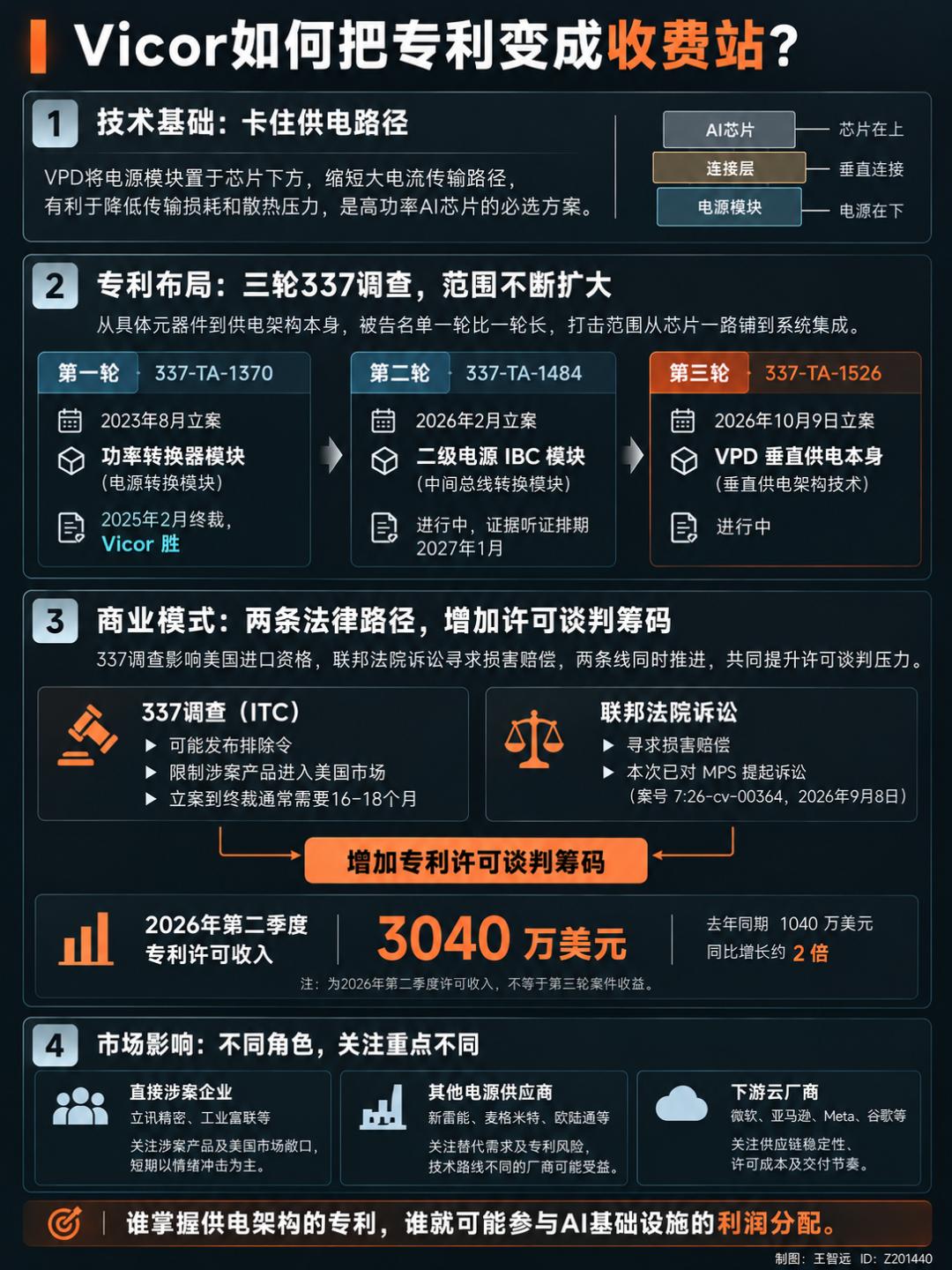
On October 9 US time, the United States International Trade Commission (ITC) released a case filing announcement. The case number is 337-TA-1526, the complainant is Vicor, a US power module manufacturer, and there are 20 respondents in total.
From Luxshare Precision to Foxconn, from Infineon to Tianhong, the entire AI server supply chain has been included in the scope of the case.
The technology involved is called VPD, Vertical Power Delivery, if you only see this news, you may think it is just an ordinary patent dispute.
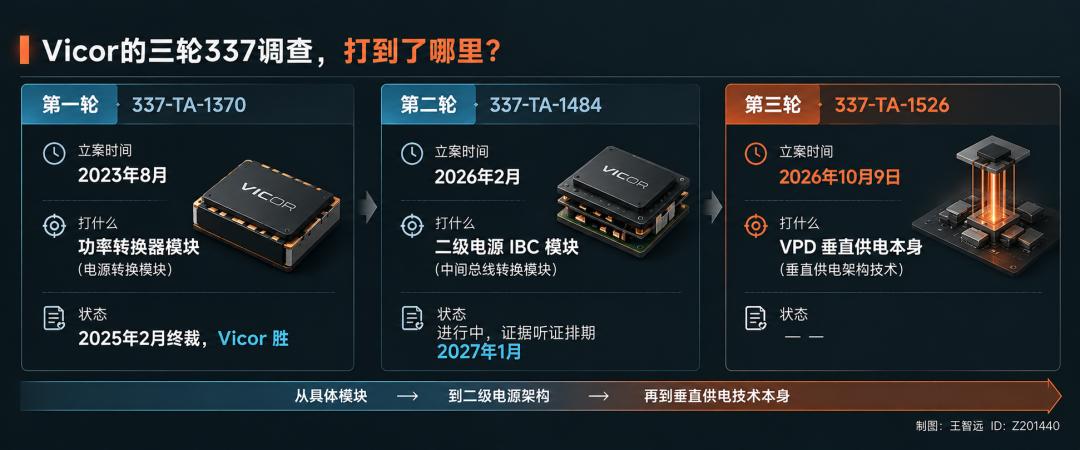
Well, that is not the case at all. This is the third round of 337 investigation initiated by Vicor in the AI power supply field.
The first two rounds have been completed: the first round was filed in 2023, with a final ruling in February 2025, and Vicor won the case; the second round was filed in February this year, targeting intermediate bus power modules, and is still in progress. The third round directly targets the vertical power delivery architecture itself.
One round targets components, one round targets secondary power supplies, and one round targets complete machines. The respondent list is longer in each round, and the scope of impact extends all the way from chips to system integration.
If you think about it carefully, a company that launches three consecutive rounds of lawsuits all targeting the same technical direction, with the scope expanding larger each time, what is it aiming at? Undoubtedly, it is targeting the entire licensing agreement, and one court judgment is obviously not enough.
......
To understand this matter thoroughly, we need to trace back to its root. I looked through Vicor's patents and sorted out its moves in recent years, and found two key facts.
One is what exactly the VPD patent protects, and the other is what Vicor relies on to make profits now. Only by looking at the two facts together can we understand why it launched three consecutive rounds of lawsuits.
Let's start with the patent. The core solution of the US patent involved in this case, in simple terms, is a "module sandwich".
For example:
The chip is a large building with huge power consumption. The traditional power supply mode is like building the canteen one kilometer away: the food gets cold and spills all over the ground during the long delivery. As for vertical power delivery, it directly places the canteen under the building, so the food can be delivered to the upper floors immediately by elevator, with short path, hot temperature and no spilling.
How is it implemented specifically? The chip is placed on the top, the power module is placed on the bottom, and an intermediate connection layer connects the two parts. Current flows from bottom to top, passing vertically through the circuit board with an extremely short path.
How short is the path? Only 1 to 3 millimeters.
In the traditional horizontal power supply mode, the current starts from the power module on the side of the chip, travels along the circuit board for several centimeters with many twists and turns before reaching the chip. The longer the path, the larger the resistance, and the higher the power loss.
Vertical power delivery reduces the path length from several centimeters to several millimeters, and reduces the resistance of the power supply loop from more than 90 microohms to just over 10 microohms, which is roughly one tenth of the original value. The heat loss caused by current is directly reduced by 70%.
What does this figure mean?
The current of AI chips often reaches two or three thousand amperes, and may even rise to 10,000 amperes in the future; the higher the current, the more terrifying the power wasted on the resistance. The power saved by VPD is real money saved on electricity bills and heat dissipation costs.
Then the question arises: since VPD is so advantageous, why can't other manufacturers develop it on their own?
I checked and found it is almost impossible. What Vicor protects in this patent is not a specific circuit design scheme, but the entire physical three-dimensional structure.
You can change the circuit, or modify the solution, but the space under the chip is so limited. If you do not place the power module directly under the chip, the current path cannot be shortened, and the resistance of the power supply loop cannot be reduced.
By the way, this physical restriction applies to all manufacturers that develop VPD. ADI acquired Empower Semiconductors at a high price, Infineon acquired C2i Semiconductors, and Navitas acquired Claros.
The three giants all made the same choice at almost the same time: to acquire related companies directly, because the technical barrier is too high to bypass.
The most representative case that can illustrate this point is NVIDIA. NVIDIA has gone through a whole detour on the power supply solution.
In the Ampere architecture era, it directly used Vicor's power modules; for the Hopper architecture and Blackwell architecture, it turned to discrete solutions, using scattered independent components to build its own power supply system.
The reason is very practical: Vicor's modules are expensive, and there is no second supplier, so NVIDIA does not want to be constrained by a single supplier.
When it comes to the Rubin architecture generation, the situation has changed: the power consumption of a single graphics card has soared to 2300W, and the current is so large that the circuit board traces for horizontal power supply cannot withstand it at all. The discrete solution was sufficient in the low-power era, but when it comes to the 2300W level, both power loss and heat dissipation hit the bottleneck.
At the 2026 CES, NVIDIA announced that the Rubin architecture will fully adopt vertical power delivery; industry analysis generally believes that the power supply efficiency can reach 96%.
Vertical power delivery has become a mandatory option, which cannot be bypassed due to the laws of physics.
Another thing worth noting is that Vicor did not only file the 337 investigation this time, it also sued MPS in the Texas Federal Court at the same time; the case number is 7:26-cv-00364, the filing date is September 8, one day earlier than the submission of the 337 complaint.
It would not even wait for the same day, and filed the lawsuit one day in advance.
The 337 investigation governs import eligibility, while the federal court governs compensation. The two lines of litigation are carried out at the same time: one blocks the import access, the other claims for compensation. The reason why MPS is singled out for civil litigation is very simple.
Its multi-phase step-down circuit is completely different from Vicor's self-developed power supply architecture, which is theoretically the biggest potential breakthrough point; Vicor wants to set a precedent here, to show other manufacturers that they will be sued even if their solutions are different.
So what exactly does Vicor sell? After going through its latest financial report, I have a clear answer.
In the second quarter of this year, Vicor's patent licensing revenue reached 30.4 million US dollars in a single quarter. What was the figure in the same period last year? It was 10.4 million US dollars, which has more than tripled.
The CEO said that 4 equipment manufacturers and hyperscale cloud vendors have obtained the license of vertical power delivery technology; after this licensing news came out, Vicor first raised its Q3 revenue guidance from a quarter-on-quarter increase of about 10% to more than 20%, and then raised it to more than 30% at the end of September. The guidance has doubled twice in a row.
The core patent will expire around 2036, so the charging window will last for at least another ten years. Series patents under the same technical system are still being added continuously, and the patent barrier is getting thicker.
At the same time, Vicor is expanding its chip factory in New Hampshire, USA, with a total planned area of nearly 1 million square feet. It is expanding production capacity to prepare for long-term demand.
For Vicor, patent licensing has become recurring revenue. The 337 investigation looks like a litigation, but in essence it is more like collecting rent.
......
Okay, now we have figured out what Vicor is doing. Next, let's look at the situation from the perspective of the respondents. How will this matter end?
First, the timeline.
From case filing to final ruling, a 337 investigation generally takes 16 to 18 months. The so-called "45-day" period is only for setting a target completion date, which is far from the final ruling. The case was filed on October 9, and the 45-day period will end in late November, when the target completion date will be set.
Referring to the pace of previous cases, the final ruling of this round is expected to be around the end of 2027 or even mid-2028, which cannot be rushed.
Second, the outcome will most likely be reached through negotiation.
After the first round of litigation ended with the final ruling in February 2025, the two parties reached a settlement with a compensation of 45 million US dollars three months later, signed a licensing agreement, and the case was closed.
The 20 respondents will most likely take the same path in the end, the only difference is the license fee amount, and they can continue to sell their products after signing the licensing agreement.
Third, the boundary of the exclusion order.
Even in the worst case, if the exclusion order is issued, it only applies to the US Customs. Products that do not enter the US market will not be affected.
Products sold in mainland China, Europe, and Southeast Asia will not be affected at all. The only market that will be actually impacted is the North American AI server market. If the main business of a company is not in North America, the actual damage is far smaller than what the sensational headlines suggest.
Fourth, there are two layers of insurance that most people have not noticed.
The first layer is presidential review. After the ITC issues the final ruling, the US Trade Representative has a 60-day window to directly veto the exclusion order for policy-related reasons.
After all, AI infrastructure is a matter of global competitiveness. Kicking key suppliers out of the US market may run counter to the US's own goal of expanding AI production capacity. This argument was raised in previous 337 cases in the DRAM field.
There is another variable in this matter, which is the attitude of cloud vendors.
Microsoft, Amazon, Meta, Google and Oracle. Goldman Sachs estimates that the total AI capital expenditure of these five companies from 2025 to 2030 will be about 5.3 trillion US dollars.
If the VPD supply chain is blocked due to the exclusion order, their AI deployment schedule may be affected; The lobbying power of these companies is enough to influence the decision of the Trade Representative during the presidential review period. The side that the cloud vendors stand on will gain the upper hand in this game.
The second layer is the counterattack of the respondents, who also have their own cards. They can apply to the US Patent and Trademark Office for patent invalidation, file counterclaims in federal courts, and promote the invalidation of corresponding Chinese patents.
Delta tried this in the last round. In May 2024, all its invalidation applications for the three core patents were rejected. This path is very difficult to take.
In the 337 wars in the photovoltaic industry, Chinese companies have successfully invalidated corresponding Chinese patents before, and they achieved a successful case in April 2026. Both failed and successful attempts exist in reality.
Therefore, this matter is far from being one-sided as the case filing announcement suggests. The two parties are fighting while negotiating.
......
Okay, here comes the key part. Many people will definitely care: what does this matter have to do with me and my wallet? I went through the respondent list and related A-share listed companies, and found that the impact can be divided into three layers.
The first layer is the respondents, whose impact is mainly emotional shock.
Luxshare Precision and Foxconn Industrial Internet, two A-share companies, are directly on the respondent list. Luxshare has announced that the involved products are still in the customer verification stage and have not been mass produced.
Consumer electronics business accounts for the majority of its revenue, and this part is not within the scope of the case; the situation of Foxconn Industrial Internet is similar, and it needs to be confirmed whether specific product models involve the vertical power delivery architecture.
Luxshare has fallen for three consecutive days from September 30 to October 9. On October 9, its stock price once dropped to more than 46 yuan during intraday trading, and there was capital taking positions at the end of the trading day, closing at 47.59 yuan.
I checked the historical data: Luxshare was once subject to a 337 investigation initiated by Amphenol in January 2021. After the news came out, its stock price once fell by nearly 9% during intraday trading, and the short-term emotional sell-off was very obvious. After the case was closed smoothly, the stock price gradually recovered along with the fundamentals.
If you hold products such as consumer electronics ETF, communication ETF and electronics ETF, Luxshare and Foxconn Industrial Internet have a non-negligible weight in these products. It is normal for the sector to fluctuate driven by sentiment, but the fluctuation is only caused by sentiment, not the fundamentals.
The second layer is companies that are not on the respondent list and may even benefit from the incident.
Xinleineng is co-developing tertiary power supplies with ADI, and has laid out VPD products, whose technical route does not overlap with the patent path claimed by Vicor.
Megmeet is the only enterprise in A-share that has entered the NVIDIA high-power server power supply whitelist; Ortustech supplies customers such as Google, ranks at the top of the domestic server power supply revenue list, and Hengdian Group's China Hengdian Electric has layout in the high-voltage direct current field.
The key information is that they are not on the respondent list, which means their power supply architecture does not overlap with the vertical power delivery patent path claimed by Vicor. They adopt 48V bus, high-voltage direct current, and independent power modules, whose technical routes are completely different.
Well, overseas companies are using patents to create a blockade, so domestic market will accelerate the search for alternative solutions. These companies are exactly the ones that can meet this demand.
The third layer is a key distinction that many people are easy to confuse.
The existing tertiary power supply products of Luxshare Precision are not the same as the named vertical power delivery products. The tertiary power supply products have passed the certification of North American customers and are already in mass production.
The involved products have not been mass produced, and the company is already selling products of another product line. As for how the secondary market will define this, I personally think that on October 12, investors may not make rational judgments.
Looking at the bigger picture, the underlying variable of this patent war is the discourse power over the power supply architecture. Whoever defines the power supply architecture will hold a lifeline of AI infrastructure. Vicor's three consecutive strikes seem to target patents on the surface, but in essence it is seizing the pricing power.
Okay, that's the whole story. The technology industry has not yet recovered from the downturn, and someone is coming to break the rules again.
Data source:
[1]. USITC case filing announcement and Federal Register, Vicor annual report and quarterly financial report, federal court complaint (7:26-cv-00364), announcements of Luxshare Precision and Foxconn Industrial Internet, research reports of Tianfeng Securities and GF Securities, Goldman Sachs research report, Wind market data; this article does not constitute any investment advice