A team hailing from Tsinghua University and Northwestern Polytechnical University has launched a smart electric yacht startup, which secured joint investment from Jiuhe, Chuxin and other institutions | Hard Krypton Exclusive Premiere
Author | Nan Huang
Editor | Silai Yuan
36Kr has learned that MIRAVA, a smart electric yacht company focused on water-based intelligent consumer hardware brands, has recently completed an angel round of financing of nearly 50 million yuan. This round is led by Jiuhe Venture Capital, with participation from InnoVision Capital and Eversnow. The funds will be mainly invested in the R&D iteration of core technologies, promote the mass production construction of production lines to ensure the delivery of the first batch of end-user orders, build localized channels and service systems in Europe, and accelerate overseas market adaptation and commercial expansion.
MIRAVA's debut product targets the consumer-grade smart electric yacht category. The team is committed to deeply integrating marine autonomous driving technology with the industrial design of leisure yachts, providing intelligent water leisure equipment for the global market. Core team members are all from leading technology giants such as Huawei and SenseTime, as well as well-known universities including Tsinghua University and Northwestern Polytechnical University, covering fields such as intelligent algorithms, on-board hardware R&D, high-end industrial design, yacht process manufacturing, and overseas channel sales, with a compound capability base integrating technological R&D, yacht craftsmanship and global market operations.
Its first smart electric yacht, the M800E, was officially launched in Europe at the Cannes Yachting Festival in September 2026, and is scheduled to make its debut at the Düsseldorf International Boat Show in January 2027. The first batch of founding user versions will be officially delivered in the middle of next year. At present, the product has completed R&D and polishing, and has entered the stage of small-batch production and delivery.
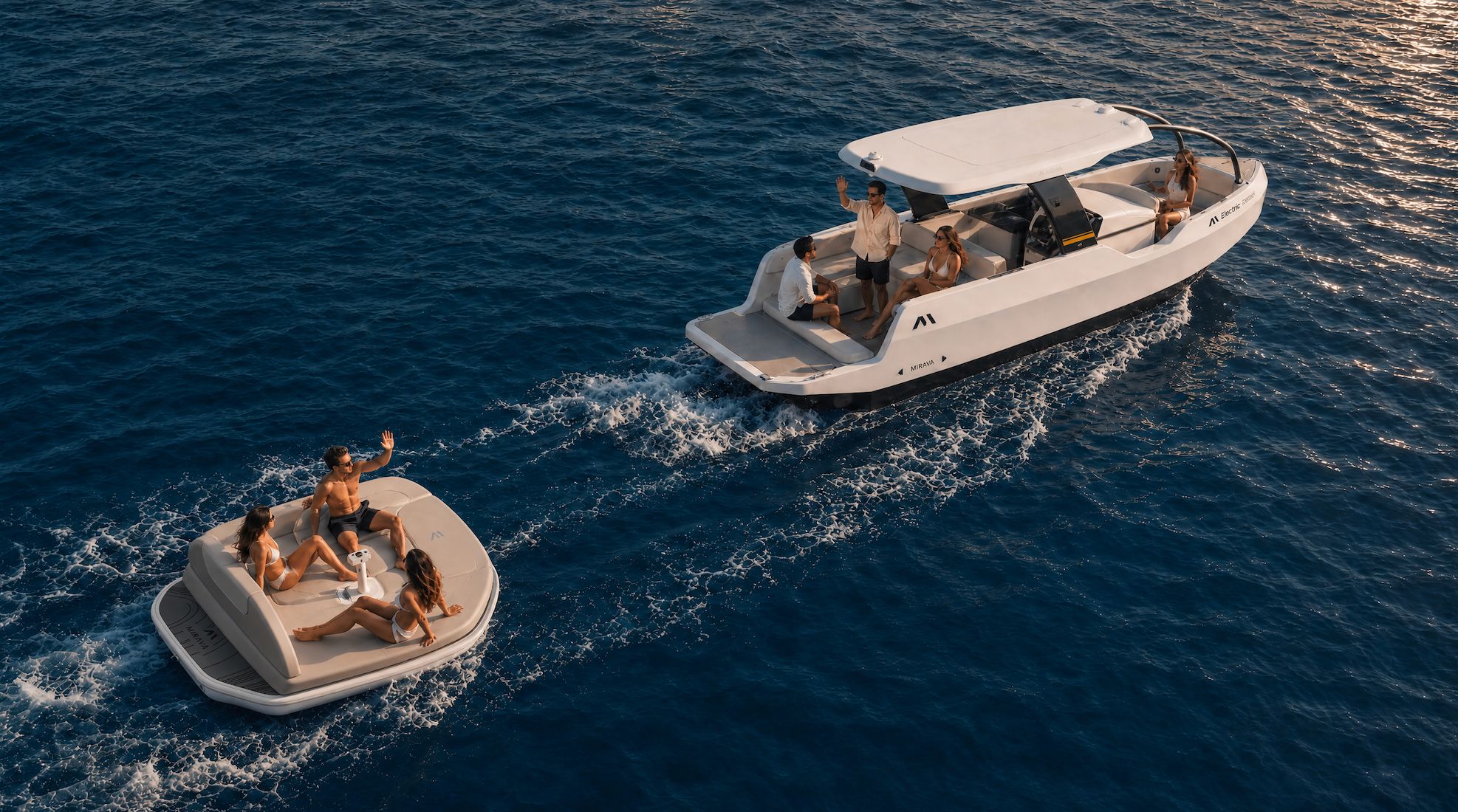
MIRAVA's first smart electric yacht M800E (Source: Enterprise)
After decades of development, the leisure yacht industry has long failed to usher in essential product innovation.
According to the industry report from the International Council of Marine Industry Associations (ICOMIA), the global inventory of leisure boats is about 33 million. Among them, the US market accounts for nearly half, with more than 11 million leisure yachts serving family entertainment, fishing and outdoor activities, and an average of one yacht for every 10 families. In Europe, the atmosphere of water leisure is particularly strong in Northern Europe, where Norway and Finland rank at the top of the world in terms of per capita boat ownership.
It can be said that water leisure activities in Europe and the United States have become a mature and popular outdoor lifestyle, just like skiing, camping and RV travel.
However, despite the considerable market size, product forms in the industry have long remained stuck in the mechanical era. Traditional yachts have high purchase thresholds, complicated driving operations, high subsequent maintenance costs, and a very steep learning curve for beginners. At the same time, the industry has severe vertical segmentation: different types of boats such as speed fishing boats, wakeboarding boats, and large-space pontoon boats mostly only serve a single segmented scenario for senior enthusiasts, which often discourages ordinary novice users.
"The vast majority of traditional yachts on the market are developed around hardcore enthusiasts. Fishing boats focus on sea fishing, wakeboarding boats specialize in wake surfing, and pontoon boats focus on static water parties, with highly targeted functions. Users who want to experience multiple gameplay scenarios often need to purchase multiple boats, leading to very high cost thresholds." Chi Yuhao, co-founder of MIRAVA, told 36Kr, "But more users hope to experience more gameplay scenarios on a single boat, rather than paying specifically for a certain extreme hobby."
This is exactly the track that MIRAVA is targeting: instead of making a more complex traditional yacht, it uses the consumer logic of smart hardware to redefine "how to enjoy water activities".
Traditional yachts follow the driving logic of "people move around the boat". When users want to swim, dive or play paddle boards, the boat can only dock at the shore or drop anchor, and cannot move after people enter the water. If you want to play paddle board or dive, people can only move around the boat and cannot go far; once you want to explore farther sea areas, someone must stay on the boat, or return to the boat to go to the next destination.
This seemingly reasonable mode restricts the experience of water activities. "What users expect is that the boat moves around the people: when people are playing in the water, the boat follows nearby and responds to demands at any time. But traditional yachts rely on manual operation, and once the user enters the water, the boat loses control." said Chi Yuhao.
To break this constraint, MIRAVA's solution is to upgrade autonomous driving from assisted driving to scenario-based automatic following, so that the yacht can independently perceive the user's position and keep following even without manual operation.
The MIRAVA team uses a smart bracelet as the perception and interaction terminal of the entire solution. The bracelet not only acts as a positioning beacon, but also supports NFC one-tap unlock of the hull, taking into account the convenient interaction for daily boarding.
When users wear the bracelet and enter the water to carry out activities such as swimming, paddle boarding and diving, the yacht continuously analyzes the user's real-time position relying on the bracelet signal, so that wherever the user swims, the boat will follow and protect. For the realistic scenario of traveling with multiple people, the system only responds to the following command of the user wearing the bracelet, and other people on the boat will not interfere with the operation logic of the hull.
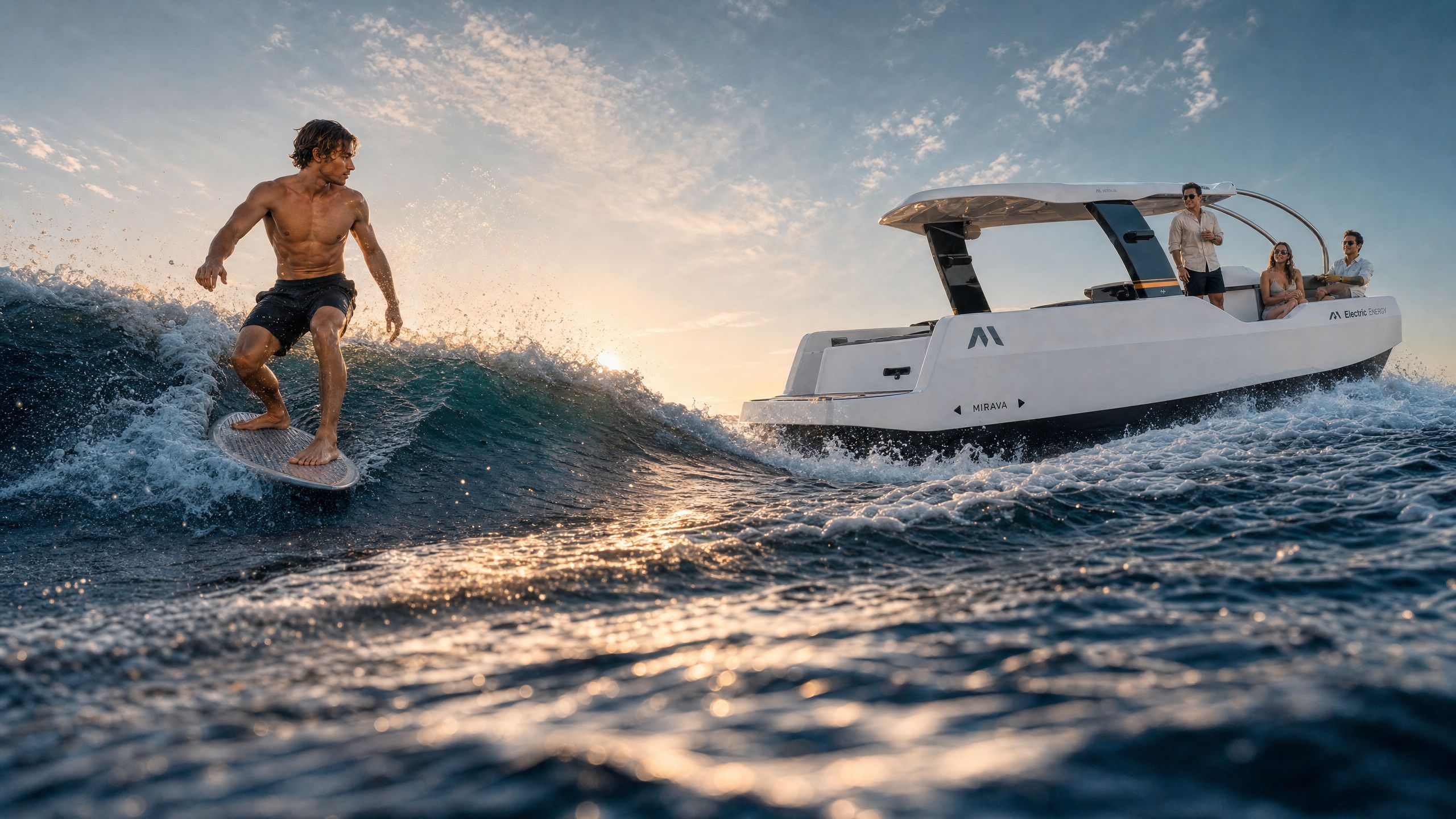
Wake surfing scenario (Source: Enterprise)
"We do not rely on autonomous driving to deprive people of the fun of driving a boat, but put the right of choice in the hands of users. Users can manually control the boat when they want to drive, and leave it to the intelligent driving platform when they do not want to operate." Chi Yuhao said.
In addition to the pioneering smart follow function, MIRAVA has also made new attempts on the product structure, allowing one yacht to carry more interactive scenarios.
The product logic of traditional yachts is "one category corresponds to one activity". Fishing boats are only suitable for fishing, wakeboarding boats are only suitable for surfing, and pontoon boats are only suitable for family gatherings. If users want to experience multiple gameplay, they either have to buy multiple boats or compromise on functions. The MIRAVA team proposes to extend the application scenarios of the yacht by transforming the spatial structure of the hull.
In terms of hull design, the 8-meter platform adopts a face-to-face large-space layout, which can accommodate 8 to 10 people traveling at the same time. Focusing on high-frequency scenarios such as family gatherings and leisure cruising, it is equipped with independent bathroom, on-board refrigerator and 6 sets of high and low audio speakers to meet the comfort and entertainment needs of multi-person trips.
The most differentiated feature is the mother-child boat mode. The stern of the MIRAVA yacht adopts a stern flipping module and A-pillar hammock design. The stern module can switch between four modes: driving, fishing, gathering and child boat entertainment, and the A-pillar can be unfolded into a hammock. Without increasing the size of the hull, the hull is expanded from a single navigation space to a multifunctional outdoor leisure platform.
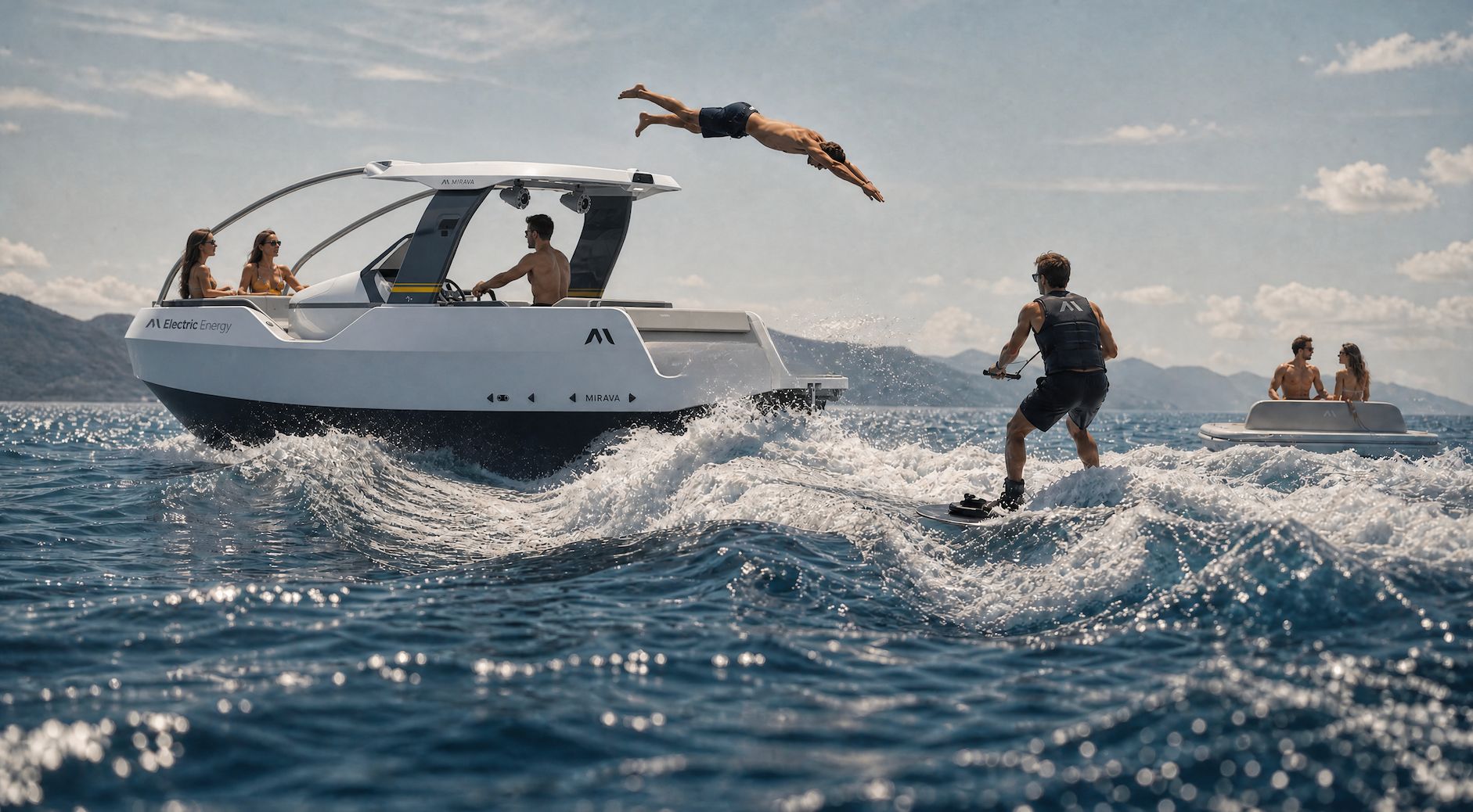
Multifunctional outdoor leisure platform (Source: Enterprise)
In the child boat mode, the extended module at the stern of the yacht has its own power, which can be decoupled and transformed into a self-driving child boat. When users need to land on an island, approach reef areas or shallow waters where large boats are inconvenient to dock, they can release the child boat to complete connection and near-shore exploration, breaking through the scenario boundaries of traditional yachts limited by draft and berthing conditions.
Over the past decades, hardware parameters have been the common competition standard in the yacht industry. Horsepower, hull size and maximum speed are the default language for dealers and users to evaluate a product. The vast majority of new product iterations are performance optimizations within this mature system. "But today's user demands have changed significantly. The driving force for industry growth comes from the new generation of young people. Their expectation for yachts is to go to sea with family and friends rather than for business receptions, and they pay more attention to versatility, ease of use and sense of closeness to the ocean."
Chi Yuhao pointed out that the core difference between these users and traditional yacht groups is that "they are not 'people who play with boats', but 'people who play with water'; what users want is not a performance machine, but an intelligent platform that can carry a variety of water lifestyles. What our product aims to do is exactly to target this demand gap, reduce the user threshold through intelligent functions, and redefine the freedom of water activities."
In terms of market strategy, MIRAVA will take Europe as its first launch base. On the one hand, Europe has a strong brand circle momentum in the yacht industry, Northern Europe and the Mediterranean region have a profound foundation of water leisure consumption, and local users have higher acceptance of intelligent innovative experiences. At the same time, structural changes are taking place in European yacht consumption, with demand gradually shifting from the past focus on business receptions to daily family water leisure, which also provides suitable user soil for MIRAVA's new category positioning.
The MIRAVA team revealed that the company plans to complete the delivery of the first batch of products next year, and after verifying the regional market and brand mindshare, it will gradually enter core markets such as the Middle East and North America.
The following is an excerpt of the interview between 36Kr and Chi Yuhao, co-founder of MIRAVA (slightly edited):
36Kr: MIRAVA's target users are "people who play with water" instead of "people who play with boats". How does this user positioning affect your product definition?
Chi Yuhao: Traditional yachts serve "people who know how to play with boats". This type of users pursue extreme performance and are willing to spend a lot of time learning boat driving, equipment maintenance and berthing operations. However, in the water consumption market, the larger group is actually "people who play with water"; their core demands are swimming, diving, accompanying children, gathering with relatives and friends, and they do not want to be bound by complicated boat operations.
There are essential differences in the underlying demands between the two groups. The former takes the boat as the core, pursuing control sense and performance boundaries, while the latter takes the water experience as the core, and the boat is just a platform for carrying activities.
MIRAVA's product definition is centered on the latter, with the entry point being Freedom: users do not need to spend time on operations such as driving, stopping the boat, and maintaining the boat position, and can really enjoy themselves. Autonomous driving does not deprive people of the fun of driving a boat, but gives you the choice: you can drive by yourself when you want to, and leave it to the boat when you don't want to. This also determines that we will not pursue the ultimate in a single performance dimension, but "want everything and get all of them well", making every aspect of performance experience excellent to meet the needs of 70% to 80% of users.
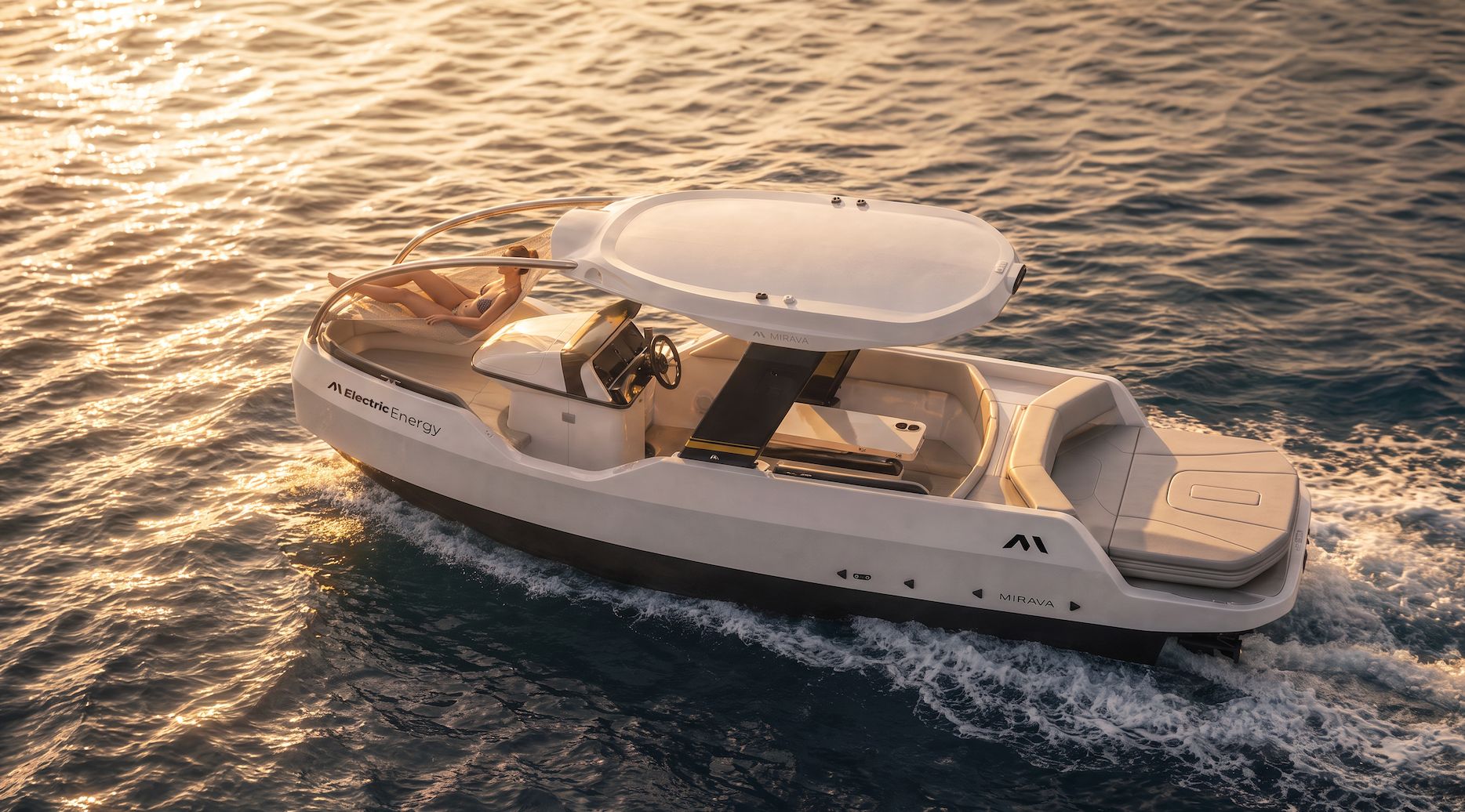
MIRAVA autonomous driving system (Source: Enterprise)
This is rooted in the team's underlying judgment on the behavior of contemporary consumer users. Nowadays, there are increasingly rich choices of leisure and entertainment, and external demands are diversified. Most ordinary users prefer lightweight, shallow-participation leisure experiences, and deep hardcore enthusiasts are not the target customer group of the brand.
Many high-unit-price leisure products will form a consumption dilemma of "ownership is a burden". After purchasing, users will have the psychological pressure of having to use it frequently, worrying that the idle equipment will cause waste of investment, forcing them to spend time and energy on the product. In the end, they often put it aside completely after a short experience, which is common for bicycles and outdoor equipment, and the same is true for yacht categories. What the MIRAVA team hopes to do is to eliminate this consumption burden carried by hardware, so that users do not need to bear additional psychological constraints for the boat itself.
36Kr: Yacht is a category with high entry threshold and long cycle. Why does MIRAVA choose to enter from this scenario? As a new brand, how do you define your category positioning?
Chi Yuhao: There are two ways to judge the entry path: develop smart accessories from bottom to top and upgrade gradually; or go from top to bottom, directly make high-value products to build brand awareness. We chose the latter.
The yacht project requires large capital investment, long R&D cycle, and high market entry threshold, but the high entry threshold itself will also be transformed into a competitive barrier. The conditions that pose challenges to MIRAVA will also block most external competitors from entering the market. Our team has many years of technical and engineering precipitation in the fields of marine autonomous driving, supply chain management and complete machine manufacturing, and these capabilities can be reused in the product development of consumer yachts, which is the foundation for us to dare to enter this asset-heavy track.
More importantly, yachts are a very rare consumer category that can carry both brand premium and intelligent experience at the same time. Once you establish awareness in this category, there will be a very large space for downward expansion.
High-unit-price products have a feature: users' first reaction is to categorize them. However, once they are classified into existing categories, they will inevitably be compared in the inherent value chain system. It is difficult for new brands to win when competing in a system familiar to others.
MIRAVA's core strategy is to create a brand new category, making Next Generation Smart Boat. It is not an electric yacht, not a smart yacht, but a category that did not exist before. It's just like when Tesla first came out, people couldn't directly compare it with any existing car model, because it represents a completely different product logic.
Only when users look at you with a new set of standards can you have the opportunity to get rid of the existing value anchoring.