Luckin Coffee Launches "Protein Drink": The Label Is A Big Hit, But The Category Remains Undeveloped
At the end of September, Luckin launched high-protein berry yogurt drink and high-protein coconut-blue yogurt drink, "Each cup contains about 20g of protein, equivalent to about 3 eggs, meeting about 1/3 of the daily protein requirement."
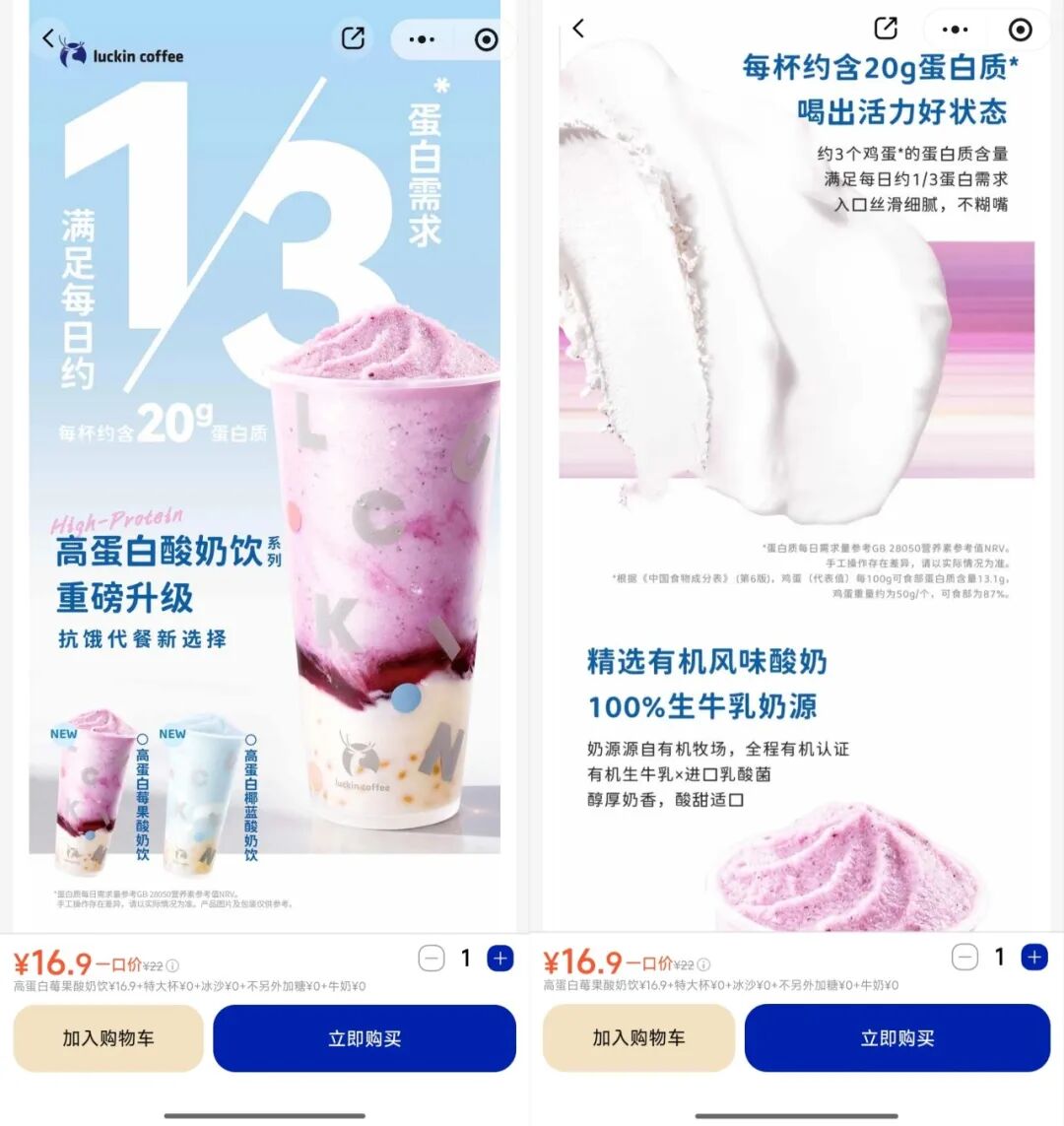
Image from Luckin mini-program
On one side is the official nutrition narrative: how much protein can be supplemented, how well it fits the health needs of young people; on the other side are complaints on social platforms: "too sweet", "high in calories", "20 grams made up by protein powder doesn't count as high protein".
To verify this, I, who only drinks Americano all year round, spent a "huge sum" of 16.9 yuan to buy a cup. It has a strong yogurt flavor and is not bad to drink, but for someone like me who fears sweetness, it is still a bit greasy. I only drank half a cup at noon, and the remaining half cup was wasted regretfully.
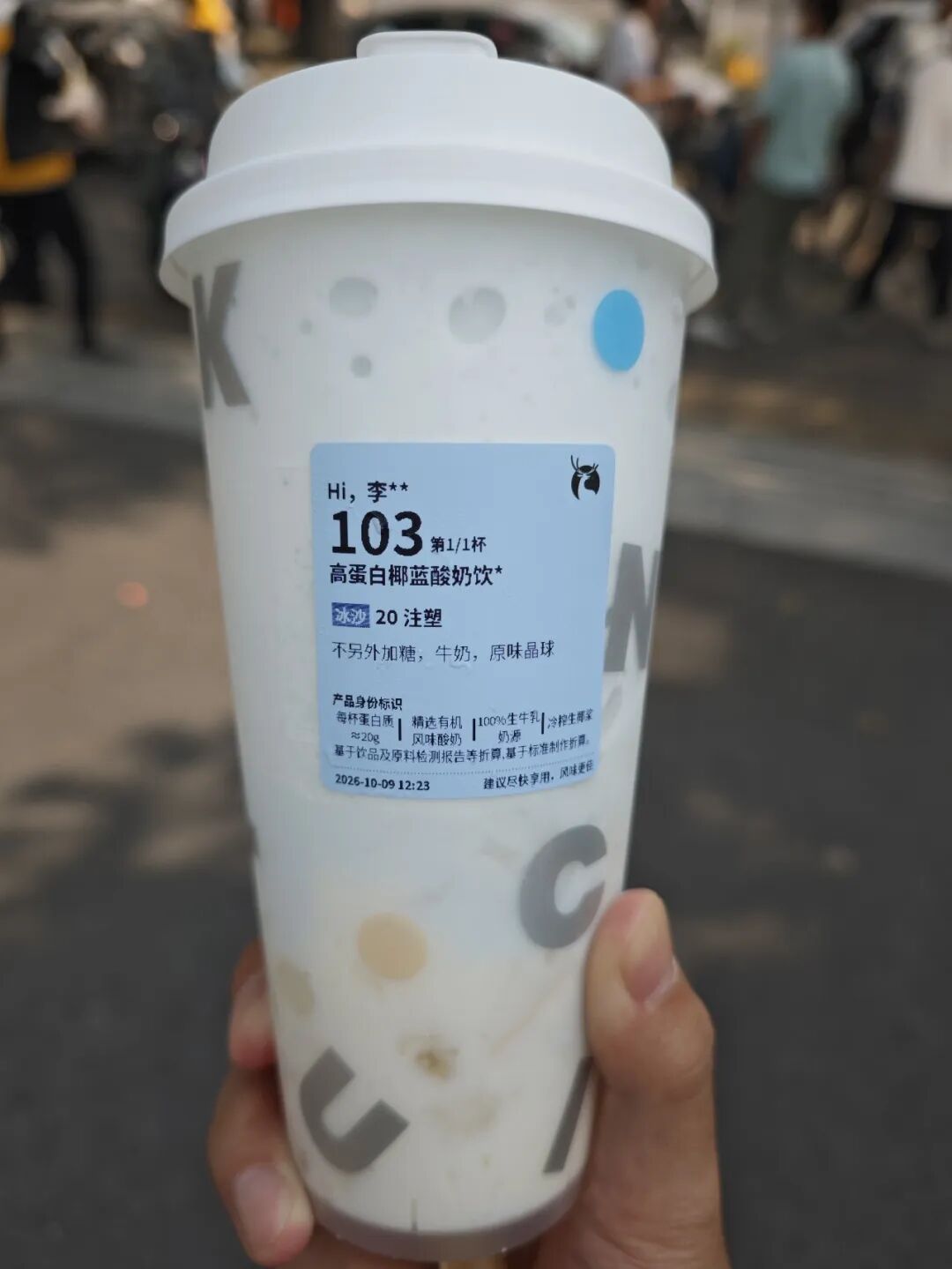
Image taken by the author
Luckin is not the first player to bet on protein drinks. As early as April this year, Starbucks launched the high-protein Latte PRO, which features "20 grams of native milk protein per cup"; Mengniu's separated whey protein water, Yili's transparent protein water and other products also followed up in the same period.
As a running enthusiast, the author has drunk Mengniu Maishang's sports protein drinks many years ago. But at that time, I only thought it was similar to energy gel, a supplement for sports people after competitions and training. I never expected that protein would now become a regular ingredient in mass drinks.
So, is this just another gimmick of collective concept creation in the beverage industry, or has it really found a more vertical, more detailed new track that better understands young people? Let's follow "TopKlout" to find out!
01
The demand for protein supplementation is definitely real
In the past few years, China's high-protein market has been supported by fitness enthusiasts and middle-aged and elderly people: the former wants to build muscle, the latter wants to fight muscle loss, both driven by physiological needs. But only 34.94% of respondents know how much protein adults should consume per day.
The "2025 National Protein Intake Status Survey Report" jointly released by Xinhua News Agency and By-Health shows that problems such as lack of scientific guidelines and insufficient cognition are affecting national health. 71.22% of Chinese people believe that "insufficient cognition of protein intake" is the primary reason, 66.96% believe that the main problem is "not knowing how to match scientifically", and 61.05% of people point out that their daily habits are dominated by staple foods (rice, noodles).
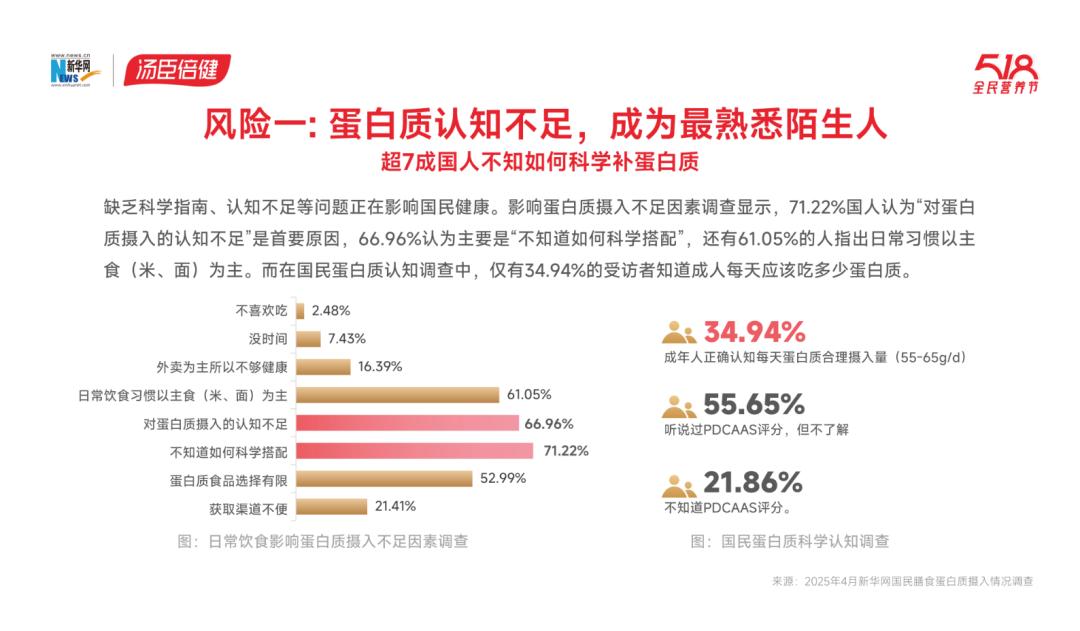
Source: "2025 National Protein Intake Status Survey Report"
Fortunately, in the past two years, young people have paid more and more attention to health, and more people have begun to actively consume protein. Data from Innova's "Top 10 Trends in China's Food and Beverage Industry 2026" shows that: 56% of Chinese consumers are actively increasing their protein intake; the growth rate of new food and beverage products with protein and at least one health claim has reached 134%.
Therefore, whether it is Starbucks or Luckin, the protein drinks they launched this year are riding on this trend. But the group they really want to influence is not the traditional fitness people and middle-aged and elderly, but young urban white-collar workers.
Why? Because for this group of busy office workers, the nutrition of breakfast is very unbalanced, there is a long-term small gap in protein, and it is very difficult to maintain regular protein intake.
Shi Qin, Category Director of Starbucks China Product Innovation Department, mentioned this view at the FBIF2026 Dairy R&D Innovation Sub-forum: The target group of Starbucks' high-protein latte is not hardcore fitness enthusiasts, but urban white-collar workers aged 25-35.
The practice of combining protein with the coffee category is actually "stacking buffs" on coffee. Because for many consumers, they may not really lack protein, but they have to drink something every day. Since there is an option with protein, they can just add a little health benefit while drinking coffee.
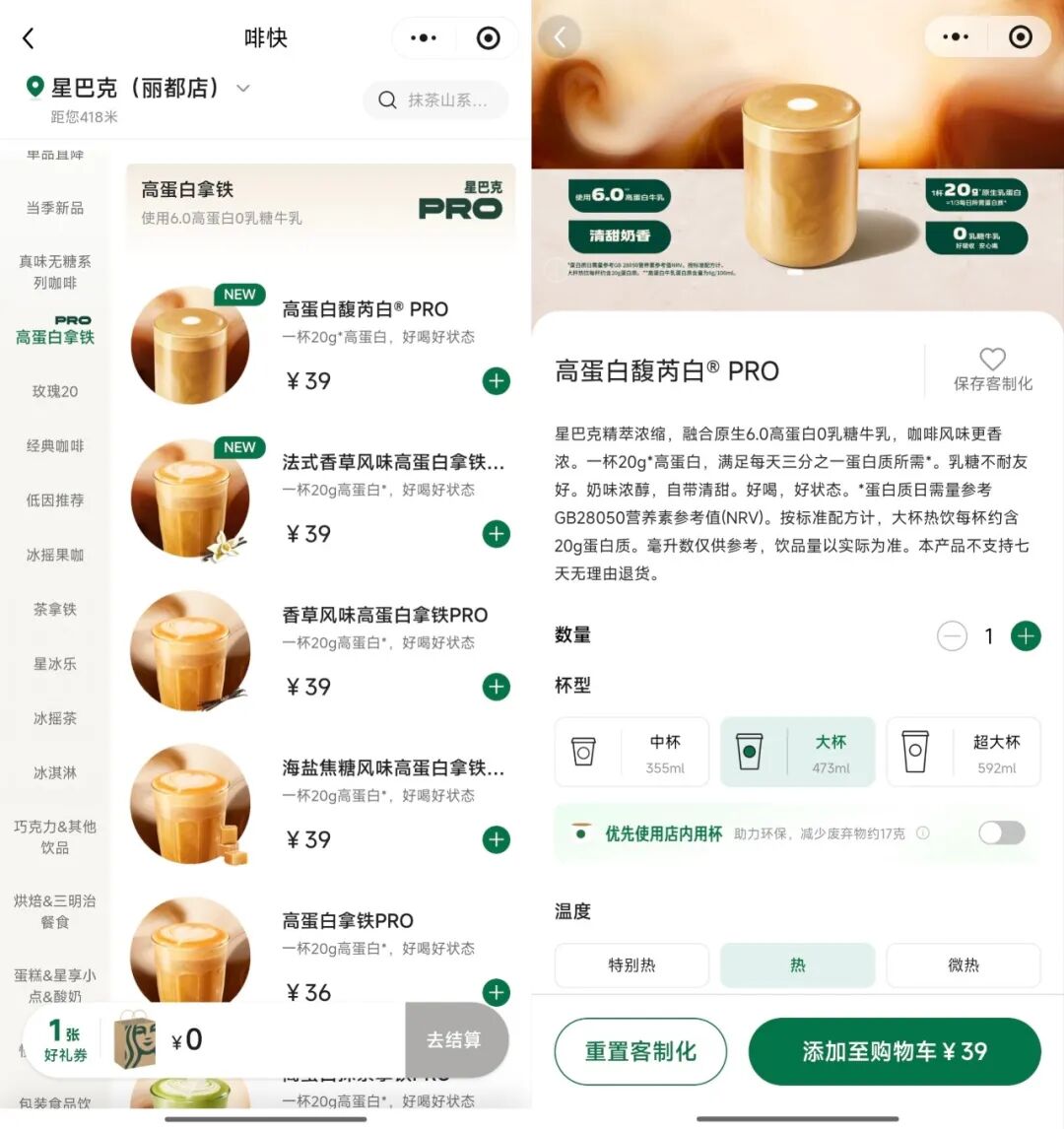
Source: Starbucks mini-program
This path has been taken by tea drinks, electrolyte water and coconut water in the past few years: first change from "health supplements" (tea, electrolytes, natural juice) to "daily water substitutes"; then complete user education with a strong health anchor, and insert the product into every "drinking" gap in daily life; finally open the category ceiling of beverages and walk out a brand new track.
02
The controversy about health is also real
The launch of new products will naturally arouse controversy. When the core group of beverage consumers does not want to supplement protein, but just wants to supplement protein while drinking beverages, they will be extremely picky about the taste.
For people like me who don't like sweet flavors, I won't buy it again after trying it once, which is a matter of taste preference; but more consumers have their own opinions on taste and calories.
Looking through the posts on Xiaohongshu, you can find that the discussions mainly focus on calories, sugar and taste.
Although Luckin's official has not stated how many calories this cup contains, most netizens believe the statement of "more than 400 kcal"; a considerable number of consumers think this drink is too sweet, "it's cloying even without additional sugar"; some netizens also questioned that the added collagen peptide is low-quality protein.
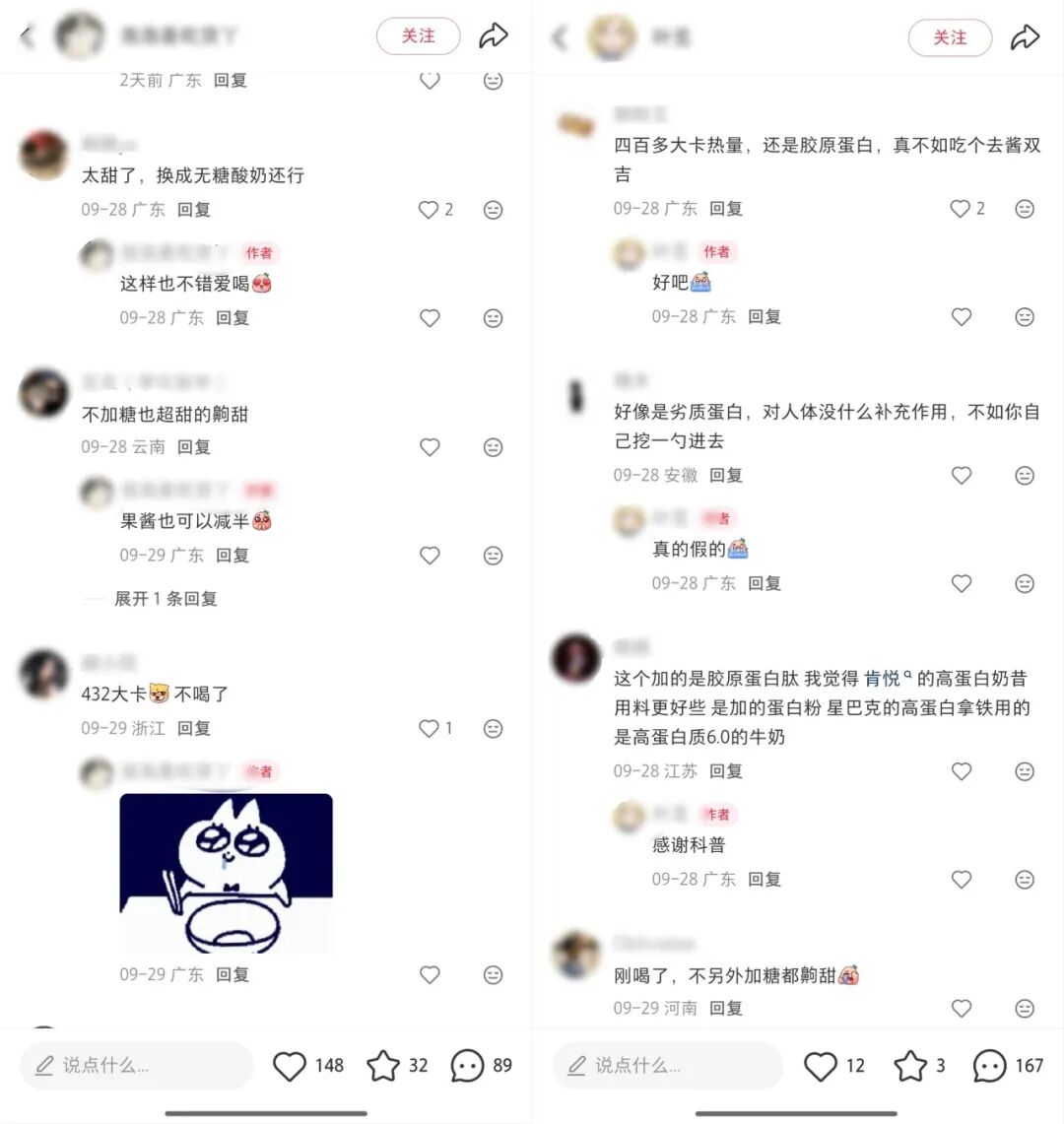
Source: Xiaohongshu
These complaints are different, but as a new product that wants to achieve high sales volume, long-term doubts will definitely affect the choices of the public. After all, the "high protein" label has changed the evaluation coordinate system, making the beverage no longer just an ordinary cup of coffee or milk tea, but a healthy cup of coffee or milk tea.
After being labeled as "healthy", consumers will automatically measure it with health standards; if it fails to meet the standards, the backlash will be more severe than that of ordinary beverages. To put it bluntly, the essence of the controversy is not "it is harmful", but "whether it is worthy of the identity it claims".
In recent years, there has been a saying in the beverage industry that playing the health card mainly relies on "subtraction": reducing sugar, reducing fat, reducing calories, and removing non-dairy creamer. But by 2026, subtraction has reached its limit - if you reduce it further, it will become plain water, so everyone switched to "addition": adding protein, adding dietary fiber, adding probiotics, adding electrolytes.
The promise of subtraction is "what I have given you less", which is relatively quantifiable and verifiable; but the promise of addition is "what I have given you more", which is invisible and untastable, and can only be trusted by the label. Therefore, addition relies more on trust and is more likely to overturn.
Coconut water is a lesson from the past: a track with an estimated scale of 114.5 billion yuan in 2026 and a year-on-year growth rate of 19.5%, but it encountered a trust crisis at the beginning of the year - many products labeled 100% coconut water were detected with exogenous additives.
Just because of the "added" substances, the entire category was affected, leading to a sharp drop in profits for most companies. Even the parent company of leading brand IF, IFBH, issued a warning, expecting that the net profit in the first half of 2026 will decrease by 65% to 75% year-on-year.
High-protein drinks, in fact, are on the same cliff edge as coconut water.
03
Whether it is a track or a gimmick depends on three judgments
Therefore, for high-protein beverages to continue to develop and become a track, at least the following three judgments must be met.
Judgment 1: The track is real, but at present it is more like a "label" rather than a "category".
The sign of a mature category is independent shelf space, repurchasing crowds and publicly available scale. At present, electrolyte water meets all three conditions - a scale of tens of billions of yuan, Nongfu Spring and Coca-Cola using their main brands to enter the market, and a growing group of sports people.
However, high-protein beverages currently still exist in the form of lattes and yogurts, and no company has disclosed independent sales data. At present, it is a distinctive product line, but it is not a track that can be counted independently, and longer time is needed to test its value.
Judgment 2: The gimmick is also real, but it is not the essence of business.
Brands are never afraid of controversy, but of no attention. Starbucks' high-protein latte is also extremely polarizing, and it is this contrast that has spawned a large number of spontaneous evaluations. What may make people drink from the "first cup" to the "second cup" is not the nutrition promotion, but the comprehensive result of taste, price and convenience.
High protein can stimulate users to place an order for a try, but whether it tastes good and whether the price is reasonable are the most important reasons for continuous repurchase.
Judgment 3: The real risk is not "unhealthy", but "label inflation".
When all beverages are labeled as high protein, "20 grams" will no longer be distinguishing, and "100% raw milk" can also be copied. Brands that have made technical investments are gradually submerged by homogeneous products, and consumers begin to doubt all promotions, which will eventually overdraft the trust of the entire category.
Therefore, there is another very critical thing: brands need to find the first batch of loyal users through social media, actively absorb feedback, and retain users with products. Otherwise, this category will most likely fall into the dilemma of "a temporary gimmick, no one buys it later".
04
Epilogue
Back to the beginning: Is it a communication gimmick or a real track?
The reason why we say it has gimmick elements is that this narrative does create the implication that "everyone is short of protein"; the reason why we say it is a track is that it does solve a specific trouble of "wanting to supplement protein but being too lazy to do so".
But in the end, what really determines whether such drinks can be continuously repurchased is still product power. No matter how healthy the drink is, it is useless if it doesn't taste good and can't be sold at a reasonable price.
This article is from WeChat official account "TopKlout" (ID: TopKlout), author: Su Men, published with authorization from 36Kr.