Xiaotiancai is popular this year
25-year-old Qin Shentao remembers that it only took one day to get the investment term sheet from BlueRun Ventures.
After the project lead finished the discussion in the morning, a partner meeting was quickly arranged at noon, and the TS was issued in the afternoon. Later, Zhu Tianyu, Managing Partner of BlueRun Ventures, recalled that it only took 30 minutes to make the final decision.
Across the ocean, 23-year-old Noah Shinn is also standing in the spotlight. His startup Instinct has only 14 employees, but has just completed a $1 billion financing round, with a post-money valuation of $10 billion.
This forms a quite thought-provoking scene in this year's primary market. "We can't miss this group of young people." An investor described this year's projects like this, "You are still judging whether he is a genius, while others are already worrying about not being able to get a spot in the investment."
The title "little genius" carries admiration, but retains a bit of the tone of treating teenagers. The more uncertain the road ahead is, the more precious the imagination of young people becomes. Investors scrambling to invest in post-2000s generations also firmly believe that the next company that reshapes the industry may be born in their hands.
Little Geniuses Are Lining Up to Announce Financing
As we all remember, in March this year, Lin Junyang left Qwen with a line of "bye my beloved qwen". In the following months, the venture capital circle was inquiring about his whereabouts. Until five months later, Pragmatik Labs was officially announced, and its Series A investors were also revealed at the same time: jointly led by Gaorong Ventures and HSG, with support from Tencent and Shanghai Future Industry Fund.
This sense of urgency is particularly distinct among post-2000s entrepreneurs.
Huang Yi, born in 2004, founded RoboParty and completed six rounds of financing in eight months, with its valuation rising more than 20 times; Liu Songming founded LiberAI, and HSG has continuously followed on four rounds of investment since the angel round.
Even a slight hesitation will make you fail to catch up with the change of valuation. A state-owned institutional investor has a personal experience of this: when they contacted Moxin Technology at the beginning of the year, the company's valuation was about 800 million yuan. From on-site visit, in-depth communication to internal decision-making, it took less than two months in total, and the valuation has almost doubled.
A few months later, Moxin Technology completed a new financing of 1 billion yuan, with a valuation close to 10 billion yuan. Its founder Chen Tianrun is still pursuing his doctorate at Zhejiang University, and in the eyes of his colleagues, he is a "college student on campus". The distance between campus and entrepreneurship has been quickly shortened by this group of young people.
Qin Shentao, who is also pursuing his doctorate and has not graduated yet, has a much more relaxed feeling about financing. "As natural as breathing." Talking about OriginFlow completing three consecutive rounds of financing within five months with a total amount of more than 500 million yuan, he used this metaphor.
Qin Shentao was born in 2001, graduated from the School of Mechatronics Engineering of Harbin Institute of Technology with a bachelor's degree, and then entered Tsinghua University to pursue his doctorate, and founded OriginFlow. This spring, there were significantly more investors coming to his door, and institutions including BlueRun Ventures, Oasis Capital, 58 Strategic Investment, Monolith Capital successively entered the market.
There is also a Guangzhou girl Hong Letong, born in 2001. She dropped out of Stanford to found the AI company Axiom. In March this year, the company completed a $200 million Series A financing with a valuation of $1.6 billion (about 11 billion yuan).
Founders in their early 20s have come to meet investors one after another. "Little genius" has become an unavoidable title in this year's primary market.
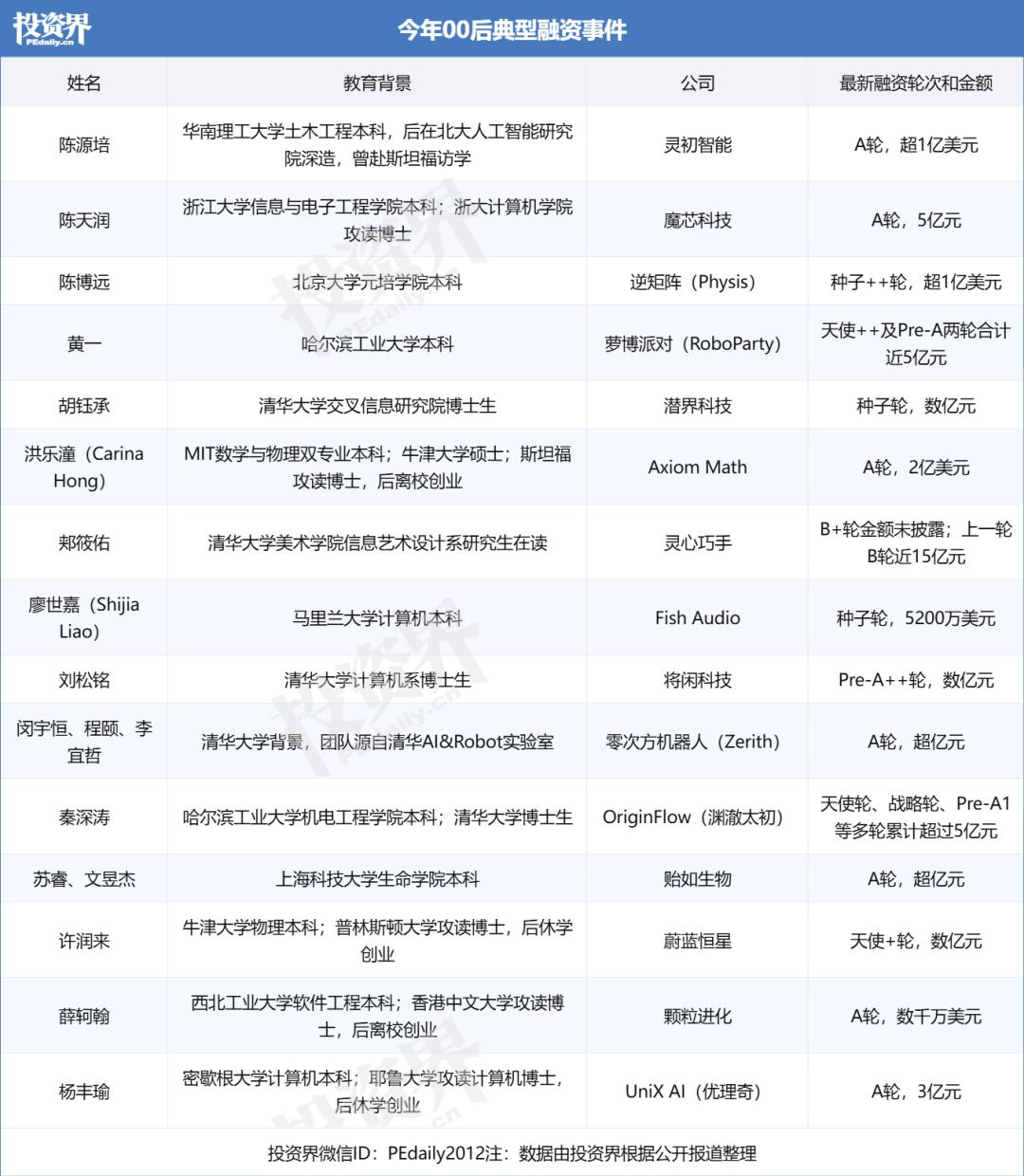
An investor outlined the portrait of "little genius" like this: in their twenties, graduated from top universities, still studying or just leaving campus, focusing on cutting-edge fields such as AI and robotics. Labels such as competition awards, open source projects or "genius youth" often allow them to quickly enter the vision of institutions.
Investors even waited outside the gates of big tech companies. Yao Shunyu is still at Google DeepMind, and he once said bluntly this year that he "will not stay at Google for a long time". Recently, he connected to an online event in China to discuss RSI, and the outside world started guessing his next stop again. People familiar with the matter revealed that leading VCs have already contacted him.
Technological iteration has loosened the seniority-based ranking. The sporadic youth entrepreneurship stories that once appeared have now formed a group portrait.
Investors Are Flocking to Campuses
"Focus on the long board." Talking about how to judge post-2000s founders, an investor summarized it this way. With very short professional experience, one sufficiently outstanding ability can already become the basis for institutions to place bets in advance.
Huang Yi and his roommates "hand-built" a biped robot in their dormitory at Harbin Institute of Technology. After graduating early, he brought 13 classmates to Shanghai to start a business. Chen Tianrun started with small hardware inventions in his dormitory, and tried to make a Rubik's cube-solving machine and a food delivery trolley.
Beyond technology, investors are also identifying the weight of entrepreneurs. Cao Xi, Founding Partner of Monolith Capital, calls Qin Shentao "a born entrepreneur". What he values is Qin Shentao's understanding of the general direction, his thinking about the organization, and his determination to "want to win".
Sometimes, in order to see more clearly, investors even need to do "home visits".
Yan Yi, Partner of Shuimu Venture Capital, recalled to PEDAILY that a founder born in 2004 decided to leave campus to start a business, and he specially met the founder's parents. After talking, he learned that this young man took his classmates to do business when he was in junior high school, and had tried to start a company in high school. What moved him even more was the founder's ability to gather talents, as he had already persuaded many doctors and scientists to join his team.
The time to look for them has also been advanced again and again. Many early-stage investors talked about a noticeable change: institutions take the initiative to look for young people who have not yet founded a company on social platforms, hackathons and universities. Some people even flew over directly after seeing a product prototype, asking the young person if he has considered starting a business.
Such contacts have more access points. ZhenFund's campus program ZhenCampus has entered many universities including Fudan University, Zhejiang University and Tsinghua University, inviting alumni entrepreneurs from its portfolio companies and the investment team to talk about entrepreneurship face to face with students. Platforms such as the "X-Day" Xilihu Roadshow Club have also held many Tsinghua University special sessions, playing the role of transition from campus to market.
Silicon Valley investors are even involved in running schools. a16z announced an investment of 35 million US dollars to support its incubated Horowitz Andreessen Academy. The first phase is planned to open in San Francisco in 2027, giving priority to high school graduates, and the admission particularly values the products that applicants have already developed. The search for young people has taken another step forward.
Campus entrepreneurship has also stepped onto a larger stage. Hunan TV launched the show "Gold Rush 2025", bringing 30 entrepreneurial students to the camera, with projects covering artificial intelligence, aerospace, biomedicine and other fields. "Looking back now, the time when I had the most energy and the greatest courage was when I was in my twenties." Ni Zhengdong, Founder and Chairman of Zero2IPO Group and CEO of Zero2IPO, one of the entrepreneurial mentors of the show, sighed.
Young people haven't even graduated from campus, but investors have already arrived one step earlier. The next important meeting may take place in a classroom.
A Generation Is in Their Prime, With Applause and Noise
Observing this group of post-2000s founders, you will find that there is a faint timeline beyond their age: their growth trajectory exactly overlaps with the ten years of accelerated evolution of AI. The evolution of technology has almost unfolded along their education stages.
"They have no path dependence, and they are learning Transformer natively in their academic journey." This sentence from investors points out another meaning behind their age: what many people need to re-learn is exactly the starting point of this group of young people.
The technical routes have not yet converged, and seniority can hardly determine the ranking in advance, so young people can enter the cutting-edge field earlier. Cao Xi summed up this change as "the generational shift in the AI industry has been completed". In the investment portfolio of Monolith Capital, the age of founders has quickly shifted from post-1995s to post-2000s.
What impresses many investors is exactly the maturity shown by these young people in technical judgment, organization and competition awareness. Some people even admitted that if there are no post-2000s members in an AI team, they will worry about whether the team is sensitive enough to new technologies.
However, opportunities come early, and tests are also advanced.
The outside world marvels at their youth, and begins to examine their dazzling resumes. Can they bear the expectations and pressure that come with getting large amounts of financing at a very young age? For this group of young people selected by capital in advance, the test has just begun.
Investors' vision is also being questioned. Some people call it a "carnival that cannot be falsified", while others tease the choices of institutions with the phrase "little genius or old treasure".
"Institutions are worried about missing out, and it is inevitable that they will be influenced by the judgments of their peers." Chen Yu, Managing Partner of Yunqi Capital, once said that in popular tracks, capital is prone to follow the crowd. A company with a sufficiently high valuation and well-known institutions standing behind it is more likely to be regarded as a leading project, attracting more capital to enter.
Chen Yu reminded that the threshold of making a Demo has dropped, but it is still very difficult to make the product stable, adapt to different scenarios and complete delivery. To turn a one-time success in the demonstration into reliable performance in daily use, there are still many problems to be solved.
"Little genius" is undoubtedly a title that is easy to spread, enough to make a young person be seen quickly, but it cannot answer how far a company can go. Outside the spotlight, what awaits them is still customers, product delivery, and the long daily operation of the business. Qin Shentao put it bluntly: "Customers and investors will not lower their expectations just because we are post-2000s generation."
Looking back, the concentrated emergence of these post-2000s generations coincides with technological changes. Cutting-edge technologies such as AI, embodied intelligence, and world models have given them opportunities to show their talents earlier. "Genius youth" such as Zhihuijun took the lead, and the figures they once looked up to have also become the reason for later generations to set off.
Talking about these young people, Yan Yi sighed that many excellent Chinese products are already part of the daily life of the post-2000s generation. This makes them believe earlier that world-class products can also be made by their own hands.
Young people have lofty ambitions. The title of "little genius" will eventually fade away. Each generation has its own opportunities, and its own answers to hand in.
This article is from the WeChat Official Account "PEDAILY" (ID: pedaily2012), written by Wang Lu and Chen Jia, authorized for release by 36Kr.