Hackathon "Economics"
In the morning, the conference hall was fully occupied. The seats in the front row were reserved for leaders, while the back rows were filled with young people who had traveled from all over the country, carrying laptops and hardware. Every time the host called a name, the leader on the stage would stand up, take the microphone and start delivering a speech.
Young contestants began to yawn. The conference hall was not their home ground, and the competition venue next door was where they really wanted to go. Tables had been neatly arranged there, power supplies were connected, and the booths of sponsors were also well set up. Stacks of campus recruitment brochures were placed on the tables, alongside roll-up banners for product promotion.
This is a Hackathon — an event where a group of people gather together to turn ideas into a runnable demo within dozens of hours. When such events are launched in different regions, they are usually named after local features: the one held in Nanjing is called "Nanke Song", the one in Guiyang is called "Guike Song". Though the names are different, the rules and gameplay are largely the same.
Scenes like this take place in cities across China almost every weekend. Back in 2025, Hackathon was still a relatively niche activity among developers and the AI venture capital circle. But by 2026, with the development of AI coding capabilities and Vibe Coding becoming the mainstream, the threshold for programming has been lowered, and so has the threshold for participating in Hackathons. According to data from the community "AI Event Hub", nearly 500 Hackathons were held across China in the first half of 2026, with 2 to 3 events taking place on average every single day.
Chen Rongxian, who has hosted multiple Hackathons, once witnessed a surprising and thought-provoking scene: when he visited a Hackathon venue, he found that some contestants did not even know what GitHub (the world's largest code hosting and collaborative development platform) was.
Beneath the bustle lies a clear logic for organizing such events: the government needs talents and industrial development, enterprises need talents and exposure, students need experience endorsements and opportunities, and the organizers need stable cash flow... Hackathons are young and lively. They do not generate profits on their own, but have become a traffic entry point and a platform for resource swapping.
When everyone wants to take something away from this event, who is actually paying for it?
From 20,000 to 1.2 Million, Hundreds of Ways to Be "Thrifty" or "Extravagant" in Hosting a Hackathon
There is no standard answer to how much it costs to host a Hackathon.
Yang Peijun has seen the most "austere" Hackathon, whose total cost was less than 20,000 yuan. When Chen Rongxian hosted the first "Nanke Song" event, the 50,000 yuan government sponsorship was all the available funds he had. A year later, the second "Nanke Song" hosted by Chen Rongxian saw its cost surge to 600,000 to 700,000 yuan. Not long ago, Mandy co-hosted the "Guike Song" event: they originally planned to control the cost at around 500,000 yuan, but ended up spending 1.2 million yuan.
From 20,000 yuan to 1.2 million yuan, where does the huge gap come from?
To break down the cost of a Hackathon, the money is mainly spent on several parts: venue setup, bonuses and prizes, contestants' accommodation and travel expenses, catering and refreshments, material design, staff labor, and various on-site emergency expenses. Some are unavoidable "hard costs" no matter what, while others depend on the scale and specifications the organizer wants to achieve for the event.
This year, Yang Peijun undertook a Hackathon event hosted by Douyin in Ningbo, which cost about 100,000 yuan for a two-day, one-night schedule. In his opinion, the only rigid, non-compressible costs are bonuses, event materials and labor, which "have to be paid out and purchased for real", and all other expenses can be reduced through proper arrangements.
You do not necessarily need to rent a venue. "In fact, the government has a lot of idle venues, and you can get access to them through proper communication and negotiation." For a Hackathon with 100 participants, Yang Peijun and his team needed a venue of around 1,000 square meters, equipped with large screens and other facilities. There were only two or three qualified venues of this kind in Ningbo in total. They visited all of them, and negotiated with the corresponding park operators and superior government departments.
Many organizers of low-cost Hackathons are student teams, or make extensive use of volunteers, so they do not need to pay for labor. They can get refreshments and drinks through resource swapping with brands. If they cannot afford cash bonuses, they can ask brand partners to provide products as prizes instead. When hosting the first "Nanke Song", as the budget was only about 50,000 yuan, Chen Rongxian and his team allocated several thousand yuan as cash bonuses, and used some "privileges" to expand the prize pool, such as the direct access ticket to AdventureX, which was known as "the largest Hackathon in China" at that time.
"There will also be a lot of temporary emergency expenses on site, which counts as the fourth rigid cost." One situation Yang Peijun encountered was that the network speed was too slow, so he and his team had to pull new wires and network cables for the venue in the middle of the night, working until 3 a.m. and spending 2,000 yuan. The tents originally prepared for contestants who stayed up all night to develop were finally used by themselves to rest.
As for computing power tokens, they usually come from sponsorships provided by model manufacturers. In addition, MaaS companies that sell computing power are also the main force sponsoring computing power for Hackathons.

● Image source: Silicon Valley
They also have some small "thrifty" tricks of their own: they wanted to hold a pre-party at a craft beer bar near the university, but could not afford the cost of covering all drinks. Chen Rongxian talked to the bar owner, promising that every guest who came in would pay for their own drink. The total price for a designer to make all the event materials was 20,000 yuan, but making the main visual design only cost 3,000 yuan. "At this point, you can ask the designer to only produce the main visual, and finish the rest by yourself." Yang Peijun said.
If a Hackathon can be hosted with just tens of thousands of yuan, where does the 1 million+ yuan go?
Since there is no unified standard configuration for Hackathons, a large part of the price gap comes from the cost for higher event specifications and better participant experience. The higher the specification, the more costs will accumulate layer by layer. When the total cost is 50,000 yuan, the organizer only thinks about whether the event can be held successfully. When the total cost reaches 1.2 million yuan, the organizer will focus on how to make the event well-run and large-scale.
The number of participants depends on the expected scale. As the number of people increases, the corresponding cost for event materials will also rise. The amount of bonuses affects the attractiveness to contestants, and how much to offer depends on what kind of contestants the organizer wants to attract. Travel expenses and hotel accommodation for contestants are not mandatory items, and how much to reimburse and in what way depends on the experience the event aims to provide.
During the second "Nanke Song" event, as more sponsorships and subsidies were secured, Chen Rongxian's team covered the 2-3 night four-star hotel accommodation for more than 100 contestants. The event was held during the May Day holiday, and this single item cost more than 100,000 yuan. The event was hosted at Nanjing International Expo Center, and the venue plus the large screen cost another 50,000 yuan. The total value of bonuses and prizes exceeded 200,000 to 300,000 yuan.
Another example is the "Guike Song" that Mandy participated in. The organizer was a state-owned enterprise in Guizhou, which provided funds and resources. "With its strong support, we did invest a lot, hoping to provide better support and services for participating contestants." Mandy said. They originally planned to hold a small-scale event as a trial, but later the event received more and more attention, and its scale and specifications kept expanding.
First, they hired a construction team to design the venue, and arranged an event space of nearly 2,000 square meters within the Digital Expo. The number of participating contestants was set at 300, which was not a small figure. To attract contestants from all over the country to come to Guizhou, they covered the accommodation and catering for all 300 contestants, and also offered 150,000 yuan in cash as bonuses.
Behind the huge span from 20,000 yuan to 1.2 million yuan lies the same question: who exactly pays for the event, and for what purpose? Events that cut costs to the extreme use resource swapping to replace cash payments. Events that cost 1.2 million yuan use cash to pile up high specifications. And the higher the specification, the more the event needs to be paid for by the government or large enterprises.
The funds and resources needed to host a Hackathon mainly flow from two sources: government subsidies and corporate sponsorships. Why they are willing to pay for such an event is a question worth further exploration.
What Do Enterprises Want to Get?
For enterprises, sponsoring a Hackathon is far more than simply "supporting an activity". They are willing to invest money, products and manpower, and one important reason is that the Hackathon venue gathers exactly the group of people they want to reach.
In June 2025, in order to create an opportunity to introduce their own Hackathon to Liu Jingkang, the founder of Insta360 face to face, Chen Rongxian blocked him at the entrance of the restroom.
That day, Liu Jingkang returned to his alma mater to attend an event. When Liu Jingkang left the venue for the restroom, Chen Rongxian rushed over immediately. Liu Jingkang was taken aback, and the two walked back to the venue from the restroom together. Along the short tens of meters of road, Chen Rongxian quickly explained his idea for the Hackathon, and invited Liu Jingkang to support the event on site.
After the event, seeing that Liu Jingkang was about to leave, Chen Rongxian's friend pulled him to rush forward again, breaking through the "layers of obstacles" formed by school leaders, and forced the printed materials into Liu Jingkang's hands. Later, Insta360 sponsored some products for "Nanke Song", and Liu Jingkang himself even recorded a promotional video for the event.
These methods are unorthodox and flexible, but they never stop until the goal is achieved. In 2024 and 2025, when AI Hackathons just began to revive in China, there were many similar stories. Almost every organizer knows how AdventureX managed to raise funds at the very beginning — if you want to cooperate with an Internet company, you can tell it that your cooperation with another Internet company is almost finalized, and you can say the same thing to the latter company in turn.
But relying only on the encouragement of individual enterprises for young people is not sustainable. After contacting more companies, Chen Rongxian gradually figured out which two departments are the key breakthrough points when seeking support from enterprises:
The first one is the human resources department. Hackathons gather a group of people who are already actually developing products and solving problems, and these companies hope to recruit high-quality talents at such events. At different Hackathon venues, campus recruitment brochures and roll-up banners of enterprises can often be seen.
The second one is the product marketing department. They have demands for product and brand promotion, and the young people at the Hackathon venue are very likely to be their target users.
What enterprises want to get is not just talents and exposure. When Intel served as the title sponsor for Tmall AI Hackathon, it gave the reason that the event can combine AI computing power with actual consumption scenarios, allowing students to test their technical capabilities in real demands. For L'Oréal's beauty tech Hackathon, the winning team can be directly shortlisted for the management trainee or summer intern program. For enterprises, Hackathons are not only a talent recruitment pool, but also a place where developers can "actually use" their products.
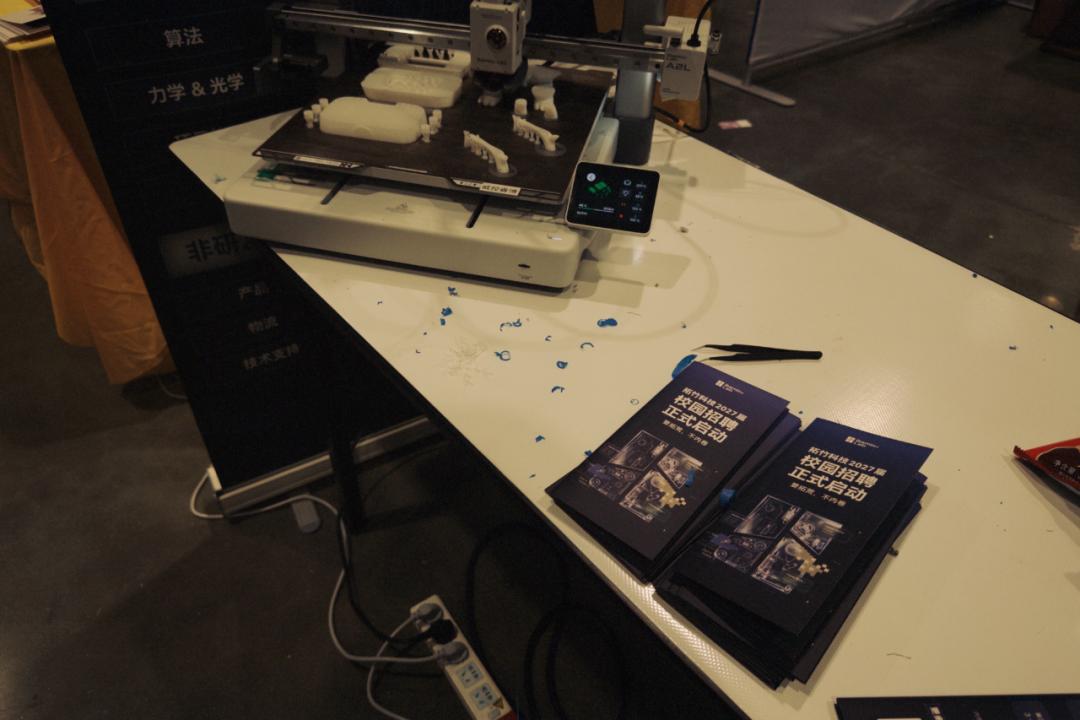
● Booth of a hardware manufacturer at a Hackathon. Photo by Lin De'an
As the head of business development, Mandy joined the "Guike Song" team midway. Her method was to participate in a large number of other Hackathons and events on the market at that time, and get to know brand representatives at these activities. She talked to every manufacturer that had a booth at AdventureX one by one, "Because since they have already sponsored one Hackathon, it means they have relevant demands." Insta360 is exactly the partner she reached out to at AdventureX.
Companies sponsor money and products for Hackathons. In return, Hackathon organizers divide sponsorship into different levels according to the amount of sponsorship, and provide corresponding different privileges. Take "Guike Song" as an example: 80,000 yuan corresponds to strategic partner status, and 50,000 yuan corresponds to core partner status. Both levels include the privileges of on-site booths and official media interviews, but the booth for strategic partners is larger and located in a more prominent position. "Since the event is held in the same venue at the same time as the Digital Expo, the booths we provide are worth more than 1,000 yuan per square meter if sold separately outside." Mandy said.
Compared with cash sponsorship, product and resource swapping is more common. Mandy expanded cooperation with more than 90 companies within a month, and less than 10 of them were willing to provide 40,000 to 80,000 yuan in cash, which is already a large number among similar Hackathons.
"Very few companies are willing to provide cash sponsorship. Now there are too many Hackathons, and sponsors are already very tired of such events. Besides, most of the companies that are willing to sponsor Hackathons are probably preparing to host their own Hackathons." Mandy said.
This is indeed another way for enterprises to participate in Hackathons: instead of sponsoring other people's Hackathons, it is better to host their own.
The Hackathon that Yang Peijun hosted in Ningbo was undertaken by him as the contractor for Douyin. At that time, he had established two AI venture capital related communities in Ningbo. When Douyin holds Hackathons in different regions, it usually looks for local teams to undertake the municipal-level events. Douyin provided a sum of funds for the municipal and school-level events, as well as salaries for the student team that are comparable to the salaries of event operation interns in first-tier cities.
More and more companies have begun to host their own Hackathons. In addition to large tech companies such as ByteDance, Tencent and Amazon, there are also hardware companies like Insta360, and community platforms such as Xiaohongshu and Zhihu.
What Does the Government Want to Get?
Compared with product and resource swapping from enterprises, government funds are usually more direct, but the application and docking process is also more complicated.
When hosting his first Hackathon last year, Chen Rongxian and his team were just a group of students with no money, no traffic, and almost no connections. The first leverage they found to push the event forward was government support.
He heard that a senior alumnus offered an innovation and entrepreneurship course at the university, and was very supportive of student activities. Even though he did not know the alumnus and did not take that course, he rushed to the classroom during the class, pulled the alumnus aside and asked: "We want to do this event, is there any way you can support us?" The alumnus introduced him to the relevant government department, which provided 50,000 yuan in sponsorship, and the event was successfully launched.
However, in most cases, government funds are not paid out by one single department at one time. This year, Luo Yu launched a Hackathon event, and he felt this point very deeply.