Did DeepSeek raise hundreds of billions of yuan in financing as soon as Liang Wenfeng took action?
Just yesterday, Bloomberg reported that DeepSeek's new round of financing is about to be finalized, with a scale of at least 800 billion yuan, while the original target was only about 500 billion yuan. According to the signed term sheet, the final amount may approach 1 trillion yuan. CATL and Tencent are the two largest capital contributors, and this sum of money is regarded as a stepping stone for its IPO in early 2027.
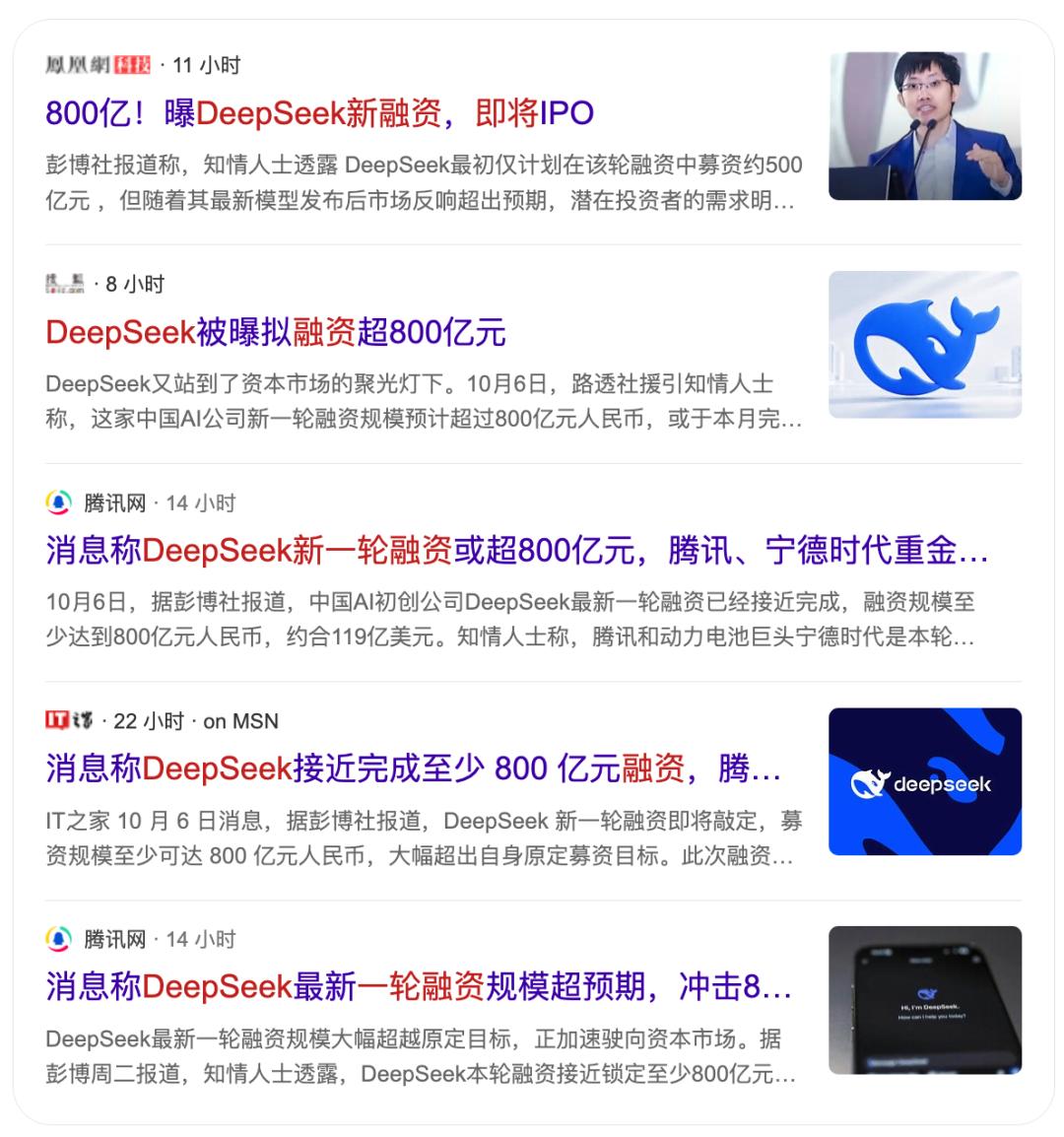
For other companies, this would just be another regular financing update. But for DeepSeek, it seems almost surreal: a year and a half ago, it was still dispelling rumors that "all financing-related claims are untrue"; Liang Wenfeng publicly stated that DeepSeek had no shortage of funds and had no short-term financing plans.
From "no need for money" to "raising far more funds than the target", DeepSeek spent less than six months. In this article, I will sort out its full development history and financing history from the beginning: where the funds come from, why it suddenly needs money, how much it has raised, and where it plans to spend the money.
01
Prequel: DeepSeek's "Angel Round" came from a quantitative fund (2015–2023)
DeepSeek's first sum of money did not come from VCs, but was earned by High-Flyer Quant. Only by understanding this point can we figure out why it could go three years without financing later.
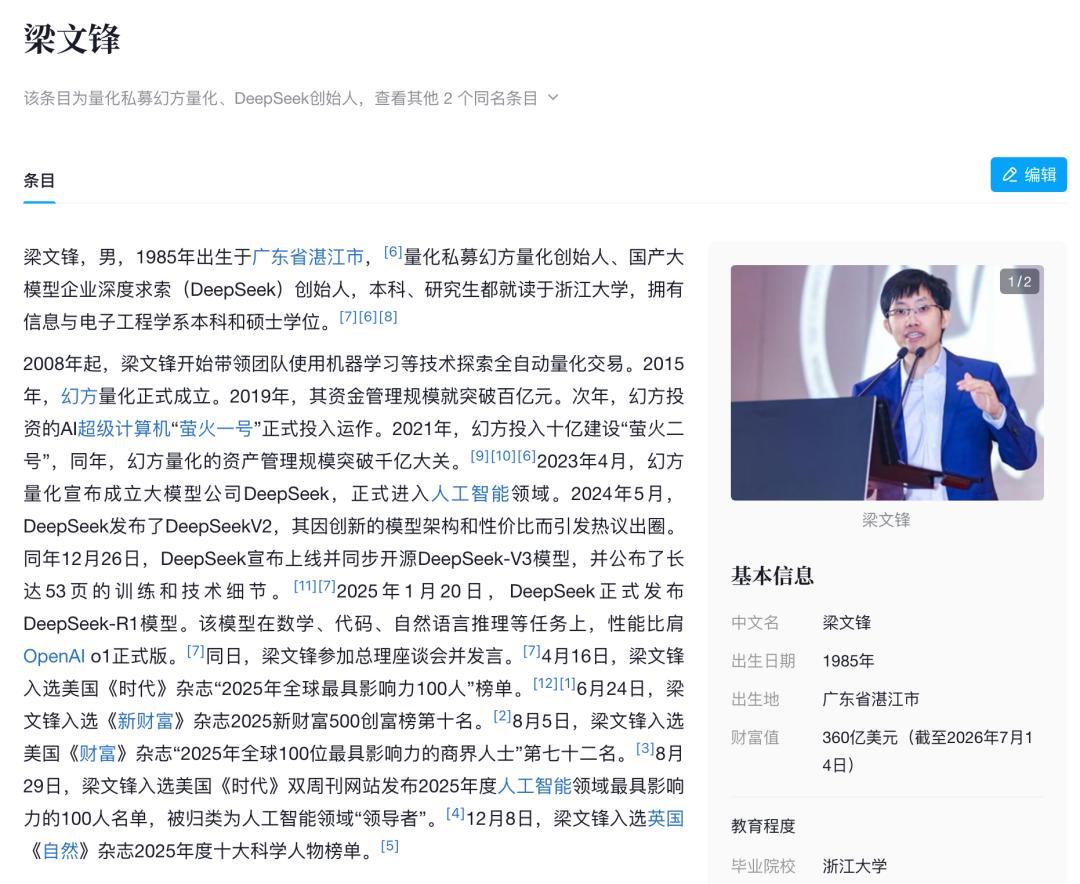
•2015: Liang Wenfeng founded High-Flyer Quant, a quantitative private equity fund whose AUM once exceeded 100 billion yuan later.
•October 2016: High-Flyer launched its first AI model, and the trading positions generated by deep learning began to be calculated with GPUs; in 2018, the company took AI as its core development direction.
•2019–2020: High-Flyer AI was established, and the self-developed training platform "Firefly No.1" was launched, with a total investment of nearly 200 million yuan and equipped with about 1100 GPUs.
•2021: 1 billion yuan was invested to build "Firefly No.2", equipped with about 10,000 NVIDIA A100s. At that time, there were no more than 5 enterprises in China that owned 10,000 GPUs, and a quantitative fund was among them.
•April 2023: High-Flyer announced the establishment of an independent research organization to explore AGI, named DeepSeek.
•July 17, 2023: Hangzhou DeepSeek Artificial Intelligence Basic Technology Research Co., Ltd. was officially registered.
Key points from Guai Ge: Before ChatGPT sparked the large model boom, High-Flyer had already stocked 10,000 GPUs two years in advance. While others were looking for GPUs all over the world in 2023, DeepSeek was born with sufficient computing power. Moreover, its parent company is a continuously profitable cash cow — according to industry estimates, High-Flyer's management fees plus performance remuneration in 2025 alone reached the order of 5 billion yuan. This is the confidence for DeepSeek to dare say "we have no shortage of money".
02
Debut: Open source, MoE and price butcher (2023–2024)
From the first day, DeepSeek chose a different path from its domestic peers: full open source, focus on efficiency improvement, and push the price down to the floor.
•November 2, 2023: Six months after its establishment, it released its first model DeepSeek Coder, which is open source and free for commercial use; in the same period, it launched the general-purpose model DeepSeek LLM.
•January 2024: DeepSeek-MoE was open sourced, which was the first open source Mixture-of-Experts model in China. MoE later became the foundation of all DeepSeek's flagship models.
•May 2024: DeepSeek-V2 was released, and its API price was suppressed to about 1 yuan per million input tokens, which directly ignited the domestic large model price war. DeepSeek also got the nickname "Pinduoduo in the AI industry" for this reason.
•December 2024: DeepSeek-V3 was released. The officially disclosed training cost was about 5.576 million US dollars, and its performance was comparable to the top closed-source models at that time.
At this stage, DeepSeek was already very famous in the domestic industry circle, but in the eyes of the capital market, it was just a "research department under High-Flyer". It was the next model that really made the whole world remember it.
03
R1 Moment: An open source model made NVIDIA evaporate 588.8 billion US dollars in one day (2025)
On January 20, 2025, DeepSeek released its reasoning model R1. It matches OpenAI o1 in mathematics, programming and reasoning, but the API call cost is 90%-95% lower.
A week later, on January 27, the US stock market reacted: NVIDIA closed down 16.86% in a single day, with its market value evaporating by 588.862 billion US dollars, setting the record for the largest single-day market value evaporation of a single stock in the US stock market. Wall Street seriously asked itself for the first time: are part of the hundreds of billions of dollars that giants have invested in AI infrastructure wasted?
The user side also saw explosive growth: DeepSeek App took only 12 days to exceed 30 million daily active users, and topped the app store rankings in 140 countries. For comparison, ChatGPT took 11 months to reach this scale.
There is another easily overlooked node in this year: September 17, 2025, the R1 paper was featured on the cover of *Nature*, becoming the first mainstream large model to pass peer review by an authoritative journal. The supplementary materials disclosed for the first time that the reinforcement learning training cost of R1 was only 294,000 US dollars, plus about 6 million US dollars for the V3 base model, which was still far lower than that of Silicon Valley peers.
Key points from Guai Ge: After R1, DeepSeek transformed from a "star in the domestic technology circle" to a "variable in the global capital market". Normally, this is the moment when founders start to meet investors and get sky-high valuations. But DeepSeek's choice was: close the door and continue to conduct research.
04
Two years of "no financing": rumors refutation, rejection and missed opportunities
After R1 became a hit, people who wanted to invest in DeepSeek queued up in a long line, but every financing rumor in these two years was denied.
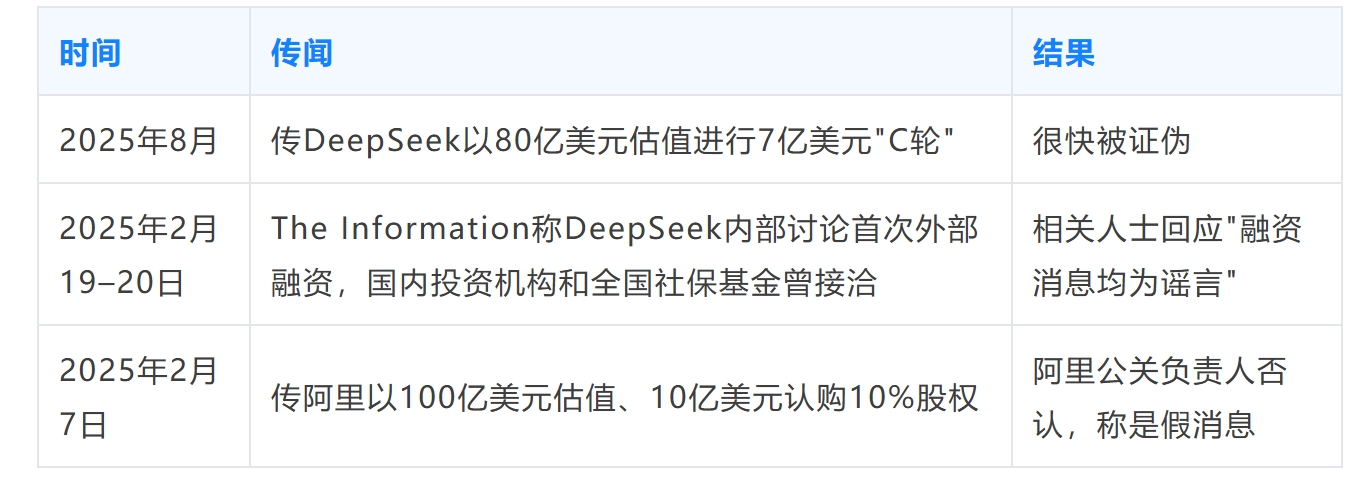
During that period, DeepSeek's funds mainly came from High-Flyer's internal resources and government scientific research grants. Even Baidu Ventures, whose office was just upstairs of DeepSeek, failed to get a share of the investment. The reason was very simple: High-Flyer had no plan to spin off the large model business for financing at all.
The reasons Liang Wenfeng refused financing can be summarized into two points:
1. External investors will interfere with the company's decision-making.
2. Many VCs have concerns about research work, they have exit demands and hope to realize commercialization as soon as possible.
Key points from Guai Ge: Pay attention to these two reasons. When DeepSeek really raised funds later, the transaction structure it designed almost responded to these two concerns one by one: take the money, but do not give up voting rights; set a 5-year lock-up period, and do not give expectations of rapid exit.
05
2026 First Round Financing: from "at least 300 million US dollars" to 500 billion yuan
In June 2026, DeepSeek completed its first round of external financing, raising about 500 billion yuan (about 74 billion US dollars), with a post-money valuation of about 3.5 trillion yuan. It is the largest first round financing in the history of China's large model industry. But at the beginning of this round of financing, the scale was only a few tenths of the final amount.
Why did it suddenly need money? According to reports, the original motivation was very simple: to set a valuation for employee options and retain researchers — in the few months before that, DeepSeek lost several core researchers. Other reports mentioned that an 11-hour service outage in late March 2026 exposed its shortcomings in cloud infrastructure. And the computing power cost of the next generation of models can no longer be supported only by the cash flow of a single hedge fund.
How was the valuation pushed up by investors:
•April 17: The Information reported for the first time that DeepSeek was seeking at least 300 million US dollars, with a valuation of more than 100 billion US dollars.
•April 22: Tencent and Alibaba were reported to be in talks to participate in the investment, and the target valuation was raised to more than 200 billion US dollars, referring to Kimi which was also raising funds at the same time with a valuation of 180 billion US dollars.
•Around May 6: British *Financial Times* reported that China Integrated Circuit Industry Investment Fund was in talks to lead the investment, with a valuation of about 450 billion US dollars.
•May 8: The valuation rose to more than 500 billion US dollars, and Liang Wenfeng planned to contribute about 29 billion US dollars personally.
•May 22: CATL was reported to participate in the investment.
•June 3: Reuters reported that the financing was about 500 billion yuan, with a post-money valuation of 3.5 trillion to 4 trillion yuan.
•Mid-June: The delivery was completed (*Financial Times* said it was completed at the end of May, while most domestic media said the delivery was in June).
Final investor list (the amounts are reported by the media, and DeepSeek has not officially disclosed):
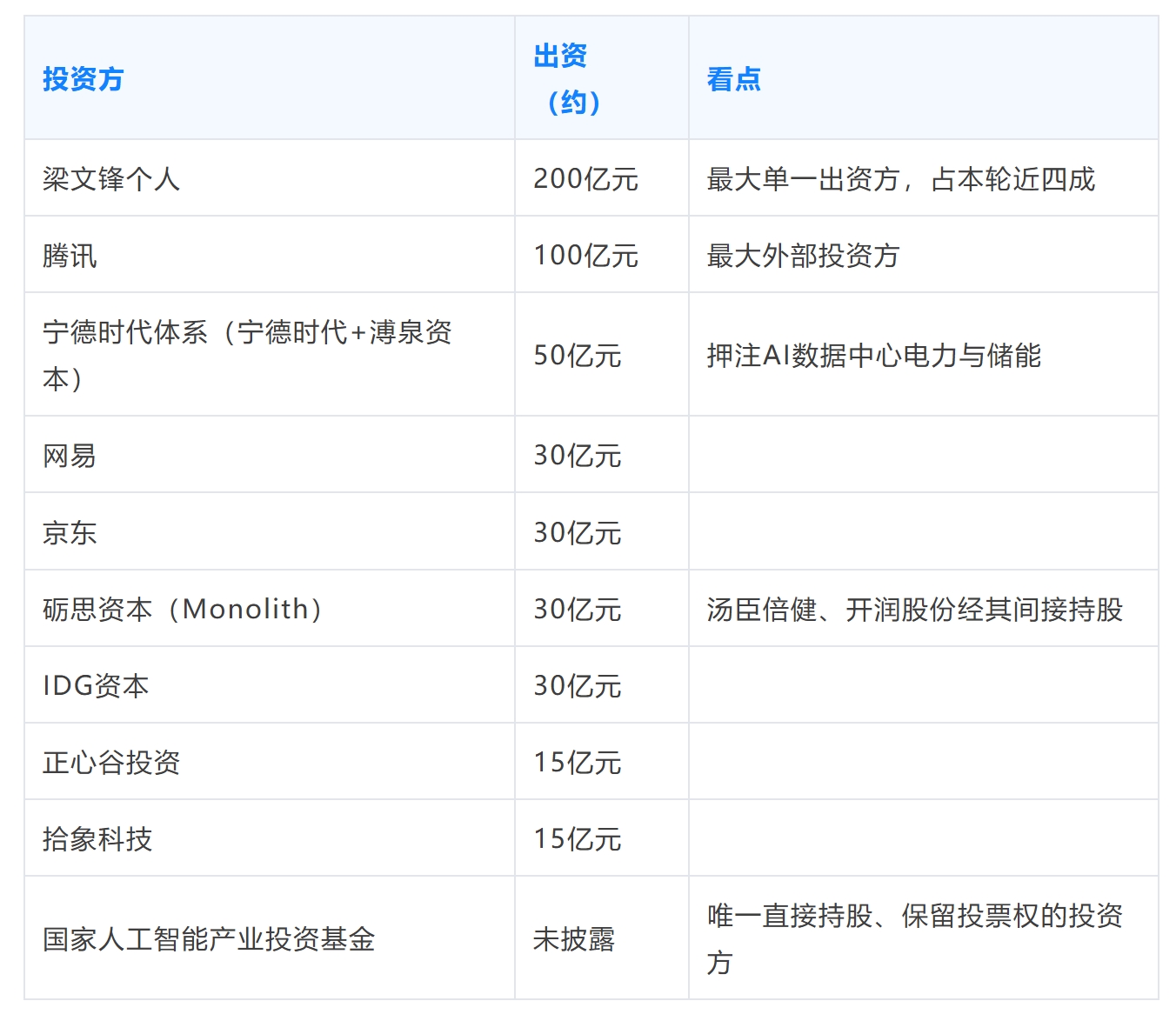
The transaction structure is the most noteworthy part of this round: Most investors' funds do not go directly to DeepSeek, but to the limited partnership managed by Liang Wenfeng, with no voting rights and a 5-year lock-up period. Only the National Artificial Intelligence Industry Investment Fund invests directly and retains voting rights.
How hot was the subscription? The intended capital exceeded 1 trillion yuan, but only half of it was finally admitted, and at least 500 billion yuan of funds were still in the queue. After the financing, Liang Wenfeng's shareholding dropped from about 90% to about 78%, but his net worth rose from 16.7 billion US dollars to about 36 billion US dollars.
There is another side evidence for the valuation: the listed company Kerun disclosed that it indirectly holds 0.0114% of the shares with 40 million yuan, which implies a valuation of about 350.8 billion yuan; By-health holds 0.04% of the shares with 130 million yuan, implying a valuation of about 325 billion yuan. *Caijing* mentioned that including the 5% employee option pool for additional issuance, the actual pre-money valuation was about 367.5 billion yuan.
06
The second round: launch, suspension, restart, over-subscription
Only six weeks after the first round of delivery, the second round started, and the process was more dramatic than the first round.
•July 14: *Financial Times* reported that DeepSeek was seeking a new round of financing with a pre-money valuation of about 710 billion US dollars (about 4.8 trillion yuan), 37% higher than the post-money valuation of 520 billion US dollars in the first round. Bloomberg reported on the same day that DeepSeek had begun to prepare for IPO, targeting a mainland listing in 2027, and submitting the application as soon as the end of this year. One of the reasons was that the quota of the first round was in short supply, and the rejected institutions were scrambling for the share of the second round.
•July 22: The 4-hour closed-door meeting between Liang Wenfeng and investors during the first round of financing, whose 34,000-word transcript went viral on the Internet.
•July 25: Bloomberg reported that DeepSeek verbally notified some investors to suspend the signing, one of the reasons was that Liang Wenfeng was dissatisfied with the leakage of the transcript.
•August 5: *Caijing* reported that the financing was restarted, with a planned fundraising of 500 billion yuan and a pre-money valuation of about 5 trillion yuan, hoping to advance it in a low-key manner.
•Around August 10: According to *IPO Early Know*, the first batch of signings was carried out in Hangzhou, with a minimum investment of 5 billion yuan per institution; the capital path was divided into two, part of the funds went directly to the DeepSeek entity, and part went to the limited partnership controlled by Liang Wenfeng.
•August 27: *Wall Street Journal* reported that this round planned to raise 74 billion US dollars, with a pre-money valuation of 740 billion US dollars; old shareholders such as CATL, Lisi Capital and Shixiang Technology increased their investment, and funds with local government background also participated. At the same time, it was disclosed that DeepSeek's annualized recurring revenue (ARR) had reached 500 million US