How Does Kuaishou Achieve Self-Consistency After Keling's Launch?
If Keling is spun off for independent listing, Kuaishou needs to provide investors with a reason to continue holding shares of the parent company.
Capital that is exclusively bullish on AI video will get the chance to purchase Keling's stocks directly. Investing in Kuaishou, by contrast, means accepting its advertising, e-commerce and livestreaming businesses all at once, as well as the management's subsequent arrangements for the profits generated from these businesses. Kuaishou can maintain control over Keling, but may lose a portion of buyers who only intend to invest in Keling.
On October 6, as reported by IT Home citing Bloomberg, Keling has selected CICC, Goldman Sachs and UBS to prepare for its Hong Kong IPO, with a planned fundraising of at least 1 billion US dollars and a target listing timeline as early as 2027, while the specific timing and scale are still subject to adjustment. Rumors about its listing direction have emerged before, and the newly disclosed details are the confirmed investment bank roster and fundraising target.
Keling has sufficient reasons to fight for its own group of investors. It charges creators subscription fees and provides video generation APIs to enterprises, and the capabilities purchased by clients can be used outside the Kuaishou ecosystem. In the second quarter of 2026, Keling's revenue exceeded 850 million yuan, representing a year-on-year growth of over 200%; during the same period, the total revenue of Kuaishou Group including Keling reached 35.535 billion yuan, with a year-on-year growth of 1.4%. Keling's growth rate has far outpaced the overall performance of the group.
In April, Adobe integrated Keling 3.0 and Keling 3.0 Omni into Firefly, allowing creators to generate footage in the platform before moving on to the editing process. Runway also added Keling to its model directory. A company with self-developed video models has become a distribution channel for Keling at the same time.
Keling has already entered the field of professional creation tools, while these tools also provide other models such as Veo and Runway. Creators can compare effects and switch suppliers in the same interface. Keling has gained access to client resources, but also needs to continuously compete for clients' usage budgets.
This will also reshape the interest relationship faced by the two founders. Cheng Yixiao is in charge of Kuaishou, serves as the chairman of Keling, and has been granted direct equity in the subsidiary; Su Hua retains important voting rights in the parent company, and is not listed as an individual grantee in the Keling incentive plan disclosed this time. The costs and benefits of Keling's independent financing are allocated to the two founders through different shareholding structures. Ordinary shareholders of Kuaishou, on the other hand, are more eager to see the e-commerce and advertising businesses continue to generate profits to support the value of the parent company's stocks they hold.
Kuaishou earns more than just commissions from its e-commerce business
No matter how fast Keling grows, Kuaishou's current revenue still mainly comes from its platform businesses that it has operated for many years.
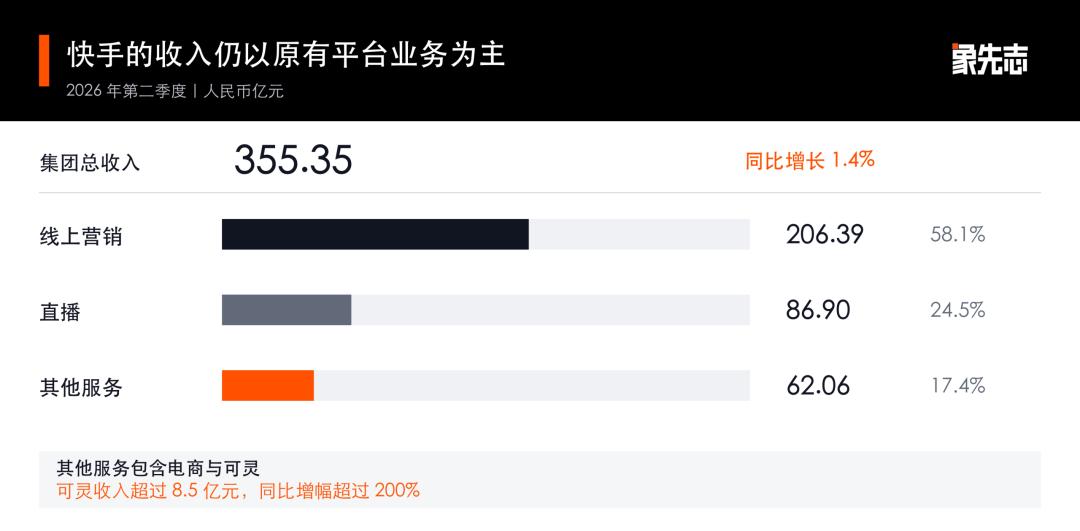
In the second quarter of 2026, Kuaishou's advertising revenue reached 20.639 billion yuan, and livestreaming revenue hit 8.69 billion yuan, the two of which together accounted for more than 80% of the total revenue. The remaining 6.206 billion yuan of "other services" revenue includes e-commerce and Keling's revenue. In Kuaishou's financial statements, there is no complete independent figure for the e-commerce business that can be directly used for separate valuation.
The reason is that a single e-commerce transaction can contribute two types of revenue to Kuaishou at the same time.
Merchants pay transaction-related fees when selling goods on the platform; to obtain more orders, they will also purchase advertising traffic. The former is counted in the other services segment where e-commerce belongs, while the latter is classified into the online marketing revenue. Kuaishou's advertising clients also cover industries outside e-commerce, but when evaluating the value of e-commerce, these two types of expenditures from merchants must be considered together.
For merchants, both traffic purchase and commission payment come from the revenue generated by selling goods. After the transaction is completed, they also need to deduct the costs of stock procurement, performance and return, and the remaining profit determines how much advertising budget they can invest next time. If the extra advertising revenue the platform earns today comes from investments that merchants cannot sustain, the revenue in the next year may not be able to maintain the same growth.
This makes e-commerce an indispensable part when evaluating Kuaishou. It is not only related to transaction service revenue, but also affects the ability of some advertising clients to continue paying. Judging the value of e-commerce solely by commission revenue will underestimate its contribution to the platform; while attributing all advertising revenue to e-commerce will overestimate the value of this business.
Cheng Yixiao has put forward the solution. At the earnings call for the fourth quarter of 2025, analysts asked him about the e-commerce growth strategy for the coming year. He defined the direction as "returning to the essence of Kuaishou's content e-commerce", planned to increase support for brand merchants and industrial belt merchants, and has identified 100 key industrial belts.
This arrangement includes support for merchant traffic, products, operation and services, as well as converting platform users into buyers through commodities, content and subsidies. Cheng Yixiao also proposed to further integrate e-commerce with commercialization to improve resource utilization efficiency. According to his vision, Kuaishou can increase both transaction and advertising revenue at the same time, while merchants can obtain better operating results from these investments.
Cheng Yixiao once disclosed that driven by brand introduction and traffic integration mechanism, the total GMV of brand merchants across all channels in the first quarter increased by more than 25% year-on-year. According to the report of Zhitong Finance on the August 19 conference call, he still regards brands and industrial belts as the two key investment directions for e-commerce. During the promotion of Keling's financing, the e-commerce arrangement publicly announced by the management is still to continue investment.
These actions also explain why Kuaishou repeatedly emphasizes the optimization of merchant structure. Since the launch of the T2000 brand merchant program in the fourth quarter of 2025, by the second quarter of this year, the proportion of GMV generated by brands' self-operation in the overall market has continued to rise, and brand advertising investment has also achieved rapid growth. A brand with sustainable operation capabilities can not only provide commodities for the platform, but also become a long-term advertising client.
However, the improvement on the supply side needs to be sustained by buyers' willingness to place orders. In the second quarter, Kuaishou E-commerce's active paying users remained basically stable quarter-on-quarter. How much new demand the growth of brand merchants can drive depends on whether consumers will increase their purchases and make repeat purchases. The better performance of some brands still needs to further drive the transaction and revenue of the entire platform.
Kuaishou is also adjusting the way merchants purchase traffic. The customer penetration rate of its net transaction ROI product rose from 45% in the first quarter to 55% in the second quarter. The company links the iteration of this product with reducing the return rate of merchants. For merchants, the number of retained orders after transaction is far more meaningful than the seemingly good sales volume shown during the advertising launch process.
AI has been integrated into merchants' daily work in specific links such as product selection, material production, advertising launch and customer service. Kuaishou disclosed that in the first half of 2026, more than 850,000 merchants used the free AI operation tools provided by the platform. To get returns from these investments, it is necessary to first help merchants reduce operating costs and improve conversion rates, so that the platform can obtain more sustainable transaction and advertising revenue.
After Keling's listing, investors who are only optimistic about AI video can directly buy Keling's stocks; those who continue to hold Kuaishou's stocks still need to accept its original businesses including e-commerce and advertising. Cheng Yixiao's continuous investment in brands, industrial belts and merchant tools is to maintain Kuaishou's own profitability. The importance of e-commerce has not declined with Keling's financing: it generates commissions, provides paying clients for advertising, and supports the returns of the parent company's original businesses.
The growth pressure at the group level cannot be entirely attributed to e-commerce. In the second quarter, Kuaishou's advertising revenue increased by 4.4% year-on-year, while livestreaming revenue decreased by 13.5%; other services grew by 18.5%, which the company mainly attributed to Keling. The superposition of changes in several businesses resulted in the 1.4% growth of total revenue.
The decline in livestreaming revenue will affect investors' profit expectations. Advertising and e-commerce need to maintain stable returns after ensuring good community experience and supporting merchant operation. More than 400 million daily active users are the foundation of operation, and maintaining this user and content ecosystem also requires continuous investment.
Cheng Yixiao has obtained direct equity in Keling
The voting rights of Su Hua and Cheng Yixiao in Kuaishou are still quite close so far.
According to the 2026 interim report disclosed on the caliber of August 25, Su Hua holds approximately 9.88% of Kuaishou's equity and 32.49% of the voting rights for non-reserved matters through Reach Best; Cheng Yixiao holds approximately 8.84% of the equity and 33.34% of the voting rights for non-reserved matters through Ke Yong. Su Hua holds more shares, while Cheng Yixiao has slightly higher voting rights.
However, their operating responsibilities have long been asymmetric. In October 2021, Cheng Yixiao succeeded Su Hua as the CEO of Kuaishou; two years later, he took over the position of chairman. Both announcements made it clear that the position changes at that time did not alter their respective different voting rights arrangements. Su Hua still serves as an executive director, while Cheng Yixiao presides over both the board of directors and daily operation.
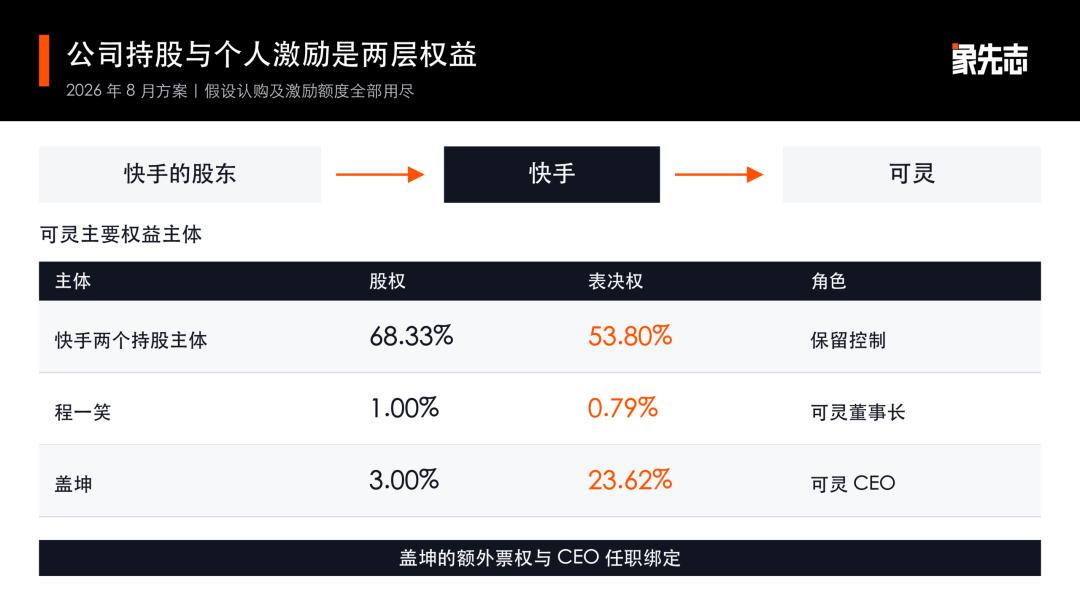
With the growth of Keling, this difference in responsibilities has further extended to the equity distribution of the subsidiary. In July, Kuaishou announced the capital increase and business restructuring arrangement of Keling with a valuation of no more than 3 billion US dollars; the updated announcement at the end of August stated that the subscription limit has been fully used. Under the scheme where all subscription and incentive quotas are exhausted, the two shareholding entities of Kuaishou collectively retain 68.33% of the equity and 53.80% of the voting rights, external investors hold 16.67% of the equity, and various equity participation plans account for 15%. The capital payment and business asset transfer will be carried out step by step in accordance with the agreement.
Kuaishou has given up part of the subsidiary's equity in exchange for external capital and talent incentives. All parent company shareholders will share the retained equity of Keling in proportion to their shareholding in Kuaishou, while Cheng Yixiao has an additional separate arrangement.
As the chairman of Keling, Cheng Yixiao is granted 1% of the restricted equity corresponding to the expanded share capital free of charge. This award is attached with transfer restrictions and a recycling condition that the equity will be recovered if he leaves his job within six years; he recused himself from voting when reviewing this personal incentive plan. Kuaishou's stated reason is to encourage him to continuously provide professional capabilities and strategic guidance for Keling.
Su Hua is not included in this round of individual grantee list. He can still indirectly share Keling's growth through his shareholding in Kuaishou; in addition to this path, Cheng Yixiao also directly holds the award linked to Keling's value. The difference between the two has extended from who is responsible for operation to how the newly added value is allocated to individuals.
If the parent company's stock is traded at a discount relative to Keling after its listing, this difference will become more obvious. Cheng Yixiao's direct equity is priced along with Keling's valuation, and its tradability is restricted by the incentive and listing arrangements; the value of the part held by Su Hua through Kuaishou is subject to the market pricing of the parent company. Cheng Yixiao also holds Kuaishou's shares, but his additional 1% equity does not need to fully rely on Kuaishou's stock price to reflect its value.
Under the current responsibility arrangement, the greater the weight Keling has in the group, the more likely Su Hua's overall operating influence on the group relative to Cheng Yixiao will weaken. The nearly equal voting rights of the parent company have not extended to equal management responsibilities for the two in Keling. Cheng Yixiao participates in Keling's strategic decision-making, while Gai Kun (alias Yuyue) is responsible for daily operation; Su Hua's important rights still lie in the parent company's board of directors and shareholder voting.
The arrangement for Gai Kun further highlights the binding relationship between operating rights and his post. Under the same full-allocation scheme, his 3% equity corresponds to 23.62% of the voting rights; if he leaves the position of Keling CEO or transfers the corresponding shares, the relevant weighted voting rights will be terminated. Cheng Yixiao's 1% equity corresponds to 0.79% of the voting rights. Keling's own equity structure has formed a power distribution different from that of Kuaishou.
The 53.80% voting rights held by Kuaishou still need to be exercised in accordance with the corporate governance procedures. Cheng Yixiao's responsibility as chairman, Gai Kun's operating rights, and the consent rights of investors for some major matters will jointly affect Keling's decision-making. The parent company retains control, but the newly added shareholders and operators have their respective interests and rights.
There is also a non-compete clause in the July announcement: Within the period specified in the agreement, Kuaishou shall not control any other enterprise whose main business is video generation models outside the Keling Group. This commitment takes effect from the completion of the restructuring, and lasts until the total shareholding of Kuaishou and its related parties falls below the control threshold specified by applicable rules, or five years after the signing of the agreement, whichever is later.
This commitment reduces the similar business competition risk faced by Keling's investors. Kuaishou retains control, but also accepts the constraints for the subsidiary's investors. It can still develop AI capabilities in its community, e-commerce and advertising businesses, but controlling another similar video generation model company separately is restricted by the agreement.
There are clear commercial reasons for incentivizing personnel who bear operating responsibilities. Keling needs to compete for talents globally, and also needs capital to undertake the risks of continuous R&D. However, when the parent company and the subsidiary allocate computing power, R&D and personnel costs, shareholders on both sides will care about different results. How much of the expenses are borne by Kuaishou and how much are paid by Keling will affect the returns of their respective shareholders.
Cheng Yixiao manages both companies at the same time, and holds the direct equity of Keling. How to price the resource input between the parent company and the subsidiary has become the interest conflict that this arrangement needs to face. The rise of Keling's valuation can increase the value of his personal incentive; for Su Hua and ordinary Kuaishou shareholders, the resources paid by Kuaishou must also bring commensurate returns.