How many side businesses do coffee shops, laundromats, pet shops and gas stations actually have?
In the early days, the non-fuel business of gas stations was essentially an "extension of shelves", but the profit from bottled water in convenience stores was extremely thin. As a result, side businesses began to evolve towards "services". A gas station is no longer just a gas station; it is turning into something you can barely recognize its original appearance. Behind this sense of "bewilderment" lies a forcedly accelerated survival experiment.
On the road of self-driving tour during the 7-day National Day holiday, many car owners encountered a kind of "bewilderment" at gas stations: after refueling, they wanted to buy a bottle of water at the convenience store, only to find a coffee window next to it; when they wanted to wipe their car conveniently, they found a self-service washing machine tucked in the corner; some people even got off the car with their dogs to get some fresh air, only to be told by the staff that "the pet washing room is at the back, 39.9 yuan, and you can pick up your pet in half an hour". A gas station is no longer just a gas station; it is turning into something you can barely recognize its original appearance.
Behind this sense of "bewilderment" lies a forcedly accelerated survival experiment.
1.
Making money no longer comes from fuel sales, but "the vehicles are still here"
The transformation of non-fuel business at gas stations has been talked about for almost a decade, but the real turning point came around 2025. The penetration rate of new energy vehicles exceeded 40% that year, and has approached 63% by 2026. Although the stock of fuel vehicles remains, the "refueling frequency", the basic foundation that gas stations rely on for survival, is being eroded. Industry forecasts are even more harsh: within the next five years, one out of every five of the approximately 110,000 gas stations across the country will disappear.
What does this mean? The fuel sales volume of a single station is declining, but the physical network of gas stations, those prime locations that occupy urban traffic nodes and community entrances, still have irreplaceable value. The daily traffic of hundreds or even thousands of vehicles is an asset that any retail format craves. The problem is that in the past, these flows only stayed for 3 to 5 minutes, buying a bottle of water or a pack of cigarettes and then leaving. Now, gas stations must extend this period of time, turning "passers-by" into "consumers".
In the early days, the non-fuel business of gas stations was essentially an "extension of shelves", where convenience stores sold water, snacks and engine oil, following the logic that "you buy them by the way when you refuel". But the profit from bottled water in convenience stores is so thin that it cannot support the operating cost of 30,000 stations. As a result, side businesses began to evolve towards "services".
Coffee was the first wave. The number of EASY Joy Coffee stores under Sinopec exceeded 1,500 by the end of 2025, while Haoke Coffee under PetroChina entered more than 8,000 stores with the combination of "freshly ground + self-service + ready-to-drink + freeze-dried", and sold 100 million cups only in 2021. The beauty of coffee is that it turns "fragmented waiting time" into "a reason for consumption". A cup of freshly ground latte takes 2 to 3 minutes to wait, which exactly covers the gap of refueling, and this waiting scene itself reversely extends the stay time of car owners, bringing additional passenger flow to the convenience store.
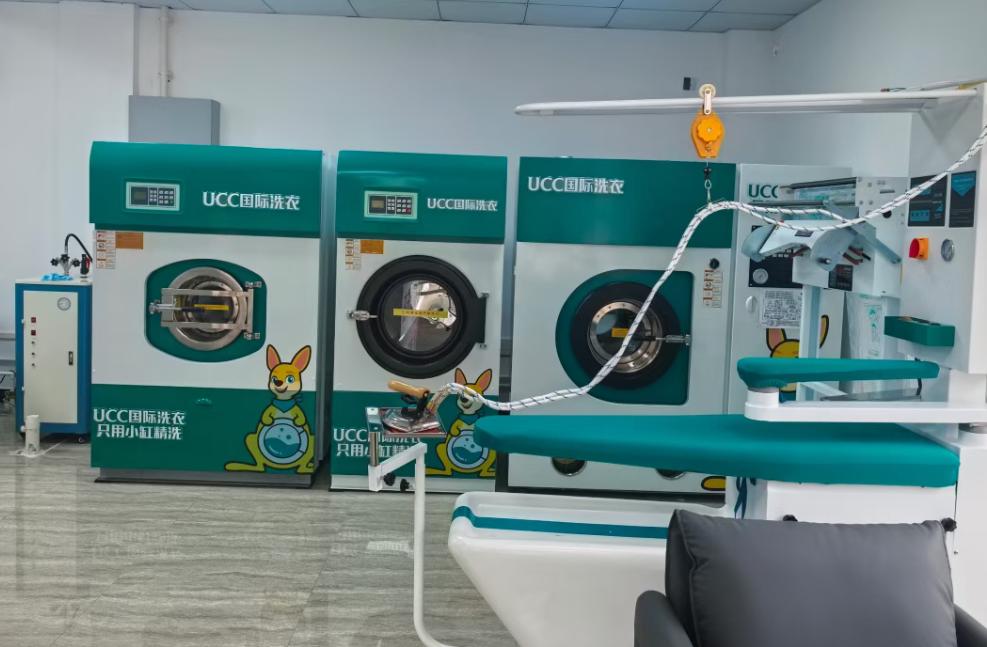
Laundry service is the second wave, and it is also a more ambitious step. Jiangsu Petroleum has set up 59 clothing collection outlets and two laundry factories across the province, while Tianjin has built 5 laundry factories and 248 clothing collection stations, collecting and washing about 10,000 pieces of clothes every month. The logic is extremely precise: it takes 3 minutes for car owners to drop off a piece of clothing for washing, and another 3 minutes to pick it up, which perfectly coincides with the stay time for refueling. Car owners do not need to make a special trip to the dry cleaner, and can complete the process conveniently while refueling. This means that the fixed frequency of gas stations (refueling once a week or every two weeks) can be connected to the fixed frequency of laundry. In 2025, the scale of China's dry cleaning market exceeded 160 billion yuan, and the demand is stable without sharp fluctuations with the economic cycle.
Pet grooming is the third wave, and it is also the most "counter-intuitive" step. In the summer of 2026, Sinopec opened the "Yi Xiao Chong" pet life hall at two gas-energy stations in Changsha. The new customer grooming price for dogs under 7.5kg is 39.9 yuan, and 49.9 yuan for cats, which is priced in line with the affordable trend of community stores. The business logic of this side business is not to "earn money from pets", but to "buy the car owner's time" — a pet grooming session can extend the car owner's stay time from 3 minutes to 1 hour. During this hour, the car owner may drink coffee, stroll around the convenience store, or get the car interior cleaned. The gas station has become a container for the one-stop scenario of "people + vehicles + pets".
2.
The boundary of side businesses:
What can be done and what cannot
Side businesses at gas stations do not have no boundaries. Observing the already implemented formats, we can find a clear screening criterion: the transaction or delivery must be completed within the 3 to 5 minutes of the car owner's stay, no on-site processing is required, and no complex manual operation is needed.
Coffee meets the standard: freshly ground coffee is served fast with a high degree of standardization, and the equipment can be embedded in the corner of the convenience store. Laundry collection meets the standard: only clothes collection and registration are needed, and the clothes are uniformly transported to the back-end factory for processing, so the station has zero inventory and zero processing burden. The "receiving" link of pet grooming meets the standard: the car owner only needs to hand over the pet to the staff and can leave, and the grooming is completed by professionals at the back end; but "on-site grooming" itself requires space and manpower, so gas station stores are usually adjacent to the refueling area but operate independently, targeting car owners who stay for a "long period" while charging, rather than car owners of fuel vehicles who stay for a "short period".
In contrast, catering and fast food, although some gas stations are also doing this, face greater challenges. On-site cooking involves kitchen equipment, fume treatment, and food safety supervision, and the operation complexity is much higher than that of coffee or laundry collection. The cooperation between brands such as McDonald's and Baijiao Yuan with EASY Joy is mostly concentrated in a few flagship stations, and large-scale replication has not yet been formed.
There is also an easily overlooked constraint: the absolute value of non-fuel profit of a single station is too small. In 2025, the total non-fuel profit of Sinopec was 4.53 billion yuan. Spread across 31,000 gas stations, the average annual non-fuel net profit of a single station is only about 145,000 yuan. This figure means that gas stations cannot develop side businesses just for the sake of developing side businesses. Any new format must achieve "no significant increase in labor cost, no occupation of additional site, no introduction of complex operation burden", otherwise no matter how high the gross profit margin is, it cannot withstand the expansion of organizational cost.
The surge of side businesses at gas stations is essentially a "reassessment of traffic assets". When the fuel business changes from a profit center to a traffic entrance, the valuation logic of gas stations changes. It is no longer a retail terminal selling fuel, but an offline service platform with high-frequency reach, prime location and stable vehicle flow. Coffee, laundry, and pet grooming are just "SKUs" on this platform. In the future, there may also appear express collection, urgent medicine delivery, community group buying pickup points, and even fast haircut — Yudaimen gas-energy station in Hubei has already introduced EASY Joy fast haircut, which has verified the feasibility of the "ten-minute life circle".
But this business has a cruel premise: you must be large enough. Only giants such as Sinopec and PetroChina, which have tens of thousands of stations and hundreds of millions of member data, can afford the fixed cost of laying laundry factories, building supply chains, and training tens of thousands of employees. Although private gas stations account for nearly half of the total number, their sales volume is less than 30%, and most of them can only do lightweight convenient services, and cannot replicate the "coffee + laundry + pet" matrix.
For car owners, the prosperity of side businesses at gas stations is a good thing. It means that you no longer need to specially plan a route to wash a coat, give your dog a bath, or drink a decent cup of coffee. These needs can be solved "by the way", and the price is usually lower than that of professional stores. What gas stations want is traffic and frequency, not high gross profit per transaction.
For gas stations, this is a transformation that cannot be lost. Fuel profit is shrinking, and non-fuel business must change from a "supplement" to a "pillar" within five years. The average annual non-fuel net profit of 145,000 yuan per station is obviously not enough, and this figure needs to double, and then double again. Coffee, laundry, pets are just the beginning. Next long holiday, you may see more things that make you feel "bewildered" at gas stations. And that sense of bewilderment is exactly the way traditional energy giants find their sense of existence in the new energy era.
This article is from the WeChat Official Account "Financial Gossip Girl Channel" (ID: baguanvpindao), the author is Jianshan, and 36Kr publishes it with authorization.