Zhou Hei Ya enters Sam's Club, Juewei launches duck leg rice meals, are braised food brands no longer competing by expanding their store networks?
A few days ago, Zhou Hei Ya, Juewei Food and Huang Shang Huang successively released their 2026 semi-annual reports.
Among them, Juewei Food recorded a revenue of 2.515 billion yuan, down 10.82% year on year, and net profit attributable to shareholders of 135 million yuan, down 23.16% year on year; the revenue of fresh food products as its core business reached 1.819 billion yuan, down 13.89% year on year. Huang Shang Huang performed relatively better, with its revenue rising 24.53% year on year to 1.226 billion yuan in the first half of the year, but the growth mainly came from the newly consolidated freeze-dried food business. The revenue of traditional braised meat products under its core braised food business was 528 million yuan, down 14.34% year on year.
In contrast, Zhou Hei Ya's revenue increased by 19.5% year on year to 1.461 billion yuan. What deserves more attention than the growth is where the growth comes from. In the first half of this year, the revenue of Zhou Hei Ya's online and offline channels increased by 80.4% year on year, of which the offline channel grew by 207.2%. As of the end of June, Zhou Hei Ya had 2,972 stores across the country, but its products have entered more than 50,000 sales points, including Sam's Club, Pang Dong Lai, snack mass retailers, convenience stores and other channels.
On the other hand, although Juewei's financial report figures are still not satisfactory, it can be seen from some of its moves that Juewei has also begun to seek changes. For example, it has started to "serve meals" for consumers.
iBrandi Pinchuang noticed that from duck leg rice and braised pork rice to spicy duck pot and stir-fried yellow beef pot... Over the past year, some Juewei stores have begun to provide meals, and Juewei has successively tried new store formats such as Juewei PLUS, Juewei Fresh Braised, and Juewei Pot Pot. This year's semi-annual report clearly proposes to upgrade the stores from "single snack braised food stores" to "all-time, multi-scenario" cross-category collection stores, adding staple foods and side braised dishes to cover more time periods in the morning, noon and evening.
Zhou Hei Ya and Juewei are taking different paths: one is trying to get duck neck products out of duck neck stores; the other is trying to give consumers more reasons to walk into the duck neck store besides buying duck necks.
In fact, these two paths seem completely different, but they point to the same change behind them: When "continuing to open new stores" is increasingly difficult to become the only answer for growth, braised food brands have begun to look for new business increments again.
01
Zhou Hei Ya:
Put more products on "other people's shelves"
The 2,972 stores and more than 50,000 sales points may be the most intuitive set of figures to understand the current changes of Zhou Hei Ya.
In the same period last year, Zhou Hei Ya had 2,864 stores. In the first half of this year, the number of stores only increased by 108, with an increase of less than 4%, and the store revenue also increased from 979 million yuan to 1.035 billion yuan. In contrast, the channel business outside the stores increased by 80.4%.
This means that for today's Zhou Hei Ya, to let more consumers buy its duck necks, it is no longer necessary to open a new Zhou Hei Ya store downstairs of their homes.
Entering a new membership supermarket, convenience store or snack mass retail system can also add hundreds or thousands of sales touchpoints. When the marginal efficiency of store expansion declines, Zhou Hei Ya begins to replace part of "opening new stores" with "finding new shelves".
In particular, putting products into other stores is not simply to move the products in the store to another place for sale. Once entering convenience stores, snack mass retailers, especially channels like Sam's Club, the products will face completely different turnover cycles, packaging specifications, price systems and consumption scenarios.
Therefore, putting more products on "other people's shelves" is essentially another change that Zhou Hei Ya is making: re-"developing products".
In the first half of this year, Zhou Hei Ya continued to promote products with long, medium and different fresh-keeping forms. Among them, the sales revenue of the medium-preservation series has exceeded 50 million yuan; for member supermarkets, it also launched fresh braised four-duck delicacies, and chose to debut at Sam's Club.
Correspondingly, the supply chain behind it is also adjusting. Zhou Hei Ya mentioned in the semi-annual report that the supply chain is transforming from the previous single store supply to the coordinated supply of "multi-format and multi-freshness forms". The lock-fresh packaging in stores and vacuum packaging in channels require different production organizations, cost structures and logistics systems, and products with multiple specifications and different temperature layers begin to exist at the same time.
This is actually very close to the operation logic of a traditional food company. In the past, the first consideration was: what should a Zhou Hei Ya store sell? Now it also needs to consider: what products are suitable for Sam's Club, what are suitable for convenience stores, what are suitable for snack mass retailers, and what are more suitable for e-commerce? The channel is no longer the last link of selling goods, but begins to influence product definition.
When braised food begins to enter more "other people's shelves", what brands need to learn is to move from operating stores to operating products. To a certain extent, this just provides another large-scale development method for traditional braised food chains.
In the past, covering one more city often meant opening a number of new stores; now, a product that can adapt to public retail channels can also cover the same group of people that used to be covered by dozens or even hundreds of stores at one time.
02
Juewei:
Create more consumption scenarios from one duck neck store
Zhou Hei Ya chooses to bring duck necks out, but Juewei is thinking about another thing: instead of rushing to leave the store, can we first make one duck neck store generate more business?
As early as the end of 2025, Juewei Duck Neck carried out hot food exploration through new store formats such as Juewei PLUS and Juewei Pot Pot. In November of the same year, Juewei launched the core hot braised product "Juewei Hot Braised Cup" in multiple branches across the country, officially testing the hot braised track with a single product.
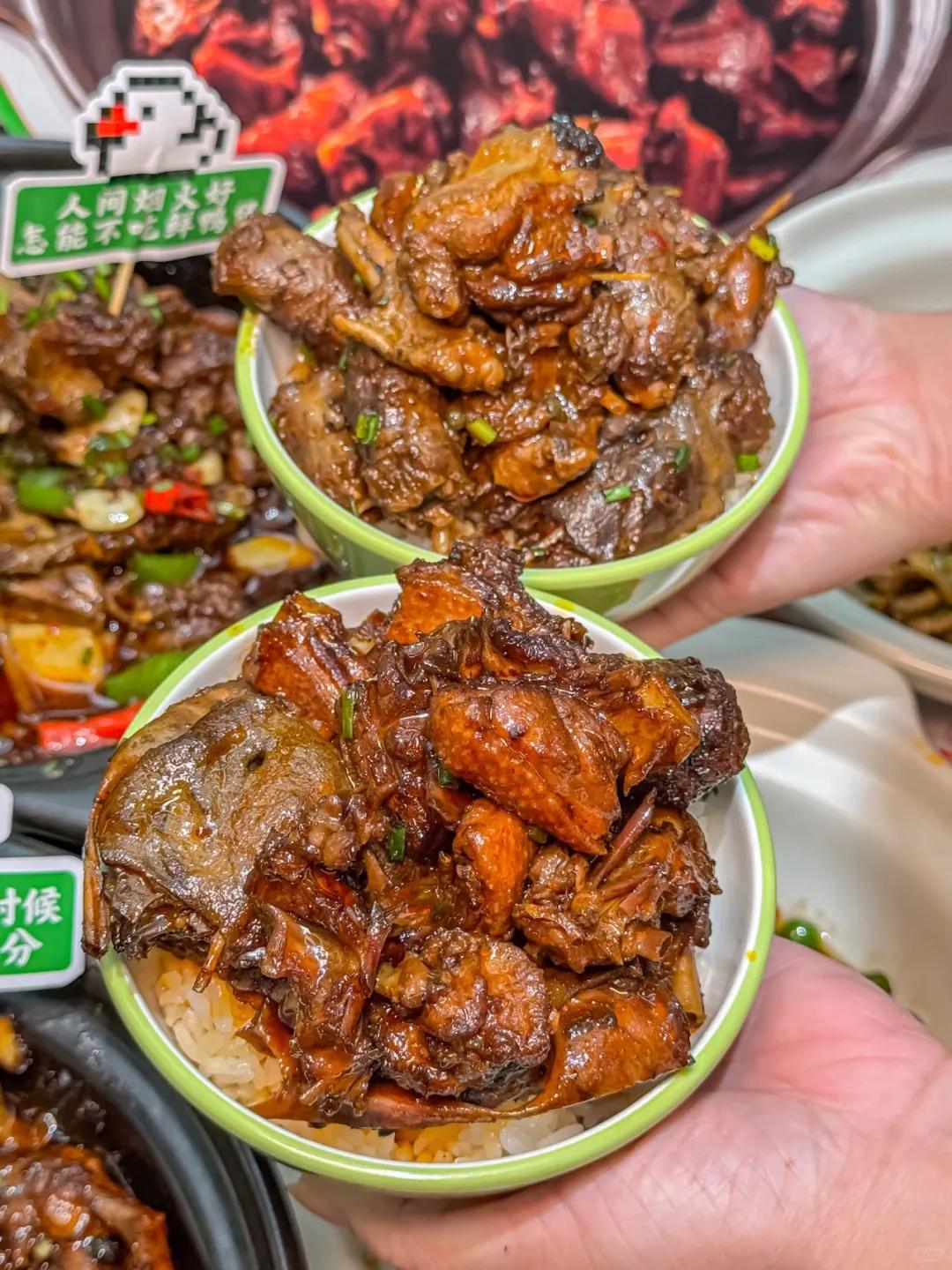
Following the same idea, Huang Shang Huang also entered the full-course track this year and launched a new hot braised store, adopting the product combination of "hot braised + staple food + drinks", covering full-time consumption at lunch, dinner and midnight snack with rich categories. Zhou Hei Ya, taking advantage of the trend of black duck pot, jointly launched "Gudu Black Duck Pot" with Micun Rice Bowl.
The three giants have all started to sell meals, but Juewei acts faster, more determined and more direct. In this year's semi-annual report, Juewei listed "store renovation and adjustment" as its core business strategy, and clearly proposed to extend from duck by-product braised products to more categories such as poultry, livestock, vegetarian food and aquatic products, while adding staple foods and side braised dishes, hoping to cover the full-time consumption needs of "morning, noon and evening". The company is also testing store formats such as hot braised rice and fresh braised mixed dishes in Wuhan, Chongqing and other places.
The reason is that Juewei just wants to give consumers one more reason to enter the store.
For traditional duck neck stores, the demand that can be received in one day is actually limited. Consumers can buy a bag of duck necks when they go shopping in the afternoon, take a box home conveniently after work, and may think of Juewei when watching dramas or having midnight snacks at night.
But at 12 noon, when consumers really need to "have a meal", a Juewei store that only sells duck necks, duck wings and lotus roots is usually difficult to be included in their choice range.
Duck leg rice changes this situation. Once rice, hot braised food and staple food enter the store, the same Juewei store will have the opportunity to extend from casual snacks to lunch, dinner, even family side dishes and midnight snacks. What Juewei wants to improve is not just the customer unit price, but how many times a day a store can be remembered by consumers.
At the end of 2023, Juewei once had 15,950 stores in Chinese mainland; the number dropped to 14,969 in the first half of 2024. After that, the company no longer disclosed the specific number of stores, and only stated at the performance meeting in June this year that it still had "more than 10,000 stores" by the end of 2025.
From nearly 16,000 stores to today's "more than 10,000 stores", it at least shows that the previous stage of rapid store expansion has passed. When the store network has covered a wide enough range, a new store may not naturally bring increments as it did ten years ago. Then another way is: make the existing stores more capable of selling.
So Juewei's current attempts are not limited to duck leg rice.
"Juewei Fresh Braised" expands the store SKUs to more than 90, adding snacks, bakery products, drinks and other products; "Juewei PLUS" tries fried braised food, staple food, drinks and midnight snacks; the semi-annual report also proposes "one store one product portfolio", adjusting product combinations according to different cities, business districts and consumers.
It is far from the answer whether these experiments can be replicated on a large scale in the end. But the direction is very clear: in the past, a Juewei store mainly solved the demand of "I want to eat some braised food now"; now it hopes to solve more extensive problems such as "what should I eat for lunch", "what dishes to add for dinner" and "what to eat at night".
Whether it is Juewei or Zhou Hei Ya, in the final analysis, they are all looking for growth beyond "opening new stores".
03
Conclusion
In the past two decades, opening stores has almost been the most effective growth method for Chinese chain braised food brands.
Fresh braised food naturally has the attributes of short shelf life and immediate consumption. Factory production, cold chain distribution, and store sales: the store is not only a shelf, but also the last link of the entire supply chain to reach consumers. Therefore, as long as the problems of franchising and supply chain can be solved, opening one more store means covering one more group of consumers.
But today, the market environment has changed.
According to the data from Redcuisine Industry Research Institute, the market size of China's braised food category was about 157.3 billion yuan in 2024, with a year-on-year increase of 3.7%; it is expected to reach 162 billion yuan in 2025, and the growth rate will further drop to about 3%. At the same time, the number of braised food stores across the country has also shown a downward trend.
More importantly, there are more and more places where consumers can buy braised food. Snack mass retailers, member supermarkets, convenience stores, e-commerce and instant retail are all seizing the "cravings consumption" that used to belong to street duck neck stores; hot braised food, fast food and community cooked food are constantly blurring the boundary between casual braised food and full-course meals.
Stores are not outdated. What is really outdated is the logic that "you can achieve growth only by opening stores".
Of course, the new path may not be easier to take. Zhou Hei Ya's revenue increased by 19.5% in the first half of this year, but its net profit decreased by 15.2%, and its gross profit margin dropped from 58.6% to 54.7%. One important reason given by the company itself is that the gross profit margin of the rapidly growing channel business is lower than that of the store business, and channel expansion has also brought more promotion, platform and logistics costs.
Juewei's duck leg rice is also still in the experimental stage. Once moving from cold braised food to full-course meals, meal delivery, back kitchen, SKU, personnel and store operation will become more complicated. Whether a bowl of duck leg rice can be truly replicated to more than 10,000 Juewei stores is far more difficult than making it.
Zhou Hei Ya and Juewei have not found a simpler answer than opening stores. They just began to realize that the braised food business can no longer only have the question of "where to open the next store".
What has really passed is not the braised food store, but the era when braised food brands can achieve growth only by opening stores.
This article is from the WeChat official account "New Consumption Daily" (ID: ibrandi), the author is Empowering Global Brands, and it is released with authorization from 36Kr.