In the age of AI, what is the decisive factor that determines the success or failure of going global?
A few years ago, when a company wanted to sell its products overseas, its preparation checklist included shipping containers, distributors and a vanguard team. Today, a small team with just a few lines of API calls can make their products available on any app store around the world, and being "born global" has become the default configuration for a new generation of Chinese enterprises.
Yet the process of going global is becoming increasingly asymmetric.
AI is re-pricing the entire overseas expansion landscape. Launching products simultaneously across multiple markets, once a rare competitive edge, has now become a standard capability. What determines whether an overseas-oriented enterprise can sustain long-term growth has shifted to its comprehensive capacity for continuous localized operation.
The threshold for accessing model services and cloud resources is falling, which means even a small team can build products for global users from day one. However, fast launch does not equal sustainable operation. The real test for enterprises has shifted from "whether they can go global" to "whether they can operate stably in local markets for the long run".
In 2026, what exactly will Chinese enterprises rely on to maintain their presence in the global market?
The Apsara Conference Globalization Summit in September answers exactly these questions. The path of overseas expansion is full of challenges, and enterprises that have entered the deep-water zone shared their experiences of navigating through all the risky segments they have encountered.
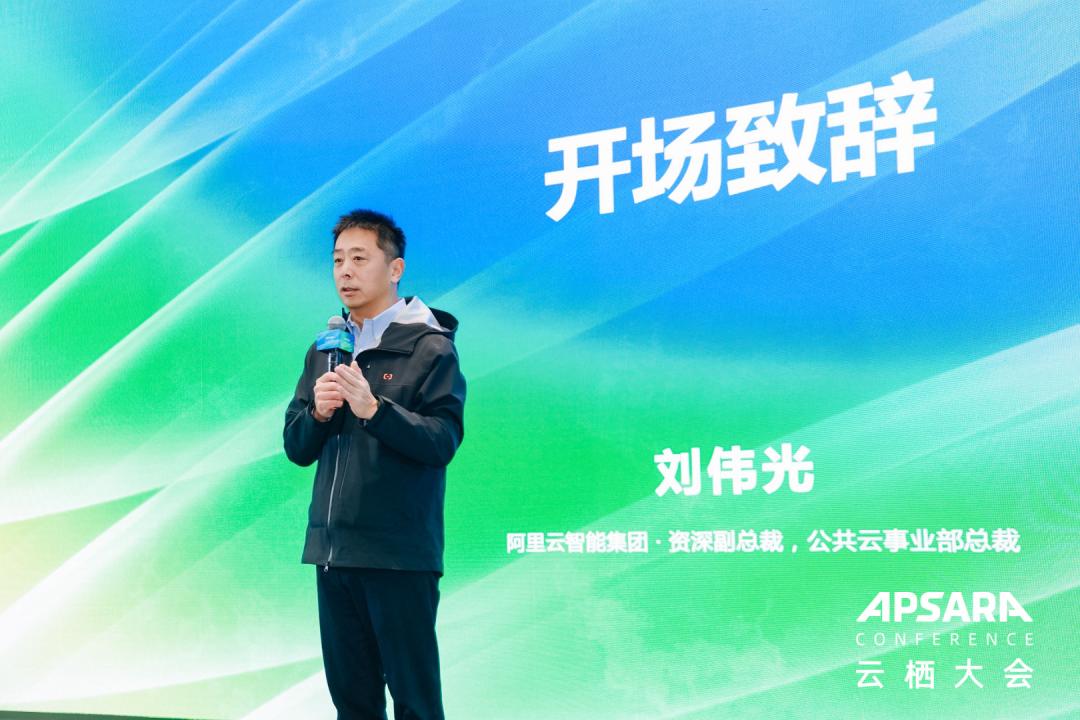
In the opening address of the summit, Liu Weiguang, Senior Vice President of Alibaba Cloud Intelligence Group and President of the Public Cloud Division, shared his intuitive observation: "Since 2025, almost all Chinese AI startups have been exploring overseas markets from Day One. The new wave of AI-driven globalization today is led by the most talented group of innovators in China."
In the AI era, enterprises are facing a whole new set of challenges: model localization, local regulatory compliance, and global service response. Each of these requires long-term investment in technology and operational capabilities.
From Product Export to Capability Export
The overseas expansion of Chinese enterprises is going through a generational shift. The scope of globalization has expanded from products and applications to models, Agents and content, and AI capabilities are becoming the new infrastructure for global growth.
This generational shift is built on the superposition of capabilities. The export of supply chains has enabled "Made in China" products to reach every corner of the world, and the export of brands has allowed Chinese brands to achieve premium pricing overseas. Both layers of capabilities are still evolving today.
Overseas expansion in the AI era adds a new layer of capabilities on top of the previous two: AI hardware, new energy, and AI-native applications, empowered by cloud services, have become new forces accelerating globalization. This new layer of capabilities also allows models, computing power and services to be embedded into products themselves. Product capabilities will continue to iterate even after sales, which means transactions and delivery are no longer the end of the product lifecycle.
What is more noteworthy is the change in the "minimum unit" of overseas expansion. In the era of cross-border e-commerce, the minimum unit for going global was a shipping container, followed by physical stores and local subsidiaries. Now, a single Agent can serve users around the clock and support tens of thousands of workstations. This change is so common that it is easy to overlook, but it perfectly reflects the generational difference of overseas expansion: from shipping products out, to making capabilities operate locally.
For capabilities to function, they need the support of computing power. Every response of an Agent is backed by an inference call, and almost all of this computing power runs on the cloud. As the minimum unit of overseas expansion changes, the technical infrastructure supporting it also evolves accordingly.
From traditional commodities where sales and delivery mark the end of the lifecycle, to products whose capabilities and value keep growing after being sold, Chinese enterprises for the first time are selling "living" products that can generate long-term compound returns through application capabilities.
The generational difference from products to capabilities is also reflected in the wide implementation of Alibaba Cloud's solutions across overseas industries. Industries that once seemed farthest from cloud computing, ranging from mobile phones and smart hardware to new tea beverages and energy manufacturing, have all integrated AI into their core businesses.
Agents are deployed everywhere in operations, customer service, content creation and R&D. Supported by AI, Chinese enterprises that have already "gone out" and "picked up speed" are now pursuing "leaping higher".
In the next two years, a global enterprise will be able to call a model even more easily than renting a server. At that point, launching a product in a new market will no longer be a barrier that sets enterprises apart, and the threshold for competition will shift to a new dimension.
Ends Are Global, Clouds Are Local
In the AI era, the vessels for overseas expansion are fully built, but the ocean has not become any shallower. For Chinese enterprises, to take root in a new market, they must first navigate three hidden reefs.
The first reef lies in deployment. New-generation overseas products, whether hardware or software, are designed with an end-cloud collaborative division of labor logic from the very beginning: the end side handles perception and real-time interaction, while the cloud side takes charge of long-term intelligence and operations.
The end half can mostly achieve global unification. A pair of earphones, a vehicle, or an app, no matter which market it is sold to, has a high degree of standardization in core capabilities. But the cloud half must be deployed in each market one by one. Latency is constrained by physical laws, real-time inference needs to be close to users, and sensitive data such as voice and images must be stored locally in accordance with local regulations.
As a result, the key breakthrough point for globalization has shifted from product globalization to infrastructure localization.
As infrastructure needs to follow enterprises overseas, choosing a cloud provider has evolved from a technical issue to an operational issue, and from a procurement decision to a market access decision. The cloud provider an enterprise chooses defines the boundaries of market access through compliance qualifications, sets the ceiling of gross margin through inference costs, and determines the rhythm of iteration through the model toolchain.
Smart hardware enterprises are the earliest practitioners that made end-cloud deployment adapt to different markets. Take a pair of smart earphones as an example: their battery capacity is measured in milliampere-hours, and their computing power is less than a fraction of that of a mobile phone, but real-time translation cannot tolerate even a half-second of latency. Anker has turned this division of labor into a mature product: the end-side model handles real-time perception, the cloud-side large model handles understanding and generation, and Alibaba Cloud lays the cross-border network between the two "brains", accelerating mutual access of core systems by 30%.
At the roundtable, Liu Jingxin, General Manager of Audio & Video Software and AI at Anker Innovations, broke down this division of labor into three layers: the end acts as the entry and routing point to receive user intentions, the generalist cloud model distills expert models for specific scenarios, and memory is closed-loop on the end while remaining consistent on the cloud.
He put it in his own words: "Today we can start from AI to figure out what features and functions on the software level users need, and hardware has instead become the core carrier or port to realize these features. This way, we can reverse-define hardware based on software requirements. There is no absolute definition of hardware form, and it is more about matching users' actual scenarios."
The second hidden reef lies in models. Today, calling a model is as simple as writing a single line of API, but calling is just the starting point. Post-training, Agent engineering, and localization for specific markets all require continuous engineering investment, and the real watershed comes after the initial call.
Localization demands the most investment, and its implementation form is being rewritten by model capabilities. Local teams, local content and local channels used to be heavy asset investments that only large enterprises could afford. Now many of these functions can be undertaken by a single post-training process or a set of multilingual models.
As a result, the team size that can achieve high-quality localization has shrunk rapidly, and even small and medium-sized teams can afford fine-grained localized operations. On the other hand, localization has also changed from a one-time investment at the time of market entry to an engineering task requiring long-term continuous input. Inference costs continue to accrue as the business grows, and optimization will iterate continuously to keep up with market demands.
The hidden reef has not disappeared, it has just moved its position, shifting from capital investment to model engineering investment.
Apart from improving internal efficiency, an important new opportunity for Chinese enterprises is to integrate Chinese models into global products, allowing models to enter the daily lives of overseas users through three channels: smart hardware, application platforms and service scenarios, so that the leading edge in model capabilities becomes the decisive advantage at the product level.
Among all the enterprises born global, Haiyi is one of the most complete players that have achieved this. Through in-depth cooperation with Alibaba Cloud in multimodal capabilities, model post-training and Agent engineering, Haiyi, whose over 90% of users come from overseas, has accumulated more than 3 million models in its open source community, and distributed the Wanxiang video generation model to creators all over the world.
"Our positioning is to deliver the 'last mile' of user services. We handle global scheduling and the application data layer on our own, and we explore the capability upgrades related to Infra together with Alibaba Cloud," Ma Fei, CEO of Haiyi AI, stated frankly at the roundtable. The team has been using Alibaba Cloud since around 2011, because doing global business requires winning user trust, which is essentially highly correlated with data security.
In addition, when talking about how to win the trust of users in different cultural regions and with different aesthetic preferences by selecting appropriate models, he believes that "models have their own aesthetics, and the data team of the model team is extremely critical for the aesthetic orientation of data". For example, among a large number of Chinese visual models, the Qwen and Wanxiang series models are more adapted to global aesthetic culture. Long-time practitioners in the overseas expansion field can clearly feel the difference, and large-scale distribution will amplify these differences in aesthetic orientation. Only by bridging the aesthetic gap first can enterprises better serve high-value regions such as North America, South America and Europe.
The third hidden reef undoubtedly lies in the fields of compliance and services.
As the EU AI Act enters into force in phases, generative content faces mandatory obligations for labeling and transparency. In addition, an increasing number of markets have written requirements for local data residency into law. Voice, image and location data that want to cross borders must go through assessment first, and pre-launch audits for AI products have already been implemented.
All these requirements are added to the R&D schedules and budgets of enterprises. Delaying compliance certification for one more day may postpone market entry by a full quarter. As a result, compliance has changed from an extra cost to an expensive admission ticket.
Service is another invisible pass line. No matter how many time zones the business covers, the service must stay "awake" for all corresponding hours. However, most overseas-oriented enterprises have their core teams based in China, so it is also a major pain point that no one can be found to solve problems when overseas services go wrong.
The solution of Dragon Pass is to cooperate with Alibaba Cloud. Leveraging the capabilities of the Qwen large model and Dragon Pass's long-established global airport service system, the AI capabilities are first implemented in the high-frequency and core airport travel scenario, and further extended to the full journey and destination lifestyle services. The service targets are high-end travel passengers who have higher requirements for certainty and experience. This type of service requires 24/7 response, and the service involves the global transmission of identity, flight and payment information. The boundary between technology and compliance is exactly the boundary of service. Alibaba Cloud provides computing power, models, and more than 150 compliance qualifications in this scenario, ensuring that no matter where the passenger travels, the data and inference are processed within the corresponding legal jurisdiction.
At the roundtable, Zhu Jiangnan, Co-founder and CEO of Dragon Pass Group, introduced that after 8 months of verification, Dragon Pass's AI airport concierge service has been launched at 5 airports in China, serving more than 100,000 users in total. At the same time, intelligent services based on full-scenario experience will be launched successively in markets such as Brazil, the Middle East and Asia Pacific, serving a wider range of global travelers. In her view, in the high-quality service industry, the core value of AI is to "connect more deeply with users", so AI has reconstructed the traditional supply-demand matching logic:
In the past, many users did not know what rights and interests they had, and they needed to spend time on "rights and interests guides" to use them. But AI has changed the user behavior from "consuming because of available rights" to "active matching of rights and services", which is essentially a fundamental upgrade of the membership economy from "rights redemption" to "service generation around user interests".
Ends are global, clouds are local. The threshold for overseas expansion has shifted from "selling products into the market" to "keeping capabilities rooted in the market": deployment must land in every market, models must be embedded in every scenario, and compliance and services must be implemented in every legal jurisdiction.
Product export is completed by enterprises themselves, while the other half of localized implementation defines the new position of cloud service providers in the intelligent era.
The Underlying Infrastructure Determines the Depth of Rooting
Deployment, models, compliance and services are interlocked and cannot be solved separately, which calls for the integrated supply of models, computing power, platforms and global nodes. This means that most core overseas businesses and their business models in the AI era need to rely on cloud services to exist.
Therefore, in the new generation of overseas expansion, the role of the cloud has completely changed: from supporting business operations to becoming an integral part of product capabilities.
The capabilities of AI products run on the cloud. Every question a user asks and every voice command a user gives is an inference call from the cloud or end-cloud hybrid, which affects gross margin and is closely related to user experience.
The same cloud expenditure used to buy stability, but now it buys growth itself. The cloud is evolving from a cost item to an innovation carrier.
"What enterprises really need is not a tool to quickly build Agents, but an infrastructure that can support Agents to operate safely and provide stable services around the world," Wan Lei, General Manager of Solutions for Alibaba Cloud Intelligence Group's Globalization Division, officially released the "Alibaba Cloud AI + Globalization Solution" for overseas enterprises at the summit's launch session.
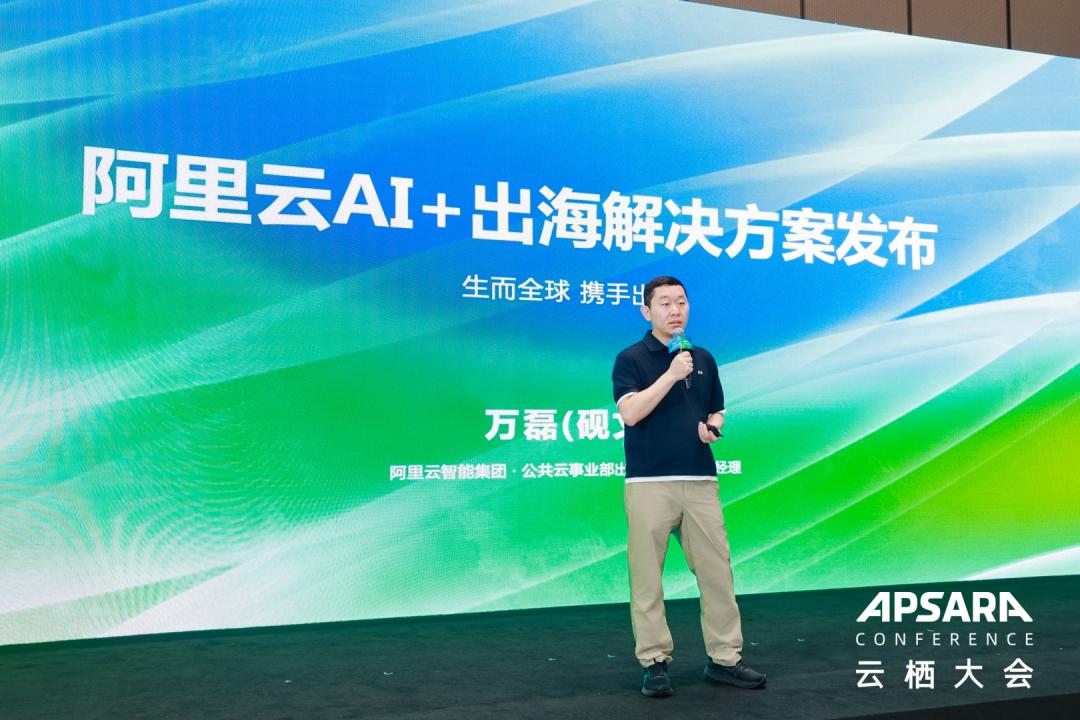
Alibaba Cloud breaks down this solution into four layers from bottom to top: the bottom layer is a global AI cloud, on top of which is an end-to-end Agent building platform, then a full-modal large model family, and the top layer is industry practices accumulated across six major tracks.
The value of this technology stack does not lie in a single layer, but in the fact that the same system can support enterprises from different industries and at different development stages. In this regard, Liu Weiguang's point of view is: "The technical philosophy of the cloud is to make it easier for everyone to use, rather than more complicated."
In the era of AI globalization infrastructure, Alibaba Cloud's solutions cover six major tracks: AI hardware, AI-native applications, retail and consumer goods, home appliances, energy manufacturing, and automobiles.
In the AI hardware field, terminal devices need to have full-modal interaction capabilities including listening, viewing, speaking, understanding and execution. End-cloud collaboration and global deployment are common engineering propositions for this track.
As a smart imaging technology company, Insta360 sells cameras all over the world, and its cloud capabilities are also deployed in different markets one by one. Today, Insta360 defines its cloud storage business as the second growth curve for AI creation. Since the launch of the subscription service Insta360+, the number of paid cloud storage users has increased by more than 124% year-on-year.
Lin Siyuan, Head of Insta360 Cloud Storage Product, summarized the logic of this transformation as a three-step flywheel: data capitalization, which allows materials to be automatically uploaded to the cloud safely and at low cost; asset intelligence, which uses multimodal models to turn materials into retrievable, understandable and recombinable digital assets; and intelligent monetization, which controls gross margin through per-unit model cost management, turning AI into predictable recurring revenue. Alibaba Cloud was the first cloud provider Insta360 used when it was founded, and over the past decade, it has used dozens of Alibaba Cloud products in total.
"Products can be copied, and hit products may go out of date, but the capability to replicate a set of capabilities to the next market and the next product category will not expire," Lin Siyuan believes. The real global competition ultimately depends on whether capabilities can continue to iterate, so it is critical to choose a reliable cloud service provider as the underlying foundation. His logic for "choosing