Having just pulled itself out of the loss quagmire, the tycoon of battery films has gone on a buying spree again.
Semcorp, which has just climbed out of losses, is preparing to spend 1.15 billion yuan to acquire assets.
The company produces a seemingly insignificant thin film inside lithium batteries, which separates the positive and negative electrodes to prevent short circuits. This product is known in the industry as "battery separator". Relying on this business, Semcorp has taken the top spot in the global battery separator industry, with CATL, BYD and EVE Energy all being its clients. In 2022, it made a profit of 4 billion yuan in one year, but lost 556 million yuan two years later amid overcapacity and price wars in the sector.
Now, orders and profits are rebounding together. In the first half of this year, Semcorp's revenue increased by more than 50% year-on-year, and its attributable net profit reached 820 million yuan. Instead of stopping at performance recovery, it has completed two consecutive acquisitions to bring more separator assets under its control.
Not long ago, Semcorp just acquired the separator assets of SK in Jiangsu, including 8 wet-process base film production lines and 10 coating production lines. Recently, the company disclosed that its holding subsidiary Shanghai Semcorp plans to acquire 45% equity in Hubei Semcorp held by EVE Energy for 1.15 billion yuan.
Interestingly, all the targets Semcorp is targeting this time are fully built factories. Among them, Hubei Semcorp, which recorded a loss of nearly 4.77 million yuan last year, has achieved a profit of 226 million yuan in the first half of this year.
The consideration of this acquisition is even higher than Semcorp's half-year attributable net profit. For a company that has just gone through the industry trough, taking out such a large sum of money again requires more than just confidence in the battery market.
In the last round, Semcorp rushed to build factories to meet surging demand; in this round, it has started to take over assets held by other players. While both moves represent increased investment, the timing and approach of the purchases have changed, so will the return of this business be different as well?
Earning 4 Billion Yuan a Year Did Not Save It From the Price War
A single layer of battery thin film once supported Semcorp's annual profit of 4 billion yuan.
In 2022, Semcorp reported a revenue of 12.591 billion yuan and an attributable net profit of 4 billion yuan, with the latter accounting for nearly one third of its revenue. At that time, the company had set up production bases in Shanghai, Zhuhai, Wuxi, Jiangxi, Suzhou, Chongqing and other regions, with a total separator production capacity of 7 billion square meters.
This business may seem unremarkable, but it is never easy to enter the supply chain of major clients. Separators are critical to the safety and performance of batteries, and client verification takes time, while stable mass supply is also a must. For battery manufacturers, qualified products from suppliers are just the starting point, and the ability to deliver continuously and on a large scale is equally important.
Semcorp's scale and manufacturing capabilities became its advantages at that stage. As the new energy vehicle market grew, battery manufacturers accelerated capacity expansion, and material enterprises also had to prepare in advance. If a company waits for client orders to come before building factories, it is often already too late.
Some clients even chose to co-invest directly. In 2021, Semcorp and EVE Energy agreed to jointly build a separator project in Jingmen, Hubei, with a total planned investment of 5.2 billion yuan, to prioritize supplying EVE Energy and its subsidiaries. EVE aimed to secure a more stable supply of core materials, while Semcorp directly brought its major client on board as a shareholder, eliminating the concern of finding orders after capacity construction.
From the perspective of that time, capacity expansion was backed by solid demand and supported by clients. But the opportunities Semcorp saw were also noticed by its peers. After factories of different players were completed one after another, the competition that originally centered on supply security gradually turned into a scramble for orders.
Since 2023, the separator industry has witnessed concentrated capacity release. By 2024, the overall capacity utilization rate of China's wet-process separator industry was only 51%, and that of some new entrants and small and medium-sized enterprises was even less than 40%. With production lines not operating at full capacity, costs such as depreciation and labor still need to be covered. To secure more orders, enterprises began to make concessions on quotations.
Downstream battery manufacturers are also cutting costs. Price competition in the automotive market is transmitted upward along the supply chain. Separator enterprises have to cope with peer price cuts while accepting the bargaining power of major clients. Semcorp's scale can help it share costs, but cannot keep it out of the price war.
There is a detail in the company's 2024 annual report: some projects have reached designed production capacity, but failed to achieve expected benefits due to the decline in separator product prices and gross margins. Factories and equipment were put into production as planned, but the returns calculated during factory construction changed along with market prices.
The factory was completed as planned, but the profit did not arrive as expected.
In that year, the shipment volume of lithium-ion battery separators in China still increased by about 28.6% year-on-year. The demand for separators did not stop growing, but Semcorp's attributable net profit turned to a loss of 556 million yuan from about 2.53 billion yuan in 2023; its overall gross margin also dropped from 37.43% to 11.07%.
For material enterprises, this is a very awkward situation. The promising market is indeed expanding, and clients are still placing orders, but their own factories cannot generate the expected profits. The problem lies in the fact that more enterprises have put their new capacity into operation at the same time, and the new added demand is not enough to allow all players to maintain the original price level.
However, the trough did not make Semcorp lose its leading position in the industry. The completed factories, verified products and accumulated clients did not disappear along with the profit decline. When prices are low, these production capacities bring operational pressure; after orders pick up, they allow Semcorp to quickly respond to rising demand without waiting for new construction and verification processes.
Changes gradually emerged in 2025. According to GGII data, by the fourth quarter of that year, the capacity utilization rate of wet-process separators had exceeded 80%; Semcorp's annual capacity utilization rate reached 94.9%. The previously hard-to-absorb capacity has been matched with more new orders.
This has created conditions for Semcorp to make new moves. In the past two years, it has paid the price of overcapacity, and still retained a batch of assets that can continue to operate. When peers' factories and partners' equity are put on the trading table, what it considers is not only whether to expand, but also at what price and in what way to increase investment.
Factories Have Just Become Profitable, and Shareholders Are Choosing to Exit
Hubei Semcorp, which Semcorp plans to acquire this time, is exactly a factory that has gone through the trough and started to make profits.
In August 2024, all 16 separator production lines of Hubei Semcorp were fully put into operation. In the whole year of 2025, the company still recorded a loss of nearly 4.77 million yuan; by the first half of this year, its revenue reached 1.04 billion yuan, and its net profit rose to 226 million yuan. The early-stage construction has gradually paid off, but EVE Energy, which holds 45% of the equity, decided to exit at this moment.
The operation of the factory is improving, so why does the shareholder want to sell? Looking at the new projects EVE plans to invest in, its demand for cash is easy to understand.
On April 7 this year, EVE Energy disclosed two battery projects in Qidong, Jiangsu and Shanghang, Fujian with 50GWh and 60GWh capacity respectively, with planned investment of 5 billion yuan and 6 billion yuan. Together with the previously disclosed projects in Huizhou and Jingmen, the planned new capacity in a short period of time has reached 230GWh, with a total project investment of about 230 billion yuan.
These projects will be advanced in phases, and there are also joint venture partners involved, so EVE does not need to take out all the funds alone at one time. But for a battery enterprise that is increasing investment in its main business, it has made a new trade-off between continuing to hold upstream equity and recovering cash.
Five years ago, taking a stake in Hubei Semcorp could help EVE secure a more stable supply; now that the factory has been completed, and a batch of new projects in the battery main business are waiting for investment, an upstream investment without controlling rights is no longer necessary to hold. The equity exit does not mean that the supply cooperation between the two sides will come to an end.
Besides, the exit price is not low. As of the end of June this year, the net assets of Hubei Semcorp were about 1.619 billion yuan, and the 45% equity corresponds to about 729 million yuan, while the transfer price is 1.15 billion yuan, which is nearly 58% premium over the corresponding net assets. This premium cannot be directly equivalent to the disposal income of EVE, but at least from the perspective of net assets, it has obtained a very favorable price.
Semcorp is willing to take over the equity, because from another calculation perspective, this transaction is also attractive.
Calculated based on Hubei Semcorp's net profit of 226 million yuan in the first half of the year, the 45% equity corresponds to a half-year profit of about 102 million yuan. If the same profit level is maintained in the second half of the year, the corresponding full-year profit will be about 203 million yuan, the transaction price of 1.15 billion yuan is equivalent to an annualized price-earnings ratio of about 5.6 times.
From the perspective of net assets, Semcorp bought the equity at a premium; but from the current profit level, this transaction may not be expensive.
Of course, Hubei Semcorp has just turned losses into profits, and the half-year profit cannot be regarded as the fixed annual income in the future. But Semcorp already controls this company through Shanghai Semcorp, and has full knowledge of the production lines, costs and operating conditions. Compared with re-selecting a site to build a new factory, buying out the remaining equity of a project that has been put into operation and started to make profits at least saves the waiting time in the construction and production launch phases.
After the transaction is completed, Shanghai Semcorp's shareholding ratio will rise from 55% to 100%. Hubei Semcorp was already within the consolidated statements of the listed company, so this 1.15 billion yuan will not bring new production lines, nor will it lead to re-consolidation of revenue. What it directly increases is Shanghai Semcorp's profit equity in this factory.
The choices of the two sides perfectly match: EVE gets the cash that can be reallocated, and Semcorp retains more future profits. Both sides have their own reasons, and whether the deal is cost-effective in the end depends on the new projects the cash is invested in, as well as the subsequent profitability of Hubei Semcorp.
Semcorp's other recent acquisition further demonstrates its interest in ready-to-use production capacity.
Not long ago, the company's subsidiary completed the acquisition of SK Jiangsu, and the target company was renamed Changzhou Semcorp New Materials Co., Ltd. What was integrated into Semcorp's system includes 8 wet-process base film production lines and 10 supporting coating production lines, with a designed annual base film capacity of about 940 million square meters.
The base purchase price of this transaction is 400 million yuan, and the final consideration will be adjusted according to factors such as cash, debt and working capital at the time of delivery. It cannot be simply said that Semcorp "acquired all the capacity for only 400 million yuan", but the ready-made factories, equipment and supporting coating capabilities do provide it with a different option from building a new factory from scratch.
For material enterprises, construction time is also a kind of cost. By the time a new factory completes the whole process from land acquisition to mass production, the market situation may have already changed. Taking over existing production lines can shorten this waiting period, and then use its own client and operation system to absorb the capacity. Whether this goal can be achieved depends on the subsequent integration, but this is at least the practical advantage of acquisition compared with building a new factory from the ground up.
The growth of energy storage demand has also given Semcorp greater room for order growth. According to SNE Research data, in the first half of this year, the global shipment of energy storage lithium batteries reached 461.3GWh, a year-on-year increase of 71%. In addition to the automotive sector, the procurement of batteries by energy storage power stations is bringing new increments to upstream materials.
Putting the two transactions together, Semcorp's logic is clearer: on the one hand, it buys back the remaining equity of familiar projects, and on the other hand, it takes over the existing production lines of its peers. It has increased its investment in the separator business, but these two acquisitions have not added new factories to the industry out of thin air.
In the last round, enterprises rushed to build new capacity; after going through the price war, some existing assets began to be transferred between different enterprises. For leading players that still have stable clients, strong manufacturing capabilities and financing channels, the trough is not all a burden, but also brings opportunities to re-select high-quality assets.
Semcorp is willing to seize this opportunity. However, assets can be negotiated at favorable prices now, but the payment arrangements also need to be made from now on. How much room the recently recovered operation can leave for this round of investment is an unavoidable issue for it in the next stage.
Where Does Its Confidence Come From This Time
The reason why Semcorp dares to continue investing at this time is first and foremost that its main business has restored profitability.
In the first half of this year, the company's revenue reached 8.671 billion yuan, a year-on-year increase of 50.47%, and its attributable net profit was 820 million yuan, while it recorded a loss of about 93 million yuan in the same period last year. The overall gross margin also rebounded to nearly 30%, significantly higher than 11.07% in 2024 and 18.77% in 2025.
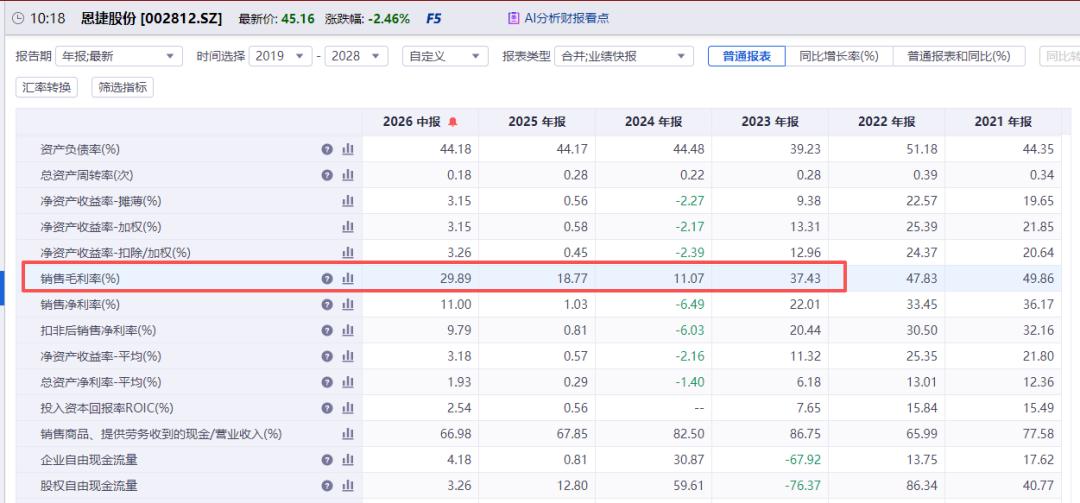
Although it has not returned to the previous high level, selling products of the same value can now retain more gross profit.
For a heavy-asset enterprise, this change is very important. Factories and equipment have already been invested, and only when orders increase and the operation rate of production lines rises can the previous investment be recovered gradually. After Semcorp got through the trough, the production capacity it retained finally began to contribute to profitability again.
Cash flow is also keeping up. In the first half of this year, the net operating cash flow of Semcorp reached 1.162 billion yuan, compared with only about 210 million yuan in the same period last year. Compared with the simple profit growth, the cash returned from business operations has given the company more room to arrange procurement, debt repayment and subsequent investment.
However, the room has increased, but it is still not very ample.
By the middle of this year, Semcorp's monetary funds were about 3.162 billion yuan, its short-term loans were 7.604 billion yuan, and its non-current liabilities due within one year were 1.897 billion yuan, the two items combined are close to 9.5 billion yuan. New acquisitions require payment, the proposed mid-term dividend plan is expected to distribute about 401 million yuan in cash, and daily operations and other project investments also need continuous capital support.
These debts do not mature on the same day, and the company can make turnover through operating cash return and loan renewal. We cannot simply subtract the cash on account from the 9.5 billion yuan to conclude that there is a capital gap of the same scale. But every additional acquisition will make the capital arrangement more compact, so the sustainability of business improvement becomes even more important.
In particular, there is always a time lag between buying assets and recovering cash. Hubei Semcorp is already profitable, but it still needs to retain funds to maintain operations; the SK factory taken over needs to complete integration, production delivery and cash collection. The return calculated at the time of acquisition can only be realized through these processes.
The twists and turns of its overseas factory have also made Semcorp realize the uncertainty of this time lag. This year, the company's Hungary plant was required to