Li wants to learn from Xiaomi to "raise fish", while CATL aims to become the "Huawei" in the battery industry.
Li Xiang has finally responded to the "de-CATL" narrative.
On September 28, Li Xiang released a public statement addressing external disputes over Li Auto's self-developed batteries. From his perspective, regarding automakers' in-house battery R&D as an attempt to replace CATL is essentially a zero-sum game mindset.
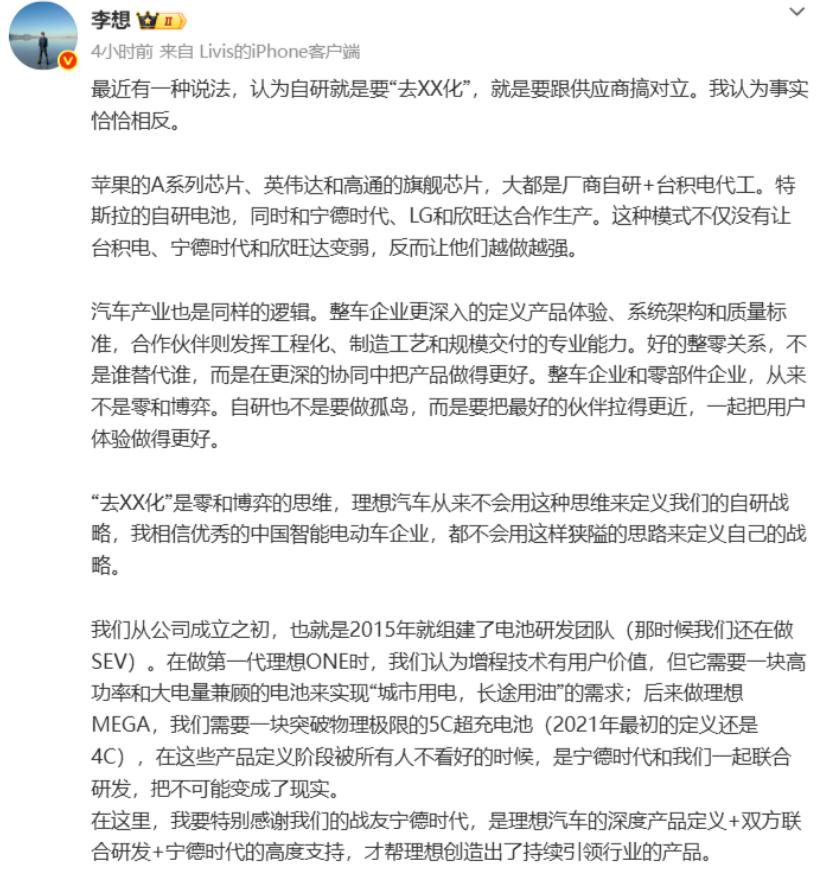
Li Auto's drive for in-house battery R&D is not aimed at kicking CATL out of the supply chain, and the truth is even the opposite.
Li Xiang specifically thanked CATL and called the company Li Auto's "comrade-in-arms". From the 5C ultra-fast charging battery of Li ONE to MEGA, many originally quite aggressive indicators were first defined by Li Auto for product requirements, then jointly developed with CATL, and finally landed with the support of CATL's engineering and manufacturing capabilities.
This statement sounds very sincere, but while denying the "de-CATL" trend, Li Xiang also mentioned three things to explain why Li Auto must continue to adhere to in-house battery R&D: to proactively meet unmet user demands, fully integrate batteries into the entire vehicle system, and open up data across the full life cycle of batteries.
In other words, Li Auto can continue to purchase batteries from CATL and is willing to continue cooperating with CATL, but one thing is changing: the capabilities that used to be largely controlled by battery manufacturers will be taken back by Li Auto. It aims to master product definition, system integration and data, and leave the manufacturing work to CATL, Sunwoda or more suppliers.
This is no longer a simple matter of "whether to get rid of CATL", but an attempt to turn the power battery industry chain into a white box and turn all battery manufacturers into its own "workers". On the other side, CATL is obviously not satisfied with only being a manufacturer that produces batteries for others.
One party wants to white-box the supply chain, while the other wants to become a system-level platform in the battery industry. What Li Auto and CATL are really competing for may never be orders for several batteries, but who will define the batteries of next-generation vehicles.
Li Xiang starts to "tame" battery manufacturers
Li Xiang's goal may not be to fully develop a battery better than CATL's on his own, but to turn the battery from a "black box" in the hands of suppliers into a "white box" that Li Auto can define, disassemble, and replace suppliers for.
Once this goal is achieved, Li Auto's control over the battery industry chain will undergo fundamental changes. After all, as long as the power battery is always a "black box" provided by suppliers, what automakers can truly master will be very limited.
What material system the battery needs, how the cell should be designed, what level the fast charging should reach, how to balance service life and safety, and even when the next-generation product will be iterated, all these are largely determined by battery manufacturers.
For ordinary automakers, this may not be a problem, but for a company like Li Auto that sells hundreds of thousands of vehicles a year and wants to make smart cars a highly integrated product, this means that one of its most important components with the highest cost proportion is not fully under its own control.
What Li Xiang wants to do now is to take back this part of the capability.
Judging from this public statement, what Li Auto wants to master in the future is user demands, product definition, vehicle system integration and data across the full battery life cycle, while the actual large-scale manufacturing can still be handed over to CATL, or introduced to other battery enterprises.
Li Auto does not necessarily need to become a battery manufacturer itself, but hopes to decide why the battery is designed in this way, what indicators it needs to meet, and how the next-generation product will be upgraded. As for who will produce it in the end, it can be left to the supply chain for full competition.
This white-box OEM model is actually not new. In the past decade, one of the most mature companies that played this model well in China's technology industry is Xiaomi.
From the very beginning, Xiaomi has not tried to bring the entire industrial chain into its own company. Screens can be purchased, cameras can be purchased, storage can be purchased, structural parts can be purchased, and assembly can be handed over to foundries.
What is truly in Xiaomi's hands is product definition.
The selling price of a hardware device, what materials to use, what hardware to configure, what screen to choose, how to design the system, and what kind of consumers to target, all these must be decided by Xiaomi itself. The remaining links that can be handed over to the supply chain are handed over to the supply chain as much as possible. Even for the same component, Xiaomi will not only bind one supplier, but introduce as many enterprises as possible to compete.
The result of this approach is that suppliers are increasingly like callable modules. Whoever has mature technology will be used, whoever has lower price will get more share, and whoever cannot keep up with the requirements of next-generation products can be replaced by new suppliers.
As the industrial chain becomes more mature and standardized, Xiaomi's control over the supply chain has become increasingly strong.
By 2025, this model has supported a large-scale hardware ecosystem. The best proof is that the gross profit margin of the mobile phone business, which is restricted by many black-box components such as Qualcomm's products, is only 10.9%, while the gross profit margin of IoT and life consumer products that control the white-box supply chain is as high as 23.1%.
To a certain extent, what Li Xiang wants to replicate on batteries now is a similar logic. Li Auto's main purpose of introducing second-tier battery enterprises this time is not to drive CATL out, but to gradually turn CATL from a supplier that masters a large number of technical definition rights into a participant in the entire supply system.
CATL can be used today, and Sunwoda can be used tomorrow; CATL is responsible for some models, and another manufacturer is responsible for other models. As long as the final product standards, system architecture and data are in the hands of Li Auto, who manufactures them is not that important.
The benefits of this approach to Li Auto are almost obvious.
When only CATL can provide a set of battery solutions, CATL naturally has stronger bargaining power. But if Li Auto completes the product definition by itself and multiple suppliers can produce according to the same requirements, the procurement itself will become a competition.
In terms of supply chain security, if one supplier encounters production capacity problems, price changes or technical route adjustments, Li Auto will not be completely tied up, and the situation that automakers bid to "beg" for CATL's batteries 5 years ago will not happen again.
What is more important is the product rhythm. In the past, battery manufacturers might produce a new battery first, and then automakers develop products according to the capabilities it can provide. But after the definition right is mastered by Li Auto, the order can be reversed: Li Auto first determines the cruising range, fast charging capability, volume and cost that the next-generation model needs, and then asks suppliers to meet these requirements.
In other words, whoever masters the definition right can truly control the product.
For brand enterprises like Li Auto, white-boxing the supply chain is certainly a good thing, but for those suppliers that are white-boxed, this often means another result.
The mobile phone industry has already staged this story, and Foxconn, which cooperates with Apple, is a very typical example.
Apple hands over a large number of manufacturing links to external suppliers, but firmly masters chips, operating systems, industrial design, product definition and user ecosystem. On the other hand, as one of the world's largest electronic manufacturing enterprises, Foxconn's revenue reached as high as 8.1 trillion New Taiwan Dollars in 2025, but its gross profit margin was only 6.15%, its operating profit margin was less than half of that figure, and its net profit margin was only 2.34%.
In the PC industry, which is more mature than the mobile phone industry, this trend is even more obvious.
As one of the world's leading notebook computer ODM manufacturers, Compal has long provided design, manufacturing and assembly services for international PC brands, and the design and production of complete machines are almost all completed by ODM enterprises like Compal. But even if Compal continues to improve its profitability through automation, optimizing product structure and improving operational efficiency, its gross profit margin in 2025 is only 5.6%.
Without Foxconn, it would be difficult for Apple's products to be delivered on such a large scale; without ODM manufacturers like Compal, it would be difficult for global PC brands to maintain today's efficiency.
When product definition rights, users and brands are all in the hands of customers, no matter how important suppliers are, they will easily fall into a role that can only compete for manufacturing efficiency, cost and yield, but can hardly master the final profit distribution right.
What's more, today's CATL is far from an ordinary manufacturing enterprise. It masters material systems, cell design, fast charging technology, safety systems and battery system capabilities. Even in many cases, automakers develop products around the battery capabilities of CATL.
If Li Xiang succeeds in the end, the last result CATL wants to see may not be losing Li Auto as a customer, but one day it will become the Foxconn in the power battery industry.
Obviously, CATL is not prepared to accept such a role. What it really wants to do may become the "Huawei" in the battery industry.
CATL starts to "tame" automakers in reverse
If Xiaomi's logic is to turn the supply chain into a replaceable "white box" as much as possible, then CATL wants to follow Huawei's path in the opposite direction: with strong enough technical capabilities, turn itself into a "black box" that customers cannot easily disassemble or replace. This is actually a business model that Huawei has repeatedly verified in the past few decades.
The most typical example is communication equipment.
Of course, operators can purchase base stations, transmission equipment, core network equipment and software separately, but what Huawei is really good at is never selling a single component alone, but combining wireless access, bearing, core network and even operation and maintenance capabilities into a complete solution.
As early as 2018, when Huawei released its 5G solution, it had already covered the core network, bearing, wireless access and terminals at the same time, and took "end-to-end" as its core selling point. For operators, this means that they do not need to reassemble dozens of sets of equipment from different manufacturers by themselves, and only need to accept the technical architecture defined by Huawei.
The cost is that once Huawei's technology is sufficiently leading and the system is easy enough to use, customers will become more and more dependent on this system. Huawei does not turn suppliers into modules by low prices, but makes its own modules more and more difficult to be replaced by technology.
In the automotive industry, Huawei has almost replicated this set of tactics.
Today's Huawei is no longer simply selling a chip or a set of software, but an integrated intelligent service provider covering ADS, HarmonyOS Cockpit, vehicle control, automotive optical and vehicle cloud services at the same time. According to the data disclosed by Huawei, as of April 2025, its intelligent automotive solution business has had an R&D team of about 8,000 people, with cumulative R&D investment exceeding 40 billion RMB.
AITO is the most typical product of this model.
On the surface, Seres is responsible for manufacturing vehicles, and Huawei is responsible for providing technology and channels, and both sides perform their respective duties. But as the cooperation deepens, Huawei is no longer just an ordinary supplier, but has gone deep into intelligent driving, intelligent cockpit, channels, marketing and even brand cognition.
This model has indeed helped Seres quickly complete brand transition, but it also brings another problem: when suppliers master more and more capabilities, it will be more and more difficult for OEMs to get rid of this system.
21st Century Business Herald previously cited people familiar with the matter as saying that Huawei was very strong in the process of cooperation with Seres, and there have been games and disputes behind both sides. According to the industry's calculation of the smart selection vehicle model at that time, Huawei's channel fees and technology licensing fees could reach about 10% of the total vehicle price.
What happened later also confirmed this contradiction.
On September 15, Harmony Intelligent Mobility Alliance and AITO announced to adjust the cooperation model at the same time. After the adjustment, although AITO still remains in the Harmony Intelligent Mobility Alliance system, product definition, product design, brand marketing, channel retail and service system are all led by Seres, and Huawei Terminal has changed from full-process leadership before to participating in empowerment.
As soon as the news came out, the public quickly projected this risk to AITO. Many consumers are worried that after Seres takes back the dominant power, will the product power of AITO's subsequent models decline, and to what extent will Huawei participate. This concern itself precisely shows that Huawei is no longer just a supplier, but has become part of AITO's product power and brand cognition.
This is what happens when a supplier is strong enough. If an automaker wants to "get rid of" the supplier, it must bear the risks of declining technical capabilities, weakened brand momentum, lower channel efficiency, and even sales fluctuations.
Today's CATL is actually moving along a more and more similar path. CATL has long been dissatisfied with only manufacturing cells according to the specifications given by automakers.
From Qilin Battery, Shenxing Ultra-fast Charging Battery to Super Dual-core Battery, CATL has been actively defining what the next-generation power battery should be like. The Super Dual-core Battery launched in 2025 even directly puts different chemical systems into the same battery pack, and CATL completes the material system, system architecture and performance trade-offs by itself.
Furthermore, CATL has begun to step out of the battery itself.
In 2024, CATL officially launched the Rock Platform chassis, extending its business from the battery pack to the vehicle chassis; at the same time, the Choco-SEBS battery swapping has gradually developed from a standardized swappable battery to a complete system covering vehicles, batteries, swapping stations and energy replenishment networks. By 2026, CATL has planned to cover nearly 190 cities with its ultra-fast charging & swapping integrated network, and jointly build energy replenishment networks with automakers such as Changan, Chery, GAC and Seres.
What CATL really wants to do is obviously not a "battery Foxconn" that waits for automakers to send drawings and then is responsible for producing batteries. It wants to master materials, cells, packs, chassis, energy replenishment, and even the entire life cycle of batteries from production to decommissioning.
At the end of the day, Li Xiang hopes that Li Auto will define batteries in the future and CATL will be responsible for manufacturing them; while CATL hopes that what the next-generation battery should look like should be defined by CATL in the first place, which is the real contradiction between the two sides.
One party wants to turn the supply chain into a Xiaomi-style "white box", while the other is striving to become the "Huawei" that cannot be bypassed in the automotive industry.
This article is from the WeChat official account "Ultra Focus foci", written by Sean, and authorized for release by 36Kr.