Are international brands staging a comeback in the Chinese market?
China's beauty market is not short of brands, but of irreplaceable reasons for consumers to choose them.
In 2026, China's beauty market continues to diverge: on one side, overseas brands including Lanolips and Filorga are shrinking their presence or exiting the Chinese market. On the other side, a number of foreign brands are ramping up investment or re-entering the Chinese market.
Behind this trend, brands that are facing diminishing traffic dividends and lack localized operational capabilities are choosing to scale back, while brands with differentiated brand positioning and strong operational capabilities are choosing to increase their investment against the market trend.
Recently (on September 24), Korean skincare brand BeginS by JUNGSAEMMOOL (hereinafter referred to as "BeginS") settled in Xiaohongshu, and officially announced its entry into the Chinese market.
It is worth noting that BeginS is the first personal skincare brand launched by JUNG SAEM MOOL, a well-known Korean makeup artist.
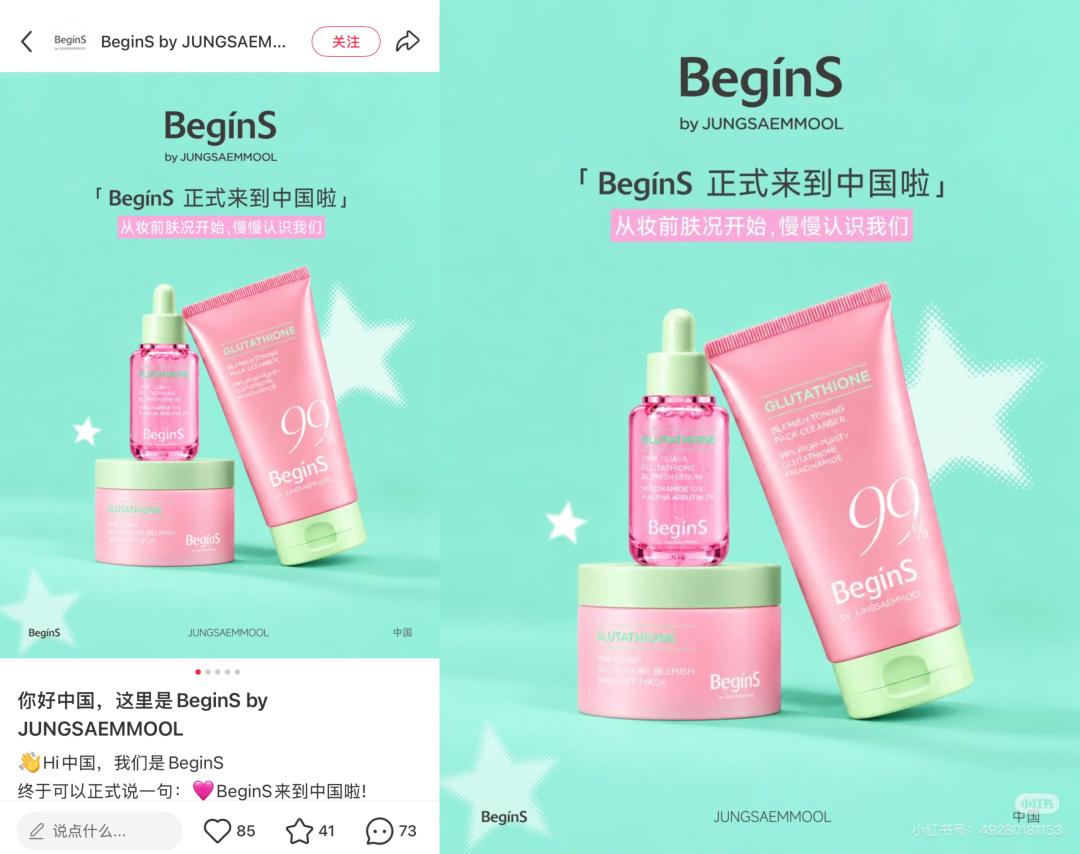
Source: Screenshot from Xiaohongshu
From makeup to skincare: Why is "Korea's Maogeping" ramping up its presence in China right now?
JUNG SAEM MOOL is no stranger to Chinese beauty consumers. Public information shows that she entered the industry in 1991, and has been working in the makeup sector for more than 30 years. She is the exclusive makeup artist for top Korean stars including Jun Ji-hyun, Song Hye-kyo and Kim Tae-hee.

Source: Screenshot from Instagram
The translucent makeup she created for Jun Ji-hyun in the movie *My Sassy Girl* established her industry status for the concepts of "translucent makeup" and "natural makeup".
From the exclusive makeup artist for top stars, to founding a beauty academy, and then launching her eponymous makeup brand, JUNG SAEM MOOL's career path is quite similar to that of the renowned Chinese makeup master Maogeping, so she is called Korea's "Maogeping" by the industry and consumers.
In 2015, JUNG SAEM MOOL founded her eponymous makeup brand JUNGSAEMMOOL, and quickly expanded into the global market with signature base makeup products such as the nude skin cushion.
At present, the brand has more than 1,300 stores covering over 200 countries and regions around the world, and its sales in 2024 reached 110 billion won (about 550 million RMB) [2].
In July last year, CLSA Capital Partners, under the CITIC Group, invested 50 billion won (about 250 million RMB) in JUNGSAEMMOOL, bringing the brand's valuation to 300 billion won (about 1.5 billion RMB).
In addition, Jumeili also noticed that JUNG SAEM MOOL has been continuously expanding its multi-brand and multi-category portfolio in recent years. Apart from the core makeup brand JUNGSAEMMOOL, she has also successively launched BeginS, a skincare-focused brand, Salon.Zip, a brand specializing in scalp care, and JUNGSAEMMOOL KIDS, a brand positioned for children's care.
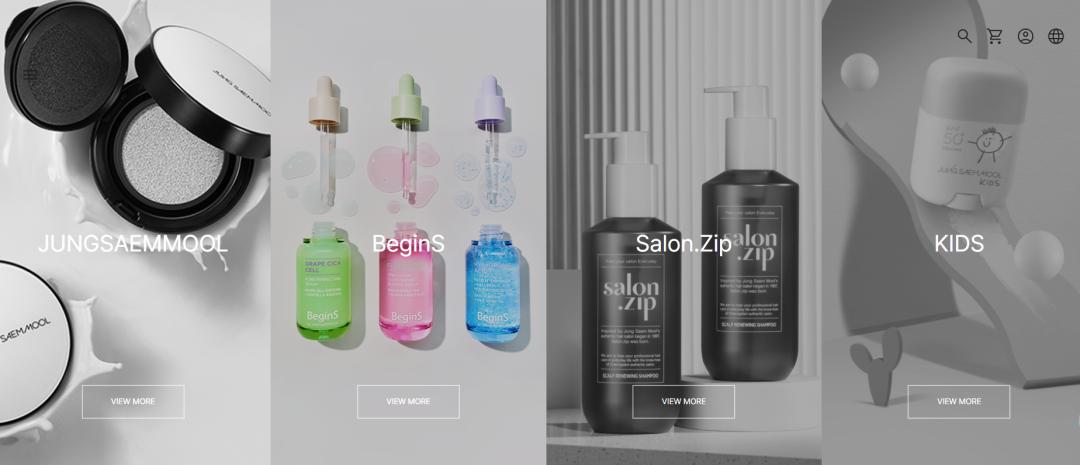
Source: Screenshot from the official website of JUNGSAEMMOOL
Among them, BeginS is an important step for JUNG SAEM MOOL to expand from the makeup sector to the skincare track. This high-performance skincare brand is mainly targeted at consumers in their 20s and 30s, advocating building a healthy skin foundation from the bottom of the skin. Its brand concept "Beauty starts from you" continues JUNG SAEM MOOL's consistent naturalism aesthetics.
In terms of product lines, BeginS has launched multiple series covering core skincare categories such as serums, creams, sunscreens and facial cleansers, with pricing ranging from 10 USD to 26.67 USD (about 67.03 RMB to 178.78 RMB), and has built differentiated barriers through "master endorsement + effective skincare".
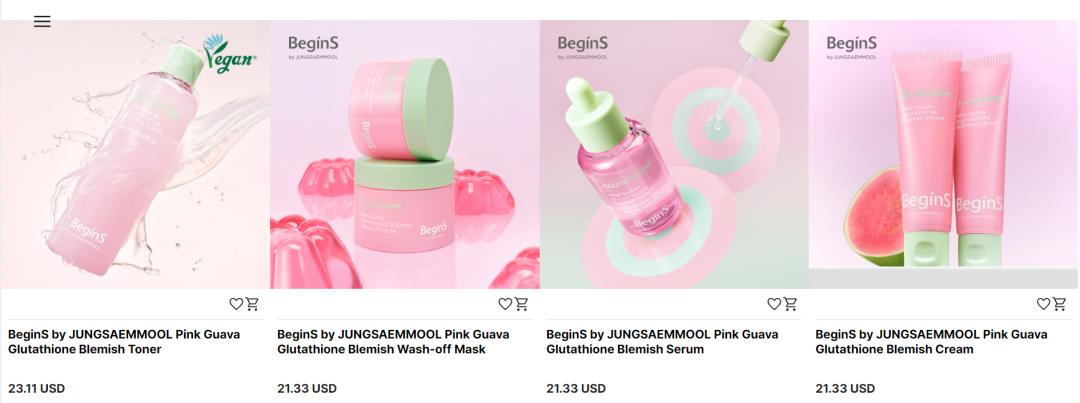
Source: Screenshot from the official website of BeginS
At present, two products, namely eye masks and moisturizing sprays, have been listed in BeginS's official store on Xiaohongshu, while some other products are also sold in third-party stores on platforms such as Taobao and JD.
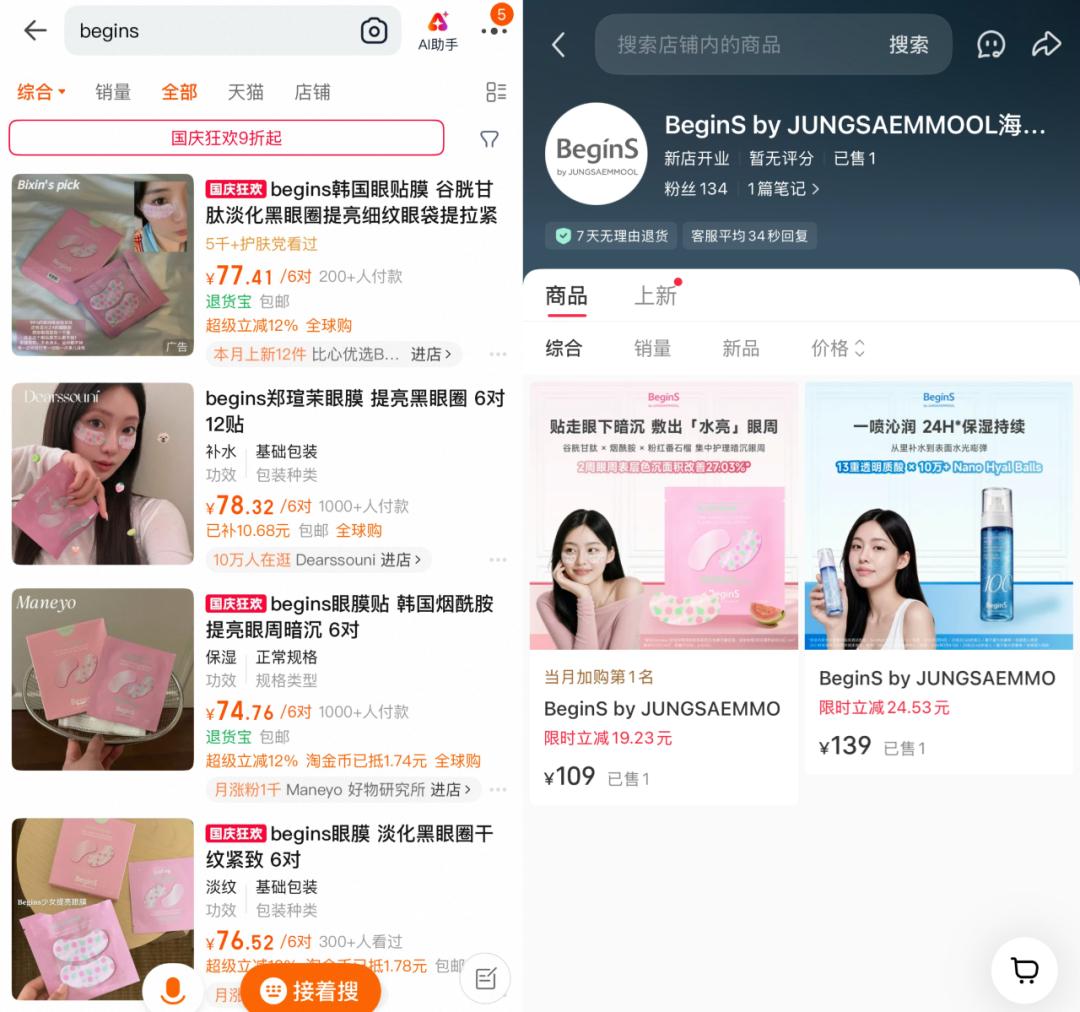
Source: Screenshot from Xiaohongshu and Taobao
This incident has also aroused certain discussion heat on social platforms such as Xiaohongshu. Some users expressed their love and expectation for BeginS: "The eye patches and eye masks are very easy to use", "I love Teacher SAEM MOOL so much", "The serum has a very refreshing texture and is quickly absorbed by the skin", etc.
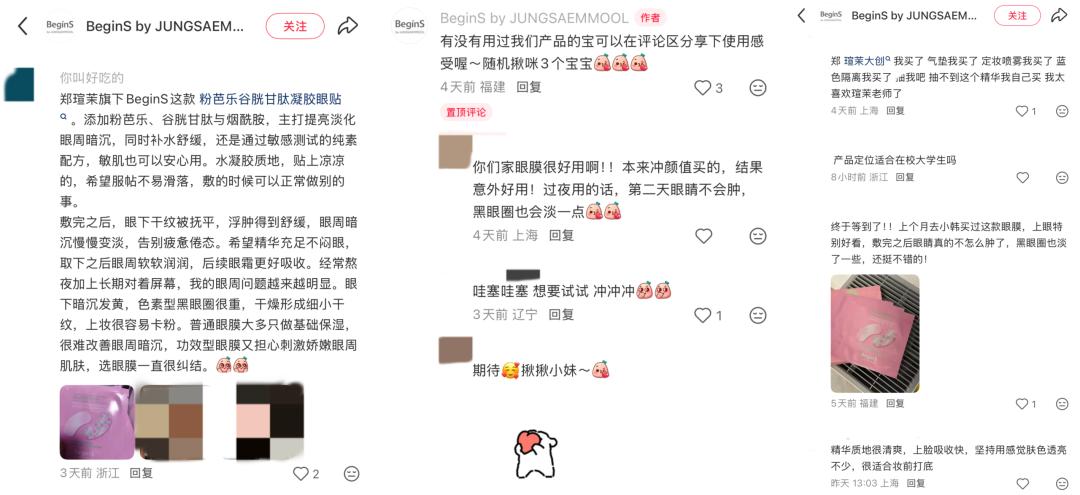
Source: Screenshot from Xiaohongshu
It can be seen that this combination of "master IP + perceptible efficacy" is in line with the current rational trend of Chinese consumers, who are paying more and more attention to the actual effect of products and no longer simply pay for the brand's halo.
Retreat and restart go hand in hand: Has China's beauty market entered a reshuffling period?
Behind BeginS's entry into China is the profound structural changes that China's beauty market is undergoing. Among them, the wave of brand contraction and retreat is obvious.
Since the beginning of this year, there have been continuous news such as the full closure of Melvita's stores in China under L'Occitane, Mamonde's closure of its official online sales channels in China, and the bankruptcy of Blank ME's parent company.
At the same time, a number of brands have made strategic adjustments to some channels, including Etude House under Amore Pacific closing its Tmall flagship store, KATE under Kao closing its Tmall and Douyin flagship stores, and Albion (under Kose) and Grow Gorgeous closing their overseas flagship stores.
Behind these measures are the survival challenges faced by brands in the Chinese market. The *2025 E-commerce Survival Survey* released by Paidai shows that more than 30% of beauty merchants were in a loss-making state in 2025, and more than 30% of merchants had a profit margin of only 0% to 5%. If a brand deploys multiple platforms such as Tmall, Douyin and Xiaohongshu at the same time, the high operating cost has become an insurmountable threshold.
But "retreat" is not the whole story. On the other side, these changes are injecting new variables into the Chinese market.
First, there is a wave of restart and entry of international beauty brands. In 2026, there have been intensive signals of Korean beauty brands returning to the Chinese market: Innisfree plans to restart its Tmall overseas flagship store, TIRTIR and COSRX appeared at CBE China Beauty Expo, and Hwahae, a Korean beauty review platform, also opened its first store in China in Shanghai.
At the same time, Medicube under the APR Group officially entered China in July; REJURAN, a Korean medical beauty-level efficacy skincare brand, also recently reached a strategic cooperation with the Shumei Group, and the two parties plan to further increase their investment in the Chinese market.
Multiple Korean brand agents contacted at the beauty expo revealed that there was a wave of Korean beauty brands' layout in China in the second half of 2025, and there will be more follow-up actions.
Different from the expansion path of the previous generation of Korean beauty brands that relied on the Korean wave and daigou (overseas purchasing agents), this batch of brands prefers to enter the market through lightweight entry points such as cross-border stores and Xiaohongshu, and their product strategies are more focused on the promotion of hit products.
In addition, brands including Decléor, Sol de Janeiro, COLOR WOW and Serge Lutens have also successively entered the Chinese market.
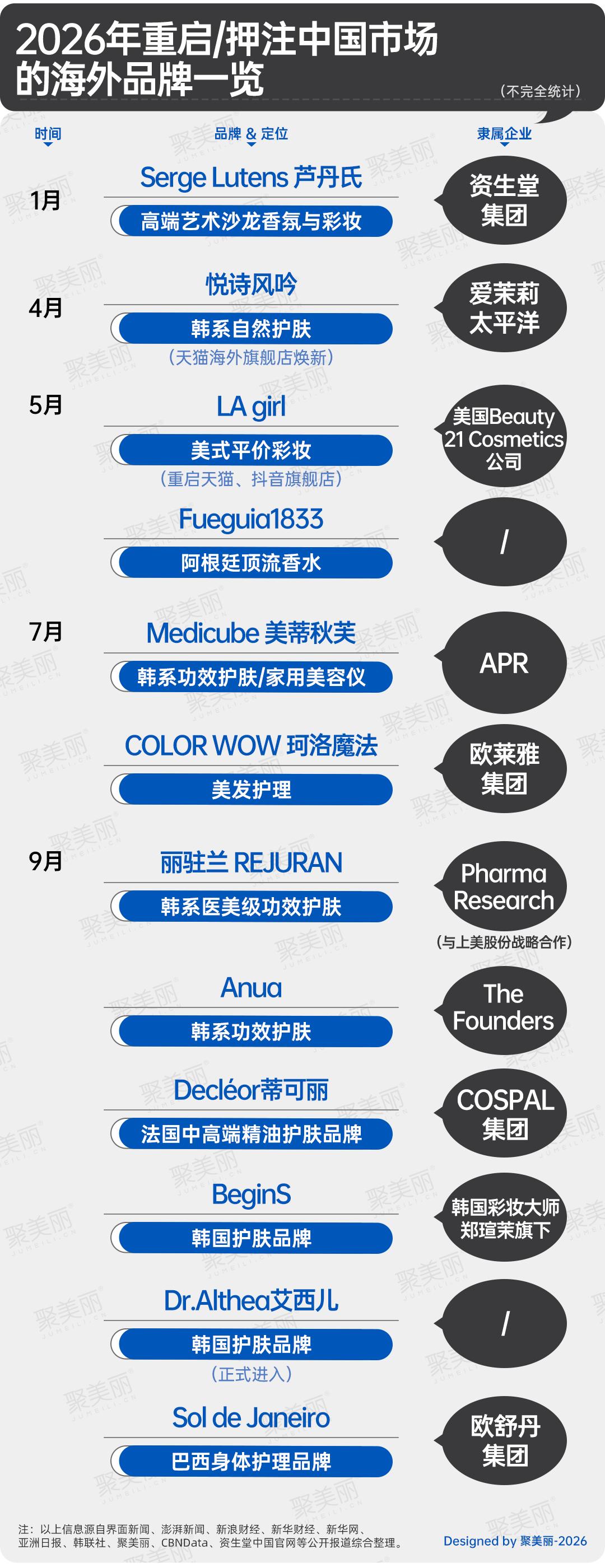
Second, domestic enterprises are restarting brands one after another to optimize their business portfolios. While foreign brands are weighing between advancing and retreating, local beauty enterprises are trying to find new growth curves by restarting brands that were previously put on hold.
In November last year, Juyi Group restarted Ligan, a skincare brand founded in 2021, and filed for record for new products such as the Ganoderma lucidum and Pro-Xylane anti-wrinkle cream.
In September this year, Bloomage Biotech restarted Runxihe, a children's skincare brand that it had previously voluntarily suspended, and has now completed the filing of three new products. In the same month, "Ji Yao", a dermatological-grade skincare brand under the Asia Group, also returned to the public view after a period of silence.
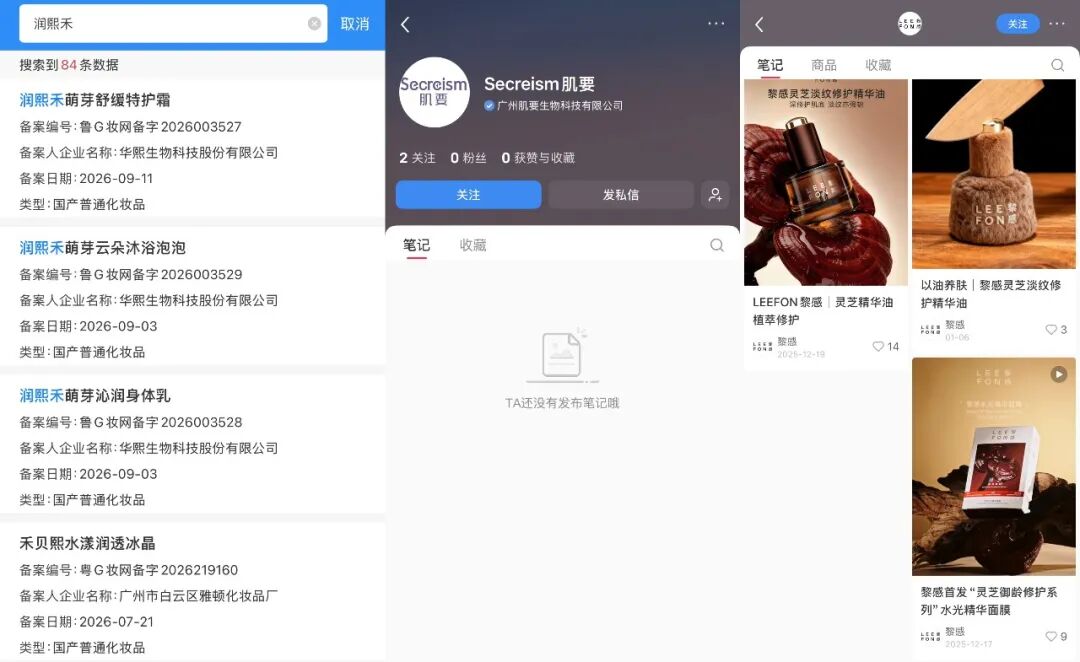
Source: Screenshot from Xiaohongshu
The logic behind these restart actions is consistent: after the growth of leading domestic brands' main brands tends to stabilize, they need more brands to cover different segmented tracks and seize the minds of young consumers.
However, restarting a closed brand is not as simple as "refurbishing and putting it on the shelves". What they are facing is a more picky market, more expensive traffic and more fierce competition than before.
Whether a brand can be successfully activated depends on whether it returns with a clear differentiated positioning and excellent operational capabilities, rather than just relying on the support of enterprise resources.
Especially in 2026, the year-on-year growth of the overall market does not mean that the track is returning to inclusive growth. The retail recovery from January to August this year more indicates that the market still has capacity, rather than the old methods working again. Therefore, when these "new" players are looking for entry points, what is more tested is their localized operation capabilities and how to seize consumers' minds.
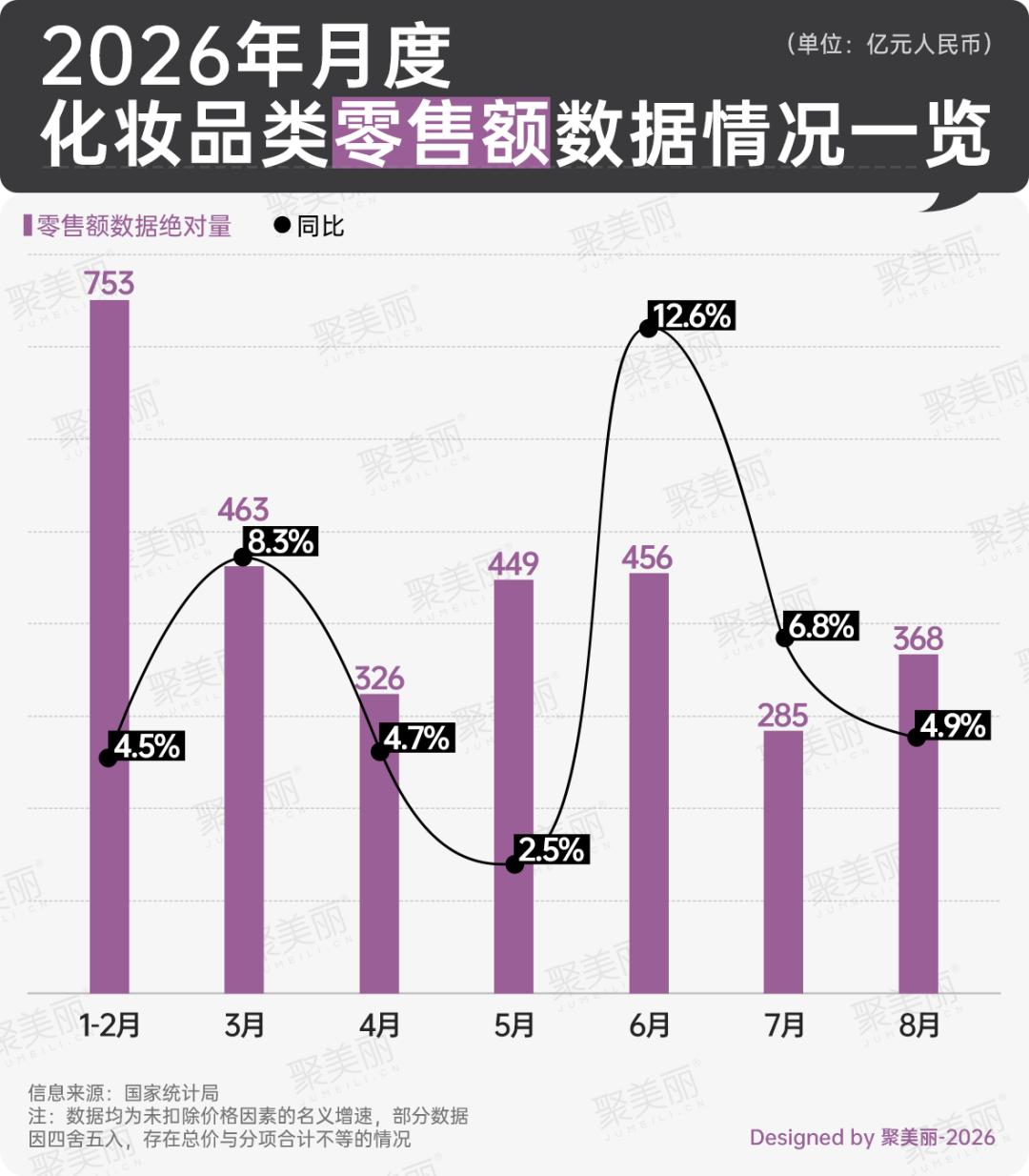
At this point, BeginS's entry into China is not just a ride on the overall market growth. In fact, it conforms to the new trend that brands seize market share through differentiated positioning and perceptible product efficacy after the fading of traffic dividends.
The advance and retreat of the beauty track in 2026 is essentially a reshuffling of capabilities. Foreign brands are scaling back and ramping up investment, while domestic brands are restarting old brands. In the current general environment, they still need to rely on differentiated and refined operations to gain a foothold in the market.
The Chinese market is not short of brands, but of irreplaceable reasons for brands to stay. Only those who can clearly occupy consumers' minds can survive through the cycle.
Note: For the foreign currency-related parts mentioned above, the conversion is based on the exchange rate on September 29, 2026: 1 South Korean won ≈ 0.005 RMB, 1 US dollar ≈ 6.7034 RMB
Information Sources:
[1] Relevant materials about JUNG SAEM MOOL are all referenced from the previous Jumeili article *Valuation nearly 1.6 billion! CITIC invested in "Korea's Maogeping"*
[2] This data is quoted from the data disclosed by *The Korea Economic Daily*, and there is no relevant report on its 2025 performance so far.
This article is from the WeChat public account "Jumeili" (ID: jumeili-cn), author: Piaopiao,