After the devaluation of brand assets, Chicecream, Uni-President and Xiangpiaopiao have offered three different responses.
Three old brands, three "reactivation" paths: who is betting on trust, who is betting on channels, and who is betting on business models?
Recently, three noteworthy signals have emerged in the consumer industry.
Chicecream appeared at the booth of the 28th China Ice Cream Industry Expo (Tianjin), with the first 3 products priced from 6.9 yuan to 7.9 yuan.
Uni-President brought back the "Assam Mini Milk Tea" that had faded out of the market for many years, focusing on jasmine matcha flavor, and chose the snack discount brand Zhao Yiming as its debut channel.
For its part, Xiangpiaopiao disclosed in the record of its investor relations activities in September that the company has a total of 9 offline milk tea stores that have been opened or are under preparation (6 in Hangzhou, 3 in Huzhou).
None of the three brands are unknown. Chicecream was once a prominent representative of the new consumption trend, Uni-President is a long-established food giant, and Xiangpiaopiao is even a national milk tea brand that "sold 300 million cups a year".
Three brands, three paths. When the core assets of a brand depreciate due to changes in the times, can they still be reactivated?
Chicecream's "half-price restart": Can price cuts buy back trust?
Chicecream's restart is not a simple "new product launch", but a liquidation and re-pricing of brand assets.
In May this year, the core assets of Chicecream (492 registered trademarks, 8 patents and 8 copyrights) were sold for 21.1 million yuan on the Jingdong Judicial Auction Platform, and the rights transfer announcement was finalized on September 14.
The entity that took over Chicecream is a brand new one.
According to the Tianyancha App, in August 2026, "Changsha Chicecream Food Co., Ltd." was registered and established. Its shareholder is "Zhongxuegao Brand Management (Shanghai) Co., Ltd.", behind which are Wang Yaqing and "Changsha Hujia Food Technology Co., Ltd.", the latter being the parent company of the frozen food brand "Royal Tiger".

(Source: Tianyancha)
New CEO Chen Dacheng has clearly stated that the parent company of Royal Tiger currently only has a financial investment relationship with Chicecream, "there is no business intersection for the time being", and the new company is independently operated by Chen Dacheng's team. That is to say, the new team takes over the "intangible assets" of the brand, excluding the debts, team and channel network of the original company, and the channel construction of the new company has not yet reached cooperation with the investor.
This time when Chicecream returns, the first thing to change is not the product, but the price.
The first three products have the same formula but different prices. The suggested retail price of 6.9 yuan to 7.9 yuan directly cuts into the core price range of mass ice cream such as Yili Qiaolezi and Mengniu Suibian.
Regarding the reason for the price cut, Chicecream's explanation is "listening to the voices of consumers", while the price of raw materials has decreased in recent years and logistics and transportation conditions have become more mature.
However, one detail needs to be noted: Chen Dacheng said that the ex-factory price of each flavor of the new product is close to the past, and the change range is far smaller than the retail price adjustment. This means that the price reduction does not come from the compression of production costs, but from the reconstruction of the terminal markup structure. In other words, the moisture of layer-by-layer markup in the past channels has been squeezed out.
In addition, Chicecream's brand premium itself has been completely consumed in the public opinion field. The pricing of 6.9 yuan is not to squander a brand that is still valuable, but to re-establish a new perception of "quality-based cost performance" for a brand that has returned to zero or even negative value.
This is exactly the three-fold test Chicecream faces in its restart.
The first test is the trust test.
The formation of the "ice cream assassin" label is not just that an ice cream is sold expensively. The deeper reason is that Chicecream does not have strict control over the channel terminals, the same product has different prices in different channels, and the terminal display is mixed with traditional ice cream priced at 3 yuan, making the price contrast extremely harsh.
In the recent public opinion comparison, Mr. Yeren, who insisted on the direct store model in the early stage, has unified prices, independent displays and controllable experiences, which just avoided the pit that Chicecream stepped on back then.
The second test is the channel test.
The intangible asset package taken over by the new entity does not include the channel network, and the dealer relationship needs to be rebuilt from scratch. At present, an important purpose of the new company's participation in the ice cream exhibition is to attract investment. Some original dealers have been invited to Changsha for negotiation, but the specific agency policies have not yet been introduced.
The pricing of 6.9 yuan requires large-scale distribution to achieve sales volume, but channel reconstruction takes time, and the peak sales season for ice cream has passed.
The third test is the competition test.
Data from Mai Shangying shows that in the peak seasons of the past 4 years, the sales of the ice cream category have declined year by year, and the peak season in 2026 has decreased by about 13% year-on-year.
The "high price range" that Chicecream relied on for survival back then is precisely the part where the entire market shrinks the most. Half of its price reduction is an active cost reconstruction, and the other half is "pushed down" by the entire market.
In the 6 to 10 yuan price range, Yili, Mengniu and Magnum are the home fields. As a "latecomer", it is still unknown whether Chicecream can break through the gap only by its brand popularity.
For Chicecream, the hardest part is not to lower the price, but to get back the trust. Will consumers remember it as that "expensive assassin" or a "cost-effective new brand after price reduction"?
Essentially, Chicecream's restart is a big gamble of "trading low price for scale". Price reduction solves the problem of "high price", but cannot solve the problems of "chaotic price" and "available for purchase".
Whether the trademark photographed for 21.1 million yuan is a good bargain or a hot potato will be answered by the sales data of the fourth quarter of this year.
Uni-President's "Channel Blood Renewal": Why Launch New Products in Snack Stores?
Compared with Chicecream's "breaking then establishing", Uni-President's restart action is much "lighter".
Uni-President chose to bring back the "Assam Mini Milk Tea" that had faded out of the market for many years, launched a new jasmine matcha product with low sugar, low fat and added pure milk, and chose the snack discount brand Zhao Yiming as the debut channel, selling at 3.9 yuan per bottle, which is lower than the 6 yuan when it was first launched in 2015, and also lower than the 5.5 yuan of Heytea's same jasmine matcha product.
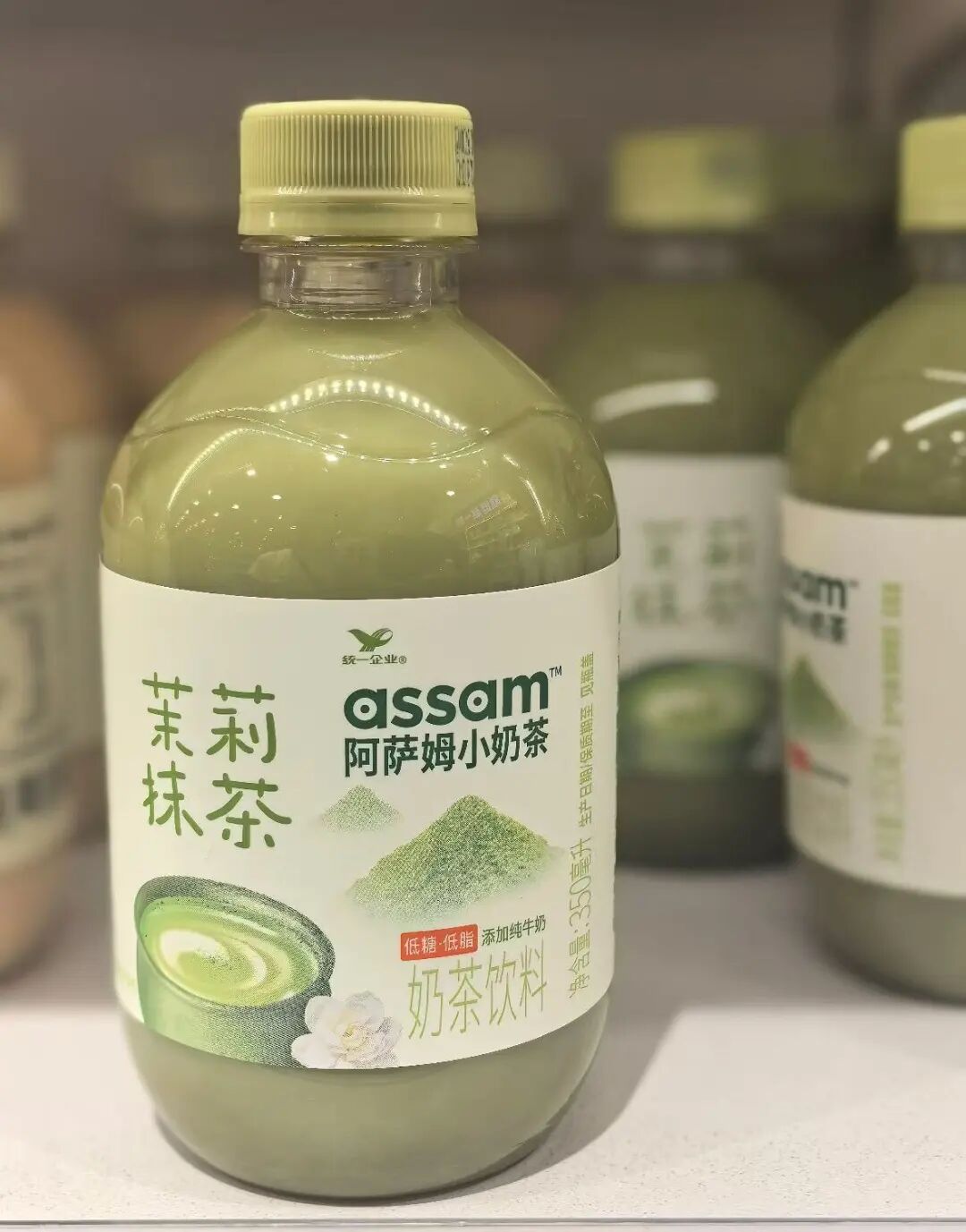
(Source of Assam Mini Milk Tea: Internet)
Assam's brand awareness is still there, but the incremental space is limited. This time, Uni-President did not put this resurrected new product on the shelves of supermarkets that it is most familiar with for its debut, but directly handed it over to snack discount stores. This is not an accidental channel choice, but a microcosm of "channel blood renewal".
First, let's look at why Uni-President wants to renew its channels.
The 2026 interim report data shows that the milk tea category to which Assam belongs achieved revenue of 3.645 billion yuan, a year-on-year increase of 7.3%, which is the only segmented track in the entire Uni-President beverage sector that achieved positive growth. In the same period, tea beverages fell by 3.5%, and fruit juices fell by 5.5%. The track that Uni-President chose to increase investment in is precisely the only one that is still growing.
In addition, in the semi-annual report released on August 5, 2026, Uni-President disclosed an easily overlooked organizational change: Chairman Luo Zhixian set up a new independent first-level department - the Strategic Alliance Development Department, which is specifically responsible for coordinating customized businesses in special channels such as member stores and snack discount stores. The department generated 671 million yuan in revenue in the first half of the year.
The establishment of this department is not a sudden adjustment. Long before its establishment, Uni-President has accumulated a large number of exclusive products in leading retail channels such as Sam's, Pang Donglai and Freshippo. However, these cooperations are scattered in different business units such as beverages and food, with fragmented resource allocation, making it difficult to form a replicable systematic capability.
The establishment of the Strategic Alliance Development Department is to gather the experience scattered in the past, and open up a complete closed loop from channel demand insight, joint co-creation R&D to customized delivery.
The debut of Assam Mini Milk Tea at Zhao Yiming is a natural move under this organizational logic.
So why are snack stores the choice?
In the past, Uni-President's beverages relied on a three-layer network of "dealers + supermarkets + convenience stores". But now, the passenger flow of traditional supermarkets continues to decline, the convenience store channels are diverted by instant retail, and the dealer system is aging. Meanwhile, snack discount stores such as Mingmang Henmang, Zhao Yiming and Haoxianglai have opened more than tens of thousands of stores in just a few years, becoming the fastest growing new offline channel.
Uni-President's decision to debut at Zhao Yiming essentially replaces "traditional supermarket traffic" with "snack traffic". The new channels have increments, the price range matches exactly, and old products can be "reused". Good sales bring increments, and poor sales will not affect the price system of the main brand in supermarkets, with extremely low trial and error costs.
Essentially, the restart of Assam Mini Milk Tea is an active attempt by traditional beverage giants under the new channel pattern.
This product was first launched in 2015, positioned as high-end but limited by the immature health consumption trend at that time; it briefly appeared in the warm cabinets of convenience stores in the winter of 2022 to 2023, verifying the adaptability of small-specification milk tea and instant consumption scenarios, but the warm cabinet scenario is too seasonal, and it loses its sense of existence after winter; it was restarted for the third time in 2026, debuting in snack discount stores.
The 3.9 yuan price point sold at Zhao Yiming is not just a bottle of milk tea, but a position that Uni-President occupies in the new channel pattern.
Xiangpiaopiao's "Model Switch": Is the Pace of 9 Stores Fast or Slow?
If Chicecream is "starting over" and Uni-President is "testing the water", Xiangpiaopiao is "turning around", and it is a turn from "light" to "heavy".
What Xiangpiaopiao wants to activate is not the sales volume of its brewing business, but the brand relevance of the name "Xiangpiaopiao" in the era of freshly made beverages. When the mindset of "brewed milk tea = Xiangpiaopiao" changes from a barrier to a ceiling, it needs a new scenario to prove that it is still relevant to consumers.
The first layer: 9 stores, it has really entered the game.
As of September 2026, Xiangpiaopiao has a total of 9 offline milk tea stores that have been opened or are under preparation (6 in Hangzhou, 3 in Huzhou). The first store was launched at Hangzhou Joy City on November 29, 2025, and the daily cup output once exceeded 1,300 cups on the opening day. The price per cup ranges from 5.9 yuan to 16 yuan, with a per capita consumption of about 11 yuan, which highly overlaps with Mixue Ice City.
But the real change is not in the price, but in the model. Xiangpiaopiao has been making pre-packaged brewed milk tea for more than 30 years: asset-light, relying on shelves and dealers. Now it wants to make freshly made tea drinks: heavy rent, heavy manpower, heavy supply chain, and heavy store operation. This is not "selling one more product", but transforming from a goods-selling company to a store-operating company.
The second layer: there are flaws in the financial report, the positioning is unclear, and the capabilities do not match.
First, look at the background of the financial report. According to Xiangpiaopiao's 2026 first-half financial report, in the first half of 2026, Xiangpiaopiao's revenue was 1.277 billion yuan (+23.31%), and the net profit attributable to owners of the parent company was 10.8597 million yuan, making its first mid-term report profit in seven years.
But when you break down Xiangpiaopiao's 2026 first-half financial report, there are two numbers hidden behind the "turnaround": The deducted non-recurring profit net profit attributable to owners of the parent company still lost 1.4797 million yuan, the turnaround mainly relies on government subsidies and financial income; the second quarter single-quarter loss was about 82.53 million yuan, all the profits in the first half of the year came from the first quarter.
More notably, the cash flow: the net cash flow from operating activities in the first half of 2026 is still -137 million yuan, and the hematopoietic capacity of the main business has not yet fully recovered.
Then look at the long-term coordinates. For the whole year of 2025, Xiangpiaopiao's revenue was 2.926 billion yuan (-11%), and the net profit attributable to owners of the parent company was 95.24 million yuan (-62.38%). The high growth of brewed products in the first half of 2026 (668 million yuan, +57.7%) mainly came from the extended Spring Festival peak window and channel restoration. This is a phased restoration, not a structural reversal.
Then look at the positioning. The company stated in its investor relations activities that the core role of stores at this stage is "brand value transmission, consumer interaction and product test feedback", rather than a revenue channel. To put it another way: Stores are not profit centers, but brand windows.
This sentence is worth pondering. It is very candid that the 9 stores are really not aimed at making money; but at the same time, it points out a problem: When a listed company defines a new business as a "promotional window" instead of a "profit center", is it prudently testing the water, or has not yet found a viable business model?
A detail can support this: Xiangpiaopiao operates two different types of stores. The Joy City store is a 49 ㎡ "mall experience store" with dine-in service, focusing on brand interaction; the Qingjiang