While maintaining robust self-sustaining profitability and conquering the critical core technical barriers that determine the industry's lifeline, the leading domestic semiconductor photoresist enterprise is achieving a two-pronged breakthrough from two fronts.
Since 2024, the explosive growth of large language models and generative AI has pushed global tech competition into the "computing power-centric" era.
Against the supply-demand imbalance triggered by the computing power race, inflation in the semiconductor industrial chain is transmitted upward layer by layer along the chain of "GPU — OEM manufacturing — components — electronic materials". Since the start of this year, multiple advanced electronic materials including MLCC, fiberglass cloth and photoresist have seen successive price hikes. While reshaping the systematic value, this trend also brings unprecedented opportunities to the materials track.
Standing at the cusp of industrial restructuring, Tongcheng New Materials, a leading domestic new material service provider, completed its H-share listing on September 29.
This comprehensive new materials pioneer founded in 1999 mainly focuses on business segments such as rubber additives for tires and electronic materials. Structurally, the company presents a typical "two-wheel drive" feature. As disclosed in the prospectus, the rubber additive business for tires is currently the company's main source of revenue, accounting for 61.9% of total revenue in H1 2026; meanwhile, the electronic materials business has also accelerated significantly in recent years, with the latest business proportion reaching 32.5%, which has become the company's new growth pole.
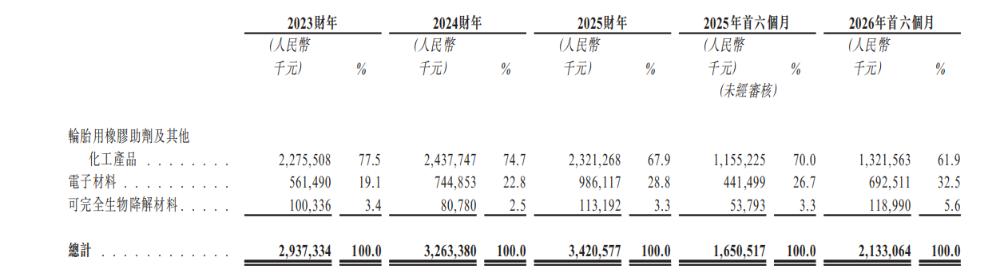
The listing on the H-share market marks that the capital market fully recognizes Tongcheng New Materials' high growth value in semiconductor photoresist as well as the steady foundation as a global new materials leader. The resonance of its dual leading advantages will open up space for the company's long-term valuation imagination.
More importantly, the second-listed Tongcheng New Materials is expected to leverage more abundant global capital reserves to accelerate the R&D of advanced photoresist products, and fill in the key puzzle for the supply chain security of domestic semiconductors.
01
From defense to substitution, the domestic photoresist leader is building a new growth flywheel
As the key to realizing the miniaturization of chip process, the performance of photoresist directly determines the integration level of chips, affects the computing speed, power consumption and cost, and is the critical link that "one misstep will affect the whole situation" in the industry. However, in this core field, the domestic industry has long been constrained by overseas monopolies.
At present, the global supply of photoresist is highly concentrated, with Japanese manufacturers occupying more than 60% of the market share. Especially in the advanced process segment, Japanese giants such as JSR, Tokyo Ohka Kogyo and Shin-Etsu Chemical control 85%-90% of the global supply lifeline.
Compared with the monopoly of Japanese enterprises, domestic photoresist presents an obvious "echelon gap". According to data from Guojin Securities, the localization rate of G/I line photoresist has exceeded 30% at present, the localization rate of KrF line is between 1% and 8%, while the localization rate of high-end ArF line is less than 1%, and the cutting-edge EUV line is almost blank.
With the intensification of geopolitical games, the supply chain security of local semiconductors is facing severe tests. In addition to the compliance risk of export control, the sharp increase in cost caused by rising prices is also continuously eroding the profit margin of wafer fabs.
According to reports from Shanghai Securities News, Japanese giants including JSR and Tokyo Ohka Kogyo will raise their overall quotations for global customers by 15% starting from October 1, among which the price increase of high-end ArF immersion long-term agreements is as high as 16%-22%. The two-way squeeze of "supply disruption concerns" and "rising costs" is forcing local wafer fabs to restructure their supply chain security, and domestic photoresist has ushered in a golden window period from "passive defense" to "active substitution". At the same time, the breakthroughs of domestic photoresist leaders in technology and production capacity in recent years have also laid a foundation for the smooth advancement of domestic substitution.
As a leader of domestic new materials, Tongcheng New Materials seizes the historical opportunity, and relies on its leading market position and full-series product matrix to build a solid independent and controllable security line for domestic photoresist. According to Frost & Sullivan data, in 2025, the company ranked first among local suppliers of semiconductor photoresist in China.
In terms of product layout, the company has built a cross-process product matrix covering G-line, I-line, KrF and ArF. In the mature G/I line field, there are more than 100 products on sale at present, and it has the capability of stable mass production and large-scale supporting supply; in the KrF field, there are more than 60 products on sale, and it has achieved technical breakthroughs in high-resolution KrF and KrF negative photoresist, becoming one of the main domestic suppliers of photoresist for 8-inch and 12-inch integrated circuit production lines in China; in the high-end ArF field, the company is also making continuous efforts, and has developed a number of ArF dry and ArFi (immersion) photoresist products, which have passed the relevant customer certification procedures and achieved substantive presence in advanced processes.
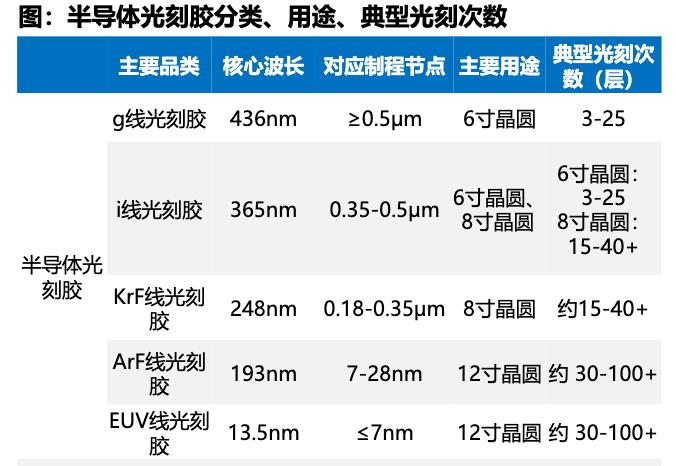
In addition to its advanced technology, the company also has the largest photoresist production capacity in China. Its Shanghai base's thousand-ton production line operates stably, forming production capacity reserves covering different application scenarios and process nodes.
While building a security line for semiconductor photoresist, the company also delivers outstanding performance in the field of display panel photoresist. At present, the company's classic TFT-LCD array positive photoresist is steadily increasing in volume, and has achieved mass production and sample delivery breakthroughs in cutting-edge fields such as high-resolution, low-temperature cured organic insulating films and OLED organic light-emitting materials, firmly securing orders from leading panel manufacturers. According to Frost & Sullivan data, in 2025, the company also ranked first among local suppliers of TFT array photoresist in China.
Compared with the breakthrough in formula, Tongcheng New Materials' deeper moat comes from the vertical independence at the raw material end. The company extends upstream to develop core base materials such as phenolic resin and PHS resin by itself, realizing the two-way closed loop of "resin raw materials + terminal formula", which not only resolves the risk of supply disruption in key fields, but also builds a deeper supply chain security boundary and profit margin defense line.
The strong rise of the photoresist business shows strong performance feedback on the financial side. From 2023 to 2025, the company's electronic materials revenue reached 560 million yuan, 750 million yuan and 990 million yuan respectively, with a CAGR of 32.5%. In H1 2026, the revenue of this segment reached 693 million yuan, a year-on-year increase of 56.9%, accounting for 32.5% of the total revenue, and has become the company's second growth curve.
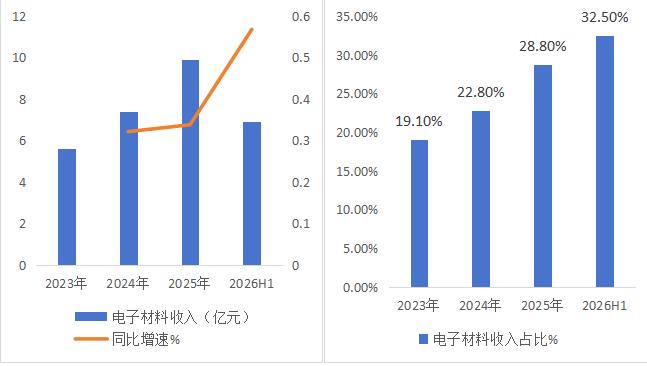
What is more of a vane significance is that the revenue of its high-end ArF photoresist in 2025 increased by more than 800% year on year, and the year-on-year growth rate of ArF and BARC products in the first half of 2026 was close to 300%; meanwhile, the net profit of the company's electronic materials in the first half of the year increased by nearly 180% year on year, far exceeding the revenue growth rate in the same period.
Considering the characteristics of the photoresist industry of "high upfront investment" and "long verification cycle", the rapidly expanding performance indicates that the company's photoresist business has successfully stepped out of the early "investment stage" and is accelerating to usher in a positive growth flywheel of "production capacity release, structure optimization and profit multiplication", providing deterministic support for the improvement of future profitability and comprehensive competitiveness.
02
Rank first in sales on both global and domestic markets, rubber additives consolidate the performance base
Admittedly, the growth story of photoresist is the core source of imagination for the capital market about Tongcheng New Materials at present. But if we look at the company's safety bottom line, it is the rubber additive business for tires that it has long been deeply engaged in that supports its performance base and endows it with operational resilience.
As a typical mature chemical product, the rubber additive business not only builds a moat for the company to resist the cyclical fluctuations of the semiconductor industry, but also acts as a "cash cash cow" that feeds the R&D of new materials such as photoresist. The latest financial report data vividly demonstrates its role as a ballast. According to the prospectus data, in H1 2026, the company's rubber additive business for tires generated a revenue of 1.32 billion yuan, a year-on-year increase of 14.4%, accounting for 61.9% of the total revenue. According to Frost & Sullivan data, in 2025, in the tire phenolic resin rubber additive track, the company ranks first in sales in both the global market and the Chinese market, with customers covering the world's top 20 tire manufacturers.
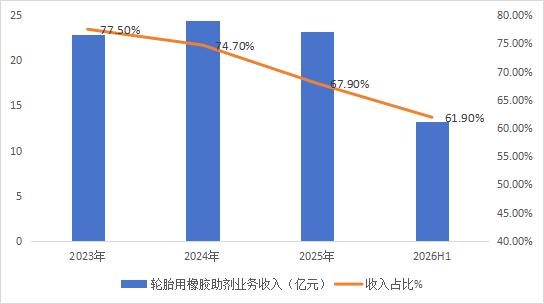
The outstanding performance of the rubber additive business is inseparable from the steady expansion of the industry scale in recent years. Supported by the increase in car ownership and the rigid demand for tire replacement, the CAGR of the global rubber additive market for tires remained stable at around 2% from 2021 to 2025. With the accelerated tire wear and high load demand brought by the increase in the penetration rate of new energy vehicles, the consumption center of rubber additives will remain stable in the future. According to Frost & Sullivan data, by 2030, the global market size of the industry is expected to reach 24.1 billion yuan, and the CAGR is expected to remain at around 1.9%.
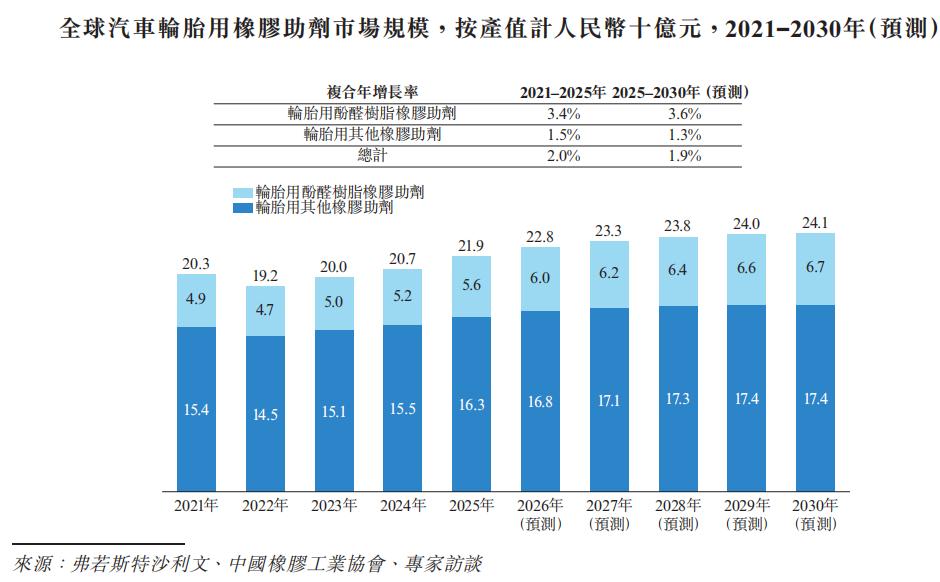
In addition to the dividend of steady industry growth, Tongcheng New Materials' deeper competitiveness comes from the leading premium brought by the high monopoly pattern. At present, the top five suppliers in the global tire rubber additive industry account for more than 95% of the market share, showing an oligopolistic feature. Tongcheng New Materials firmly ranks first in the market share of the global tire rubber additive industry, deeply grasps the industry pricing power, and at the same time fully shares the excess profit under the cost dividend through large-scale procurement and efficient production scheduling.
The core reason behind this is that rubber additives for tires directly determine the grip, wear resistance and driving safety of tires. The certification cycle of mainstream international tire giants is as long as 2-3 years, and they rarely change suppliers once the certification is completed, thus forming extremely high access thresholds and conversion barriers, and the whole industry also presents the Matthew effect that the strong get stronger.
Under the guarantee of excellent competition pattern, the rubber additive business undoubtedly provides the most solid financial lower limit for the company's performance, and becomes the direct source of its stable and abundant cash flow. It is this continuous self-capability that not only directly reduces the company's capital expenditure pressure, but also allows its innovative businesses such as photoresist to not rely too much on "financing for survival". Therefore, while sharing the high growth curve of semiconductor materials, the company also maintains a more stable performance bottom line.
03
Listing on H-share market, domestic materials pioneer competes in the global value chain
Overall, Tongcheng New Materials shows a rare "dumbbell-shaped" business structure: one end is the tire rubber additive business with a global oligopoly position, acting as a cash cow; the other end is the explosive growing photoresist business, which further raises the valuation ceiling. This structure not only holds the safety bottom line under the fluctuation of traditional cycles, but also endows the company with more imaginative valuation flexibility in the emerging strategic growth narrative.
The listing on the H-share market this time is not only a key leap in Tongcheng New Materials' own capital territory, but also a landmark event for China's advanced semiconductor materials to move towards the international stage and participate in the reshaping of the global value chain. As a strategic link connecting local and global capital, the Hong Kong stock market on the one hand opens up a diversified international capital market financing channel for the company, optimizes the shareholder structure and improves the overall risk resistance capability of the company; on the other hand, it also builds a more solid international credit endorsement for Tongcheng New Materials' global expansion strategy.
This has far-reaching restructuring significance for the local semiconductor supply chain that is under great pressure. With the help of abundant international capital reserves, domestic forces represented by Tongcheng New Materials can accelerate the R&D and mass production of advanced photoresist and cutting-edge materials with higher fault tolerance, and promote the smooth implementation of overseas production bases, so as to reduce the impact of supply constraints from overseas manufacturers. The endorsement of the Hong Kong stock market also helps domestic forces build global brand awareness, significantly shorten the production line certification cycle of international wafer fabs, and boost them to step into the first-tier arena of global semiconductor materials.
Judging from the market reaction, the cornerstone investors in the prospectus phase subscribed for a total of about 126.4 million US dollars, covering about 35.1% of the global offering size. The recognition from institutional investors undoubtedly guarantees the market stability of the company in the initial stage after listing. But of more strategic significance, this also reflects the high consensus of long-term capital on the scarcity of Tongcheng New Materials' "mature overlord + independent controllable pioneer" two-wheel drive model.