Shi Yaqiong of Jinqiu Fund: Opportunities are born alongside bottlenecks.
"In any era, investment opportunities lie exactly where the bottlenecks are."
On September 21, at the salon "Summit Encounter: Kevin Kelly in Dialogue with New Chinese Tech Forces" held in Beijing, Shi Yaqiong, Vice President of Jinqiu Fund, made such a statement from the perspective of early-stage investment. This event was co-hosted by 36Kr and Chen Yuan 139 of Zhongjian Zhidi.
During this event, Kevin Kelly, Wang He, Founder and CTO of Galaxy Universal Robotics, Zheng Qingsheng, Partner of HSG, Shi Yaqiong, Vice President of Jinqiu Fund, and Feng Dagang, CEO of 36Kr, shared and discussed around the theme "When AI Reshapes Civilization: Technology, Uncontrollability and Investment Judgment".

Shi Yaqiong from Jinqiu Fund
As an investor with nearly 10 years of venture capital experience and long-term focus on early-stage projects, Shi Yaqiong has contacted more than 3,000 startups, and the investments of Jinqiu Fund have always been concentrated in the early stage. This event consists of two parts: keynote speeches and roundtable dialogues. At this event, she put forward her observations combined with data and cases on issues such as how to evaluate an AI project and why funds are pouring into models and upstream infrastructure.
Feng Dagang, CEO of 36Kr, raised a question during the salon: Today a project can produce a very complex demo, but what is the key link between a demo and an investable intelligent system?
When talking about this issue, the first thing Shi Yaqiong emphasized is sustainability. "The key in between is that there are sustainable elements to capture users' attention." She took the change in the number of applications as an example: "In 2022, I remember clearly that there were about 2,000 new applications per month, and today this figure is about 114,000, a 17-fold increase in four years." She also observed that the continuous improvement of the capabilities of creative models and content models since last year is one of the important reasons for the explosion in the number of applications; and after the model capability crosses a certain threshold, for startups, "the threshold to develop a product by quickly using interfaces is basically no longer valid compared with large manufacturers". She also specifically emphasized that "the backflow data from real scenarios is very important for this wave of AI, which is very obvious in the automotive sector as well as in applications".
But she also said that as an early-stage investor, she is "very optimistic and very radical", otherwise she would not be able to participate in this era. "Today we can see that the per capita code volume has increased by 10,000 times, which brings a lot of possibilities, and we can reassemble things in a coding way. In addition, there is a significant improvement in efficiency, and the cost of services has been greatly reduced. The services that only a small number of people could develop in the past can now become city-wide accessible services." In her words, this optimism is very similar to what Kevin Kelly talks about.
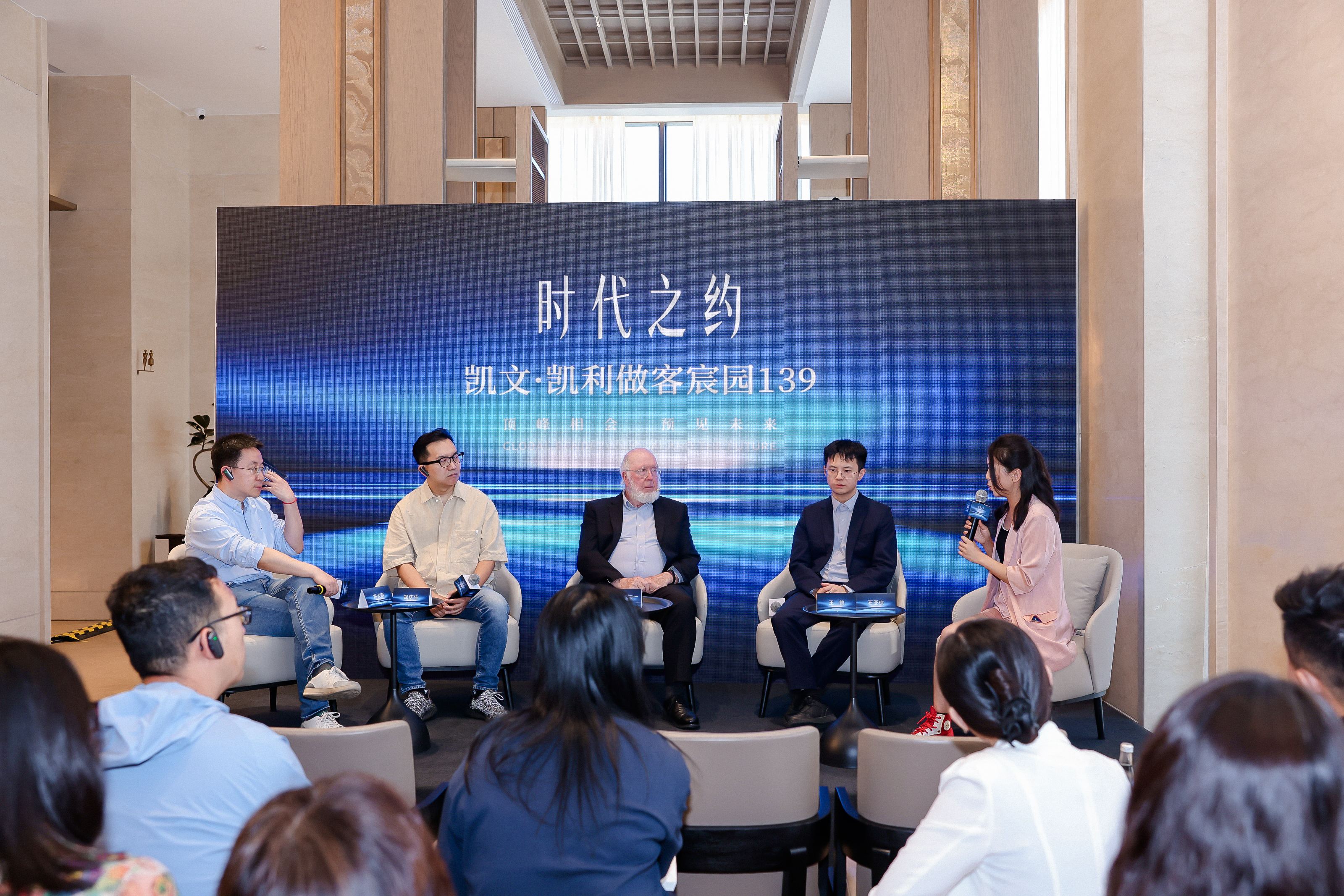
Event site
So what do investors need to do next? How can they do better?
In her view, the current direction of capital is very straightforward, and a large amount of capital is pouring into AI infrastructure. "At present, about 80% of the project logic centers on models and upstream infrastructure. The capital invested in models and infrastructure in China is about more than 70 billion yuan, and the latest batch of Y Combinator (the US startup incubator) is roughly the same, showing a highly consistent capital flow direction." She thinks this logic is very clear, "Because in any era, investment opportunities lie exactly where the bottlenecks are. How much computing power we can use and how fast we can work today determines what we can achieve."
The problem lies in the mismatch — precisely because computing power and speed are the bottlenecks at this stage, the application layer has been neglected by capital, and "the market's confidence in the application layer is shrinking". She said that if there is any mismatch, "I personally feel that I am quite confident in the application sector".
She also mentioned that AI technology is increasingly promoting the development of models, and the iteration speed of models is getting faster and faster, "which makes people feel that models will eventually dominate all applications". "In the To B field, we can actually see some new AI technology companies that provide services in the form of human-machine collaboration, and it is possible that in the end, what users face is still people." But she believes that if we look at a longer time horizon, what users ultimately purchase is the service itself.