The unicorn with a valuation of 117 billion yuan was sold for 9 billion yuan.
In the venture capital reports of recent years, there is a frequently mentioned time node, that is, the massive dollar liquidity injection in 2021 — a byword for disaster.
The current consensus is that the massive dollar liquidity injection directly turned the primary market into a speculative paradise at that stage, with hot money surging and inflated valuations. While trapping a large number of venture capital funds at high positions, it also created a large group of "pseudo-unicorns" with no real substance. The short-term result was the capital winter from 2022 to 2023, with dried-up liquidity. The long-tail result is that these pseudo-unicorns either cut their valuations by half to barely survive, or go bankrupt directly, with a large string of investors' bets wiped out instantly.
However, even pessimists could hardly imagine that the harm caused in the era of massive liquidity injection would continue into the second half of 2026, a timeline that seems to have been boosted by the AI narrative.
Recently, technology company Bending Spoons announced that it plans to acquire remote collaboration platform Miro at an enterprise value of about 1.36 billion US dollars. Considering the approximately 435 million US dollars in net cash held by Miro, the equity value of Miro corresponding to this transaction is about 1.79 billion US dollars.
Miro is a typical representative of the "overinflated unicorns" that emerged in the era of massive liquidity injection, whose valuation at the Series C financing completed in January 2022 was as high as 17.5 billion US dollars (about 1.17 trillion RMB).
An equity value of 1.79 billion US dollars is only equivalent to 1/10 of the Series C valuation. In 4 years, the valuation plummeted by 90%. It was originally a super unicorn, but the word "super" was wiped out by the plunge, leaving only the unicorn.
A Special Product of the "Cloud Era"
Let's start with a brief introduction to Miro.
Strictly speaking, it is somewhat unfair to put Miro in the same group as the "pseudo-unicorns" born in the era of massive liquidity injection with distinct speculative features. After all, they are indeed a team that is down-to-earth in product development. As early as 2012, the core team developed the prototype of the product. The two founders Andrey Khusid and Oleg Shardin are not professional entrepreneurs of the usual kind.
Before founding Miro, the two of them jointly ran a well-known design firm Vitamin Group in the industry, whose main business focused on website and APP design. The reason why they chose to found Miro is that as the influence of Vitamin Group grew, more and more customers came attracted by their reputation, most of whom were out-of-town customers, making the communication of demand details very troublesome. That is to say, Khusid and Shardin decided to start a business in 2012 with real insights from the industry. Miro's original name also implied their deep industrial genes — RealtimeBoard, a real-time whiteboard for remote collaboration.
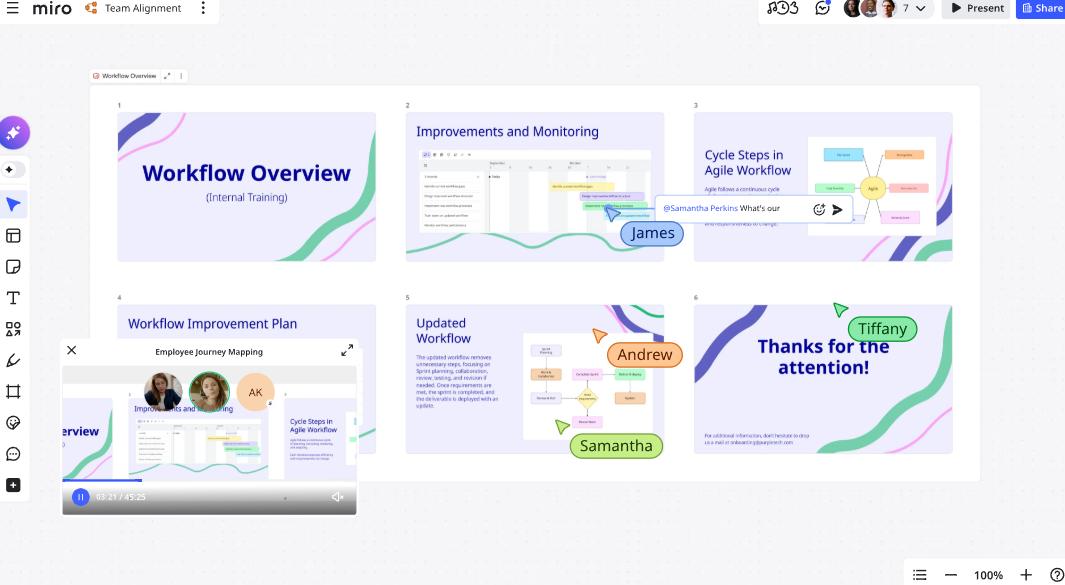
(Miro's product interface, Source: Miro official website)
But it is no exaggeration to say that Miro is a stakeholder who benefited a lot from the era of massive liquidity injection.
After the launch of the first-generation product in 2012, Miro actually maintained a "small but beautiful" state for a long time, with a very simple positioning: it is a tool to help designers and customers align their demands. Even Khusid admitted in an interview many years later that at the very beginning, Miro did not even plan to make a separate product, their goal was to "embed a real-time whiteboard supporting cloud collaboration into the browser". Under such a laid-back positioning, Miro did not complete the first round of financing after its corporate operation until around 2017, with an amount of only 1.3 million US dollars, and the investor was a little-known small institution called Altair Capital.
In November 2018, Miro officially entered the vision of Silicon Valley. This year, Accel, a well-known Silicon Valley VC, led Miro's Series A financing, with a total scale of 25 million US dollars. At this time, with the help of seed round funds, Miro had completed preliminary market expansion, with 2 million users and about 8,000 enterprise-level users, including well-known companies such as Netflix, Twitter, Hubspot and Airbnb. But at this point, the Miro team still conservatively anchored its positioning as "a real-time whiteboard supporting remote collaboration".
But in 2020, God stepped hard on the accelerator.
In the spring of that year, the virus swept the world, people had to reduce contact, but life had to go on. What should we do? The demand for "remote collaboration" began to surge under such a background. According to statistics from Gartner, a well-known research and consulting firm, only 27% of white-collar workers around the world had the demand for remote work in 2019 — here remote work refers to working at a site outside the company (whether at home, at the customer's company or on the road) for at least one day a week — by the end of 2020, this proportion had soared to 51%, of which the vast and sparsely populated United States was far ahead, reaching 53%.
Miro naturally became a highly sought-after project. In April 2020, Miro completed Series B financing. The scale of this round of financing reached 50 million US dollars. In addition to the old shareholder Accel, the investor also attracted another active Silicon Valley VC Iconiq, and NBA star Stephen Curry also participated in the investment as a super angel. It can be said that this was the first time that Miro became a "star project" in the true sense, and Miro's ambition has since become active.
In the press release of Series B financing, all financial media no longer used the word "whiteboard" in their descriptions of them, pointing out that Miro is not a "lightweight plug-in for collaboration" like "Zoom or Microsoft Teams", but more like a platform, "an integrated platform for many different office tools". Khusid's statement also had a subtle change at this time, he said, "From the very beginning, our philosophy is to build a real-time collaboration platform, and the concept of platform is very important, because we hope people can develop on the basis of our product".
From the short-term data, such a transformation is of course correct. Miro, which had only 2 million users and 8,000 paid users at the end of 2018, had jumped to 5 million users and more than 20,000 paid users by April 2020. But the fate of a company depends not only on its own efforts, but also on a full understanding of the historical process.
In January 2022, Miro completed Series C financing, with a financing amount as high as 400 million US dollars, more than 5 times of all its accumulated financing before. The valuation surge was even more exaggerated. In the Series C financing, Miro's valuation reached 17.5 billion US dollars (about 1.17 trillion RMB), while according to the data collected by Pitchbook, Miro's valuation in the Series B financing was only 750 million US dollars (about 5 billion RMB), which directly soared 23 times in less than 2 years.
Of course, Miro's business growth was also in a state of surge. According to the report at the time of Series C, Miro already had 30 million users in early 2022, and almost all of the world's top 100 enterprises were its customers, of which 20 of the world's top 100 enterprises signed annual contracts of more than 1 million US dollars with Miro.
But in terms of revenue specifically, Miro's revenue in 2021 was 300 million US dollars, which means that the valuation of 17.5 billion US dollars reached 58 times of its revenue.
This is obviously not a result of rational accounting. And for some reason, Miro also cooperated very well with the rhythm of the capital market and chose to expand synchronously. In the 12 months before the Series C financing, Miro doubled its staff size to more than 1,000 people. They also opened branches in 11 cities including Berlin, Munich, Tokyo, and London, turning themselves into a "global company" in the physical sense. Khusid proudly said that this is to "strive to meet market demand and make every customer have a good experience", and called this strategy "building the plane while flying it".
After the Series C financing, in order to realize the vision of the "platform", they also embarked on the path of mergers and acquisitions. For example, in June 2022, they spent about 250 million to 300 million US dollars to acquire the video collaboration platform Around, trying to compete directly with Zoom.
In addition, other crazy expansion behaviors include that before the Series C financing, they moved Miro's global headquarters in Amsterdam into a building with an area of 32,496 square feet (about 3,018.98 square meters). Although the area is not large, this building is one of the historic landmarks certified by the Amsterdam government, built in the 1920s. It is the work of Pieter Lucas Marnette, a well-known architect and representative of the Amsterdam School, and is the only building directly facing the water on the famous Stadhouderstraat Avenue in the center of Amsterdam.
Let's roughly estimate the value.

(Source: Local property advertisement)
In short, such an expansion speed is clearly an all-in bet on the general mood of "tomorrow will be better", leaving almost no way out for itself, let alone dealing with the impact of the GPT wave in the second half of 2022.
In the second half of 2022, with the weakening of the virus, the end of liquidity injection, the GPT wave, the rise of new tools such as Figma and Canva, and a series of other factors, these beneficiaries of the cloud era quickly fell into hard times. In the secondary market, the price-earnings ratios of Zoom, Asana and Monday.com, three once-sensational unicorns, plummeted from 119 times, 89 times and 84 times at their peak to 3.3 times, 5.2 times and 8.5 times in September 2023.
Miro naturally could not escape. Starting from February 2023, Miro began to lay off employees and cut unnecessary operating expenses. In an open letter, Khusid, who served as CEO, admitted that the company had carried out large-scale expansion in a "special period", and now it needs to "adapt to the changing environment". In 2024, Miro carried out another round of layoffs, with the layoff ratio reaching 18%.
Up to now, Miro's data has basically remained at the level of 100 million total users and 4 million paid users. According to the data released by the acquirer Bending Spoons, Miro's current ARR is about 600 million US dollars, 90% of which comes from enterprise-level customers. Calculated based on this data, Bending Spoons' acquisition price of 1.36 billion US dollars is only equivalent to 2.3 times of ARR.
The "Prometheus Project" in the Software Industry
If Miro is an excellent specimen for studying the era of massive liquidity injection, then the acquirer Bending Spoons will most likely be an excellent specimen for studying 2026 in the future.
Don't think I used "technology company" to modify Bending Spoons at the beginning, that's because I really can't find a more appropriate word. I once mentioned in the article "700 Billion, Bezos Raised a 'Vulture Fund'" that the rise of artificial intelligence is not just as simple as improving efficiency. The production processes and industrial structures we are familiar with in the past will be reconstructed in the process of artificial intelligence development — this brings the possibility of progress in the long run, but the inevitable result in the short term is that a large number of enterprises that are on the verge of being eliminated by the times and cannot determine the transformation direction will appear.
Bezos therefore formed a 700 billion fund called the "Prometheus Project", which intends to find opportunities in this predicament. Its main business is to acquire traditional manufacturing enterprises that have been severely impacted by artificial intelligence, and use artificial intelligence to modernize them to bring them back to life. Bending Spoons, on the other hand, can be roughly regarded as the "Prometheus Project" in the software industry.
Bending Spoons, founded in 2013 and based in Italy, its main business is to acquire "old software companies", and then help them resume growth through various transformations and empowerment. The well-known software companies it has acquired so far include AOL, Eventbrite, and Vimeo. There are two most classic cases. One is Evernote. When it was acquired in 2023, Evernote had suffered losses for many consecutive years. Two years after the operation, its revenue in 2025 increased by about 30% compared with 2023, and the average revenue per active user increased by 150%. The other classic case is the photo editing software Remini. According to the data released by Bending Spoons, since the acquisition five years ago, the monthly active users have increased by more than 5 times, the revenue by more than 9 times, and the average user revenue has increased by about 50%.
What's more powerful is that Bezos's plan is to use "artificial intelligence" to revive old enterprises, while Bending Spoons will also use AI for transformation, but AI is only the most common part of the whole play. Strictly speaking, their transformation idea has nothing to do with technology at all, and the core idea is one sentence: A small, highly autonomous team of top talents will always outperform a bloated organization.
In a podcast program, Francesco Patarnello, one of the founders of Bending Spoons, once shared three screening criteria for their acquisition targets. First, see if their platform can bring real value to the target company — such as helping it attract talents, turn data into insights, or bring new users; second, see if the revenue scale is large enough — the company would rather do fewer deals every year but make each one larger, than send a team of 50 people to toss a company with an annual revenue of only 20 million US dollars; third, see if the revenue is predictable — note, it is not to see if the growth is fast.
It is precisely because of this idea that Bending Spoons has become one of the phenomenal topics this year. On July 3 this year, Bending Spoons completed its IPO on NASDAQ, with a maximum market value of 250 billion US dollars (about 1.677 trillion RMB). At that time, 20VC made an episode praising Bending Spoons as a landmark "anti-AI IPO", because this company is essentially "a collection of software assets with a history of 20 years". Under this premise, Bending Spoons successfully went public and its stock price soared, proving that AI is not the only way for operational growth. Through "slightly modifying products, improving experience, and re-pricing", it is entirely possible to "package originally low-growth assets into a high-growth portfolio".
In this regard, Bending Spoons' acquisition of Miro is very worth looking forward to, because few companies are more suitable than Miro to interpret the dilemma of traditional software development ideas in the AI era. The whole rescue process of Bending Spoons is full of symbolic significance. At the very least, this is a way for human beings as the "weaker side" to prove in front of the huge technological impact that they really have a "unique ability" that cannot be replaced by technology, and human nature still "leads progress".