Has the lipstick effect disappeared?
If investors in the A-share beauty and personal care sector were asked to sum up the past five years in one word, it would most likely be "speechless". The index has plummeted by 54%, valuations have shrunk from 50x to 28x, and the net value of funds is in a disastrous state.

Figure: The A-share beauty and personal care index has cumulatively fallen by 54% over five years, with a total decline of 60% from its peak
It is often said that the economy has shown uneven performance in the past two years: macro data is relatively decent, but micro-level personal experience is rather poor.
A proposition thus stands out abruptly: Has the lipstick effect disappeared, or has it evolved into another form?
54% Drop in Five Years: Valuation Compression Explains the Majority of the Decline
Let's first look at the industry fundamentals.
The growth rate of retail sales of cosmetics has shifted to a lower gear, but it is still positive. Over the past 10 years, except for a 4.5% decline during the pandemic period, the previously high-speed growth of cosmetics retail sales has slowed down significantly, with only a 1.1% drop recorded in 2024. From January to August 2026, all months posted positive growth, with an average growth rate of 5.66%.
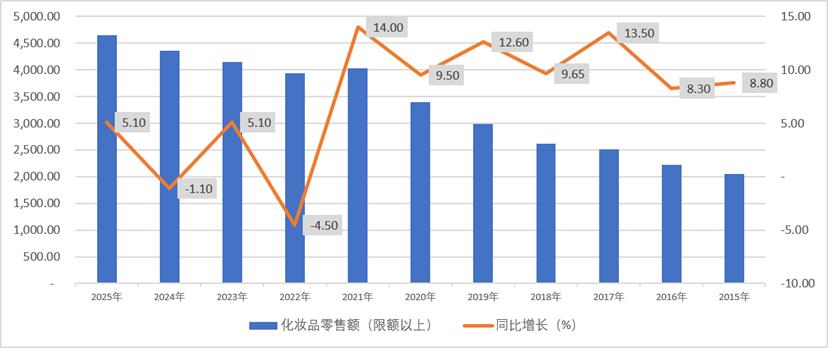
Figure: Retail sales of cosmetics (above designated size) and year-on-year growth rate, Unit: 100 million yuan, %
However, from the perspective of listed companies, the revenue growth of the beauty and personal care industry has slowed down in recent years, and net profit growth has largely stagnated. The year-on-year growth rate of attributable net profit has been continuously lower than the revenue growth rate, rooted in the continuous rise in the sales expense ratio. In recent years, the gross profit margin of the industry has continued to increase, but the net sales profit margin has declined instead, and the scissors gap between the two is widening. In essence, traffic has become more expensive.
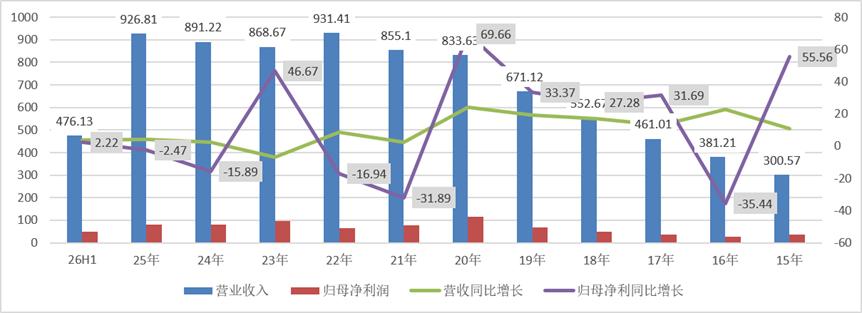
Figure: The attributable net profit of listed beauty and personal care companies has almost stagnated in growth in recent years
Since the pandemic, the beauty and personal care industry has expanded its online layout, and online channels have become the main battlefield. Domestic companies are aligning with international players, focusing on "affordable domestic alternatives", making products increasingly premiumized, and increasing the unit price of individual SKUs, which is reflected in the rising gross sales profit margin.
The previous model that achieved explosive growth relying on traffic dividends from platforms such as Douyin has failed. Traffic costs are rising steadily, while conversion efficiency continues to decline. The delivery ROI of the beauty industry has dropped from about 1:2.5 last year to 1:1.8. "It is difficult to drive sales without traffic investment, and it is hard to make profits with traffic investment" has become a common dilemma across the industry.
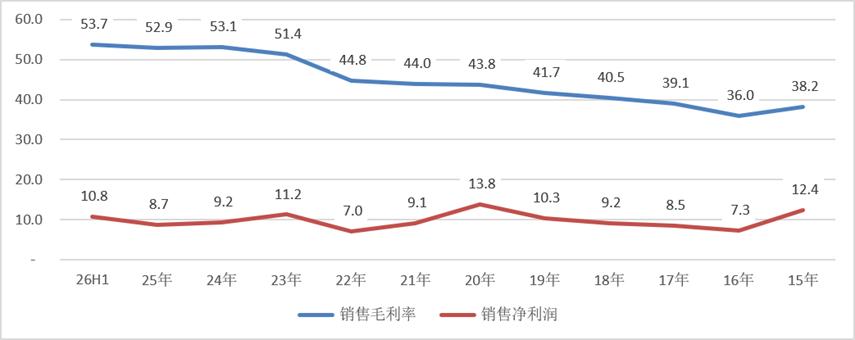
Figure: The gross sales profit margin rises while the net sales profit margin declines, rooted in the rising sales expense ratio
Back to the opening topic: What is the core reason for the decline of the beauty and personal care sector? From the PE curve, the sector's PE has fluctuated downward from 50.76x five years ago to the current 28.9x, with PE explaining 43% of the decline. In essence, it is a return from the previous high valuation driven by consumption upgrading and affordable domestic alternatives to a normal level.
The overall ROE of the sector in 2025 was 7.56%, with a median of 5.86%. Combining ROE and PE, there is no significant undervaluation opportunity for the sector as a whole.
However, individual stock differentiation is obvious, with PE ranging from 11.98x to 91.27x. Proya has a PE of 12x, a dividend yield of 4.17%, and its net profit in the 2026 mid-year report increased by 46.26% year-on-year, but its stock price has fallen by 15.79% since the beginning of this year. The overall pessimism towards the consumer sector has dragged down the valuations of leading enterprises. From a vertical perspective, Proya is currently at a low level of its historical valuation range.
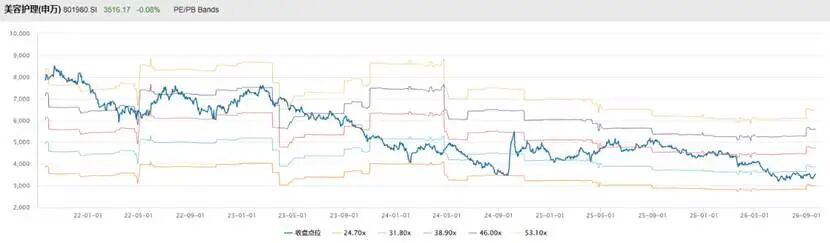
Figure: The PE of the beauty and personal care sector has fluctuated downward from 50.76x to 28.9x in the past 5 years
The Truth of the Lipstick Effect: Female Labor Force Participation Rate Is the Hidden Variable
The "lipstick effect" originated in the United States, and was also verified during Japan's "Lost Three Decades".
During the Great Depression in the United States in the 1930s, lipstick sales saw a staggering increase. Statistics show that U.S. lipstick sales in 1931 reached 1500 times that of 1921. During the entire Great Depression, total sales of the cosmetics industry increased by 25%, while the total industrial output value of the United States almost halved. After the 9/11 incident, Lauder, Chairman of Estée Lauder, observed that lipstick sales increased by 11%, thus formally proposing the "Lipstick Index" in 2001, advocating that lipstick sales be used as a reverse indicator of economic prosperity.
Japan entered a long-term stagnation in the 1990s. In the 30 years from 1992 to 2022, Japan's traditional optional consumer goods (such as white goods and home decoration) fell by an average of 29.3%, while the beauty industry recorded an increase of 45.9%.
However, from the perspective of domestic beauty and personal care data, the "lipstick effect" does not seem to hold. The revenue growth rate has shifted down, and net profit has largely stagnated, which is completely contrary to the high growth that people expected. What is the root cause?
From the cases of the United States and Japan, the common feature of the lipstick effect is a depressed general environment, pessimistic consumer expectations, and consumption downgrade becoming the mainstream. Products that bring emotional sustenance have the dual attributes of low absolute price and the ability to provide emotional value.
However, it cannot be ignored that after the economic depression in the United States and Japan, men alone could no longer meet the necessary expenses of their families, and the female labor force participation rate rose significantly. The female labor force participation rate and their disposable income level determine whether they can afford "self-pleasure" consumption.
Therefore, the lipstick effect is essentially the product of the resonance between self-pleasure consumption in a downward cycle and the rise in female labor force participation rate.
In 1990, Japan's female labor force participation rate was only 57.17%, which surpassed China after 2017 and currently stands at 76.97%. In China, the figure was 79.18% in 1990, then continued to decline, reaching 69.58% in 2025, which is still at an absolutely high level globally, far higher than that in Europe and the United States. This is partly related to the longer years of education for women, and partly related to the current overall employment situation.
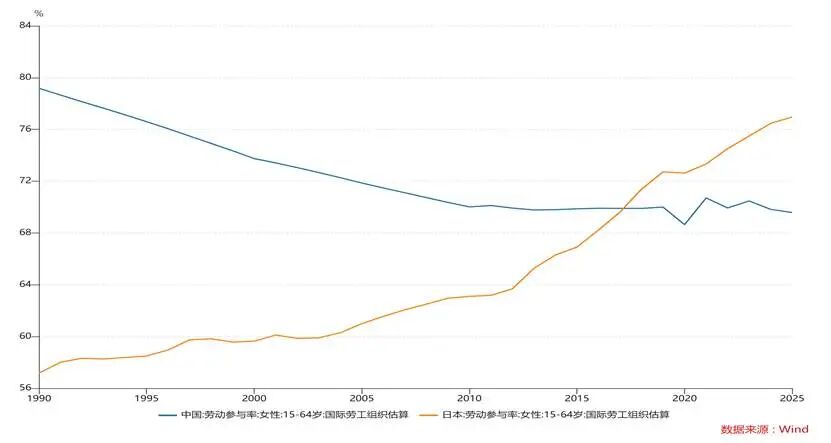
Figure: China's female labor force participation rate remains at a high level and has declined slightly in recent years
The Particularity of the Domestic Market: Coexistence of Weakening and Generalization
The domestic "lipstick effect" has been weakened. The most direct evidence is that during the 2026 "618" promotion period, the sales of beauty skincare, perfume and makeup products fell by 2.43% year-on-year. In addition, due to the decline in the female labor force participation rate, the "lipstick effect" has been weakened — workplace social interaction has disappeared in some women's lives, and the corresponding consumer demand has shifted from makeup to categories that better meet personal care needs, such as skincare products and base makeup.
But on the other hand, the lipstick effect has not disappeared, but has been generalized and transferred. When young people temporarily put aside their demand for purchasing houses, the scope of the effect has expanded from lipstick to more diverse categories.
The first is the substitution within the beauty category: "small happiness" categories with lower unit prices and perceptible effects, such as facial masks, serums and acne patches, are taking over from lipstick as new emotional carriers. In January 2026, the year-on-year growth rate of facial acne patches reached 4445.4%, and that of facial oil-absorbing paper/membranes reached 15448.3%.
The second is cross-category expansion: trendy toy blind boxes, new-style tea drinks, cultural play collectibles, concerts and other products and activities that can provide emotional compensation, sense of control or immediate rewards are becoming new carriers of the "lipstick effect". The explosive growth of trendy toy brands such as Pop Mart is a typical example.
Taking Japan as a Mirror: Consumer Blue-Chip Stocks Never Emerge from a Single Track
Drawing lessons from Japan's history over the past 30 years, consumer blue-chip stocks do not come from a single track, but emerge intensively along the cracks of consumption stratification, following two paths: "ultra-high cost performance" and "overseas expansion logic".
The first is to focus on the domestic market, serving the vast majority of consumers who pursue "ultra-high cost performance" in the context of consumption downgrade and stratification. Discount retail and drugstore chains are the tracks with the strongest offensive performance, whose long-term market value growth rate has exceeded 20% during this period. In essence, they are the winners and survivors in the stock game. Purely locally-reliant companies essentially redistribute market share in the stock market, with efficiency as their core weapon, but their ceiling is clear.
The second type of companies are those that replicate their local efficiency advantages overseas — just like Kikkoman, Ajinomoto and UNIQLO. Kikkoman, through overseas expansion of soy sauce products, has an overseas revenue ratio as high as 75%, occupying a leading position in the North American market. Ajinomoto adopted the strategy of "thorough localization", with overseas revenue accounting for about 65%, evolving from a condiment enterprise into a comprehensive food and health group.
For the beauty and personal care industry, Shiseido's market value increased by about 4.2 times from 1992 to 2017, and its adjusted net profit increased by 4.1 times in the same period. The core reason for it to cross cycles and become a consumer blue-chip stock is that it converted its century-old R&D accumulation into the pricing power of premium brands, and when the Japanese local market changed drastically, it decisively switched its growth engine to the global high-end market, using continuous structural reform to hedge against the long-term shrinkage of the local market.
Combined with the characteristics of the domestic market, no beauty and personal care company with significant advantages in R&D has been observed for the time being. Most companies rely on marketing concept driving and internet traffic to create hit SKUs.
In terms of overseas operation data, except for Waterbaby Co., Ltd. whose overseas revenue ratio reached 37.52% through mergers and acquisitions, other companies such as Proya, Mao Geping and Beni all have single-digit overseas revenue ratios. For the vast majority of companies, overseas expansion is still a long-term story with "strategy in place but no verification".
Implications for Investment
Taking Japan as a mirror and combining the evolution of domestic consumption logic, there are three implications.
Be alert to the "high gross profit trap" and pay attention to the inflection point of expense efficiency. The beauty and personal care industry is characterized by high gross profit, low net profit and sales-driven growth. High gross profit does not equal high return, the key lies in whether gross profit can be converted into free cash flow.
Structural opportunities are better than sector-wide opportunities. Different from Japan and the United States, China's female labor force participation rate has always remained at a high level, coupled with the demographic inflection point, which determines that the overall market is not an incremental market. Segmented sectors show differentiation: the personal care sector recorded 34% revenue growth and 54% non-recurring profit-deducted net profit growth; the internal differentiation of the cosmetics sector is drastic; the medical aesthetics sector faces the most severe profit pressure. Investment needs to sink into segmented tracks, individual companies, and even individual hit SKUs, rather than staying at the industry label level.
Search for individual companies with incremental logic. They are either winners in the domestic stock market competition through efficiency revolution, or companies that have achieved premiumization of their brands and run through the overseas expansion logic.
Lipstick has not disappeared. It has just turned from a single lipstick into a facial mask, a blind box, and a cup of milk tea. When young people's demand for purchasing houses is temporarily put aside, the outlet for emotional consumption will not be closed, it will only be transferred. Returning to the essential dimension, the problem of the beauty and personal care sector does not lie on the demand side, but on the supply side —
When traffic is more expensive than products, this industry should adopt a new way of operation.
This article is written based on public materials, for information exchange only, and does not constitute any investment advice