Jiuhe and K2VC have invested in a consumer-grade exoskeleton that was featured in *The Wandering Earth*, with its revenue exceeding 100 million yuan | Product Observation
Written by Huang Nan
Edited by Yuan Silai
On the ice-covered post-apocalyptic surface, rescue team members wearing mechanical exoskeletons covered with pipelines trek through the frozen wilderness to transport flint, use structural assistance to carry heavy weapons and drag fallen companions, and finally jointly push the firing pin of the planetary engine to complete the rescue mission.
This is the most profound imagination of exoskeletons left to the public in the movie *The Wandering Earth*. For Xu Zhenhua, founder of Aosha Robotics, this was a very important opportunity to break into the mainstream public view.
Xu Zhenhua has a background in automotive electronic systems. He co-founded Jinghe Tech and Fourier Intelligence earlier, engaged in R&D of medical rehabilitation robots, and then led his team to work on industrial exoskeletons for a full 8 years, with the company's revenue exceeding 100 million yuan in 2025. The company has also raised hundreds of millions of yuan in successive financing, with investors including well-known funds such as Jiuhe Venture Capital, Vision Capital, and Shunfeng Capital. This year, Aosha officially launched the consumer-grade exoskeleton robot VIATRIX X.
When companies with valuations of several billion have already emerged in the industry, Aosha seems to be a little "late" to the market, and even took the initiative to slow down some early financing nodes for this reason.
But Xu Zhenhua is not in a great hurry. In his view, consumer-grade exoskeletons are like hexagon warriors, which must find an "extremely strict balance point" among battery life, weight, heat generation, wearing comfort and power output. He cannot launch immature products into the market.
While a large number of manufacturers are seizing time to build first-mover barriers, Aosha's entry rhythm has instead become an opportunity for the team to avoid the homogenized track and rethink product positioning.
Therefore, Aosha spent more than two years independently developing the core power system and the floating hip joint architecture, and put forward a brand-new design concept of outdoor exoskeleton, hoping to help ordinary white-collar workers cope with complex mountain road conditions. They may not be able to tell too many exaggerated stories, but Xu Zhenhua is very clear that exoskeletons, products that extremely test detail experience, can only make users pay for them for a long time in the end by relying on technical capabilities.
Vehicle-grade Technology Cascading Down
Exoskeleton is a hardware that attaches great importance to "comprehensive tuning". An exoskeleton is not an ordinary wearable device, but a machine worn on the human body. Any performance shortcoming of it will directly affect the real experience of the human body. If there is any slight discomfort, users will throw it into the corner.
However, its performance improvement can hardly be driven by the independent optimization of a single parameter. Indicators such as assistance, weight, and battery life are coupled with each other. Increasing assistance means larger motors and higher power, at the cost of increased weight and heat generation; extending battery life relies on larger batteries, while weight is exactly the hard constraint of wearable devices; accelerating response requires stronger computing power, which itself also brings power consumption and heat. It can be said that no manufacturer has found the optimal solution yet.
"In the past, exoskeletons have always remained in the stage of parameter competition. The ultimate performance at a single point is still valuable, but the marginal benefit of parameter improvement decreases as it goes higher. In the end, what we compete for is the integration capability of the engineering system." Xu Zhenhua, founder and CEO of Aosha Robotics, told 36Kr.
The latest consumer-grade product VIATRIX X released by Aosha Robotics is an implementation of this engineering integration idea.

VIATRIX X (Source/Enterprise)
For exoskeletons, the power system is the underlying foundation of the whole machine's performance. Core experiences and performance limits such as the equipment's assistance output, battery life performance, lightweight control, and thermal stability are ultimately determined by the motor and drive architecture. Therefore, the first thing VIATRIX X did was to reconstruct the underlying layer of power and thermal management.
Power improvement is usually accompanied by increased heat generation, but the device is close to the human body, and users will not accept a machine that gets hot when attached to the legs. In terms of structure, Aosha's R&D team did not rely on additional cooling hardware to passively reduce the temperature, but moved thermal management forward to the motor design itself.
VIATRIX X has independently developed a power solution, adopting the flat wire winding design which is very commonly used in the automotive field.
In the past, traditional motors mostly used round wire windings with a slot fill rate of only about 78.5%. The low slot fill rate means that the copper wire in the motor of the same volume is not filled enough, resulting in high resistance, more heat generation and low efficiency. The flat wire winding adopted by Aosha can achieve a cross-sectional slot fill rate of 97%, which is equivalent to filling more copper wire in the same volume, with lower resistance and less heat generation.
The direct benefit brought by this vehicle-grade technology cascading down is the efficiency leap, which can increase the overall efficiency of VIATRIX X by 20% to 30%, and finally take into account a stronger assistance ratio and maintain low heat generation in the limited body space, solving the problem of stuffiness during wearing.
The efficiency improvement also directly reduces the product volume. Compared with the previous generation of products, VIATRIX X has a 40% smaller volume and the whole machine weight is reduced to 2.58kg.
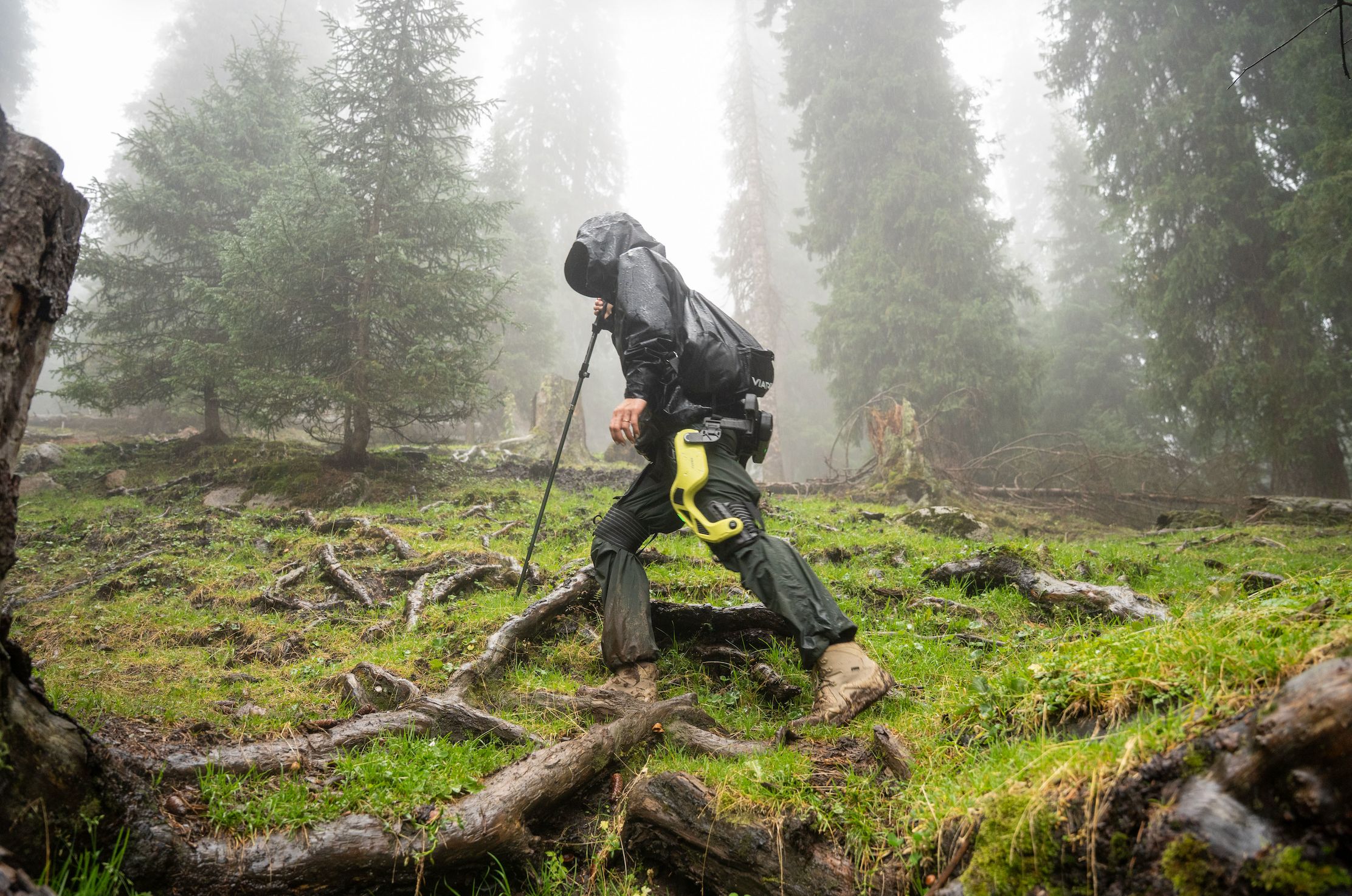
Vehicle-grade Technology Cascading Down (Source/Enterprise)
If the power structure and lightweight design determine the "capability ceiling" of the exoskeleton, then the algorithm scheduling determines the rhythm and way in which these capabilities are released.
On the algorithm side, Aosha has independently developed an automatic energy management system, the core of which is to dynamically adjust the upper limit of exoskeleton assistance according to the remaining power. The system is equipped with a "Boost mode", that is, the "sprint gear" of the exoskeleton, which can output the strongest assistance, suitable for climbing hills, carrying heavy loads or short-time high-intensity walking, but with the highest power consumption.
When the user walks with VIATRIX X, the system will manage in different levels as the power consumption: when fully charged, Boost can be fully turned on; when the power drops below 75%, the upper limit of assistance will be gradually narrowed; when below 25%, Boost will be turned off and the strongest assistance will no longer be provided; when below 10%, only the basic gear will be retained to maintain the most basic walking assistance.
This is not a simple power protection, but the algorithmization of the physical strength distribution logic in long-distance hiking.
When people walk normally, they usually do not sprint at full strength as soon as they set off, but allocate their physical strength according to the road conditions. The automatic energy management system of the exoskeleton needs to cooperate with the user's own rhythm, not only to avoid power failure halfway, but also to ensure that the product can provide assistance when the user needs it.
In addition to power distribution, the assistance provided by exoskeleton products must also be stuck in the correct window of the gait cycle. Lifting the leg, swinging, landing, and pushing off, each stage requires different intervention methods. The human's own tactile response time is about 120 to 200 milliseconds. If the exoskeleton is slower than this rhythm, it will be difficult to synchronize with the human's movement, and the assistance will be misaligned, which will not only fail to help, but also create a dragging feeling.
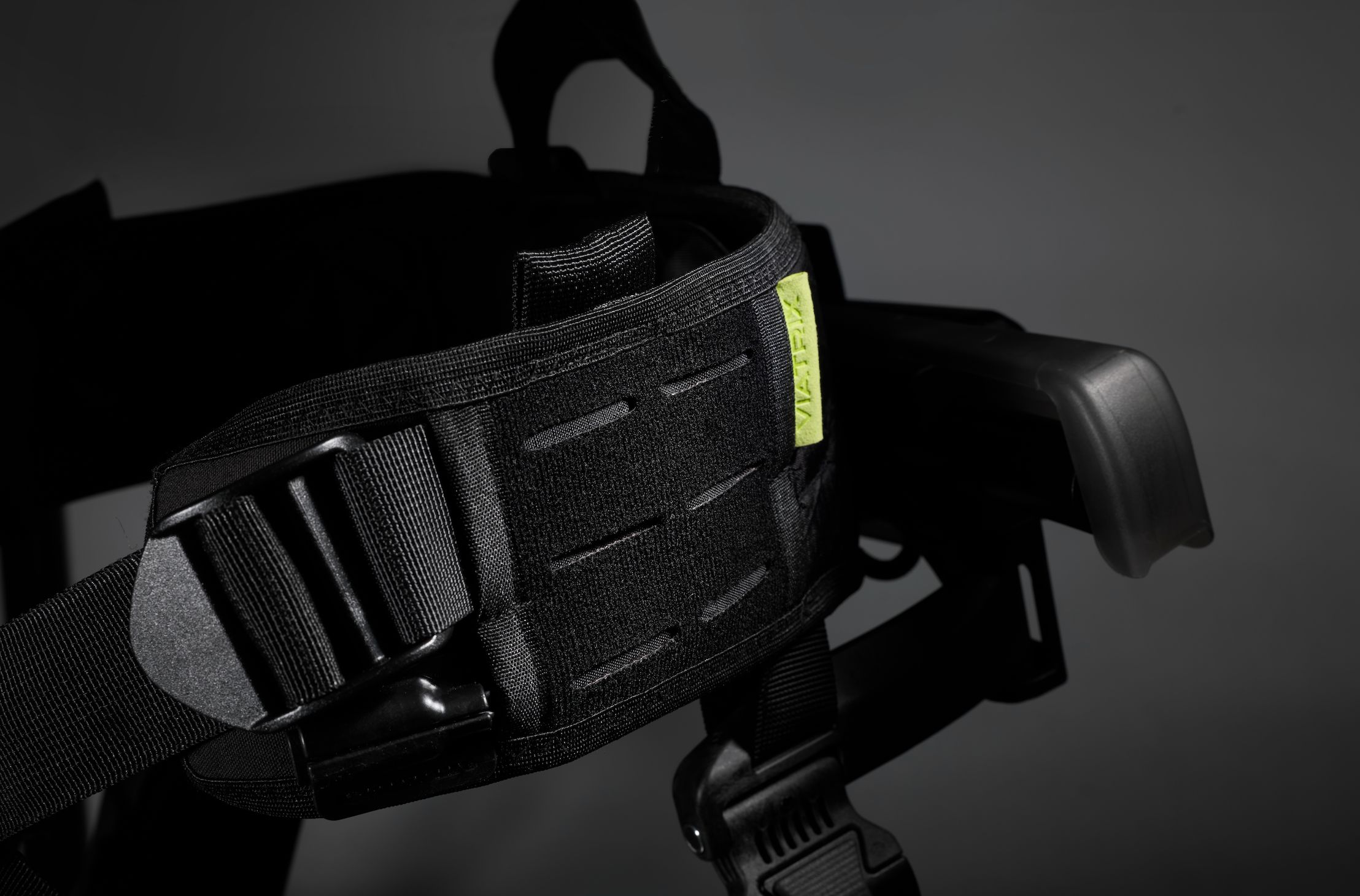
VIATRIX X MOLLE Quick Release System (Source/Enterprise)
VIATRIX X also uses a vehicle-grade gait recognition chip, and compresses the response time of the AI adaptive algorithm to 0.5 to 1 millisecond. This allows the device to quickly follow the user's rhythm and intervene proportionally according to the stride length in each step.
"The essence of the exoskeleton's assistance logic is not to replace humans, but to complement humans. Human movement is a continuous process of 'intention-force-adjustment'. If the device wants to truly integrate into this closed loop, it must answer two questions at the same time: how much assistance to provide, and when to provide it." Xu Zhenhua pointed out, "Therefore, the exoskeleton is ultimately not a tool, but a set of wearable collaborative systems."
Users may not be able to perceive these capabilities one by one, but they determine the stability and completeness of the product in real scenarios. It is these details that make VIATRIX X not a trial sample only for geeks to try out, but closer to a consumer-grade product that can be used daily.
From Industrial Scenarios to the Wilderness
Aosha's entry into the outdoor track is not a hasty business turn under the market trend.
In the early stage, Aosha's industrial exoskeletons mainly served handling operations. Although they had walking capabilities, since most of the time workers focused on lifting heavy objects, the demand for continuous long-distance walking was not prominent.
Around 2023, a number of industrial customers in power inspection, forest fire protection, and border patrol put forward new demands. In order to meet the needs of long-time mountain trekking, smaller devices that focus on walking load reduction are required. To this end, Aosha made a center of gravity adjustment in product definition, weakening the heavy load handling capability, and putting lightweight and walking assistance in the first place in the design.
Until 2024, Arc'teryx released the MOBILE knee assistance system, which quickly ignited the market's awareness. This also made Aosha see the opportunity to enter the pan-consumer market.
However, Aosha did not simply turn to the consumer electronics logic. For VIATRIX X, this exoskeleton derived from the industrial system is actually targeting a larger pan-outdoor group. The most typical ones are middle-class white-collar workers who sit in the office for a long time on weekdays and go hiking in the mountains on weekends.
The wilderness is different from the paved and flat road surface in the factory. Turning, crossing ditches, sideways avoiding, and adjusting posture on ramps are all normal situations.
Since the movement of the human hip joint is a multi-axis compound movement, the mechanical rotation axis of the traditional rigid exoskeleton is offset from the axis of the human biological joint. Therefore, many exoskeleton products perform well in laboratory and flat road tests, but once they enter the complex mountainous area, there will be discomforts such as hip jamming and friction, which will directly ruin the outdoor experience.
This is exactly why Aosha insists on independently developing the Float360 four-degree-of-freedom floating hip joint architecture.
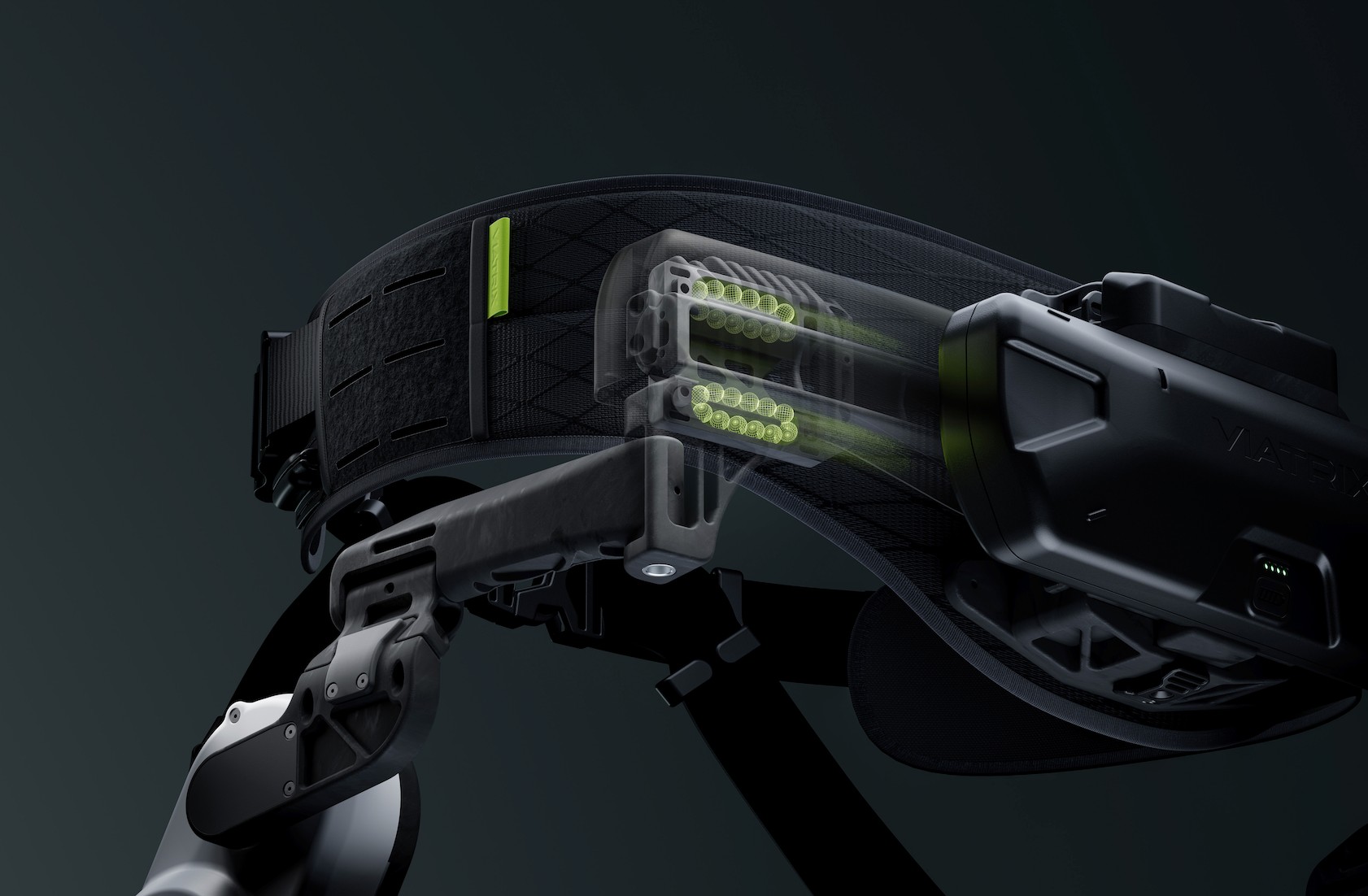
Float360 Ball Bearing Structure (Source/Enterprise)
"The human hip joint is very flexible and can move in three main directions. The four-degree-of-freedom floating exoskeleton hip joint we developed can fully cover the movement trajectory of the human thigh and hip joint." Xu Zhenhua told 36Kr. Most of the hip joints of traditional exoskeletons have only one or two rotating shafts, which essentially use mechanical structures to define the human movement trajectory.
Float360 arranges multiple sets of floating joints between the hip and the thigh, opening up the originally locked movement dimensions, so that the rotating shaft of the exoskeleton is no longer fixed at one point, but adjusts in real time with the human posture, which fits the compound movement trajectory of the human hip and thigh better, and reserves sufficient follow-up redundancy for limb movements.
The design idea of Float360 also reflects the consensus that is being formed in the consumer-grade exoskeleton industry: the competition of multiple degrees of freedom is never to compete for the paper number of rotating shafts, and the core is to reconstruct the relationship between human and machine.
"The value of the so-called effective degree of freedom is to return the initiative of movement to the user, and superimpose assistance on the premise of completely retaining the human's original movement ability." Xu Zhenhua said.
However, it is difficult for outdoor people to establish a personal perception of this design concept only through online texts and demonstration videos. To this end, Aosha chose to cooperate with Haglöfs, the leading Swedish outdoor brand. The target users of the two are highly overlapping, both targeting outdoor enthusiasts who love hiking and mountain trips.
Relying on Haglöfs' offline resources, Aosha has set up regular experience points, where users can directly go to the store to wear the exoskeleton in person, and intuitively feel the degree of freedom and assistance effect. Through real trial experience to complete cognitive education, it gradually precipitates user minds in the core outdoor circle.
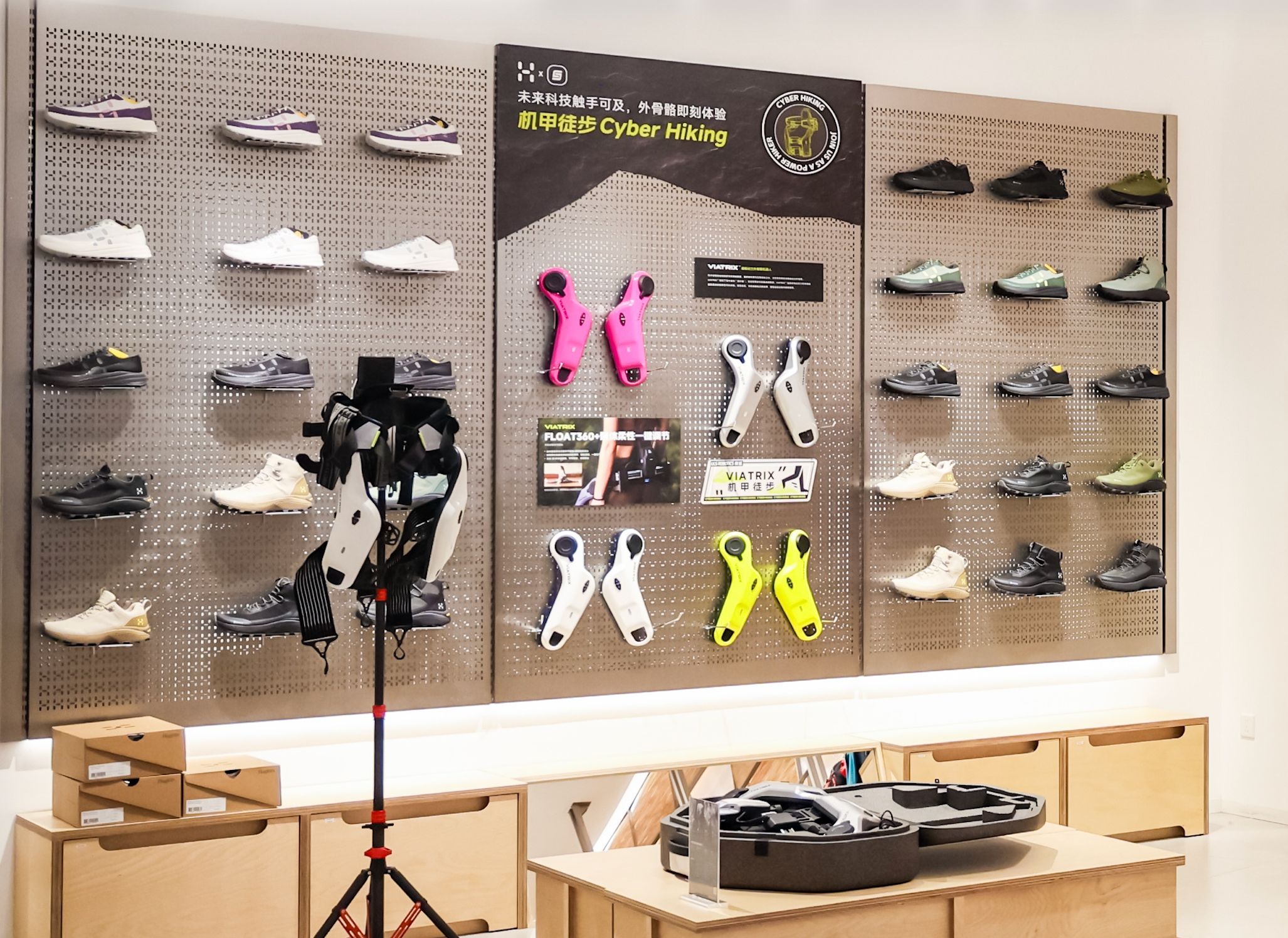
Aosha's exoskeleton products are exhibited in Haglöfs' store (Source/Enterprise)
In Xu Zhenhua's view, human beings can never do without the support of technology when entering the wilderness. Jackets solve the problem of waterproof and heat preservation, carbon fiber materials realize the lightweight of equipment, and trekking poles provide physical support; while exoskeletons go a step further, it is a set of intelligent devices that output mechanical assistance.
Similar to auxiliary jackets and other equipment, the ultimate proposition of exoskeletons has never been to create "supermen", but to learn how to respect the human body.
It will not eliminate the fatigue of hiking itself, nor can it replace the human's experience and persistence in the wilderness, but it can allow people to walk further, and have the opportunity to reach the mountains that are difficult to reach by their own physical strength.