Stanford postdoc working on flexible tactile sensors secures another 100 million yuan-level financing | HardKr Exclusive First Report
Author | Nan Huang
Editor | Silai Yuan
36Kr has learned that Tujian Technology (Beijing) Co., Ltd. (hereinafter referred to as "Tujian Technology") has recently completed a 100 million-yuan Pre-A++ round of financing, jointly led by the Beijing Artificial Intelligence Industry Investment Fund and the Beijing New Material Industry Investment Fund managed by Shunxi Capital. The funds will be mainly used for R&D of underlying core technologies, construction of automated production lines and process iteration, improve the supporting supply chain for embodied intelligent data collection tools and consumer-grade terminals, and accelerate the transformation of technological achievements into end products.
Since its establishment, Tujian Technology has focused on the R&D and manufacturing of stretchable multimodal flexible electronic skin and tactile perception systems. Taking tactile gloves, Ego vision collection solutions and SDK as entry points, it has deployed tactile data collection, multimodal time synchronization and tactile model algorithms. Lai Jiancheng, Founder and CEO of the company, has long been focused on research in the fields of flexible electronic skin materials, devices and system integration. He once engaged in postdoctoral research in the laboratory of Academician Zhenan Bao at Stanford University, and led a number of national key projects such as the first batch of sub-projects for disruptive technology innovation under the National Key R&D Program of the Ministry of Science and Technology of China.
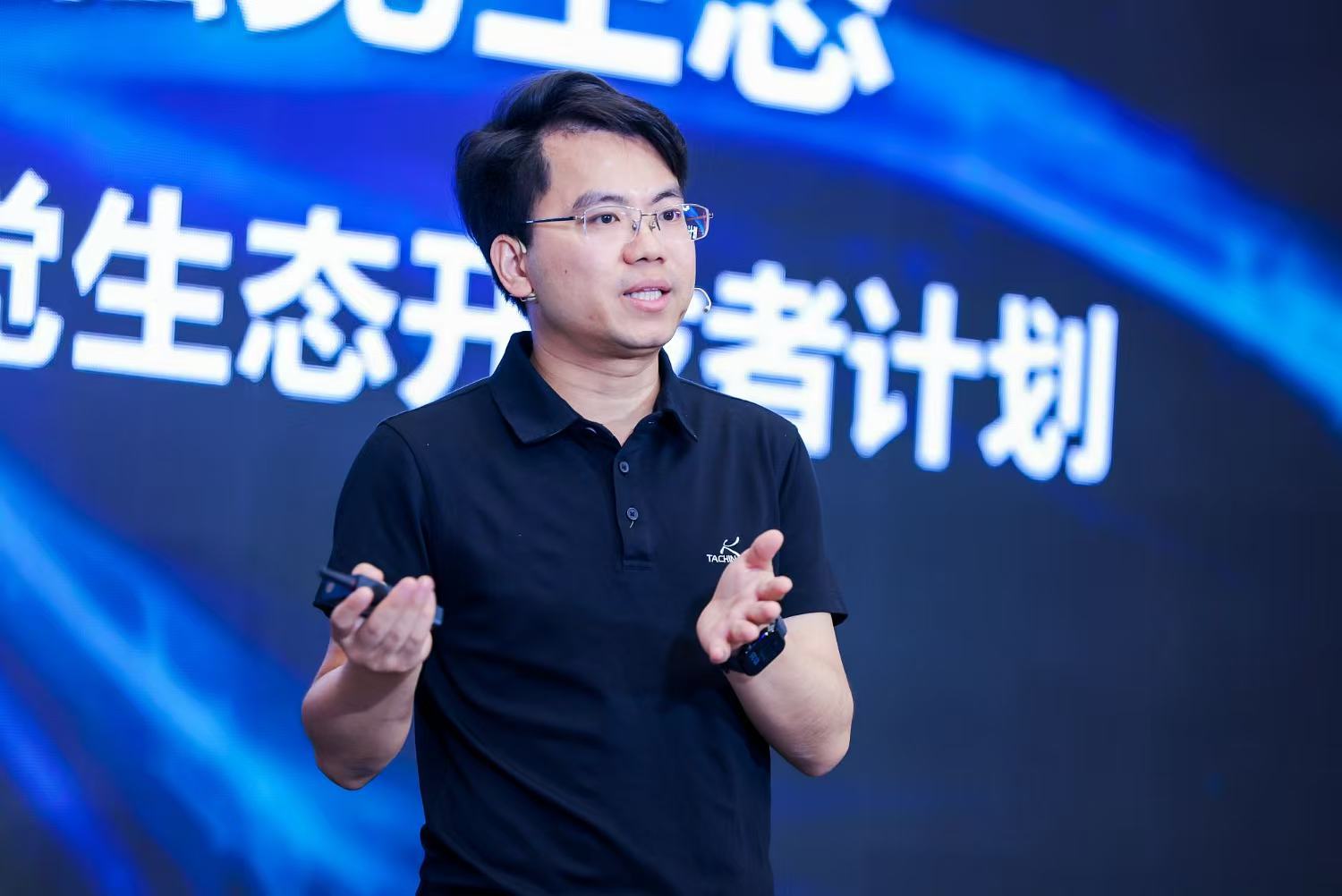
Lai Jiancheng, Founder and CEO of Tujian Technology (Source: Enterprise)
Tactile sense is becoming a key puzzle piece for embodied intelligence to move from "being able to move" to "being able to work reliably".
In the past few years, the industry's technological breakthroughs have mainly focused on two major directions: visual perception and motion control. Relying on visual models, robots can identify the environment and locate objects; combined with motion control algorithms, they can plan travel routes and replicate complex limb movements. However, most of these capabilities belong to long-distance perception and non-contact motion execution. Once robots perform fine physical interaction tasks such as grasping and assembly, it is difficult to directly obtain mechanical information such as contact force and deformation only by vision, and the perception shortcomings will emerge accordingly.
Different from vision, which can rely on massive public images and videos on the Internet to complete training, tactile sense currently lacks ready-made reusable large-scale corpora. Information such as the magnitude and direction of force, stress distribution on the contact surface, slip trend and temperature difference in physical interactions such as grasping, pressing and sliding usually need to be generated and collected at the moment of real contact.
A stable and usable tactile perception system needs to accurately locate contact points, maintain stable signals, and achieve complete and consistent sampling on the contact surface.
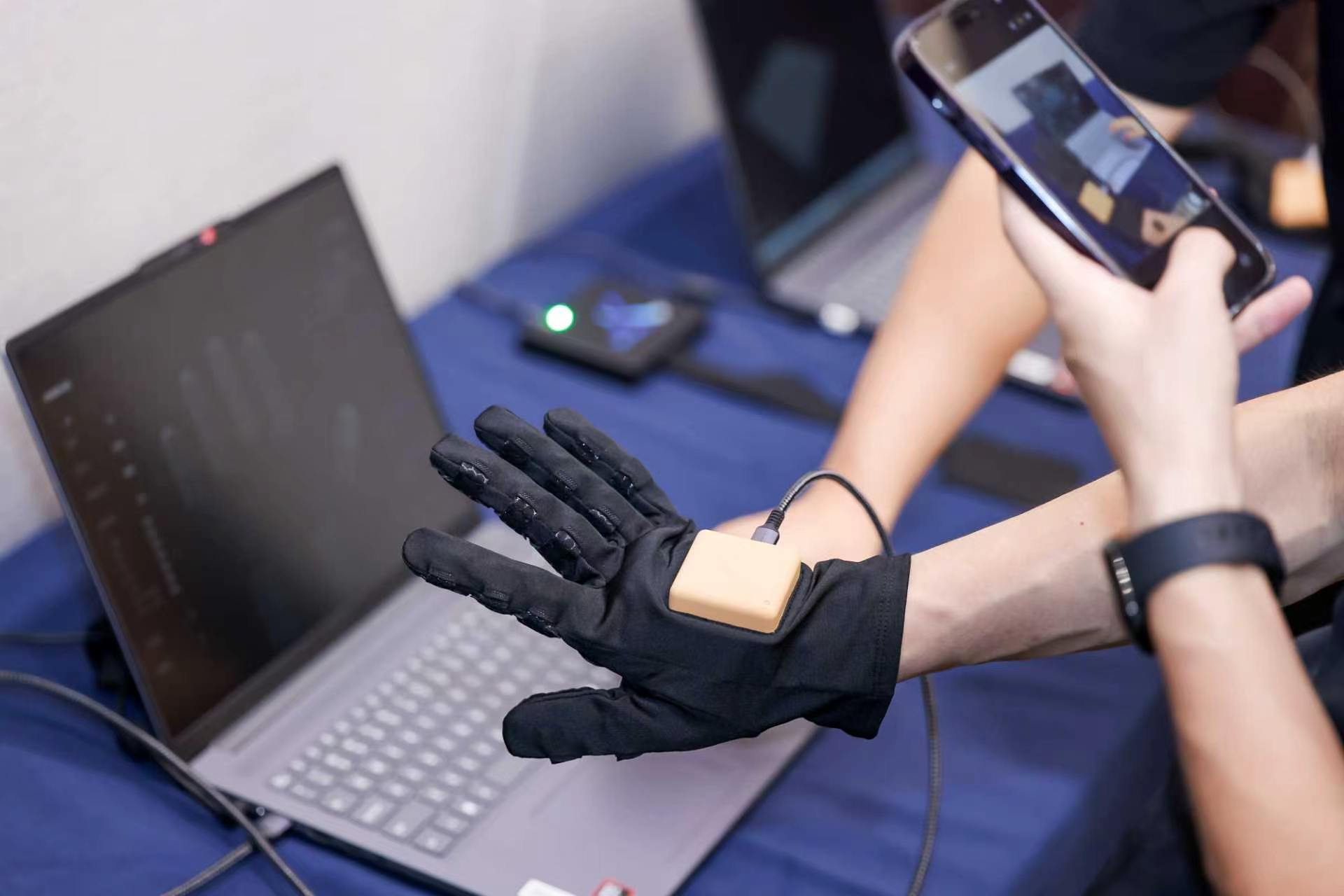
Tactile Data Collection Glove of Tujian Technology (Source: Enterprise)
Underlying materials and device processes are the foundation for achieving this goal. The flexible electronic skin tactile perception system of Tujian Technology adopts a self-developed elastomer composite electronic paste system. While controlling costs, its stretch rate exceeds 100% and it can fully rebound, with a bending radius of less than 1mm. It can adapt to special-shaped complex curved surfaces and improve the use stability under dynamic deformation scenarios.
On this basis, a single piece of electronic skin integrates a multimodal sensor array, and the standard product is equipped with 400 sensor units per square centimeter; relying on topological structure design, it can synchronously collect multi-dimensional information such as pressure, temperature, tangential force, surface texture and proximity perception. Among them, the proximity perception can detect the approaching of an object from a maximum distance of 20 cm before it touches; the tangential force sensor obtains tangential force information at different positions on the curved surface through single-point perception and array design.
Reliable and stable perception realized by hardware is only the first step. How to continuously obtain high-quality tactile data and make models use these data effectively is the next hurdle for tactile technology to move towards embodied intelligent applications.
The TachinGlove flexible tactile data collection glove launched by Tujian can collect multimodal information such as normal force and tangential force, with thousands of sensing points, and can perceive tiny forces at the mN level. The core empty-grasping no-noise signal design provides a source solution for improving the purity of tactile data and reducing subsequent cleaning costs.
With a good hardware entry, it is also necessary to realize stable large-scale acquisition of high-quality tactile data, complete time alignment of multimodal information, and finally output effective information that can be directly called by the model.
At present, one important path is to complete data accumulation with the help of wearable tactile collection devices. Operators wear tactile gloves to complete various practical operations, and the equipment synchronously records tactile signals, picture information and hand postures, transforming human operation experience in the real physical world into multimodal training materials that robots can learn. Its advantage is that it can continuously accumulate tactile-vision-pose aligned data in real operations without waiting for the maturity of the complete high-degree-of-freedom dexterous hand.
However, wearable collection is not simply integrating sensors into the glove body. The key is whether the output data can meet the requirements of model training. If there is a time difference between the tactile signal and the visual picture, the information of "seeing" and "touching" will be difficult to correspond, which will affect the training effect.
To solve this problem, Tujian launched the TachinGlove tactile glove with a supporting self-developed Ego solution, which realizes millisecond-level time alignment between tactile sense and vision; customers can also use the official SDK to perform data synchronization calibration on their own Ego devices. After alignment processing, the tactile data has the basic conditions to access the multimodal training link.
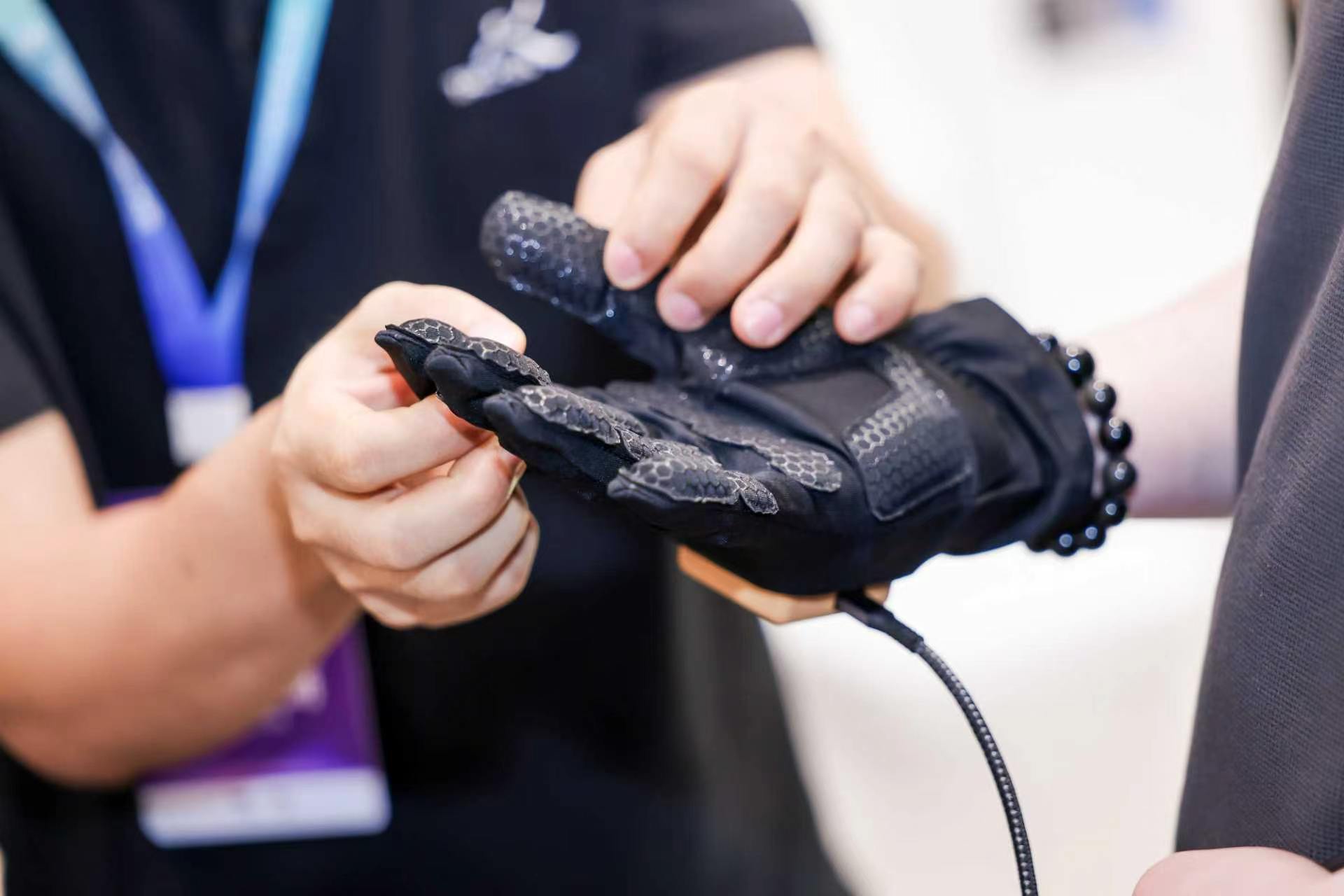
Tactile Data Collection Glove of Tujian Technology (Source: Enterprise)
In addition, one month after the official release of TachinGlove, Tujian launched the TachinGlove Snap quick-release version, which enables the collection module to be reused, making it more suitable for high-frequency and multi-batch data collection scenarios, and supporting the large-scale accumulation of high-quality tactile data.
However, it is far from enough to only complete data collection and time synchronization. Downstream customers will not directly parse the underlying original electrical signals output by the sensor dot matrix, but need more processed high-level semantic outputs: identify contact events, judge interaction states, and output standardized results that can be directly connected to the system. "Some customers are not willing to process the underlying sensor signals, but prefer to get the output that has been parsed, such as what kind of contact behavior has occurred and what characteristics the interactive object has, so that it can be directly connected to the model and control system," said Lai Jiancheng.
This also means that the capability boundary of tactile enterprises cannot be limited to hardware manufacturing, and algorithm and model capabilities are equally crucial. Based on the aligned tactile data, Tujian is building a tactile expert model, focusing on capabilities such as contact semantic understanding, slip detection, spatial force analysis and multi-source time alignment, to explore VTLA multimodal fusion of tactile sense, vision, language and motion control.
From the perspective of industrial applications, the value of wearable tactile collection devices has long gone beyond the sensor hardware itself, but to build a reusable data base for the entire tactile intelligence track. Only when stable collection, precise synchronization and modeled analysis are connected to each other, can tactile data be transformed from original signals to reusable training and interactive information.
At present, Tujian takes materials and device processes as the foundation, takes tactile gloves and consumer-grade electronic skin as product entry points, and superimposes the upper-layer capabilities of high-precision data synchronization, tactile expert models and VTLA multimodal fusion, further building a complete tactile perception solution of "hardware + data + model".
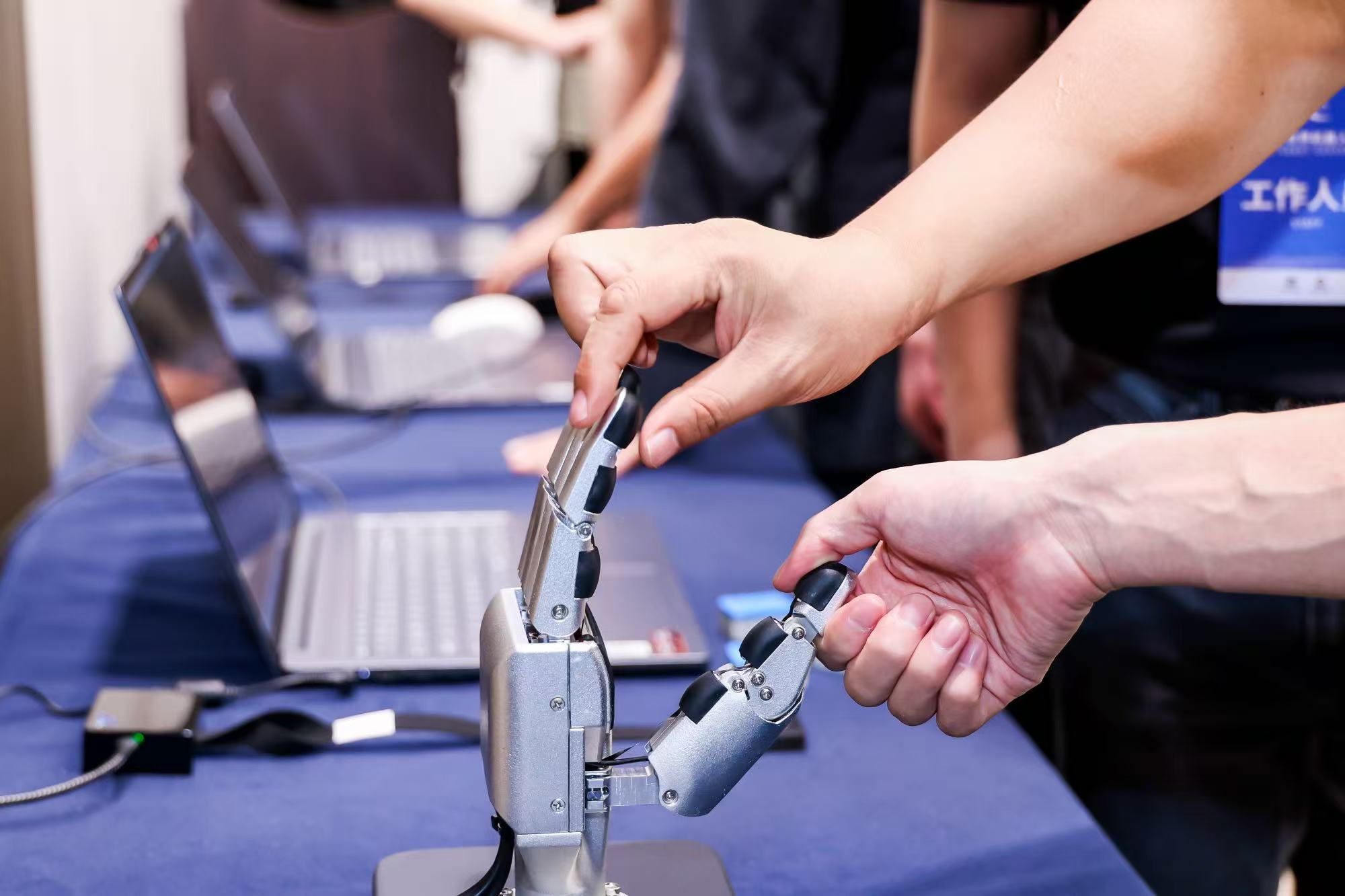
Application of Tujian's Flexible Tactile Technology on Dexterous Hands (Source: Enterprise)
In terms of commercialization progress, Tujian Technology has not bet all its stakes on the embodied intelligence track. On the one hand, the company provides full-coverage tactile solutions for dexterous hands, anti-collision solutions for robotic arms and whole-body perception solutions for robot ontology enterprises; on the other hand, it extends its technology to scenarios such as intelligent vehicles, consumer hardware, health monitoring and emotional companionship, landing products such as intelligent cockpit perception and anti-pinch systems, intelligent sleep monitoring mattresses, plantar posture rehabilitation perception devices, and AI interactive dolls.
In different business scenarios, the core demands of customers have different focuses. Embodied intelligence in the R&D stage pays more attention to the adaptability of solutions; consumer-grade hardware puts forward higher requirements for cost, device life and mass production consistency.
At present, some dexterous hand projects are still in the stage of small-batch customized development, and the product knuckle structures are quite different. The cost of mold opening and labor allocated to a small number of samples pushes up the unit price. In contrast, consumer hardware usually has standardized orders with a minimum order quantity of 100,000 units, and one set of molds can be put into production continuously, which can fully spread all the investments such as mold opening, process and labor, and reduce the unit cost of devices to a lower level.
Lai Jiancheng said, "Relying solely on small scientific research orders in the robotics field, it is difficult to achieve large-scale cost reduction of tactile devices. We need to complete the cost closed loop of the entire supply chain with the help of standardized mass production on the consumer side."
From embodied intelligence to consumer-grade applications, Tujian Technology is verifying a complete path from material innovation to system output. According to the plan, the company will build an automated production line in Beijing, upgrading the preparation of flexible electronic skin from the manual intermittent mode to continuous manufacturing, so as to improve the large-scale delivery capacity.
The following is an excerpt of the interview between 36Kr and Lai Jiancheng, Founder and CEO of Tujian Technology (slightly edited):
36Kr: Has the industry formed a relatively unified consensus on the technical route of tactile interaction at present? What dimensions are the main engineering bottlenecks concentrated in?
Lai Jiancheng: The industry has formed a preliminary consensus on the key evaluation dimensions of tactile sensing systems. Two points are particularly critical: one is the spatial distribution capability of sensor units, and the other is the fidelity and accuracy of output signals.
In actual development, the first thing to avoid is the spatial sampling positioning deviation. If the contact point acts on the left side of the array, but the coordinates output by the sensor are biased towards the middle, such spatial positioning error will directly cause misjudgment of the system algorithm and affect the functional reliability.
Another type of problem is the perception blind area of the sensor array: when the external force is loaded uniformly and the stress is distributed diffusely, if there are missing local sampling points inside the array, forming a perception cavity similar to "alopecia areata", the consistency of the global tactile perception will be destroyed. When attending industry exhibitions, I usually directly conduct actual machine tests such as pressing and rubbing on many exhibited prototypes. Some problems that are not easy to appear under laboratory calibration conditions may be exposed in tests closer to real usage scenarios.
The entire industry is still solving the engineering problems of tactile sensing. According to feedback from some downstream customers, some solutions have problems such as frequent calibration requirements and sensor signal drift; even if the continuously changing analog signal is simplified to trigger judgment, false triggering or missed triggering may still occur. To enter practical applications, long-term stability and signal consistency must stand the test of verification.
36Kr: There are many participants in the tactile sensing track at present. From the perspective of the industry, how do you view the competition pattern in the next 1 to 3 years?
Lai Jiancheng: A large number of peers have poured into the track now, and I think this is a positive signal. But we need to see that the real competitor of current tactile technology is not similar solutions in the industry, but the pure vision solution.
Since the rise of embodied intelligence, there has always been a view that relying solely on visual information can solve most perception tasks of robots, and tactile sense is not a necessity. But what tactile sense needs to prove is that without tactile perception, many tasks cannot be completed with high quality — vision can replicate the appearance of actions, but cannot capture the physical essence behind contact interaction.
More entrants now mean that the industry is maturing, but what kind of pattern will it eventually move towards? The core foothold is to make truly adaptable and implementable products that meet the needs of embodied intelligence, and there are two basic bottom lines: one is the adaptability of shape and form, and the other is the fidelity of sensing data.
Just making usable hardware is already a huge challenge. Tactile sensors are brand new self-developed devices that require continuous R&D in materials, devices and processes. It is not like some tracks where finished products can be assembled by integrating existing parts. This is somewhat similar to the flexible display industry in the early years, when a large number of start-ups emerged and targeted the flexible display track; but only after truly making products that meet the performance standards and meet the actual needs of terminals, and solving hard indicators such as form adaptation and bending reliability, did the industry complete a round of convergence. This is a very test of the comprehensive engineering strength of enterprises.
In the next 1-3 years, our primary goal is to realize the large-scale mass production of high-performance and highly reliable tactile sensor devices, and at the same time build the capability of deep collaboration with embodied intelligent customers. Enterprises cannot only stay at the level of hardware delivery, but also need to convert tactile information into structured representations (tokenization) that can be called by models to reduce downstream integration costs.
Therefore, looking ahead, tactile enterprises with long-term competitiveness must not only master manufacturing capabilities, but also make up for algorithm and model capabilities, form the comprehensive capability of software and hardware integration, and carry out deep collaborative development with downstream customers.