Without slaying monsters or fetching Buddhist scriptures, the wildly popular "2026 Edition of Journey to the West" hits a raw nerve with office workers.
Audiences see workplace burnout, the hardships of daily life, and reflections of themselves and their colleagues in the show — some, like Sun Wukong, work their hardest with real efforts but keep getting blamed for others' mistakes; some, like Zhu Bajie, are lazy and fond of good food, and keep shifting responsibilities to others; still others, like Tang Sanzang, only talk about plans without taking action, only mention dreams but never raise salaries.
The journey to the West is long, and demonic troubles do not appear often. When the 81 tribulations have not come, what can the four masters and apprentices do every day? In the past, audiences rarely thought about this question and could hardly guess the answer, until the recent 2026 version of Journey to the West — "Heroes of the West Tour" came out of nowhere, this seemingly absurd assumption finally got its answer, and they even created the most popular live-streaming footage of this summer.
In the footage, there are no Black Wind Demon, Yellow Wind Monster, no White Bone Spirit, Bull Demon King, nor are all the Buddhas and deities online. All there are four young people in costumes holding props, improvising the daily life of the "no demon version" Journey to the West in front of the live camera.
The whole process has no script and no preset lines, only retaining the core settings of the characters: Tang Sanzang still twists the prayer beads and mumbles nonstop, but instead of reciting scriptures, he is drawing empty promises for the three accompanying people; Sun Wukong still scratches his ears and cheeks, jumps up and down, and from time to time performs a set of stick tricks, but he is no longer afraid of Tang Sanzang's Tightening Curse, and when angry, he will even take off the golden hoop and throw it on the ground; Zhu Bajie retains his true nature of gluttony, and still speaks sharply to Tang Sanzang; Sha Wujing, as always, is an honest man, working silently without making a sound.
What makes the audience feel even more bizarre is that many modern "magic tools" also appear in the footage: edible oil in a bottle, a modern wok that has been kept shiny and oily, with several Chinese cabbages placed next to it. The highly dramatic and contrasting scenes have attracted many netizens to leave messages: "Tang Sanzang and his disciples are finally eating well, even Chinese cabbages have appeared." This is not at all a pilgrimage for scriptures, it is clearly a spoof. But for some reason, this live broadcast that does not require chasing monsters and has no immortals coming to the rescue, unexpectedly makes people watch with great interest.
In the live streaming room, Journey to the West has reached the "2026 Version"
At 11:20 every noon, in a small forest in the Linhai Ecological Expo Park in Shouguang City, Shandong Province, four young actors in costumes start the live broadcast on time. There is no script, no rehearsal, and even no clear division of labor, everything depends on the four people's on-the-spot performance. They set up a large iron pot, take out a Chinese cabbage and a small handful of enoki mushrooms, and start the live broadcast of cooking, teasing each other and acting crazily.
This seemingly unserious live broadcast has unexpectedly become a fixed program for countless netizens to watch while eating lunch. Relevant data shows that when the four are live streaming, the maximum number of simultaneous online viewers in a single live session reaches 400,000, the total views of a single live session once exceeded 13.9 million, and they gained more than 4.7 million fans in three months. Some netizens gave this series of live broadcasts a resounding name — the "2026 Version of Journey to the West".
This live broadcast based on the classic IP has gradually grown from a small-scale attempt to a phenomenal hit this summer. The famous scenes born in the live room first made the online audience laugh nonstop, and then spread across the Internet through countless short clips, becoming a hot topic across the entire network.
The most classic scene is no more than Tang Sanzang's "pointing a stone as mother". One day, Tang Sanzang smiled and held out a stone painted with a smiling face, solemnly handed it to Sun Wukong, and said pointedly: "Your mother is smiling." This teasing operation instantly made Sun Wukong fly into a rage, and the live room was quickly flooded with bullet comments. Many netizens exclaimed: "This Tang Sanzang really knows how to annoy people." Some netizens who later brushed to this clip couldn't help but sigh: "How did I miss this episode!"
Another famous scene comes from Tang Sanzang's "ineffective management PUA". Sun Wukong is burying himself in chopping wood and making a fire to cook, almost wishing to call all his monkey grandchildren to help, but Tang Sanzang is taking it easy in the shade, not forgetting to taunt: "If I knew this would happen, I should never have rescued him from under the Five Elements Mountain in the first place." Sha Wujing, who mindlessly echoes, immediately says: "Master is right!" Zhu Bajie also adds fuel to the fire on the side. Under the pincer attack from three sides, Sun Wukong finally explodes, looks up and roars: "Did I beg you to save me?" As he speaks, he jumps three feet high. The funny and playful scene instantly reminds people of young people in the workplace who stay up all night working overtime, but are emotionally manipulated by their leaders.
On social platforms, some people even connect this scene with the original Journey to the West, proposing that Wu Cheng'en's Journey to the West is not a myth at all, but a revelation of the workplace. In the book, everyone has their own workplace positioning: those monsters with backgrounds that are rescued are "connected people" in today's society; those monsters without backgrounds that are killed are "Qi Tongwei" who have no resources, no backers, and are eventually shot dead.
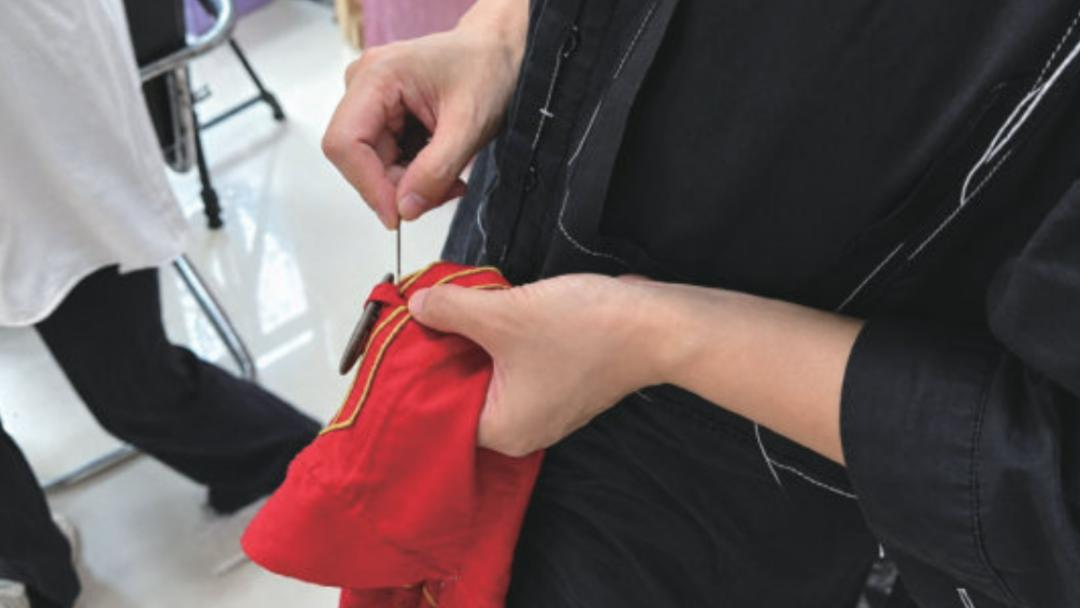
Sun Yu, the actor who plays Zhu Bajie, personally processes the props and costumes. (Picture/Screenshot of the "Heroes of the West Tour" video)
This live broadcast method that translates Journey to the West in a contemporary way brings the live stream closer to the audience, allowing them to empathize with each other. If you observe carefully, you will find that although the four actors have stepped out of the mythical narrative of the original work, the character settings of the four masters and apprentices have not changed much. Audiences see workplace burnout, the hardships of daily life, and reflections of themselves and their colleagues in the show — some, like Sun Wukong, work their hardest with real efforts but keep getting blamed for others' mistakes; some, like Zhu Bajie, are lazy and fond of good food, and keep shifting responsibilities to others; still others, like Tang Sanzang, only talk about plans without taking action, only mention dreams but never raise salaries.
Some netizens summed it up brilliantly: "It's like watching a real record of workplace survival." This sentence shows the authenticity of the "2026 Version of Journey to the West".
Becoming Popular is No Accident
After taking off the heavy costumes and removing the thick makeup, when the actors of the "2026 Version of Journey to the West" return to their real lives, they are no longer performers in front of the camera, but real, flesh-and-blood people.
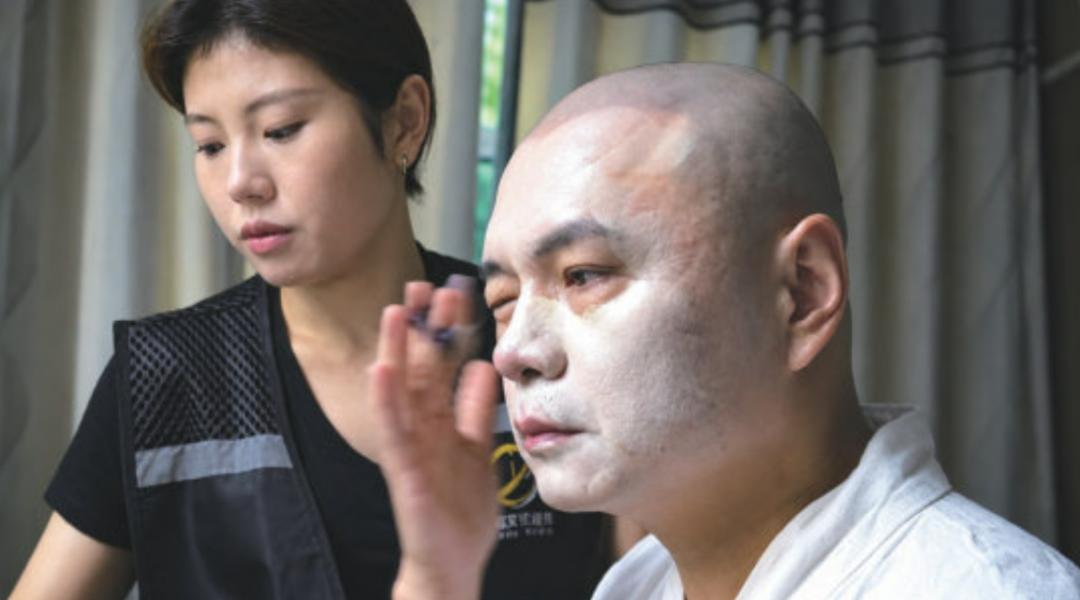
Before the performance, in order to finish the makeup quickly, Tang Sanzang's actor Jia Hui does it by himself. (Picture/Screenshot of the "Heroes of the West Tour" video)
This seemingly temporarily formed, error-prone "amateur troupe" actually has a strong background: Jia Hui, the actor playing Tang Sanzang, has more than 20 years of stage experience and has been touring for performances since he was 18 years old; Wang Wei, who started learning monkey opera at the age of 12 and has nearly 20 years of experience now, plays Sun Wukong; Sun Yu, the actor of Zhu Bajie, stepped onto the stage at the age of 13, polished the image of Zhu Bajie for nearly 20 years, and is now the fourth-generation inheritor of the national intangible cultural heritage of vocal mimicry; Da Xiang, the actor of Sha Wujing, does not have a professional background, but his tall figure and quiet characteristics perfectly fit the character's setting.
For the four of them, the popularity of the live broadcast is unexpected, but also reasonable. After all, professionalism is the foundation, and passion is the driving force. In the process of performing, they have laughed, made fun, and even got injured, but they never gave up.
One of the hardest factors is to overcome the hot summer in Shandong. During the long daytime, the whole of Shandong is like soaked in hot air, and the temperature in the forest where they live stream often soars to 40℃. The headgear, masks on their heads, and the costumes on their bodies, when the weather is hot, become "torture devices", making them like steamed buns on a steamer, sweating profusely and struggling to breathe.
After a live broadcast, it is normal for them to be soaked in sweat, but this is only the low-level difficulty. In an interview with the media, Jia Hui shared an incident: when he was lifted up by other actors, he accidentally fell to the ground, causing a rib fracture. But that day, he endured the pain and insisted on finishing the live broadcast, just to keep the performance in the camera going.
At that time, no one knew Tang Sanzang's pain, they only saw him teasing Sun Wukong and Zhu Bajie, bickering and joking, and he used playful banter to hide the severe pain in his body. It has to be said that this performance is really professional, which is even more valuable in the case of unscripted live broadcast.
This may be another reason why the four's live broadcast became famous. Under the premise of live streaming without scripts and preset lines, and achieving certain program effects, the skills they possess are by no means just talk. Improvisational performance has become the best antidote for them to cope with unscripted live broadcasts. There are no lines to recite, no camera shots to retake, every word and every expression is happening in real time, which is exactly the charm that no carefully edited short video can replicate.

The shooting site of "Heroes of the West Tour" has attracted other live streamers to watch. (Picture/Screenshot of the "Heroes of the West Tour" video)
In the live streaming market, actors with professional backgrounds like them are often the first choice for many MCN companies when recruiting. According to statistics from the Douyin platform, there were 128 million performing arts live broadcasts on Douyin in 2025, with an average of more than 350,000 sessions per day. Among them, the growth rate of tips received by anchors relying on professional talents is much higher than that of ordinary live rooms, and the former is about 7 times that of the latter.
New Form Enters the Market, Grassroots Group Live Breaks the Stereotype
The explosive popularity of "Heroes of the West Tour" is not just the success of one live room, but also represents a new content form in the live streaming industry — the rise of group live broadcast.
For a long time in the past, the most active live streaming method on various platforms was individual live broadcast: one person facing the camera laughing or crying, singing or dancing, fighting alone to put on a show. Now, as a new form, group live broadcast not only inherits the stage show, but also introduces more roles. Members cooperate with each other to tell stories and perform improvisationally in a certain scene, creating unexpected program effects.
The China Online Performance (Live Streaming and Short Video) Industry Development Report (2025-2026) released at the 2026 China Online Performance Industry Annual Conference shows that the scale of China's group live broadcast market has exceeded 150 billion yuan, and group live broadcast has become a new engine for the growth of the live streaming industry.
"Heroes of the West Tour" just caught up with this trend, except that they do not attract the audience with dance, but retain the passing viewers through role-playing and improvisational performance, and their performance can be regarded as a unique variant of the traditional group live broadcast form. During the live broadcast, the four anchors have their own responsibilities — Tang Sanzang is in charge of "adding fuel to the fire", Sun Wukong is in charge of "flying into a rage", Zhu Bajie is in charge of "pouring oil", and Sha Wujing is in charge of "throwing a spanner in the works". As soon as the four stand there, the drama is ready.
At the same time, the way the audience participates has undergone qualitative changes. Audiences no longer passively receive content, but actively create and play with memes in the comment area — "The White Dragon Horse's dashcam footage leaked", "I just said I missed this episode when I watched Journey to the West as a kid"... These interesting secondary creations continue to spread, and in turn help the content break through the circle.
In this process, the audience has changed from bystanders to participants in content dissemination, and also become judges — some people question that their creation based on the background of Journey to the West is a blasphemy against the classic and disrespectful to the "Great Sage". But looking back at the more than 400 years since the birth of Journey to the West, it is not difficult to find that various derivative works such as operas, storytelling, and films and television works related to Journey to the West have emerged in endlessly, and most of the audience's cognition of this old IP is obtained through these "unofficial channels" — if you don't believe it, ask the people around you, the number of people who have watched the film and television version of Journey to the West must be more than those who have read the original work.
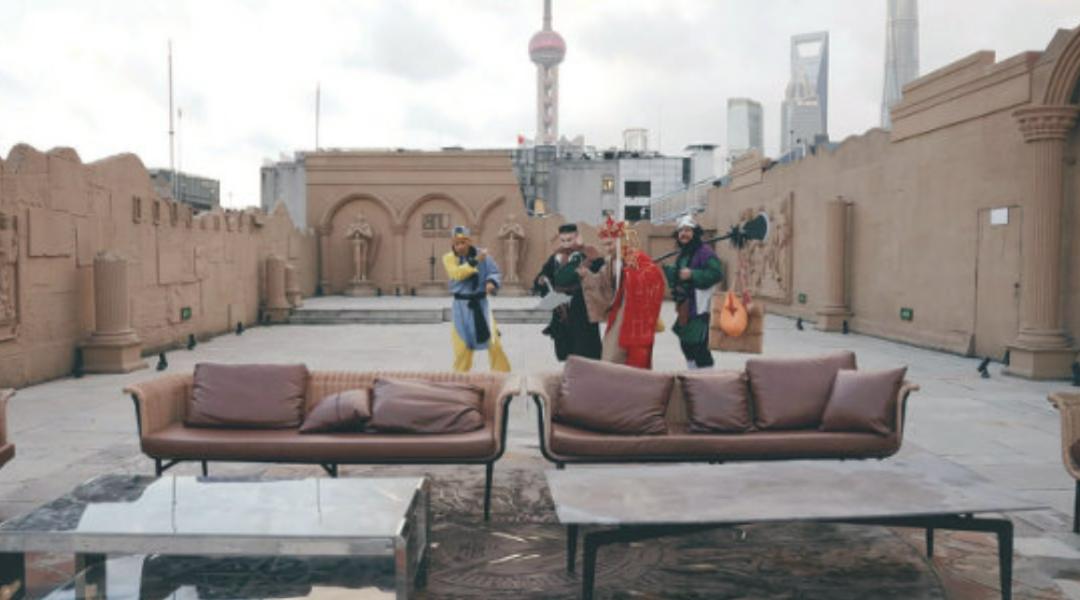
The four masters and apprentices of Tang Sanzang are shooting in Shanghai. (Picture/Screenshot of the "Heroes of the West Tour" video)
This is perhaps the most thought-provoking point after the popularity of "Heroes of the West Tour": classics cannot live in the present automatically, they need ferrymen of the new era. And the best way to ferry them may be to bring them into the daily life of ordinary people, turn them into a steaming "stew", turn them into the line "all the monsters are on the route you planned", and turn them into the expectation of 400,000 people waiting for an impromptu performance at the same time.
Now, looking back at the state of the four when they first started the live broadcast, people can't help but feel a trance, as if a long time has passed. At that time, Shouguang was still in the warm April sun, the weather was not hot, and there were not many viewers in the live room. Even the actors themselves could hardly believe that a few months later, "Heroes of the West Tour" would change from an unknown team to the "top stream" that is hotly discussed across the entire network.
For the audience, this period of time is very short, but for the actors, they have walked for a very, very long