After raising 300 million yuan in financing, she announced that her company had gone bankrupt.

Author / Chen Jia
Reporting / PEdaily
After 7 years of entrepreneurship, raising $50 million in financing and hitting a $250 million valuation, she chose to voluntarily shut down her company.
This is the story of well-known entrepreneur Yin Wu — recently, equity management platform Pulley announced that the company will cease all operations and services by the end of the year. As the founder, Yin Wu also shared this difficult decision on her social media accounts.

Yin Wu is known for being bold and free-spirited — she dropped out of Stanford University shortly before graduation to start her business in her early years, and has founded 4 startups. Now that she personally shut down the company she built over 7 years ago, it echoes a sharing she made many years ago by coincidence:
How to shut down a startup gracefully.
Dropped out of Stanford, she appeared on the cover of Forbes
Yin Wu, a Chinese female entrepreneur, has an impressive life resume.
In high school, she started learning programming to participate in science competitions, and became a finalist of the Intel Science Talent Search. Later, she was admitted to Stanford University to study computer science, and served as co-chair of the Stanford Entrepreneur Club.
However, in 2011, when she was only one semester away from completing her degree, Yin Wu chose to leave Stanford and join Y Combinator to start her business. As we all know, Y Combinator is a well-known American startup accelerator that has incubated tech companies including Airbnb and Stripe.
Her earliest startup project was AdRaid, a video advertising project that aimed to overlay brand logos into videos through technology. The project raised $1 million a week after its debut at YC Demo Day, but when it officially entered the market, advertisers and content creators did not come as expected.
In less than a year, AdRaid came to an end, marking Yin Wu's first entrepreneurial failure.
In 2013, she launched Prim, an on-demand laundry service company. But the number of people in the Bay Area willing to pay a high premium for laundry services was too small, and traditional laundries were both unavoidable competitors and suppliers. Prim announced its closure about half a month after its launch.
But this failure soon led to another product. While operating Prim, she and another founder were often interrupted by mobile notifications while driving, which led them to develop Echo, an Android lock screen application that sorts messages by importance. The app got millions of downloads, and was acquired by Microsoft in 2015.
Yin Wu later recalled that the money was not enough to change her life, but it exceeded all the money she had earned in her entire life before that.
It was not until she sold the company that she found out the equity she actually held was about 10% less than she had previously thought. As a founder, she could not even clearly tell how much company equity she owned, which became the starting point for founding Pulley later.
It was 2019 when Yin Wu and Mark Erdmann founded Pulley, targeting the equity management needs of startups, providing services including cap table management, employee stock options, financing modeling and 409A valuation.
The first 100 users of Pulley were almost all acquired by Yin Wu one by one, through hands-on onboarding. She learned from the early practices of Stripe, sitting directly next to founders before YC Demo Day, helping them register and get started with Pulley in person.
On the first day of Pulley's launch in 2019, Yin Wu set a goal for the team: finish building the product in 4 months, and sell it to companies from the same YC cohort in January of the next year.
This time, Yin Wu caught the market trend.
At that time, Silicon Valley was entering a new round of startup and financing boom. In 2021, US VC investment reached $329.9 billion, nearly twice the amount of the previous year. Hot money poured in, and new companies emerged. For Pulley, every new startup that was born could potentially become a new customer.
In this way, Yin Wu and Pulley took the first wave of dividends from the Silicon Valley startup boom, and even appeared on the cover of Forbes magazine.
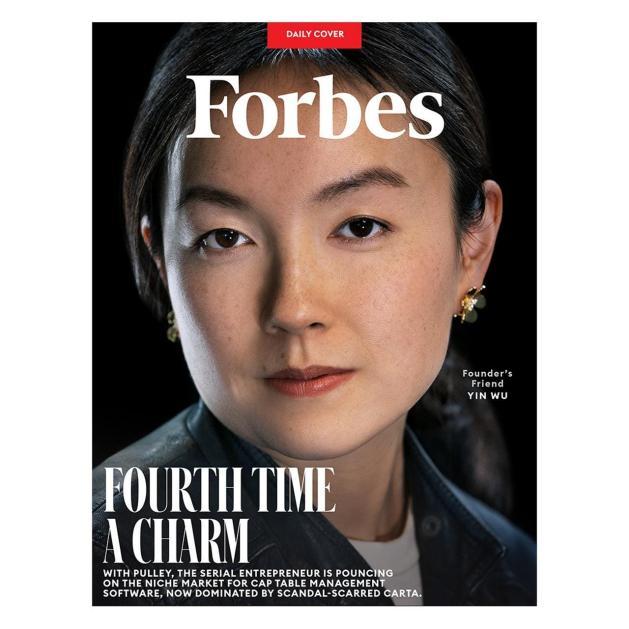
Raised $300 million in financing, chose to leave voluntarily
In 2024, Yin Wu and Pulley ushered in their highlight moment.
Objectively speaking, Yin Wu was not the first entrepreneur to enter the equity management market. When Pulley was founded in 2019, Carta, which was founded in 2012, had already served more than 13,000 companies and 800,000 equity holders; in the same year, Carta just completed a $300 million Series E financing with a post-money valuation of $1.7 billion.
Pulley kept catching up, and was highly expected by Silicon Valley, with investors coming in continuously.
In 2020, Stripe led Pulley's $10 million Series A round; in 2022, Keith Rabois from Founders Fund led a $40 million Series B round, with Stripe, Elad Gil, Jack Altman and Avichal Garg continuing to participate in the investment. According to Forbes, the two rounds of financing totaled $50 million (about 300 million RMB), and Pulley was valued at $250 million (about 1.6 billion RMB) at the Series B round.
Pulley's chance for a counterattack came on a weekend in January 2024.
At that time, its old rival Carta fell into a trust crisis. Karri Saarinen, CEO of project management software company Linear, publicly stated that an employee of Carta contacted its shareholders without Linear's consent, trying to arrange share sales. The CEO of Carta later apologized and shut down the company's secondary share trading business. Carta was serving about 40,000 companies at that time, and the incident soon alarmed the Silicon Valley startup community.
That Sunday night, Yin Wu's email kept ringing. According to Forbes, Yin Wu felt strange at that time, because usually no one would study a company's equity structure on a Sunday night. All the emails were messages from potential customers of Pulley, as Pulley helps startups track their equity ownership. Yin Wu immediately seized this opportunity.
A few months later, Yin Wu announced on LinkedIn that the company had just had "the best quarter in history", with the number of companies switching to Pulley hitting a record high. The number of Pulley's customers grew by 83% in 2024, reaching 7700.
No one expected that this highlight moment could not change the final outcome.
On September 15 this year, Pulley's official website announced that the company will cease all operations and services on December 8, and has established an exclusive migration partnership with Carta. Pulley not only asked Carta to take over its customers, but also suggested on its official website that all potential customers visit Carta directly.
Yin Wu did not announce the reason for the shutdown. A former employee who was once in charge of Pulley's marketing business mentioned that AI killed the company — Pulley's product itself was not bad, but when AI tools can already help companies organize and maintain spreadsheets, customers' willingness to pay more for a dedicated equity management software naturally declines.
Of course, there are other pressures. As early as 2024, Yin Wu reflected on the capital environment from 2021 to 2022 in a public interview at Stripe: investors kept urging the company to grow and spend money, but she was worried whether the customer acquisition cost could be recovered and whether the growth could be sustained. If she could do it all over again, she would run the company in a different way.
She used rockets and steam engines as a metaphor: rockets fly fast, but they will fall back to the ground when the fuel runs out. When money is almost free and the next round of financing always seems to be coming, startups can easily mistakenly think that their fuel is inexhaustible. Steam engines are slower, but they can keep moving forward by momentum.
The favorable wind that helped Pulley take off later really changed. More and more money is concentrated in a small number of large projects, especially leading AI companies. Data from PitchBook and NVCA shows that in 2025, AI companies accounted for 65.4% of total US VC investment, and the total financing of only five companies including OpenAI, CoreWeave, xAI, Anthropic and Databricks was close to $60 billion.
In the end, Yin Wu chose to shut down the company voluntarily and leave gracefully.
Entrepreneurship is tough, how to shut down a company gracefully?
Entrepreneurship is really hard.
Yin Wu once wrote her position on LinkedIn as "janitor", because a founder has to pick up all the work in the company that no one else does. Later she changed her title to "Customer Success". She once said that Pulley can only be successful when its customers are successful.
Later, investors suggested that she adjust her job title, thinking that as a female founder, "Customer Success" might not convey the entrepreneur image they expected.
According to data from PitchBook and the National Venture Capital Association, in 2025, all-female founding teams in the US only received about 1.1% of venture capital funds. Yin Wu is already one of the very few people who have successfully crossed those thresholds: she participated in the Y Combinator program three times, her lock screen app Echo was acquired by Microsoft in 2015, and later raised more than 300 million RMB in total for Pulley.
Apart from entrepreneurship, Yin Wu also has to face the pressure brought by another identity.
Her friend recalled on social media that the first time she met Yin, Yin had just given birth to a child not long ago, wearing a headband, and the cry of a baby could be heard from the video background from time to time. At that time, she was taking care of her newborn, running Pulley, and sharing with other entrepreneurs how to manage the company, the team and the family at the same time.
Entrepreneurship itself is something against human nature. People are used to pursuing certainty, but entrepreneurs have to keep betting on the unknown; people instinctively resist denial and setbacks, but entrepreneurs have to face reality repeatedly: the product is not accepted by the market, business judgments go wrong; people can't let go of the time and cost they have invested, but entrepreneurs have to personally shut down the company they built from scratch.
Yin Wu once said in an interview that even if a founder has been successful before, when she starts a business again, she still has to start from the bottom of the company, "become an intern again", and bet everything she has once more.
Entrepreneurial success has always been a low-probability event.
As early as 2022, Yin Wu wrote an experience post titled "How to shut down a startup gracefully". She said, there is a huge amount of advice on how to scale a company, but few people tell founders how to shut down a company when things no longer work. The article has three parts: how to break the bad news to investors, how to complete legal and financial liquidation, and how to get out of it psychologically.
Entrepreneurship is always a high-risk journey with slim chances of survival. Some people shut down their companies and leave quietly; others sort out the mess and set off for the next journey at night. Yin Wu's entrepreneurial story comes to an end here, but shutting down the company is just a full stop, not an end. The next chapter of her life starts all over again.
This article is from the WeChat official account "PEdaily" (ID: pedaily2012), author: Chen Jia, published with authorization from 36Kr.