LG was fined 108 million yuan in India, and continues to build factories with a sigh of relief, as it has long regarded the fines in India as part of its operating costs.
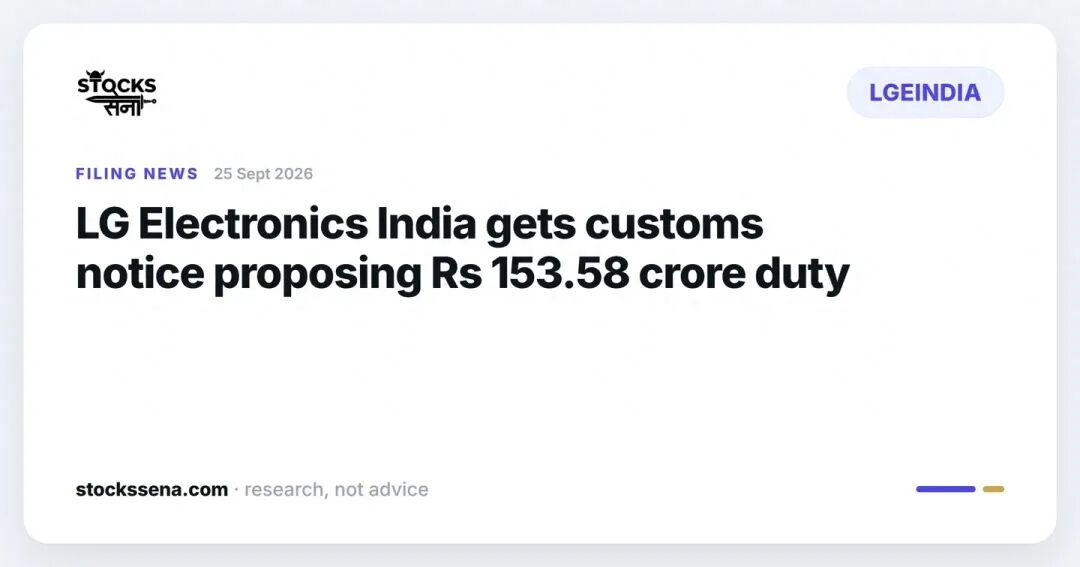
On September 25, LG Electronics released an announcement stating that its Indian subsidiary has received a supplementary tax notice from Indian customs authorities, amounting to 1.5358 billion Indian rupees, equivalent to 108 million RMB.
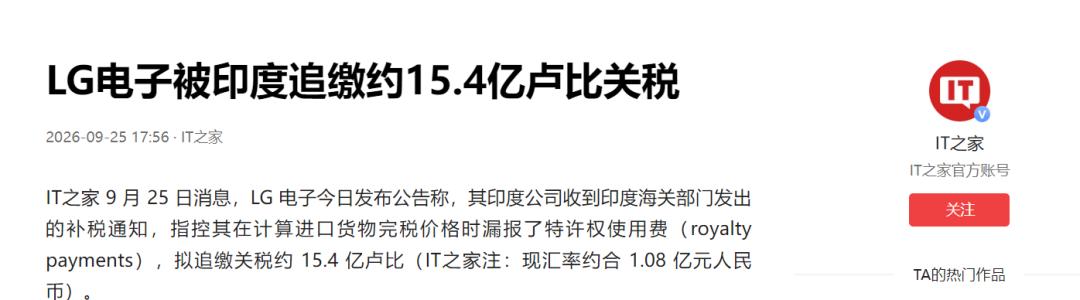
There are two reasons behind the notice: first, LG paid tax at a 5% rate when importing OLED TV components, but India's Directorate of Revenue Intelligence (DRI) claims that a 15% tax rate should apply; second, the royalty fees paid to its South Korean headquarters were omitted from the declared dutiable value of the imported goods.
LG's reaction was quite notable: it did not appeal for unfair treatment nor file a lawsuit, instead it first paid a deposit, then submitted a written response to the customs authority. The company confirmed the matter in an announcement released on the Korea Exchange on September 25, and its stock price barely dropped.
This kind of reaction is not unusual in India. What is really worth pondering is another fact: LG's being fined in India happened at the exact same time as its business expansion in the country.
India is known as the "graveyard of foreign investment", and is also regarded as a hub of penalty notices for multinational corporations. Samsung, Xiaomi, OV, Ford, Walmart, Vodafone, Nokia, Amazon — almost all companies that entered the Indian market have received sky-high fines issued by Indian authorities. Given how difficult the operating environment is, why do LG, Samsung and other peers not leave the market, but choose to continue expanding instead?
How large has LG's business scale in India actually reached?
Let's look at several sets of figures first.
LG has been operating in India for 28 years. In the third quarter of 2026, LG held a 27.3% market share in India's TV market, ranking second.
But for the niche segment of high-end OLED TVs, LG's market share reaches 62.4% — which is close to a monopoly. In Q4 of FY26, LG India hit a record high quarterly revenue, with an EBIT margin of 13.4% for its TV business.
A company that accounts for 60% of India's high-end TV market was ordered by customs to pay a supplementary tax of 100 million RMB, so the answer to why LG refuses to leave is that it cannot afford the cost of exiting.
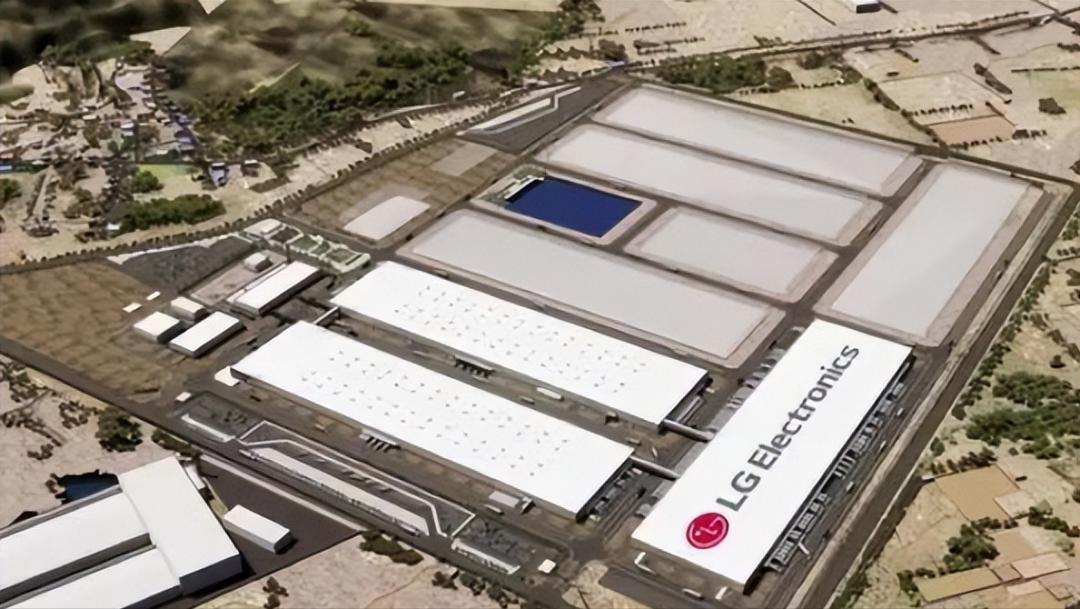
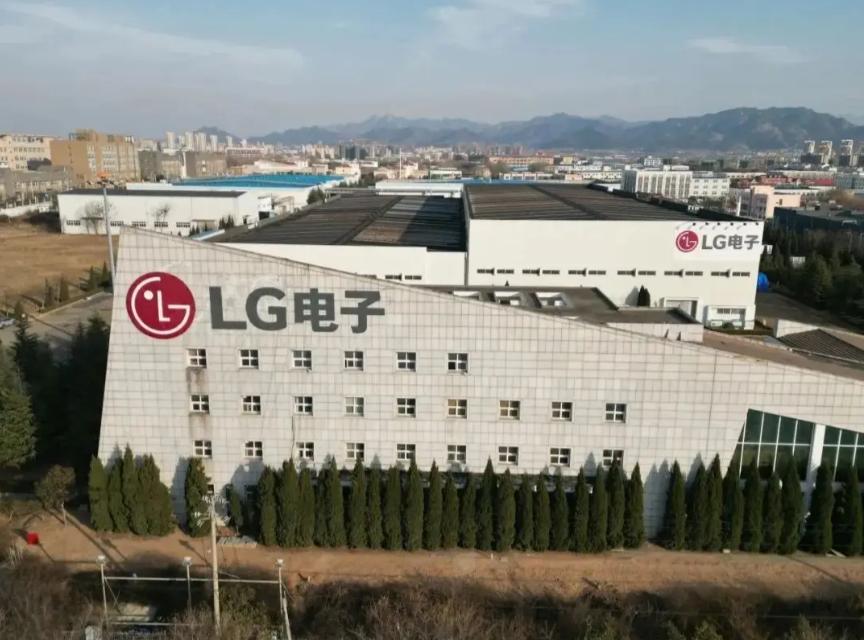
LG's business in India is far more than just selling TVs. It has three large manufacturing bases in Greater Noida, Pune and SANAND, realizing full local production of TVs, refrigerators, washing machines and air conditioners. It has spent more than 20 years building its distribution channels, with tens of thousands of offline retail stores covered.
LG's Indian factories have been in operation for 5 to 8 years, its channel construction has lasted for more than 10 years, and its brand enjoys extremely high recognition among Indian middle-class households.
If it divests from the market just because of a 100 million RMB fine, it will lose tens of billions of RMB in fixed assets and the market opportunities for the next two decades.
What's more critical is the enormous potential of the Indian market itself.
India has a population of 1.4 billion, with a median age of less than 30. The proportion of the middle class was 29% ten years ago, and now it has reached 53%, which is expected to hit 60% by 2030.
In 2025, India's TV market was valued at 4.7 billion US dollars, while OLED TVs only accounted for 4% of the total — which means the high-end market is still in its early stage, and all future growth will come from this segment.
LG now holds a 62% share in the OLED TV segment, which means it stands at the top of a market that has not yet fully taken off. It is a position that no enterprise would give up even facing a fine of 1 billion RMB.
This is exactly what the Indian authorities have anticipated: these companies cannot afford to exit, and from the perspective of these enterprises, as long as they treat Indian fines as part of operating costs, the Indian market is still profitable to operate in.
India is the "penalty calculation problem" for multinational corporations
LG's fine is not an isolated case. In the same week, DRI was also investigating Samsung and LG for OLED tariff issues at the same time.
Looking further back: Samsung was ordered to pay 601 million US dollars in back taxes and fines on charges of evading import tariffs on telecom equipment; Volkswagen faced a 1.4 billion US dollar recovery request on charges of disassembling complete vehicles into spare parts to avoid whole-vehicle tariffs; Pernod Ricard was ordered to pay 314 million US dollars in supplementary taxes for under-declaring the import value of Scotch whisky.
Vodafone left India after more than a decade of lawsuits caused by India's retroactive tax law amendments; Apple faces a maximum fine of 380 billion US dollars due to an anti-monopoly investigation launched by the Competition Commission of India (CCI).
All these fines add up to form a very interesting structure.
Where are the clear rules? They are all controlled by Indian tax authorities. It is not clearly specified in legal provisions whether OLED components are classified as a type of LED (subject to 5% tax) or an independent product category (subject to 15% tax), and DRI can arbitrarily set the tax rate at 15% as it sees fit.
The interpretation of whether royalties should be included in the dutiable value varies from case to case and from port to port. Enterprises calculate their budgets based on the rules in force when they enter the market, but after a couple of years the rules will be changed, and the accounts of the past ten years will be re-examined all at once.
This is why multinational corporations in India show extremely unified behavior patterns: they treat fines as part of operating costs.
This 100 million RMB fine for LG is an affordable amount compared to its annual profit of several billion RMB in India.
Samsung did not withdraw after being fined 600 million US dollars. Xiaomi did not withdraw even when 4.8 billion RMB of its funds were frozen. Facing the potential 380 billion US dollar fine, Apple still continues to expand its iPhone production capacity in India.
Relieved after seeing the fine amount, LG increases its investment in India while being penalized
In the same quarter when it received the fine, LG's OLED TV market share in India rose from 60% to 62.4%, and it is still ramping up offline factory construction and channel expansion.
The construction progress of LG's Sri City factory in India exceeded expectations, and it is scheduled to start trial operation in the fourth quarter ahead of schedule, with an annual output of 1.5 million air conditioners, which will help lift LG's total annual air conditioner production capacity in India to 4.7 million units.
Ten years ago, multinational corporations entered India only regarding it as a low-cost assembly base — importing spare parts, assembling locally, and selling products to the local market.
The situation is different now. The Indian government provides PLI (Production Linked Incentive) subsidies, local supply chains are under construction, and the 1.4-billion-strong consumer market is booming.
LG and Samsung together account for more than 90% of India's high-end TV market. Once this market share is given up, it can never be regained.
Jamie Dimon, CEO of JPMorgan Chase, commented on India a few years ago with a remark that roughly means: the Indian government often uses regulatory measures to protect local enterprises and hinder competition. No matter how large the market is, foreign companies that enter it will be continuously consumed by compliance costs and fines.
The remark is sharp, but very accurate.
When LG saw the 108 million RMB fine officially implemented, it most likely breathed a sigh of relief, and its stock price also rose. Fines in India have already been regarded as operating costs by the company, which means the uncertain negative impact has landed.
From the perspective of India's 20-plus-year history of foreign investment introduction, this fine amount is very small. It is far smaller than Vodafone's multi-billion-dollar tax dispute and Samsung's 600 million US dollar fine, and it is just a tiny fraction of the potential 380 billion US dollar fine that Apple may face.
India's attitude towards multinational corporations is very clear — you are welcome to build factories here, create jobs and help us build local supply chains, but the rules are set by us, the right of interpretation belongs to us, and fines can be issued at any time.
You either accept this rule of the game, treat fines as fixed expenses just like rent; or you leave, and give up the 1.4-billion-people market to your competitors.
Almost all companies that are still willing to stay in the Indian market have chosen the former option.
This is not because they are overly tolerant, but because for traditional home appliance manufacturing enterprises like LG, the current global operating situation is not optimistic, and most markets around the world have already become stock markets with saturated demand.
India, with a population of 1.4 billion, young demographic structure, expanding middle class, is almost the only remaining incremental market with large-scale demand. The home appliance demand in the Chinese market with the same population size has become saturated, with stock competition and increasingly strong competitiveness of local brands. The Southeast Asian market is too small, and the African market does not have sufficient consumption power.
For traditional manufacturing enterprises like LG, India is a sub-optimal choice that they cannot afford to give up, and LG can even pass the fine cost on to product prices.
Spreading this 100 million RMB fine across the millions of TVs, refrigerators and washing machines that LG sells in India every year, raising the price of each product by just a few dozen rupees will be completely imperceptible to consumers.
In other words, the Indian government fined LG 100 million RMB, but in the end, it is the Indian middle class that quietly paid for this 100 million RMB when buying home appliances. LG did not pay a penny, and Indian consumers covered the cost for it.
When all multinational corporations staying in India have learned to include Indian fines in operating costs, learned not to place core technologies in India and only bring in assembly and low-end production capacity, the "local manufacturing ecosystem" that India wants to build will be extremely difficult to realize.
What India has lost is not just those few tax fines, it has narrowed its own development path. In 2026, foreign investors withdrew 25 billion US dollars from the Indian stock market.
If things continue to go like this, more international capital will abandon India, because India has lost the trust of foreign investors who are willing to bring in core production capacity. The more fines India issues, the harder it will be for "Made in India" to become the next world factory.
This article is from WeChat Official Account "Hot Micro Comments" (ID: redianweiping), written by WANG Xinxi, published with authorization from 36Kr.