The top spot in the yellow rice wine sector has changed hands, with Kuaijishan overtaking Guyue Longshan. Where did Guyue Longshan fall short?
For a long period, Guyue Longshan was the absolute "top leader in the yellow rice wine sector", until it was surpassed by Kuaiji Shan in the first half of this year.
In the first half of 2026, Kuaiji Shan achieved an operating revenue of 853 million yuan, a year-on-year increase of 4.43%; its net profit hit 129 million yuan, up 37.04% year on year. By contrast, Guyue Longshan recorded an operating revenue of 787 million yuan, down 11.89% year on year; its net profit stood at 92 million yuan, representing a 1.38% year-on-year growth.
From the semi-annual perspective, Kuaiji Shan sees faster growth in some indicators, marking the first time since its listing that Kuaiji Shan has overtaken Guyue Longshan in semi-annual operating revenue.
Then, both selling yellow rice wine, where did Guyue Longshan lose out this time?
Underperformance in the mid-year exam, insufficient growth momentum
In fact, in 2025, the operating revenues of Guyue Longshan and Kuaiji Shan were already very close. Guyue Longshan posted an operating revenue of 1.831 billion yuan, down 5.45% year on year; Kuaiji Shan recorded an operating revenue of 1.822 billion yuan, up 11.68% year on year. Between the one increase and one decrease, the gap between the two narrowed to 9 million yuan, and Guyue Longshan held the top spot with a slight edge.
Since 2022, the competition between the "two giants of yellow rice wine" has become increasingly fierce, and the revenue gap has been shrinking continuously. By the first half of 2026, Kuaiji Shan's operating revenue was 66 million yuan higher than that of Guyue Longshan, realizing the overtaking.
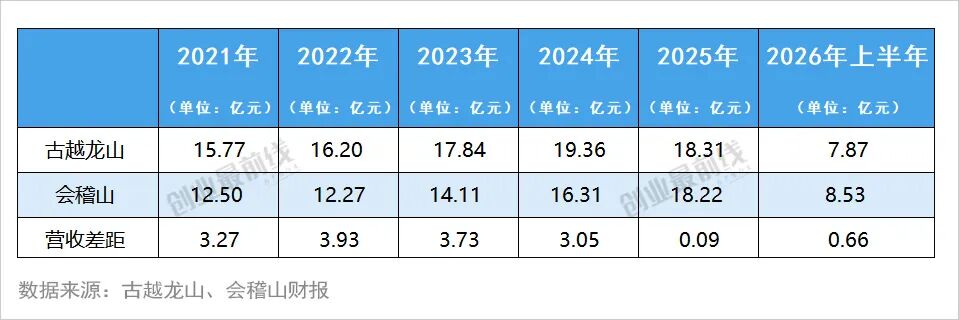
Guyue Longshan once led Kuaiji Shan by hundreds of millions of yuan in scale for a long time, but now, this industry ranking that has lasted for more than ten years is being rewritten.
Objectively speaking, this phased overtaking in the first half of 2026 is not enough to fully prove that the ranking of the two yellow rice wine giants has been completely changed, but the pressure on Guyue Longshan to hold the title of "top leader in yellow rice wine" is getting greater and greater.
Looking back at this change of leading position, it did not happen by accident.
In the third quarter of 2025, Kuaiji Shan's operating revenue once overtook Guyue Longshan by 102 million yuan, but Guyue Longshan immediately reversed the situation by relying on channel restocking in the traditional peak season of the fourth quarter, and secured the first place in yellow rice wine revenue in 2025.
However, in terms of profit, Kuaiji Shan has taken the lead in overtaking: in 2025, Kuaiji Shan's net profit was 245 million yuan, exceeding Guyue Longshan's 222 million yuan.
In the first half of 2026, the operational gap between the two is expanding, and there is great uncertainty about whether Guyue Longshan can rely on the peak season in the second half of the year to maintain its leading position.
In addition to revenue, Guyue Longshan's profitability is also facing severe tests. In the first half of 2026, Kuaiji Shan's non-recurring net profit was 104 million yuan, while Guyue Longshan's was 53 million yuan. Kuaiji Shan's figure was almost twice that of Guyue Longshan, meaning it not only sells more products, but also makes more profits.
But Kuaiji Shan has also paid a high price behind its high growth. (For details, see: Kuaiji Shan under the management of Fang Chaoyang: Spent 500 million yuan on advertising in 3 years, can sparkling yellow rice wine continue to sell well?)
In the first half of 2026, Kuaiji Shan's sales expenses reached 236 million yuan, with a sales expense ratio of about 27.7%, of which advertising and promotion expenses were 132 million yuan, 6.6 times that of Guyue Longshan. It is a typical "exchange growth with expenses" model, and its long-term sustainability remains to be verified.
In the same period, in terms of gross profit margin, Kuaiji Shan's operating cost was 377 million yuan, with a gross profit margin of 55.86%; Guyue Longshan's operating cost was 467 million yuan, with a gross profit margin of 40.62%.
The gross profit margin gap between the two exceeds 15%. Guyue Longshan's product premium capability is weaker than that of Kuaiji Shan, which is directly related to Kuaiji Shan's higher proportion of high-end products and more solid brand pricing power.
From the perspective of cash flow, the situation is also not optimistic. In the first half of 2026, Kuaiji Shan's net operating cash flow was 43 million yuan, a significant improvement from -8.8441 million yuan in the same period of the previous year; while Guyue Longshan's figure was -310 million yuan, further deteriorating from -150 million yuan in the same period of the previous year, which it attributed mainly to the decrease in revenue in the current period.
What is also worth paying attention to is the contract liabilities, which is the "reservoir" for dealers' payment, directly reflecting dealers' expectations for subsequent product sales and profit space of the brand. In the first half of 2026, Guyue Longshan's contract liabilities decreased by 60.05% year on year, which to a certain extent reflects dealers' cautious attitude towards making payments for stocking goods.
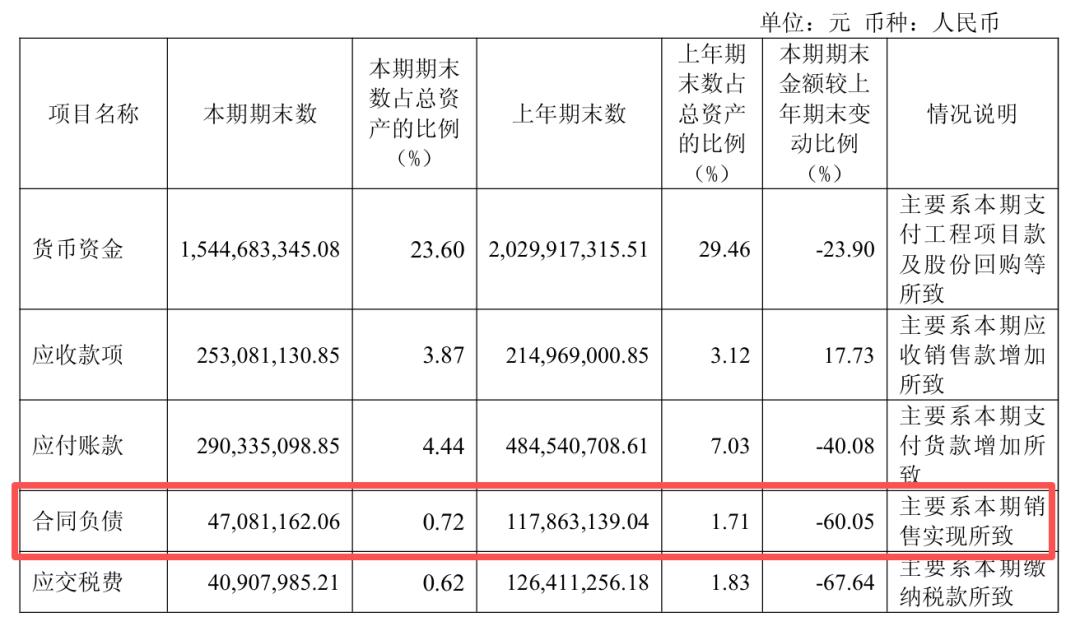
Figure / Guyue Longshan 2026 Interim Report
Sun Yang (pseudonym), a yellow rice wine dealer in East China, told Chuangye Zui Qianxian (Frontline of Entrepreneurship) that since the second half of 2025, Guyue Longshan has significantly increased the pressure on dealers to stock up, but the terminal sales are not ideal. The inventory cycle of some dealers has extended from the original 2-3 months to 4-6 months, and they are unwilling to make payments even for the "good start" in the first quarter. The channels are very cautious about future sales expectations.
Overall, Guyue Longshan's growth momentum is slightly insufficient.
Unbalanced business layout, loss of core home market
If financial performance is the result, then the differentiation of business structure is the internal cause.
Both Guyue Longshan and Kuaiji Shan have put forward the strategic direction of "high-end and youth-oriented", but their focus points and effects in the three dimensions of products, channels and regions are obviously different.
After visiting many supermarkets in Guiyang, Chuangye Zui Qianxian noticed that there are few types of yellow rice wine products on the shelves, with the year mark mostly concentrated in 3-5 years, and the price is mainly in the range of 10-30 yuan per bottle, mainly including Guyue Longshan 3-year Pure Yellow Rice Wine, Kuaiji Shan 5-year Pure Yellow Rice Wine, Nv'er Hong 3-year Yellow Rice Wine, etc. In many supermarkets, the production dates of Guyue Longshan products are mostly concentrated in June and December 2025, and the speed of channel inventory digestion is relatively slow.
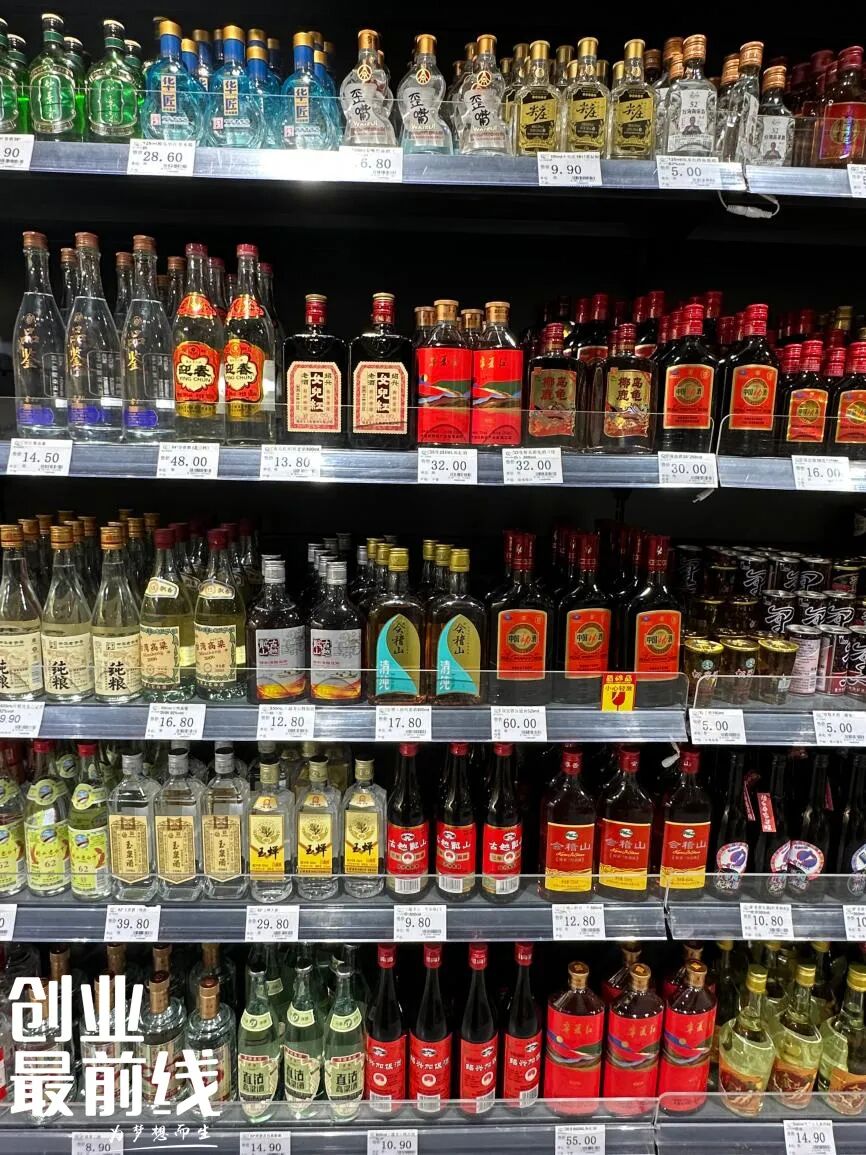
Some supermarkets place yellow rice wine products in the condiment section, on the same shelf as cooking wine and other products. High-end yellow rice wine products are rarely seen in supermarkets. Some so-called high-priced yellow rice wine products are basically only in the range of 100-200 yuan per bottle, and only one or two SKUs are on sale.
"The sales volume of high-priced yellow rice wine is very low, and sometimes you can't sell a bottle even in a month." said Xu Qianqian, a supermarket shopping guide.
In addition to the difficulty of finding high-end yellow rice wine at the terminal, high-end yellow rice wine products online are far less popular than low-priced ones. In Guyue Longshan's Tmall flagship store, the monthly sales of products priced above 1,000 yuan are mostly in single digits.
In recent years, both Guyue Longshan and Kuaiji Shan have been eager to break the stereotype that "yellow rice wine is cheap".
In the first half of 2026, Guyue Longshan scaled back low-gross-margin ordinary yellow rice wine, adopted the "volume control and price stabilization" policy for its Guoniang series, and concentrated resources on mid-to-high end products such as Qinghuazui and Guoniang.
During the period, Guyue Longshan's total revenue from alcohol business was 773 million yuan, down 12.08% year on year; the revenue from mid-to-high end alcohol products was 560 million yuan, down 9.9% year on year, but its proportion in the total alcohol revenue reached 72.45%, up from 70.71% in the same period of the previous year.
In the same period, Kuaiji Shan's total revenue from alcohol business was 826 million yuan, up 5% year on year, and the proportion of mid-to-high end yellow rice wine increased from 66.23% in the same period of the previous year to 72.03%.
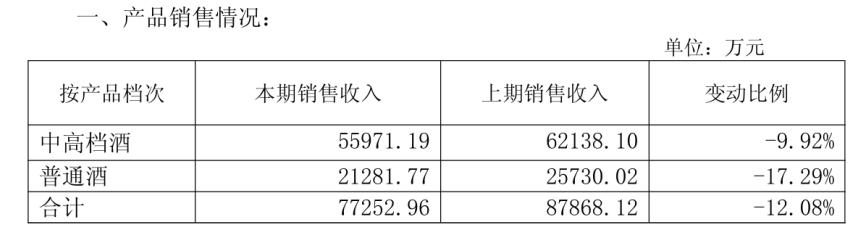
Figure / Guyue Longshan's operational data announcement for January-June 2026
Both enterprises are compressing ordinary alcohol products and increasing the proportion of mid-to-high end products, but Kuaiji Shan's mid-to-high end alcohol products have achieved double-digit revenue growth, while Guyue Longshan's mid-to-high end business is still shrinking. This contrast reflects that there has been a certain gap between the two in high-end brand building.
In addition to wanting to sell products at higher prices, yellow rice wine also wants to attract younger consumers.
Kuaiji Shan became a hit with its single product "One Day One Smoked" sparkling yellow rice wine, whose sales exceeded 100 million yuan in 2025. While Guyue Longshan took the "matrix route", launching innovative products such as "No High No Low" series, coffee yellow rice wine, lime yellow rice wine, and Xiao Yellow Beer, but most of these products have received mediocre market response, with sales far lower than Kuaiji Shan's sparkling yellow rice wine. The products are numerous but not excellent, and lack of explosive hits.
In terms of market strategy, as early as 2018, Guyue Longshan set the development strategy of "high-end, youth-oriented, globalization, and digitalization" (hereinafter referred to as the "four modernizations" strategy). Kuaiji Shan chose to take the high-end and youth-oriented route, did not focus on national expansion, but concentrated on the core market in Jiangsu, Zhejiang and Shanghai regions.
But from the perspective of market layout, Guyue Longshan is fighting a battle that needs "single-point breakthrough" with a "full-domain defense" posture.
For a long time, Guyue Longshan has played the role of the leader in the national expansion of yellow rice wine, following the route of "early breakthrough, full coverage": it established the Southwest Branch in March 2026, promoted the market with the contracting system, and from September onwards, extended the responsibility and authorization model to Shandong, Shaanxi, Shanxi and the three provinces in Northeast China, encouraging local teams to seize the market, with rapid pace of outward expansion.
But the cost is that the sales volume in the core local market (Jiangsu, Zhejiang and Shanghai regions) has declined, and the incremental revenue from other provinces has not yet made up for the gap in the local market.
In the first half of 2026, only Shanghai region achieved a slight increase in Guyue Longshan's revenue, while all other regional markets declined. The revenue from markets outside Jiangsu, Zhejiang and Shanghai accounted for about 40.28%, laying a certain foundation for national expansion, and it is currently the brand with the highest degree of national expansion in the yellow rice wine industry.
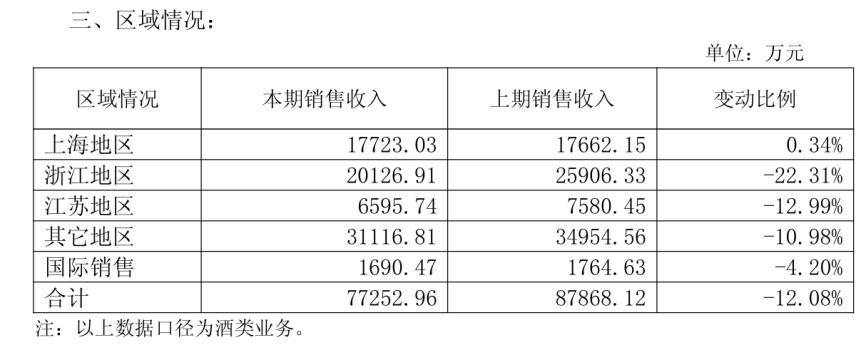
Figure / Guyue Longshan's operational data announcement for January-June 2026
While Kuaiji Shan took the route of "stabilizing the base before expanding outward", chose to deeply cultivate its advantageous market in Jiangsu, Zhejiang and Shanghai, at the same time focused on the high-end Lanting series, and introduced large liquor distributors to expand national channels on a large scale.
This has led to Guyue Longshan's sales in its original advantageous market of Jiangsu, Zhejiang and Shanghai being gradually overtaken by Kuaiji Shan. In the first half of 2026, all markets of Kuaiji Shan achieved growth except Zhejiang market.
Jiang Sixiang, a strategic consulting expert in liquor marketing, once served as the regional director of Kuaiji Shan Lanting Division. He said that Guyue Longshan operates yellow rice wine with scale thinking, using 5 brands including Guyue Longshan, Nv'er Hong, Jianhu, Zhuangyuan Hong and Shen Yonghe, covering all price ranges and all regions to share the same consumer mind and the same marketing budget. As a result, the main brand has not been established, and its core home market "collapsed first".
"Guyue Longshan needs to make subtraction, cut off scattered brand resources, concentrate all its strength on one main brand, one price range and one model market, to fight a battle of single-point breakthrough." Jiang Sixiang said.
Lost in management style?
Guyue Longshan is gradually falling behind in the competition with Kuaiji Shan. On the surface, it is caused by differences in market actions, while in the deep level, it may be related to management style.
As two listed yellow rice wine enterprises, Guyue Longshan is a state-owned enterprise, and Kuaiji Shan is a private enterprise. The former adopts a bold and radical style, while the latter moves forward steadily with small steps and makes single-point breakthroughs. From the market perspective, Kuaiji Shan is more flexible, while Guyue Longshan needs to balance many aspects, and is often trapped in the dilemma of "wanting this, wanting that, and wanting more".
This difference is particularly obvious in market competition. For example, Kuaiji Shan adopts high-investment promotion for the high-end Lanting series and youth-oriented light alcohol products, while Guyue Longshan's market actions are relatively conservative, with insufficient investment in single region and single product, and relatively restrained marketing investment.