Spending thousands of yuan on fridge magnets, why are the young generation of today falling in love with museum cultural and creative products?
Nowadays, more and more young people regard the last stop of museum visits — the cultural and creative store, as their main consumption scenario. The logic of cultural and creative consumption is shifting from "product functionality" to "scene and emotional solution". In other words, what young people buy is not a metal sheet or an ornament, but a memory that can be touched repeatedly and awakened at any time.
Text by Jianshan, Author of Finance Gossip Girl
The Mid-Autumn Festival holiday and the National Day long vacation are approaching. If you think young people will only eat, drink and have fun, you are wrong.
This generation of young people is more artistic and intellectual than you imagine. Nowadays, more and more young people regard the last stop of museum visits — the cultural and creative store, as their main consumption scenario.
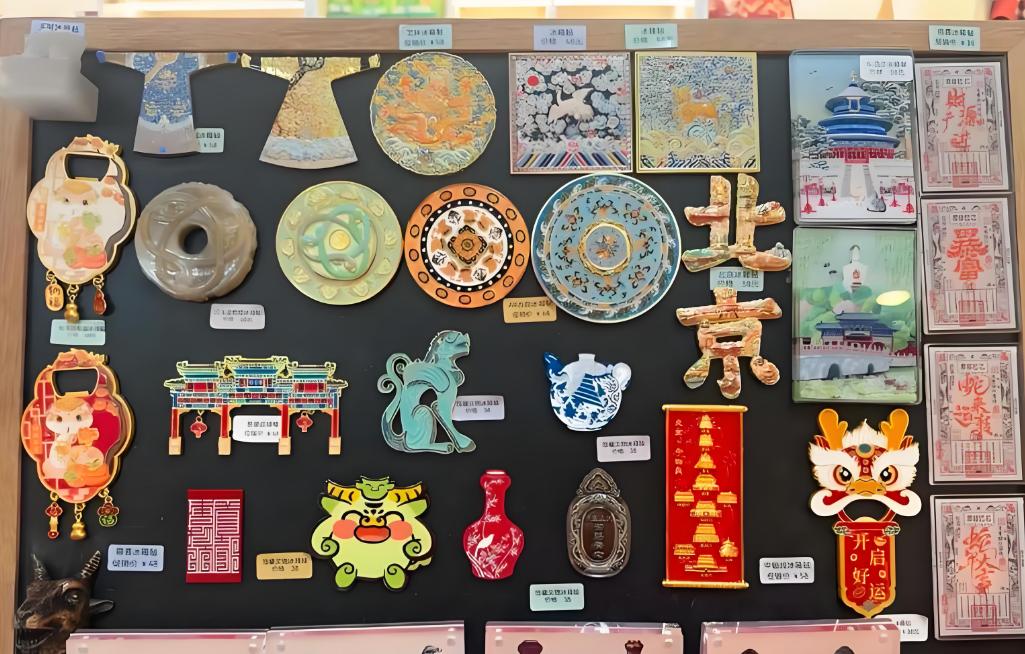
Shen Wei, who is from Hangzhou, just took a trip to Shanxi. She originally planned to stay in Datong for two days, but ended up visiting the cultural and creative store of Datong Museum three times. She bought two fridge magnets on her first visit, and liked them so much after returning to the hotel that she went back the next day to buy four more. When she calculated the total, her cultural and creative consumption in Datong alone exceeded 600 yuan, accounting for 40% of her total travel budget. "It's more expensive than accommodation, but I don't regret it at all."
Shen Wei's consumption behavior is not an isolated case. Over the past year, fridge magnets, once an inconspicuous tourist souvenir, have become a major category on Taobao with a transaction volume of nearly 700 million yuan, attracting more than 10 million purchasers, of which cultural and creative products account for over 60%. On Tmall, museum cultural and creative products have maintained a transaction growth rate of over 50% for three consecutive years, and 77 domestic museums have opened official flagship stores.
Behind the data is a profound shift in consumption logic. The "2026 Tmall Cultural and Creative Industry Trend Report" released by Taobao Tmall clearly points out that the logic of cultural and creative consumption is shifting from "product functionality" to "scene and emotional solution". In other words, what young people buy is not a metal sheet or an ornament, but a memory that can be touched repeatedly and awakened at any time.
1. "Emotional value" is not empty talk
Shen Wei took a photo of the set of miniature vase fridge magnets she bought in Datong and posted it on Xiaohongshu, with the caption "I spent over a thousand yuan on fridge magnets, my mom says I'm crazy". The post got more than 2,000 likes, and in the comment section some people asked for the link, while others shared how much they spent on their most expensive cultural and creative product. For Shen Wei, the fridge door covered with fridge magnets is no longer just a door, but a "travel resume" pieced together by consumption records.
To understand why this generation of young people are willing to spend thousands of yuan on a bunch of fridge magnets, we must first understand the actual weight of "emotional value" in young people's consumption decisions.
The "Green Horse" series of Gansu Provincial Museum is a typical case. The little green horse, which is based on the bronze galloping horse prototype and became popular for its "ugly-cute" shape, initially appeared on the cultural and creative shelves as a plush doll with a non-cheap price, but soon became a "must-share item" on social platforms. Consumers' purchasing motivation is very clear: it makes them happy. Gansu Provincial Museum later expanded the "Green Horse" IP to a series of products including fridge magnets, keychains, commemorative badges, almost all of which maintain the same emotional tone.
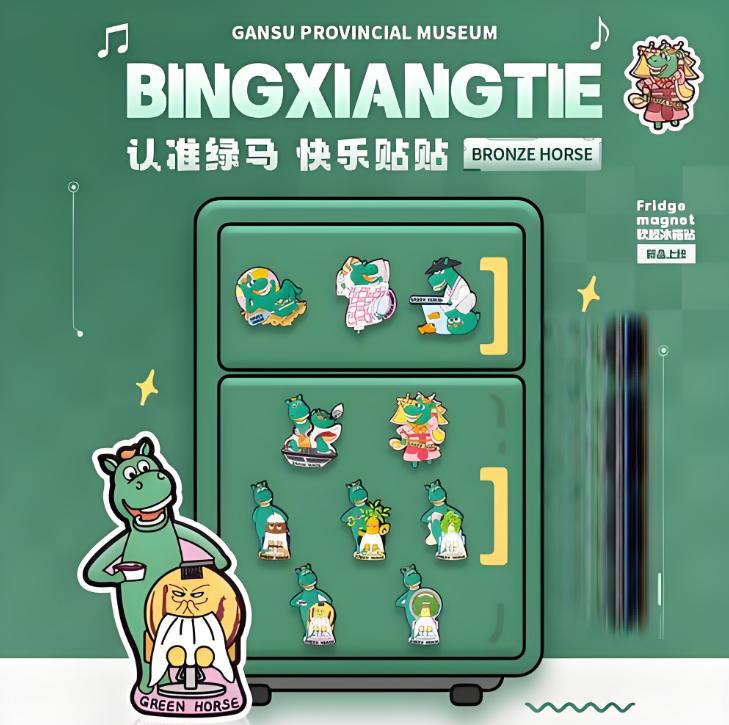
This mentality of "paying for happiness" is clearly reflected in financial data. The Taobao Tmall report points out that the core driving force of cultural and creative consumption has shifted from "commodity functionality" to "emotional value", and consumers are more willing to pay for products with cultural connotations and experiential attributes. More specifically, the core consumption scenarios of cultural and creative products are concentrated in four directions: gifting, decoration, blessing praying, and wedding ceremonies, which correspond to deep-seated demands of social interaction, aesthetics, belief and ritual sense respectively.
A notable detail is that the consumer profile of cultural and creative fridge magnets is not the stereotypical "student group". Data shows that women aged 25 to 49 in first- and second-tier cities are the core consumer group of cultural and creative fridge magnets, with a repeat purchase rate of old customers as high as 40%. This group has a stable source of income, is relatively insensitive to price, but has extremely high requirements for the "emotional return" of products. They will not buy something just because it is "cheap", but will spend money without hesitation because "this thing reminds me of something".
2. From "sticker business" to "content business"
Young people's willingness to spend 1,000 yuan on fridge magnets also relies on the evolution of the supply side as another necessary condition. Without good products, no matter how strong the consumption willingness is, it cannot be released.
Three years ago, the vast majority of museum fridge magnets on the market were still at the stage of "a metal sheet printed with patterns". The design was rough and the homogenization was serious. Fridge magnets from different cities showed almost no difference except for the names of landmark buildings. An industry observation once sharply pointed out that many cultural and creative products are still stuck in the stage of symbol copying, "landmark + fridge magnet" has almost become the standard configuration of cultural and creative stores, and tourists see similar souvenir forms in different cities, only the names are changed.
The turning point came from the stimulation of several "phenomenal products". The "Celestial Palace Caisson Fridge Magnet" of the Beijing Ancient Architecture Museum reproduces the Ming Dynasty caisson in the museum collection with a five-layer three-dimensional structure, priced at 168 yuan, and its cumulative sales after launch are close to 40 million yuan. The phoenix crown fridge magnet of the National Museum of China has exceeded 2 million units in cumulative sales, driving the sales of products in the same series to exceed 100 million yuan. The common features of these products are:
They are not satisfied with "printing cultural relics on commodities", but try to "translate" the structure, craftsmanship and even viewing experience of cultural relics into a playable form.
The "Cute Horse Presents Auspiciousness" series of the Cloisonne Art Museum provides an interesting observation window. The fridge magnets of this series are based on the bronze chariot of the Qin Mausoleum, the treasure of the museum, but the designers did not stop at reducing and copying, but added playable and interactive mechanisms to each product. After the products were launched, the sales kept rising, becoming a landmark case of the cloisonne category shifting from "viewing and collection" to "daily practical use".
The innovation pressure on the supply side is real. An independent designer once confessed to the media that the original design completed by the team in two months was soon copied after launch, and the counterparty only modified the details to sell at a low price. The asymmetric competitive structure, where original creation has a long cycle and high cost while imitation has a low threshold and quick return, in turn forces teams with real capabilities to maximize the "irreplaceability" of their products, either by widening the gap in craftsmanship or building barriers in interactive experience.
3. "Purchasing" becomes a social behavior
If we only understand the museum cultural and creative boom from the perspective of "personal consumption", we will miss a key variable — social interaction.
After Shen Wei shared her fridge magnet collection on Xiaohongshu, she received a private message, asking her if the set of vase fridge magnets from Datong Museum was still in stock, and the sender was willing to pay a higher price for a purchasing service. This made her realize that she had inadvertently become a publisher of a certain "consumption guide". Under the topic of "Young People's Fridges", the number of views has exceeded 100 million, with more than 500,000 discussions. A fridge door covered with fridge magnets from museums across the country is a kind of "content" that can be read, liked and inquired about on social platforms.
This social attribute is changing young people's consumption decision-making chain. In the past, buying souvenirs was an affiliated behavior of travel; now, what to buy, how to buy, and how much to buy may have been "previewed" on social media before departure. The penetration of museum cultural and creative products in online channels further amplifies this effect. In the past year, 700 million people "visited museums online" on Taobao Tmall, of which users aged 18 to 34 accounted for more than 80%. Many people will browse, collect and add products to their carts online even if they cannot visit the museum temporarily.
This behavioral pattern of "virtual purchasing" extends the consumption scenarios of museum cultural and creative products from "offline instant impulse" to "continuous online content seeding". A young person may be attracted by an unboxing video of a certain cultural and creative product, place an order in the flagship store, take photos and post after receiving the goods, and then trigger the next round of attraction. The consumption behavior is embedded in a circular content production chain.
Calmly speaking, the museum cultural and creative track is undergoing a round of structural adjustment. Many practitioners mentioned to the author that the sales of cultural and creative products in 2026 are not as good as in previous years. The hottest period was from 2023 to the first half of 2025, and the popularity began to decline in the second half of 2025, with no phenomenal hit products emerging. When the Celestial Palace Caisson fridge magnet was launched, cultural and creative companies only dared to produce a few hundred units, and the subsequent factory could not keep up with the increased production, which instead pushed up the topic popularity because "the more you can't get it, the more you want it". But this "scarcity dividend" is not sustainable.
The problem of homogenization is also intensifying. A museum cultural and creative practitioner observed that the number of suppliers has risen from 20-30 to 70-80, and the products are becoming more and more similar, making it difficult to produce hit products again. The fridge magnet market is already a red ocean, "consumers can see similar products everywhere in museums, scenic spots and street stalls".
This is not necessarily a bad thing. Industry consensus is taking shape: cultural and creative products cannot only rely on the two paths of "cultural relic sticker" and "cute transformation". The observation of China Publishing & Media Business News points out that museum cultural and creative products are entering the era of "fine operation", "the market is punishing those 'pseudo-cultural and creative' products that only have gimmicks but lack design and practicality".
For consumers like Shen Wei, the judgment standard is actually very simple. "Will I take an extra look at it when I open the fridge? If yes, it's worth it." The fridge door covered with fridge magnets is the result of her voting with consumption. Most of the products she gave up have one thing in common: they look good, but have no real connection with her life.
This article is from the WeChat Official Account "Finance Gossip Girl Channel" (ID: baguanvpindao), written by Jianshan, and published with authorization from 36Kr.