Quadruped Robots: Unitree ranks first, with Agibot and Deep Robotics vying for the second place?
On September 21, Counterpoint and IDC released their global quadruped robot market reports on the exact same day.
Unitree Robotics took the first place in both reports. Starting from the second place, the rankings are completely inconsistent: Counterpoint ranks by shipment volume, with Agibot Kuto taking the second place; IDC ranks by revenue, with Deep Robotics coming in second. When it comes to the industry application segment, Unitree drops to the fourth place in terms of shipment volume, and the top positions given by the two institutions are Agibot Kuto and Deep Robotics respectively, showing another discrepancy.
The total figures also do not match. According to Counterpoint's data, global shipments of quadruped robots in the first half of 2026 are close to 35,000 units, 40% of which are used for industry applications. The full-year shipment in 2025 reached 46,000 units, with the total industry revenue approaching 700 million US dollars. IDC's figures show that the shipment in the first half of this year exceeded 49,000 units, a year-on-year increase of 92.5%. The full-year shipment in 2025 was about 58,000 units, and the market size exceeded 490 million US dollars.
The shipment gap between the two institutions ranges from 12,000 to 14,000 units. For reference, Unitree's total sales of quadruped robots in 2025 was 23,000 units, and the gap between the two institutions is more than half of Unitree's annual sales. In terms of revenue, the situation is reversed: Counterpoint, which recorded lower shipment volume, calculated a market size about 200 million US dollars larger than that of IDC.
Why are there two sets of figures for the same market? Who is the real second-place player?
01. Two ranking lists, only the "first place" is the same
In the two reports, the rankings related to enterprise positions are measured from two dimensions.
First, let's look at the overall market share.
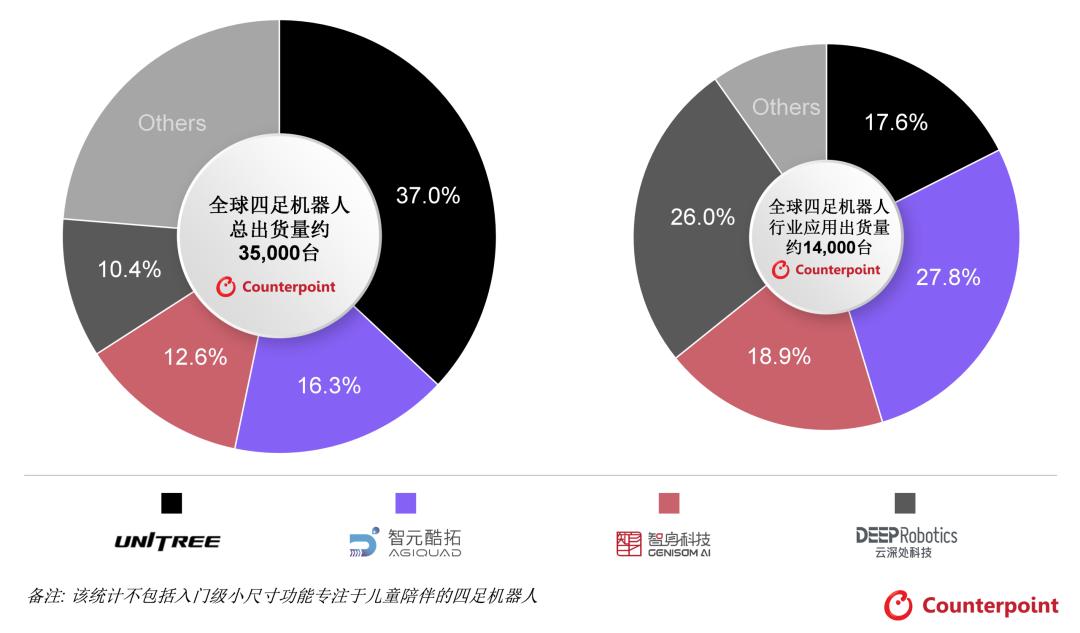
Counterpoint ranks by shipment volume, in the order: Unitree 37% > Agibot Kuto 16.3% > Zhishen Technology 12.6% > Deep Robotics 10.4%.
IDC ranks by hardware revenue, in the order: Unitree 13.8% > Deep Robotics 9.2% > Agibot 8.4% > Micbot 6.3%.
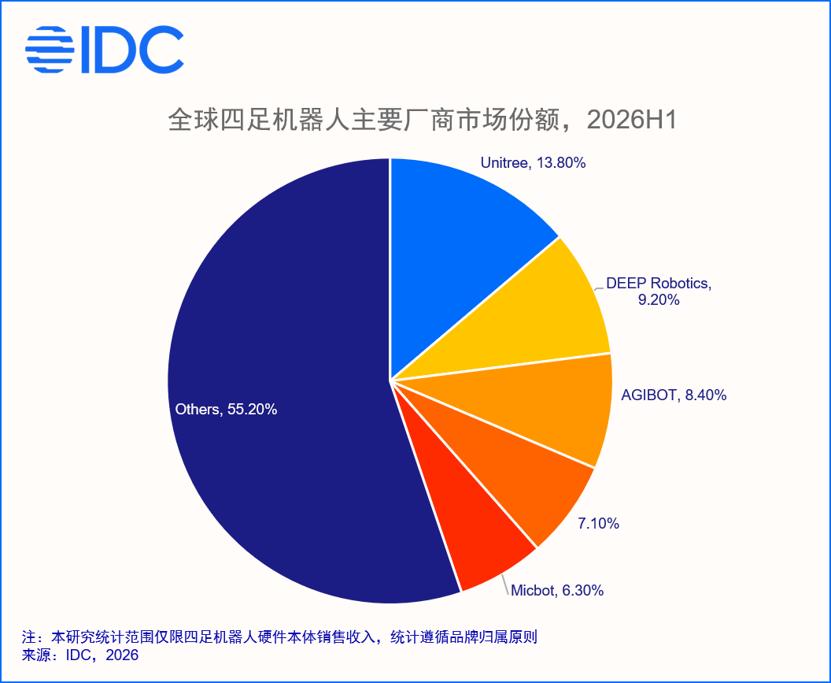
It should be noted that Agibot in the two lists refers to the same business. Counterpoint records it based on the spun-off entity as Agibot Kuto; IDC records it based on the group caliber as Agibot Robotics (AGIBOT).
Comparing the two lists, it is not difficult to find that Unitree ranks first on both, but the leading margin varies greatly. In terms of shipment volume, its figure is 2.3 times that of the second place; in terms of revenue, it only leads Deep Robotics by 4.6 percentage points. The reason lies in the unit price: in 2025, the average unit price of its quadruped robots was only 30,300 yuan. On the revenue-based ranking list, the low unit price compressed its leading advantage to just a few percentage points.
Then look at the second place. Under IDC's revenue caliber, Deep Robotics ranks second with 9.2% share; under Counterpoint's shipment volume caliber, Agibot Kuto takes the second place, while Deep Robotics drops to the fourth.
Deep Robotics is an early-established industry player on this list. Founded in 2017 with Zhejiang University background, its STAR Market IPO application was accepted in May this year. According to its prospectus, its revenue in 2025 reached 337 million yuan, of which industry applications contributed 258 million yuan, accounting for nearly 80%. Its core product is the industrial-grade quadruped robot Jueying X series, which was priced at 287,500 yuan per unit in 2025, with 681 units sold for the whole year, contributing 58% of the company's total revenue. The price of one Jueying X is nearly 10 times the average unit price of Unitree's quadruped robots. Therefore, Deep Robotics can rank second in terms of revenue, but only fourth in terms of shipment volume.
Agibot Kuto is spun off from Agibot Robotics. Agibot originally had four product lines: Yuanzheng, Lingxi and Jingling for humanoid robots, and Kuto for quadruped robots. In April this year, Agibot spun off its quadruped robot business into a wholly-owned subsidiary Agibot Kuto registered in Shenzhen, with Deng Taihua, the founder of Agibot, serving as chairman. Its strategy is to lay out full product lines and expand through ecological channels. IDC also mentioned that Agibot mainly expands industrial applications with the help of ecological partners.
There are two other names in the two lists that most people are not familiar with.
Zhishen Technology ranks third on Counterpoint's list. The company was founded in Beijing in December 2023, and its co-founder Liu Yulong was once the product lead of Xiaomi's quadruped robot "Tiedan". It has two product lines: "Gangbeng" is oriented to medium and light load scenarios such as security inspection and patrol, and also covers commercial cultural and entertainment scenarios; "Chuichui" is a heavy-duty model applied to high-demand scenarios such as electric power and fire protection. According to the company's disclosure, it completed the 5000th mass-produced unit delivery at the end of 2025, and the 10000th unit rolled off the production line in May this year. On September 20, Zhishen Technology announced the completion of several hundred million yuan Series B financing.
Micbot only appears on IDC's revenue list. Founded in Hangzhou in early 2025, this company mainly develops wheeled quadruped robots with a dynamic load of 200kg level. Its main application scenarios are extreme high-risk industrial environments that other players cannot enter, such as explosion-proof, strong magnetic field, and extremely cold scenarios, and thus it has obtained equity investment from industrial capital of many listed companies.
The reason for the position change of the four companies is the same: the larger the unit price gap, the greater the gap between the two ranking results.
The second dimension of the report is the ranking of the industry application market.
In terms of shipment volume calculated by Counterpoint, Agibot Kuto ranks first with a 27.8% share, followed by Deep Robotics with 26%, Zhishen Technology takes the third place with 18.9%, and Unitree ranks fourth with 17.6%. The public content of IDC does not announce the caliber and specific ranking of its manufacturers, but only clarifies that Deep Robotics ranks first in the industry-level application market.
What kind of procurement counts as industry application? IDC's public caliber is exclusive: all applications other than education, scientific research and household consumption are included in industry-level applications. Counterpoint has not released a clear definition, but from the comparison examples with cultural entertainment, education and science in the report, it can be roughly inferred that industry scenarios are concentrated in core scenarios such as industrial inspection, security patrol, fire emergency, logistics and transportation, and the two institutions have similar definition boundaries for industry applications.
In addition to the ranking of enterprises, there is also a large discrepancy in the overall shipment volume and market size of quadruped robots given by the two reports.
In terms of total volume, Counterpoint shows that the shipment volume in the first half of 2026 is 35,000 units, while IDC's figure is 49,000 units. Counterpoint, which recorded lower shipment volume, gives a total industry revenue of nearly 700 million US dollars for 2025, while IDC's figure for the same period is only 490 million US dollars.
This is mainly a problem of statistical caliber, with differences in two aspects.
The first is the different scope of revenue calculation. The market size counted by Counterpoint covers supporting revenue such as sensors, scheduling software, operation and maintenance services, while IDC only counts the revenue of the hardware body. This explains why Counterpoint, with lower counted shipment volume, gets a larger market size.
The second is that the two institutions have inconsistent standards for which products are classified as quadruped robots.
Counterpoint explicitly excludes entry-level small-sized products with functions focused on children's companionship, while IDC's public caliber covers consumer-grade products without such exclusion. However, the specific manufacturers and products covered by the two lines are not disclosed in the public materials of the two institutions.
02. Who are these quadruped robots sold to, and how far can the market go?
The competition for rankings behind the lists reflects a mature and established business.
The reason why quadruped robots took the lead in realizing commercialization in the field of embodied intelligence is that the problems they solve are very clear. Humanoid robots are mainly used for operation tasks such as handling, sorting, and loading/unloading, and their difficulties lie in the "hand" and "brain", namely fine manipulation and task generalization. While quadruped robots are mainly responsible for arrival and perception tasks, facing environments that are difficult for people to reach such as substations, underground pipe galleries, and post-disaster fire scenes, their core difficulty lies in the "legs", namely all-terrain movement and stable passing. With the gradual maturity of legged motion control and complex terrain adaptation capabilities, quadruped robots have quickly formed a closed loop in scenarios such as inspection, security, and emergency response.
Source / Zhishen Technology WeChat official account
In terms of shipment volume, quadruped robots also lead humanoid robots. According to data from SAG, a US market research institution, global shipments of humanoid robots in the first half of 2026 are about 19,100 units, equivalent to 40% to 50% of the shipment volume of quadruped robots in the same period.
Who are these robot dogs sold to?
IDC's data shows a clear customer structure: education, scientific research and household consumption contribute about 60% of the shipment volume, and the remaining 40% of the shipment volume comes from industry-level applications such as government, industrial manufacturing, and public utilities.
Breaking down into specific industries, industrial manufacturing is one of the fastest growing directions. IDC data shows that in the first half of 2026, the global industrial application market size of quadruped robots was about 76.75 million US dollars, a year-on-year increase of 194.2%, with more than 4100 units deployed, a year-on-year increase of 537.9%.
Electric power inspection is another major application scenario. The "2026 Embodied Intelligence Development Plan" issued internally by the State Grid in April shows that it plans to centrally procure about 8500 embodied intelligent devices within the year, with a total investment of about 6.8 billion yuan, including 5000 quadruped inspection robot dogs with a budget of 1.5 billion yuan, and the average unit price is about 300,000 yuan, making it the largest single product category by volume.
Fire emergency is another market driven by policies. In 2025, the "Fire Product Catalogue (2025 Revised Version)" issued by the National Fire and Rescue Administration included fire robots in the sequence of fire unmanned equipment for the first time, giving relevant products clear access and certification basis.
Counterpoint's forecast is similar: by 2030, the global quadruped robot market size will exceed 10 billion US dollars, of which industrial inspection and security patrol will account for about 60%.
At present, the shipment volume and revenue of quadruped robots are ahead of the embodied intelligence industry, but this leading position may not last forever. How far the market can go depends on three things: whether the scenarios are valuable enough, whether the technology can keep up, and the competition with humanoid robots.
The current main business of quadruped robots is inspection, and its value ceiling is essentially the saved labor cost and reduced safety risk. Such demands are small and scattered. Calculated based on the caliber of 490 million to 700 million US dollars from the two institutions, the annual market size of the whole industry is about 3.5 billion to 5 billion yuan. IDC's judgment is that scenarios such as industry, government and energy are highly fragmented, and no single product can dominate all markets. Therefore, this is more like a "project-based" business, and its scale effect is not as good as that of selling consumer-grade products.
Whether the scenario ceiling can be raised depends on technology. At present, the biggest technical bottleneck of quadruped robots is "load bearing": to work with a robotic arm and detection equipment, the load usually needs to reach more than 50kg, but once the load increases, the obstacle-surpassing and climbing ability will be weakened. Battery life is also a short board: consumer-grade products usually only have 1 to 2 hours of battery life, while industry-grade products have 3 to 5 hours.
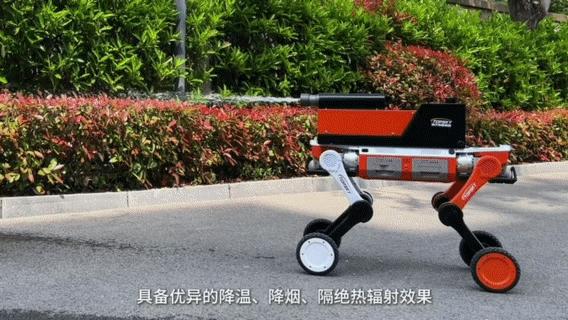
One of the solutions given by manufacturers is to add wheels to the legs. It is difficult to achieve both heavy load and low power consumption, but wheeled quadrupeds at least improve the movement efficiency after heavy load: they run on wheels on flat ground to save power and achieve longer endurance, and switch back to leg movement when encountering steps and ditches. The more functions the robot wants to achieve, the less it looks like a traditional quadruped. Unitree B2-W and Deep Robotics Bobcat are still named as quadrupeds, but their legs are already equipped with wheels.
Another technical bottleneck is intelligence. Most industrial robot dogs still rely on remote control or preset routes. Counterpoint believes that perception, motion control and autonomous navigation are important breakthrough directions, with the goal of realizing monthly long-term unattended inspection.
Competition with humanoid robots is also a variable. SAG data shows that in the first half of 2026, about 70% of global humanoid robots are deployed in industrial and commercial scenarios such as factories, warehouses, and supermarkets. The B-end market is also the target market that humanoid robots are competing for.
The boundary between quadrupeds and humanoids is blurring. Agibot puts quadrupeds and humanoids on the same R&D base, sharing technical accumulation such as embodied intelligence models, data management, and simulation. Zhishen and Deep Robotics also have humanoid product lines. So does Unitree: in 2025, Unitree's humanoid robot revenue reached 868 million yuan, exceeding the 698 million yuan revenue of its quadruped robots. The future competition is more likely that the same company selects different forms for different scenarios, rather than a duel between robot dogs and humanoid robots.
In the future, the quadruped robot ranking lists of the two institutions will continue to be updated, and the rankings in the second half of the year may continue to change. This business is truly established, but before humanoid robots achieve higher reliability and lower cost, quadruped robots still need to run at full speed.
* The cover image is from the official Weibo account of Unitree Robotics.
This article is from WeChat official account "AIX Finance", author