Have ordinary users become the negative assets of AI?
"Doubao, which has 200 million daily active users, has become a marginal product" has hit the trending list on Weibo.
Reading this post brings a feeling similar to fans supporting a female celebrity from a K-pop group, pushing her to the top of the entertainment industry, then earnestly advising her not to attend a certain fashion show in France, only to get the reply "You are not invited" — a strong sense that all the public's support has been wasted.
In fact, it is not only Doubao. At the ongoing Alibaba Cloud Apsara Conference, Alibaba has begun to widely promote the "machine intelligence" civilization theory, and launched an office robot priced at 899 yuan. Baidu is also advocating that "industrial intelligent agents are the future direction". Liang Wenfeng from DeepSeek went even earlier. In a conversation circulating a month ago, he was reported to say: "At one point, we even did not want to maintain those users, but they would not leave no matter how hard we tried to drive them away."
No matter whether this statement is true or not, Doubao, Qianwen, Baidu, and DeepSeek have long collectively shifted their focus to the B-end. The number of individual users is no longer that important.
But in 2023, when this wave of AI development was rising, major AI manufacturers did not treat us this way.
Once, We Held Deep Affection For Each Other
On November 30, 2022, the first generation of ChatGPT took the world by storm, exceeding 100 million monthly active users in two months. On March 16, 2023, Baidu's ERNIE large model was released, kicking off this wave of domestic AI development.
In those years, to popularize AI knowledge, leaders of major tech companies spared no effort to paint a rosy picture for the public.
Wu Yongming said at the 2023 Wuzhen Conference, "AI assistants will be everywhere, becoming helpers in everyone's work, life and study."
Lei Jun claimed at an important occasion the following year: "We should make good use of AI tools. When most people do not know how to use them at the initial stage, being able to use them is a great opportunity for you."
Li Yanhui also called on the public, stating that ordinary people do not need to worry about losing their jobs, as new opportunities will emerge with the demise of old positions, just as what has happened in the past 100 years.
Since all the leaders said so, the most sensitive group of ordinary people quickly seized the opportunity to catch up with the trend.
For a time, AI became the "super prominent discipline" of 2023.
AI painting became a new traffic hotspot on Douyin. Painting prompts were packaged in batches at the price of 20 pieces for 9.9 yuan, and sold extremely well on Xianyu.
The explosive popularity of Kuaishou's Keling came later, but this did not stop the earliest group of "AI cultural workers" from using it to produce advertising clips and spoof short videos, charging 50,000 yuan per order, replacing traditional advertising agencies that usually required dozens of staff, charged 600,000 yuan, and spent one to two weeks on shooting.
AI training courses were booming. Online courses priced at 299 yuan, 399 yuan and 599 yuan were all titled with eye-catching headlines like "Since I used AI, my side income has exceeded 50,000 yuan per month", occupying Bilibili. It seemed that if you did not buy a course and use DeepSeek, you would fall behind the times, and almost everyone suffered from FOMO (fear of missing out) all at once.
The public was successfully "encouraged", and major manufacturers also tried all kinds of gimmicks to attract users at that time.
Doubao successfully became a hit by "providing sufficient emotional value", and successfully penetrated into primary school student groups with its cute voice lines and witty remarks. At the 2026 Spring Festival Gala, 1.5 to 2 billion yuan of Doubao red envelope rain fell continuously, which even attracted a large number of elderly people who did not play mahjong on New Year's Eve.
Qianwen even showed "extremely strong financial resources". It gave away milk tea, coffee and daily groceries. It probably never expected that its high-end capabilities could also be linked to the down-to-earth food delivery war, forming a relationship that is "more than friends but less than lovers".
Yuanbao, which is now somewhat less prominent, also used its own WeChat ecosystem to quietly attract users in the early days, until it was discovered by Zhang Xiaolong, who has extremely strict standards for product experience.
Back then, the public and major manufacturers got along so well. We cheered for various AI products, queued up to get practical benefits, but overnight, the "star products that ordinary users supported wholeheartedly" began to treat us with a cold and distant attitude.
The reason is actually very simple. Just like marriage, without solid interest connection, "love alone cannot support a lifelong relationship".
"Love Cannot Be Bought and Sold As You Wish"
Looking back now, AI's "affection" for ordinary users did not even last for 3 years.
From 2023 to 2026, some ordinary users who were finally used to AI services have been betrayed by AI. Overnight, the support of ordinary users became no longer that important for an AI product.
A Doubao employee told the media, "Doubao has now become a marginal product with more than 200 million daily active users". This sends a very clear signal.
In the past, in tech enterprises, whoever's product won by the number of users could show off this achievement in their weekly reports as a great honor. However, now, "the measure of the value of an AI product is no longer how many people use it, but how much revenue these users can bring."
When Doubao, which has 200 million daily active users, generates less than 1 million yuan in revenue per day, most of which comes from e-commerce commissions rather than membership payments; when the daily computing power consumption cost is likely to reach tens of millions of yuan, this kind of "operation model" is doomed to go bankrupt sooner or later.
It is not only Doubao that has stopped losses in time.
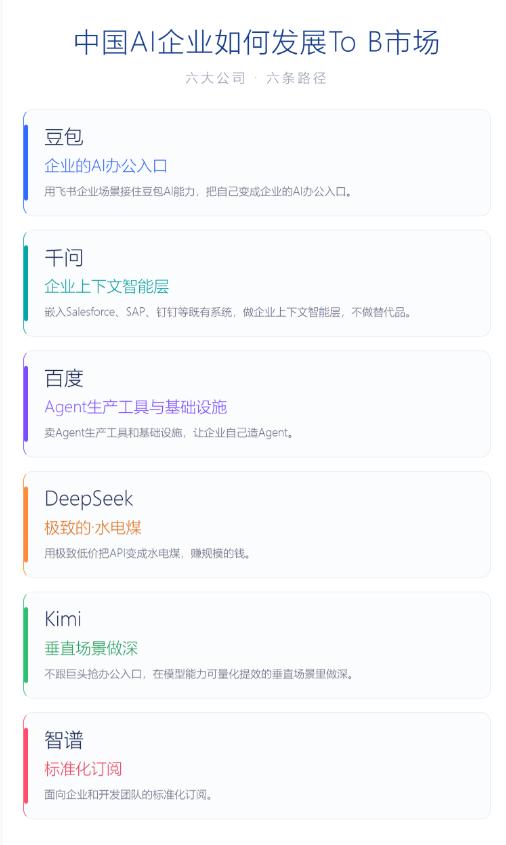
Baidu has long been more focused on large central and state-owned enterprise clients. Back then, when its ERNIE app was competing for C-end users, it did not even outperform Doubao or Yuanbao, so it was committed to the To B business from the very beginning. Now it seems that this was a blessing in disguise, as it did not waste too much cash reserves in those years. The proposal of "industrial intelligent agents" can be said to be completely consistent with Baidu's previous decision and logically self-consistent.
Qianwen's office business came a bit late, but it also finally embarked on the "right track". It also took the lead in launching an 899-yuan office robot. On one hand, it advocates the grand vision of "machine intelligence" civilization, and on the other hand, it is down-to-earth to realize monetization, finally understanding that "one never knows how hard it is to run a family until one does it oneself" — cash flow cannot be broken, and the capital reserves cannot be squandered. It is more cost-effective to get 80 billion Hong Kong dollars of non-repayable permanent capital through equity financing in the market than anything else.
Anthropic also provided very valuable hints to its Chinese peers. By focusing on enterprise API and Agent deployment, it has continuously increased its valuation with real revenue, and also inspired Zhihuipu across the Pacific, as well as Kimi, which launched the FDE (Field Deployment Engineer) mode, letting engineers go to the client site to help enterprises integrate AI into their core businesses.
But the awakening of ordinary users is sometimes a bit slow.
It was not until much later that people found their own camp began to be divided. Programmers and white-collar workers have become the most valuable paying users that major manufacturers want most — they have clear efficiency anxiety, reimbursable budgets, and bosses urging them to "use AI as soon as possible". However, those who stay at home and pour out their life troubles to Doubao have become digital records that only contribute to daily active users but do not generate actual revenue.
"Useless People"?
Facing AI, many members of the public have now become very calm.
Ordinary users are not "customers" in the AI ecosystem, but training grounds and data sources for AI capabilities. They are a verification pool that can be called at any time, but not a core source of revenue.
Of course, some people say that this does not mean ordinary users are abandoned. A more accurate statement is that ordinary people have changed from "the objects of dedicated services" to "the objects of incidental services".
The 200 million daily active user entry can be turned into traffic at any time when ByteDance needs to verify its life service business, but the service targets that Doubao wants to serve now are, to a larger extent, suppliers. As for ordinary users, their value has not been fully tapped now, which does not mean there is no possibility in the future.
This kind of "value positioning of ordinary people" has already appeared in the mobile Internet era. We read news for free, watch short videos for free, and search for free. Platforms collected public data and turned it into "algorithms" sold to the To B market — to some extent, selling advertisements in the mobile Internet era is selling algorithm services.
The AI era is repeating this logic. We chat for free, write some basic texts for free, and generate images for free. But without the data fed by us, the large model that needs to be iterated every 44 days will face the situation that "even a smart housewife cannot cook a meal without rice".
Although ordinary users are no longer the core focus in that round of "deep affection" wave, they are the foundation for large models to exist in the world.
In the AI account books of major manufacturers, there is still some space reserved for ordinary people's payment. Enterprises will pay the majority of the revenue, and the rest of the revenue will be supplemented by ordinary people paying for practical Agents.
Looking back, the "love-hate entanglement" between ordinary people and AI is actually very natural. At the beginning, AI manufacturers thought that more friends would make the road easier, which was the continuation of the mobile Internet logic back then.
Now, AI manufacturers have woken up — the road can only go smoothly when there are more friends who can pay.
From covering all operating costs for the public alone in the past, to now sharing the operating costs with enterprise clients, this is not a change of heart or a breakup. Because back then, although AI said it would bring a happy life to everyone, it never promised to support us for the rest of our lives.
Ordinary users are not negative assets of AI. At a certain moment, people will re-evaluate their own value, such as personal data assets.
The daily conversations of 200 million people not only cultivate the model's intelligence, but also its understanding of the world. This account will be settled sooner or later.
This article is from the WeChat official account "Muhe Business and Finance", author: Gong Zheng, published with authorization from 36Kr.