The Supply and Marketing Cooperative Band Sparks Controversy: When "AI" Moves from Streaming Media to the Live Performance Market
At 12:30 on September 22, the second round of ticket release for the 2026 national tour "Opening for Business Today" by Supply and Marketing Cooperative Band officially kicked off.
The Wuhan stop is scheduled to be held at Buwan InTimeLive (Cherry Shop) on October 24, and the Shijiazhuang stop will be held at 1969 CHIZHAO LIVEHOUSE on October 31. The two previously unannounced cities have been officially confirmed.
So far, three stops of this tour in Jinan, Wuhan and Shijiazhuang have been confirmed, with ticket prices remaining 128 yuan for early-bird tickets and 168 yuan for full-price tickets. Less than two months passed between the band's first music festival performance and the launch of the national tour. However, before Supply and Marketing Cooperative Band officially stepped onto offline stages, controversies surrounding this "AI band" had lasted for an entire summer.
In early July, some users on social platforms posted that "I have been listening to Supply and Marketing Cooperative Band with full affection for so long, only to find out it is AI-synthesized", and bluntly said that "it is really hurtful". More netizens called it a "Frankenstein band", questioning that its songs were suspected of splicing works of many original musicians. On September 2, Supply and Marketing Cooperative Band posted on Weibo, saying: "We know our music level is not high and cannot meet the high standards of many teachers, we only ask music critics to let us go."
In fact, although there are many controversies surrounding Supply and Marketing Cooperative Band, the band has never admitted that its works are "AI products".
The editorial department of Music Finance (ID: musicbusiness) found that, as the music large model itself is a product of "song fusion", for works created by real people using AI music tools, how much of them can be counted as their own original creations? How to define the boundary of work plagiarism in the AI era? These problems are hanging over the industry and urgently need new industry rules to solve. At the same time, when AI works are exploding, AI virtual artists are also emerging in batches. In 2026, they are not only occupying streaming media platforms, but also trying to enter the offline performance market. (Review: The Creator Forum of Wave Music Awards: When 162,000 new songs are added to the database every day, how can the industry preserve the soil for high-quality music?)
Two years since debut, astonishing output speed, ridiculed as "AI band"
At 17:00 on August 30, the "Light-Chasing Folk Music Healing" special session of the Light-Chasing Beach Music Carnival kicked off at the Performance Square at Gate 1 of Wanpingkou, Rizhao. As the opening guest, Supply and Marketing Cooperative Band performed on stage for 40 minutes, which was the band's first appearance on the offline music festival stage.
According to subsequent reports, Supply and Marketing Cooperative Band has a strong down-to-earth urban atmosphere, with relaxed and lively music style. With simple instrument collocation and narrative singing, it laid a relaxed and lazy atmosphere for the whole performance. The official Weibo account of the band also posted after the performance, "We left the first song of Supply and Marketing Cooperative Band in the beach evening breeze of Rizhao".
However, under the video clips of the music festival performance, the associated keyword of "People are also searching" on the platform is "real-person band that writes songs with AI".
As for the comment section, there are all kinds of voices: "These people don't seem familiar with each other... they are temporarily gathered to make money", "The live version is so different from the recording version, which makes me more convinced that it has been fused by AI", "This is just plain vocal, even the lyrics are memorized on the spot, it's so bad".
Public information shows that Supply and Marketing Cooperative Band was founded on June 25, 2024, with the label "A Sparrow", and the OP (original copyright owner) is Jiangxin Wuxian. At present, Supply and Marketing Cooperative Band has 114,000 fans on NetEase Cloud Music, more than 100,000 fans on Qishui Music, and 26,000 fans on QQ Music.
Among them, its representative work Let Time Fade It Away has been collected more than 770,000 times on NetEase Cloud Music, which is the most played song of Supply and Marketing Cooperative Band, and ranks first among all songs of the band on platforms such as Kugou Music and Shazam. The song production information shows that the lyrics and music are signed by "Bianyuan", the arrangement is by Tian Chenguang, the mixing is by Ren Tianyu, the guitar is by Yang Chun, and the producer is Zhang Qihua.
Other popular songs such as I Hear It, Your Pain Stayed in Yesterday, Someone Stayed in Yesterday, Let All Thoughts Go with the Wind also rank high on the popular song charts of multiple music platforms.
Of course, the most notable feature of this band is its astonishing output speed.
Since its establishment in June 2024, at least 74 albums (each with 2-3 songs, usually one song plus instrumental version and DJ version) can be retrieved on NetEase Cloud Music, with a total of 133 songs. The Shazam platform shows that it has released more than 12 EPs (including instrumental versions) in 2026 alone.
It released Mr. Jiang and Miss Wang on July 3, Life is Like Picking Up Flowers at Dusk on July 18, Lonely Train on July 31, Self-Righteous on August 7, I Lost the Moon in My Night on August 20, Ripples on August 27, and Give Me Back Myself on September 14. The songs cover various styles such as urban lyric, folk and pop, and new works are launched almost every one or two weeks. This output rhythm is indeed unusual for a band that claims to be composed of real people.
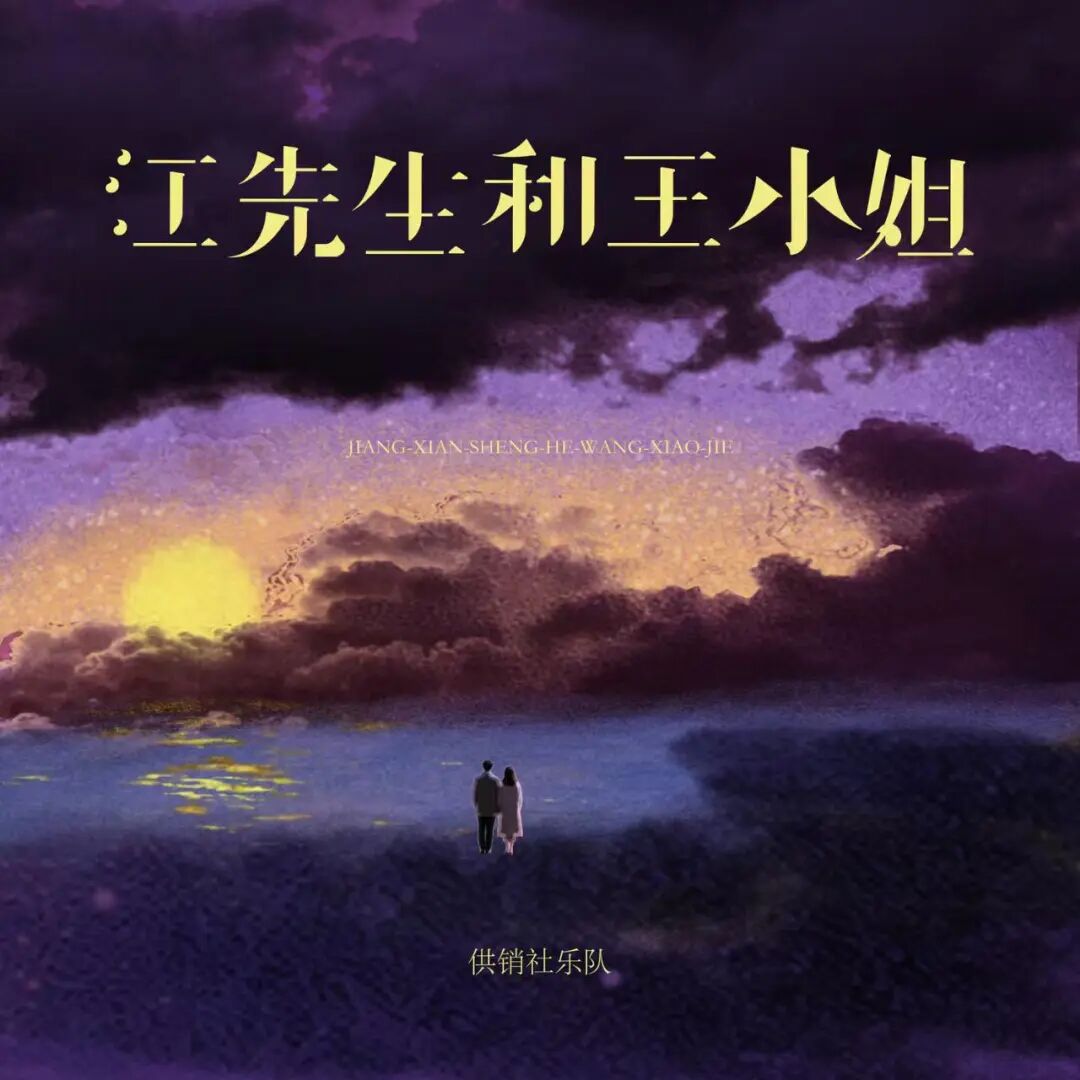
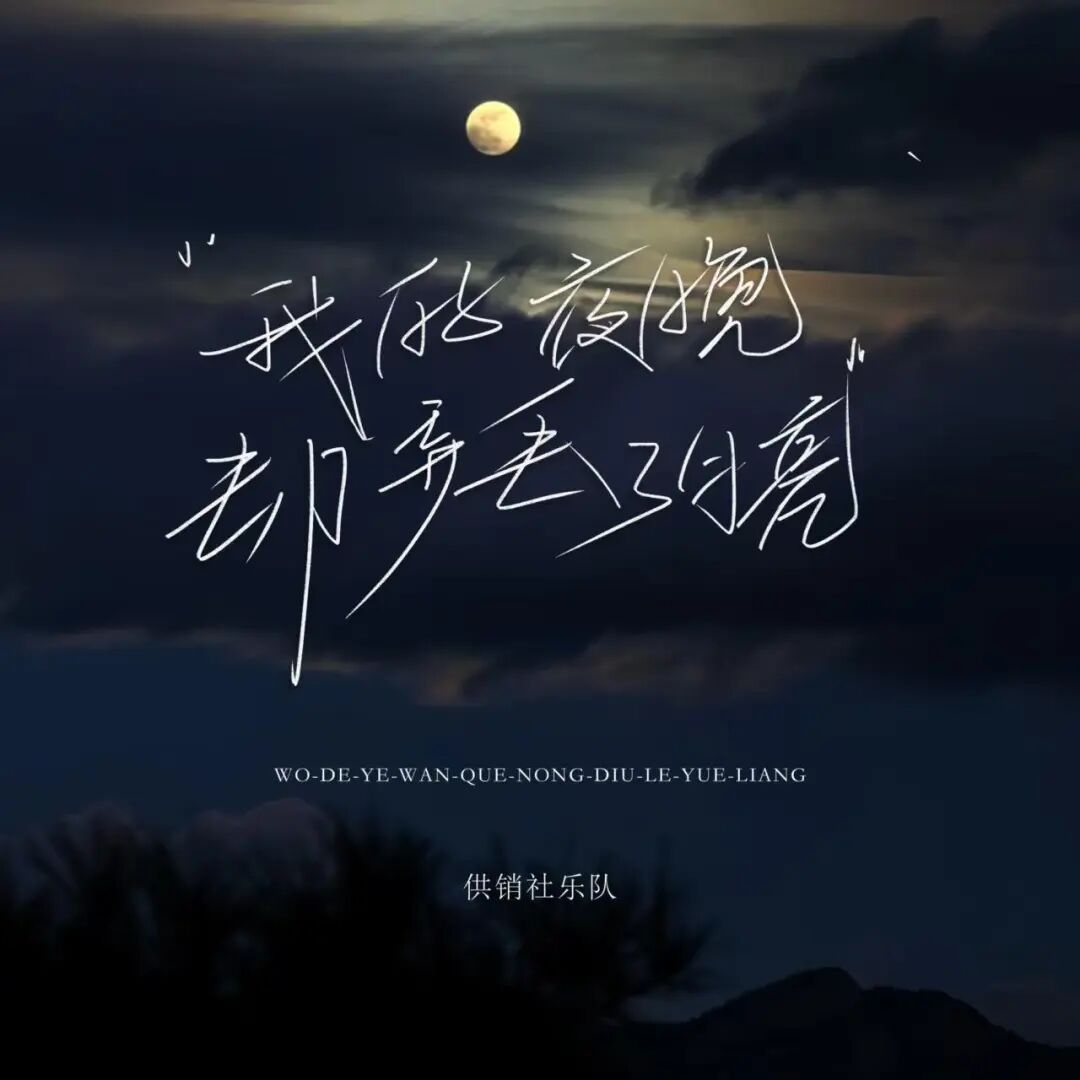
The controversy escalated from then on. More and more fans began to question that Supply and Marketing Cooperative Band is not a traditional real-person band, but an AI band.
What puts more pressure on Supply and Marketing Cooperative Band is the plagiarism accusation. It is understood that Liu Ang, the lead singer of the Aotuti Band, once posted consecutive videos on social platforms questioning that Supply and Marketing Cooperative Band committed plagiarism. For example, the song How How How was accused by Aotuti Band of plagiarizing the song Dust Smoke, and the suspected similar clips were also posted online, which sound very similar.
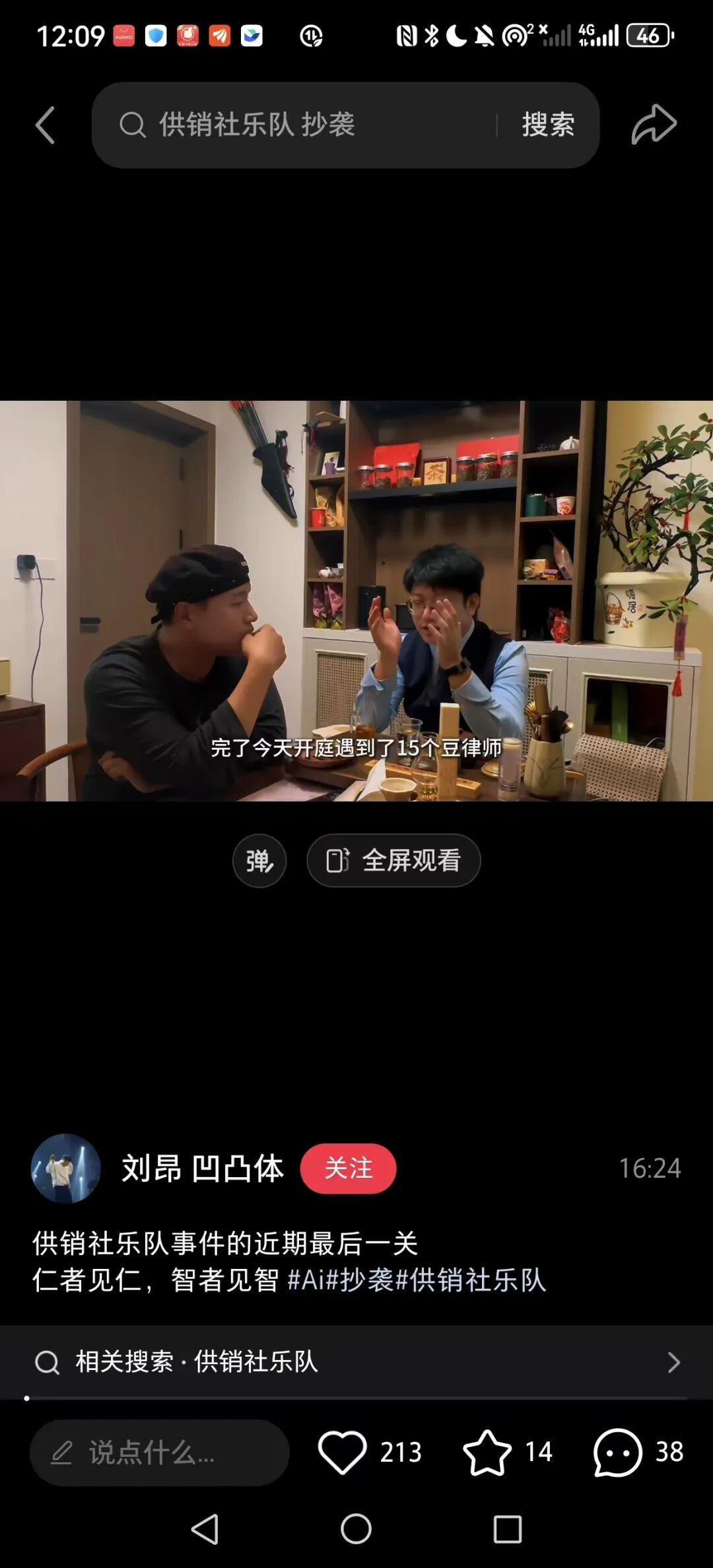
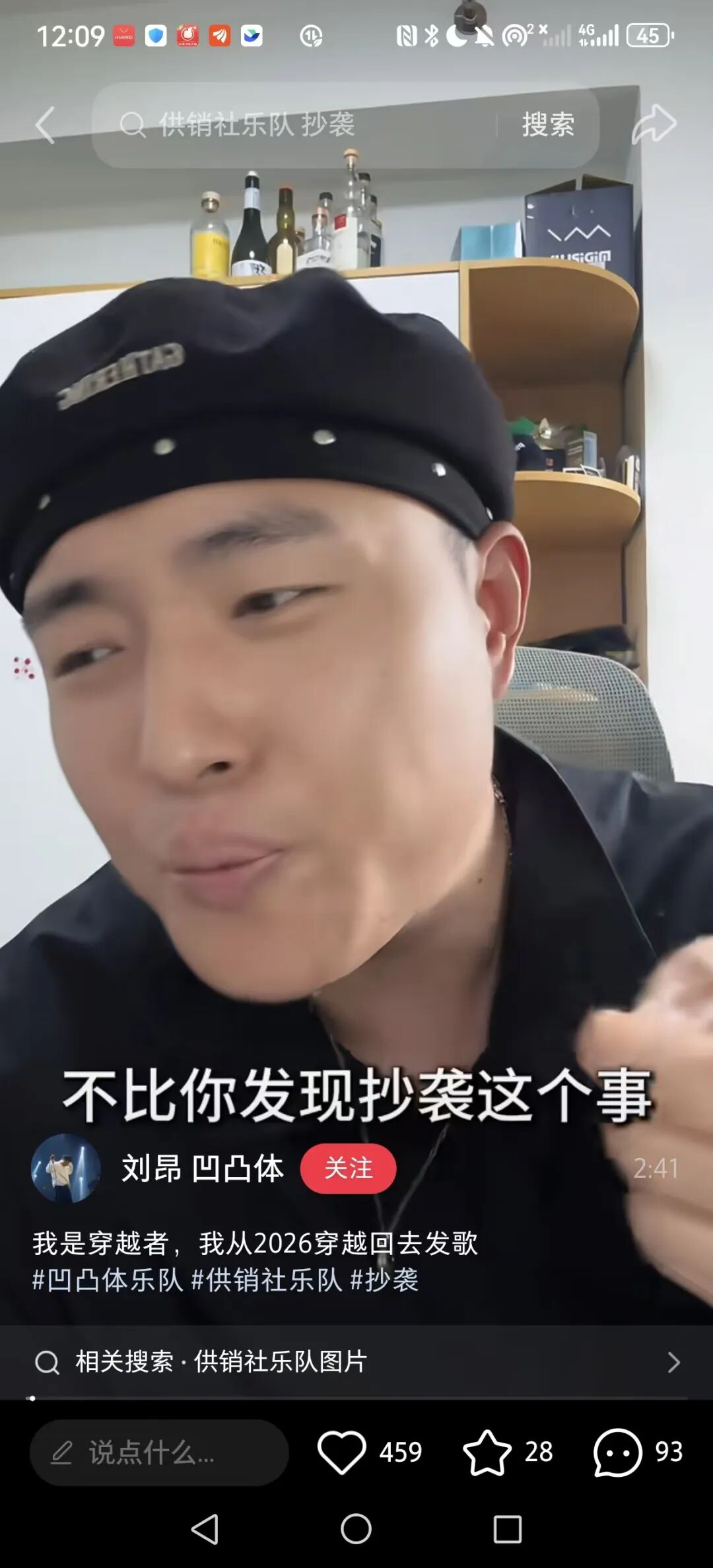
Nowadays, many catchy popular songs have the problem of similar listening experience. The so-called "splicing" refers to using AI tools to reorganize and transpose the melody, lyric structure and arrangement logic of many existing works, so that the final finished product does not look like any original song, but the shadow of original works can be seen everywhere.
Facing the accusations, Supply and Marketing Cooperative Band has made two public responses.
The first response said "We are not AI, we are already preparing for the tour", and asked back "In 2023/2024, did AI even exist back then?"
On September 2, the band posted another article, "I don't want to be discussed, judged or defined", the statement also explained the reason for its high output: "The reason why I write a lot of songs is that before the band was established, I was already a lyricist and composer who had written a large number of songs."
NetEase Cloud Music once told the media that currently the platform does not allow users to use AI works to certify musician identities. But the person also admitted that due to the rapid iteration of AI technology and the fact that some works are mixed with manual modification, it is currently difficult for the platform to achieve 100% pre-identification of AI works.
The reason why Supply and Marketing Cooperative Band has triggered wider discussion is also related to its high popularity. Its songs are really loved and collected by a large number of audiences, and even became a small hit on short video platforms such as Douyin, but its output is indeed very high. This release frequency and the familiarity of popular melodies in the songs naturally made it labeled as "AI".
Music Finance consulted a senior music producer about the uploaded songs of Supply and Marketing Cooperative Band. In his view, judged from the listening experience of the finished products on the platform, the human voice in the songs is sung by a real person, not AI synthetic voice. The breathing, articulation and emotional fluctuations all have the characteristics of real-person singing. It is not accurate to directly call Supply and Marketing Cooperative Band an "AI band". It is more like a product that uses AI tools to generate lyrics and music, and is sung by real people.
For the high-output issue that has been most questioned by the outside world, this producer believes that it is difficult to avoid and cannot be used as a judgment standard. "Now AI tools have been widely used in the music industry, including arrangement, mixing and even creation drafts, the production capacity has been generally improved. Large output itself cannot explain anything, the key problem is how to determine plagiarism."
Then for the current industry situation, is there a "failure problem" between musicians using AI tools and not using AI tools?
Just like the Can Music Festival used AI-generated posters as souvenirs for sale, most music fans could not accept it after discovering it, and this incident is still ridiculed by music fans from time to time.
Then, if a real person creates a large number of works with the help of AI works or AI tools, and luckily gets traffic on the platform through the horse-racing method, but the platform does not mark the AI attribute, and the user finds the AI trace by themselves, is this considered the platform's "fraud" or the artist's "career collapse"? Do musicians need to prove whether they have used AI tools or not?
In addition, the lyrics and music are generated by AI, and the real person is responsible for singing. Is the person standing on the stage a musician, or a performer of an AI music product? If the AI generation process splices the works of other original musicians, how to define the copyright ownership and creative ethics?
With the penetration of AI tools, users' resentment towards the use of AI has made the problem more complicated. In the literary world, not long ago, the science fiction writer Hao Jingfang admitted generously in an interview that her new novel used AI, which was also criticized by many readers who said "it is completely unacceptable".
It is worth noting that the industry changes pointed out by the producer have shown a clearer direction in the recent month.

Music large model itself is a product of "song fusion"
On September 9, 2026, the AI music generation platform Suno released the v6 series model, which is its first new generation system trained entirely on the licensed music library signed with record companies. Its partners include Warner Music, BMG, as well as distribution platforms Believe and TuneCore.
This series is divided into three versions: v6, v6-wild and v6-mini. Among them, v6-wild is clearly oriented to musicians and producers, and is officially positioned as a brainstorming partner with more imaginative space. v6 and v6-wild can only be used by subscribing to Pro or Premier packages.
What is more noteworthy is Suno's additional investment in the professional production process. For example, the built-in Suno Studio provides multi-track editing, which can split a song into up to 12 time-aligned WAV separate tracks, supports 6-band equalization, Warp Markers speed alignment and Remove FX de-reverberation, and can export MIDI, allowing creators to import the generated results back to professional host software such as Ableton, Logic Pro and FL Studio for further processing.
Jack Brody, Chief Product Officer of Suno, said that the revenue sharing with record companies has taken effect since the release date on September 9. Obviously, the role of the tool is shifting from "one-click song creation" to entering the workflow of musicians, becoming an "accelerator for professional production".
However, the reputation of V6 is far less impressive than its release momentum. At present, the feedback from long-term subscribers is mainly negative, many old users have started to unsubscribe, and the problems are concentrated on audio quality.
On Suno's Reddit community, users describe the output of V6 as muffled, dull and strangely lifeless.
One user said: "The human voice is buried, the high frequency almost disappears completely, and the whole mix sounds like a blanket covering the speaker". Others think that "the output of V6 sounds generic, plain, over-produced and heavily compressed, and there is no trace of melody, roughness or soul in the tracks".
An old user who has released two albums with V5.5 wrote that the feedback from listeners is that his songs, human voices and orchestration are almost indistinguishable between real and synthetic. Later, he used the same style and prompt words to put all two days of free quota into V6, but still got muffled, generic and soulless results.
Some dissatisfied users asked Suno to bring back the old model, but the old model has been permanently removed from the shelves due to continuous pressure from large record companies.
Of course, the public information can only give an indirect explanation for the reason of quality decline at present. Because the complete composition of V6 training data has not been disclosed, its scale is obviously smaller than the data set used by the previous generation model, and the diversity is also lower.
The industry generally believes that the output quality of the model is directly related to the scale of training corpus and the width of covered styles. On the premise of only using licensed materials, the capacity of available music library is naturally limited. This causal chain has not been confirmed by Suno, but the subjective feelings of users are highly consistent with the fact that the training data has shrunk.
At present, Suno has reached a settlement and signed an authorization agreement with Warner Music Group, and the legal disputes between Universal Music Group and Sony Music Entertainment are still ongoing.
This turmoil also puts a fact that was previously covered up by the label dispute on the table.
No matter Suno, Udio or other music generation models, their capabilities are essentially products of "song fusion training". The model generates new works by learning the melody trend, harmonic structure and arrangement logic of a large number of existing songs, and the output naturally carries the shadow of the training corpus.