Why are consumers spending more instead even though car prices keep falling again and again?
From January to August 2026, in the overall passenger vehicle market, models priced below 200,000 RMB remain the absolute mainstay of the market, with a sales share of 60.1%, but this figure has dropped by 2.9 percentage points compared with the same period in 2025.
Nowadays, in the perception of most users, under the fierce involution of market competition, automobiles should be getting cheaper and cheaper. But why is the actual price consumers pay for cars getting higher and higher?
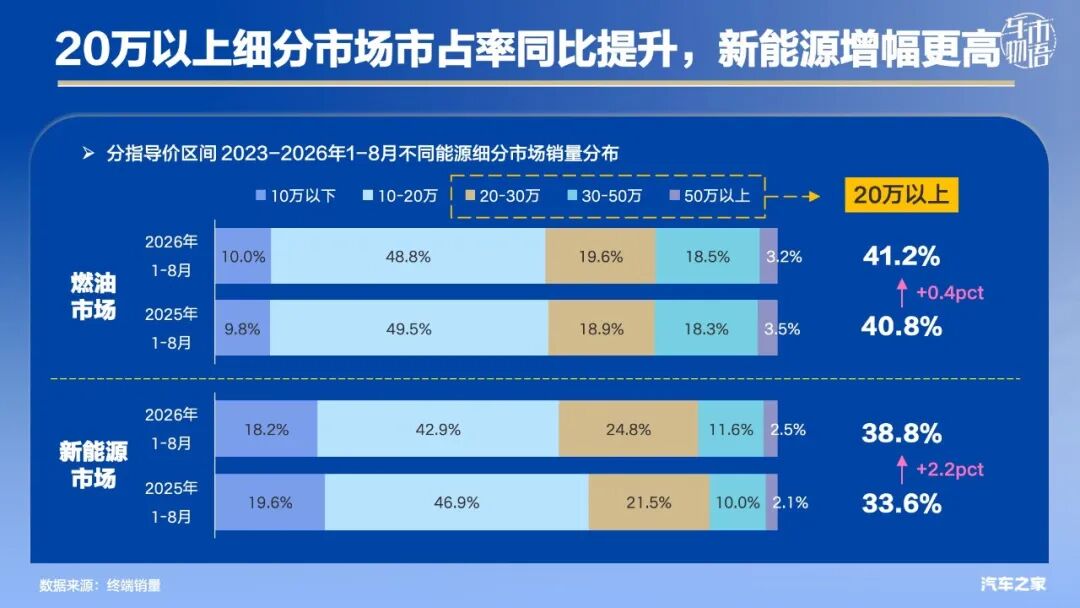
The shrinking share of the economy market and new energy vehicle consumption drive the growth of the mid-to-high-end market
By energy type, in the sub-market above 200,000 RMB, the sales share of both fuel vehicles and new energy vehicles has increased year on year. Among them, fuel vehicles have a higher base share, rising by 0.4 percentage points to 41.2% from January to August 2026.
The new energy sector has seen a more prominent increase, rising by 2.2 percentage points from 33.6% in the same period of 2025 to 38.8%, and the share gap with fuel vehicles continues to narrow. The consumption of new energy vehicles in the mid-to-high-end market directly drives the growth of the overall market.
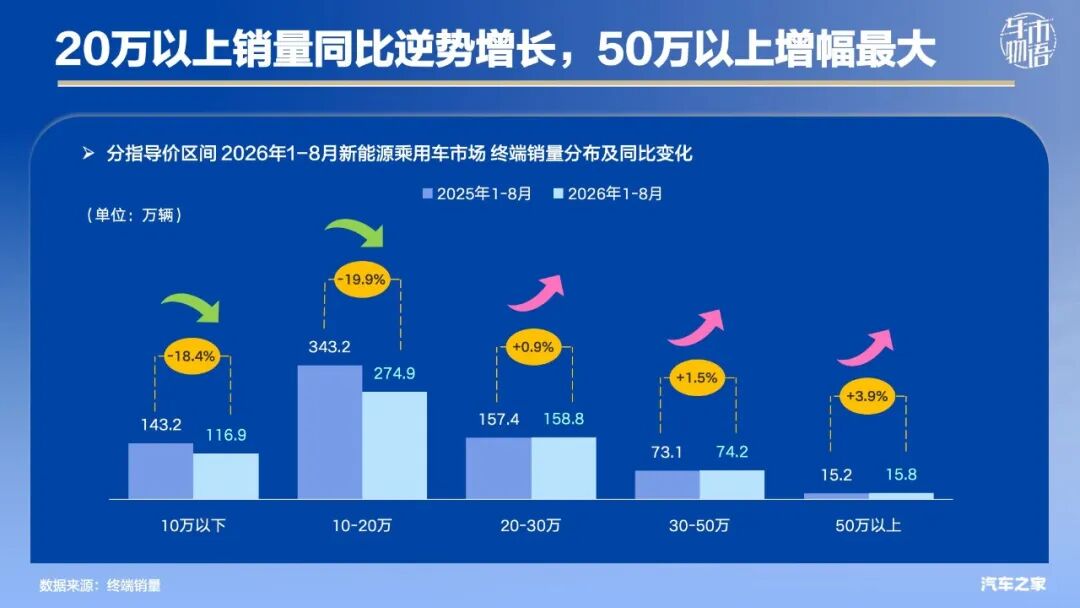
Further analyzing the new energy market based on specific sales figures, sales in the price range below 200,000 RMB have dropped sharply by nearly 20% year on year, while all segments above 200,000 RMB have achieved positive year-on-year growth.
Among them, the high-end market above 500,000 RMB has the highest year-on-year growth rate, reaching 3.9%, which is directly related to the low base of this market in the same period last year. But it is an undeniable fact that new energy consumers this year are more willing to spend more money on buying cars than last year.
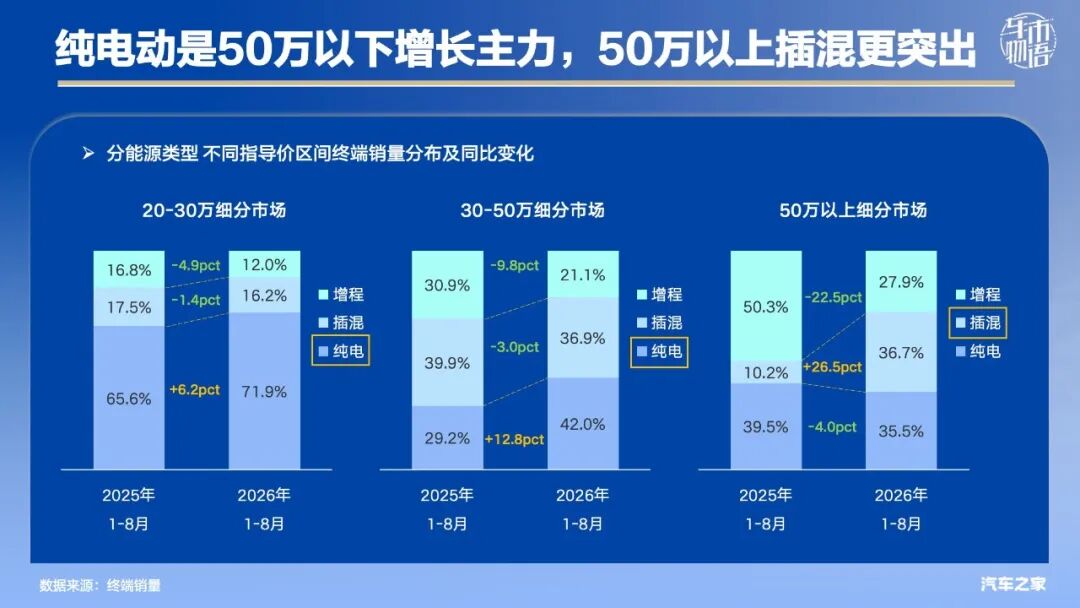
Looking at different energy types separately, in the 200,000-300,000 RMB price range, pure electric vehicles remain the main force of the market, with their sales contribution share rising by 6.2 percentage points to 71.9%. In the 300,000-500,000 RMB segment, the original pattern where plug-in hybrid vehicles took the lead has been rewritten, and pure electric vehicles have overtaken them, with their share surging by 12.8 percentage points to 42.0%.
Although plug-in hybrid vehicles have lost some share in the 300,000-500,000 RMB market, they have achieved a leapfrog breakthrough upwards, seizing the share of extended-range models in the high-end market above 500,000 RMB, with a year-on-year increase of 26.5 percentage points, accounting for 36.7%. This change is mainly driven by popular new models. The Zeekr 9X alone contributes 91.1% of the sales of plug-in hybrid vehicles in this price range.
The sales volume of the mid-to-high-end market is rising against the trend, and its share continues to expand. Could it be that the inherent perception in the past was biased? The automobile market is not continuing to cut prices, but instead showing a trend of getting more and more expensive?
New models with guide prices above 300,000 RMB are growing rapidly, and there are more and more mid-to-high-end new cars
Facts have proved that the new energy vehicle market is indeed getting "more expensive" as more high-end new cars are launched.
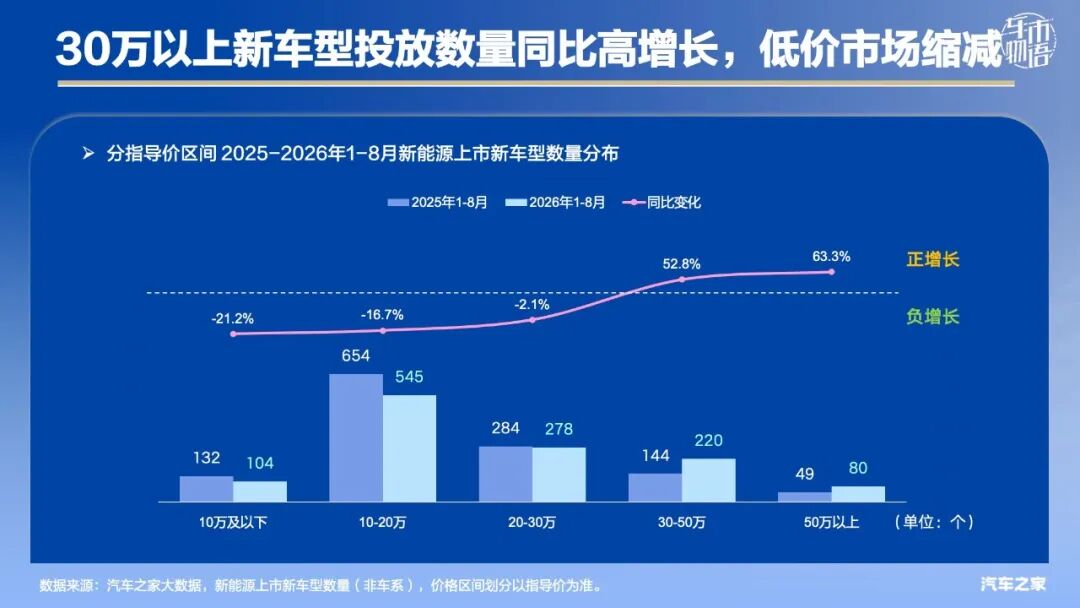
According to the big data from Autohome, compared with the same period in 2025, among the new energy vehicles launched from January to August 2026, the number of models with guide prices below 200,000 RMB has shrunk significantly year on year; the number of new cars in the 200,000-300,000 RMB range has fluctuated slightly, down 2.1% year on year.
In sharp contrast, the number of new cars in the guide price range of 300,000-500,000 RMB has surged by 52.8% year on year, and the growth rate of high-end models above 500,000 RMB is even more prominent, reaching 63.3%.
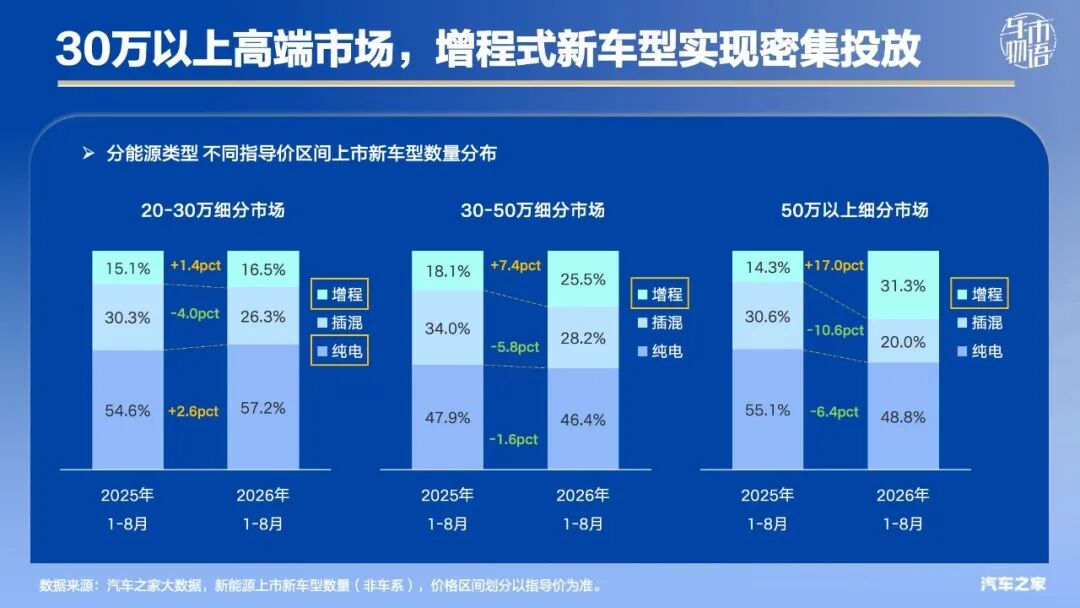
By specific energy type, in terms of the number of new models launched, in the market above 200,000 RMB, the growth in the 200,000-300,000 RMB price range is mainly contributed by new pure electric and extended-range models, whose launch share has increased by 2.6 percentage points and 1.4 percentage points respectively. The increment in the market above 300,000 RMB all comes from new extended-range models, among which the performance in the segment above 500,000 RMB is the most prominent, with the launch share of new extended-range models reaching 31.3%, a significant increase of 17.0 percentage points compared with the same period in 2025.
In conclusion, it is not difficult to see from the data that compared with the same period in 2025, the number of mid-to-high-end new cars priced above 300,000 RMB has indeed increased, and the average guide price has also risen accordingly. But why do people still intuitively feel that cars are getting cheaper?
Although consumers spend more money, they feel that it is more cost-effective
Although the focus of new car launches continues to shift to the mid-to-high-end market, consumers have the feeling that car buying is "cheaper". The core reason is that under the same budget, the level of optional products has been greatly improved. With more new energy flagship models being launched and prices continuing to drop, large-size flagship products that were once out of reach are now within the choice of ordinary consumers, which forms the intuitive feeling that car prices are going down.
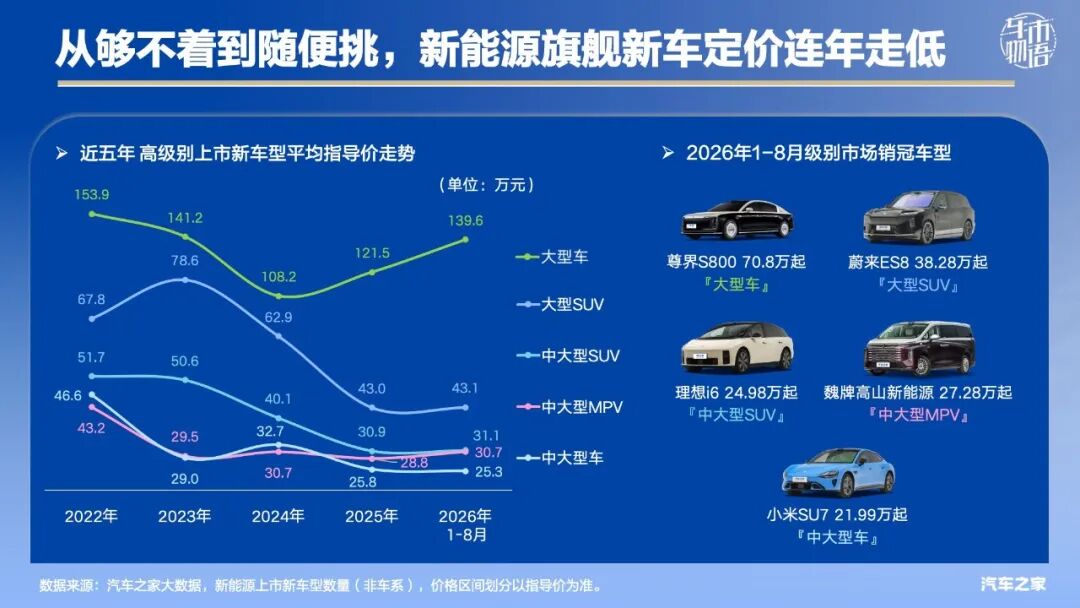
The big data from Autohome confirms this point: among the new cars launched at the mid-large level and above, except for large cars which have slight fluctuations due to the small number of products, the average guide price of new cars at all other levels shows a downward trend.
Looking at the top-selling models in each sub-market, the entry price of the Li Auto i6 mid-large SUV and the WEY Gaoshan new energy mid-large MPV is less than 300,000 RMB. The Xiaomi SU7 mid-large sedan is priced starting at 219,900 RMB. In the past, this budget could only buy a midsize car, but now consumers can directly get a higher-level product.
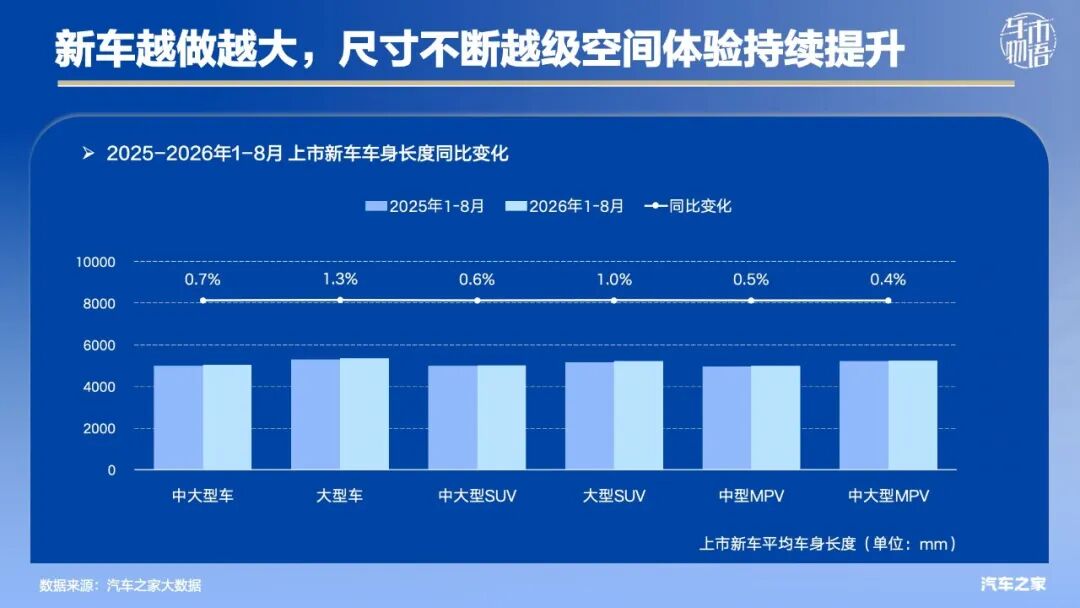
High-level new models are not only seeing continuous price cuts, but their body size is also constantly upgraded. Compared with the same period in 2025, the average length of new cars at the mid-large level and above launched from January to August 2026 has increased to varying degrees. Among them, large cars and large SUVs have the most prominent growth rates, rising by 1.3% and 1.0% respectively. Although the growth rate does not seem high, the original car length is already over 5 meters with a high base.
In the current consumption scenario, consumers nominally buy a mid-large car, but essentially use the budget for a midsize car to enjoy space close to that of a large car. In addition, the price reduction, configuration increase and size expansion of high-level models have also squeezed the economy market, forcing economy models priced below 200,000 RMB to cut prices synchronously. Even if consumers do not choose mid-to-high-end models, they can buy products with richer configurations within their original budget. With the same budget, consumers get higher product value, so they naturally feel that car buying is more cost-effective.
Fierce market competition has spawned deep involution in the automotive industry. Although the average pricing of new cars continues to rise and the price war seems to have subsided, it has actually just changed its form of competition. Automakers no longer simply compete for lower prices, but put more efforts into larger leapfrogging space, more advanced technology support and a wider variety of preferential policies.
Against the background of continuously increasing model size, richer configurations and falling prices of flagship models, the original price system of China's automobile market is facing reconstruction. With a budget of 200,000 RMB, what kind of car can be bought and how large is the optional space? The reality is constantly refreshing the public's past inherent perception. It is not yet known when this reform of the price system will end, but at least at the moment, the reform is still continuing to advance. (Written by Auto Market Story)
This article is from the WeChat official account "Auto Market Story" (ID: autostinger), written by Sun Ying, and published with authorization from 36Kr.