Moats and the "Barbellization" of the Software Industry
Shen Translation is the translation team under 36Kr, focusing on technology, business, workplace, lifestyle and other fields, with a focus on introducing new technologies, new perspectives and new trends from abroad.
Editor's Note: AI has driven the cost of coding down to zero, and the software industry is stepping into the same collapse scenario that the newspaper industry faced in the 1990s: the middle-tier players are waiting for their demise collectively, leaving only behemoths and one-person companies. This article is translated and edited.
Ben Thompson loves using analogies, and one of his most frequently cited analogies is the newspaper industry landscape in the 1990s. Before the birth of the Internet, running a newspaper was an extremely profitable business. Due to extremely limited competition, newspaper offices monopolized the audience attention in their respective regions. Warren Buffett was very fond of the newspaper industry back then.
The monopoly position of these newspapers was deeply rooted in their distribution infrastructure: in Des Moines, it was relatively difficult to buy a copy of *The New York Times*, while it was much easier to subscribe to the local *Des Moines Register* conveniently.
When the Internet arrived, the distribution cost instantly dropped to zero, and the entire market was reshaped accordingly. The final end state of the industry (that is, the current situation now) presents a distinct "barbell" structure:
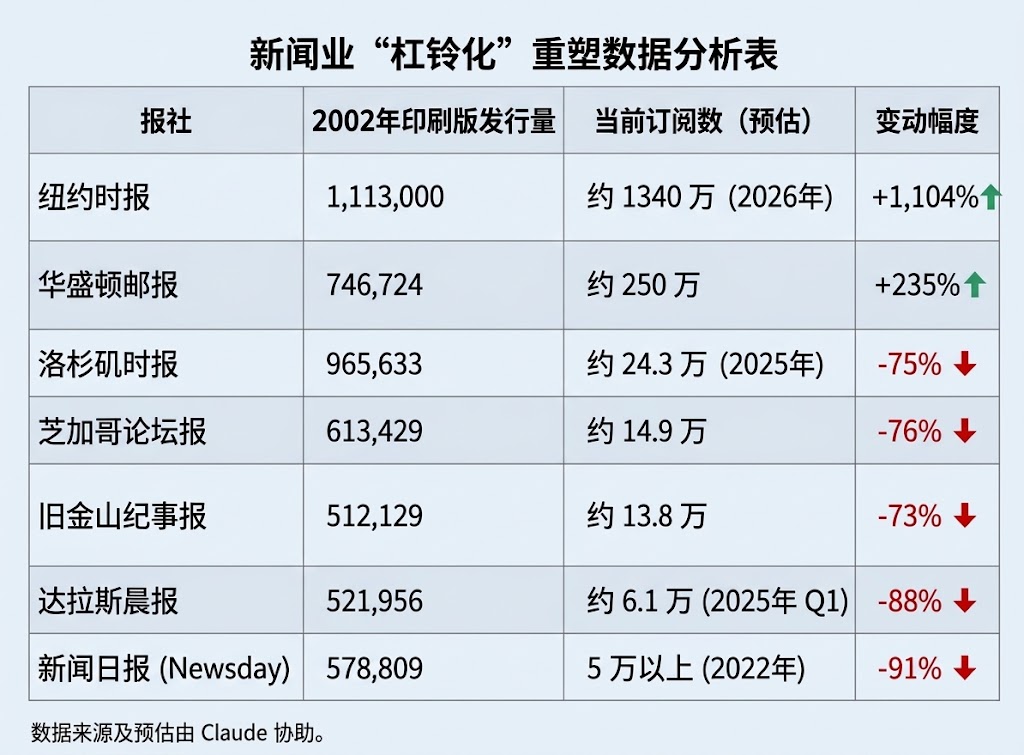
By contrast, @lennysan's *Lenny's Newsletter* already has more than 1.2 million subscribers (tens of thousands of whom are likely paid subscribers).
If you are reading this article, your daily information sources are most likely some combination of *The New York Times*, X (formerly Twitter), and various Substack newsletters.
In the newspaper industry, the once solid mid-tier echelon has completely disappeared. You either become one of the world's top super newspapers, or you become an independent creator or small micro-institution working alone.
Software and Moats
Today, the mere thought of competing with Amazon is already overwhelming. Their moat seems unfathomable and multi-faceted: dozens of cargo planes, hundreds of AWS cloud services, and tens of thousands of logistics vans.
But if you trace back to the very beginning, Amazon actually had the most vulnerable and hardest-to-defend business starting point among all tech giants. At that time, they only sold books in a much smaller niche! The business was nothing more than purchasing books in batches from publishers, repackaging them into smaller cartons, and then shipping them out. Anyone could run this kind of business.
So how did they transform from the enterprise with the weakest moat to the tech empire with the most solid foundation in just 30 years? The answer lies in extreme execution and non-stop reinvestment. Their real moat is the accumulation of more than 7,500 days, continuously building products, making profits, and then reinvesting all the profits to build more new things.
The moats of the vast majority of software companies are usually built on three pillars:
The development cost and engineering complexity of reproducing existing systems
The high switching cost for customers to migrate out after the system is launched
The ecosystem network effect built by software interfaces, professionals in specialized fields and system integrators
However, what will happen when the marginal cost of software engineering approaches zero infinitely? I believe the previous moats are being eroded away:
Reproducing a set of existing software is becoming cheaper and more agile
System migration can be carried out with a very high degree of automation
Interface integration is automated; AI's performance in specialized fields has even surpassed the top 5% of human experts
Facing this drastic change, where should software enterprises go?
One perspective to understand Amazon's moat is to focus on its large-scale heavy asset facilities such as cargo planes, trucks and data centers.
Another more essential perspective is to regard it as uninterrupted continuous reinvestment. On the first day of starting a business, it was extremely easy to defeat Amazon; in the second year, the competition threshold might still not be high; but by the 10th year, challengers have to retrace all the hard paths they took in the first 9 years, because they never let off the gas pedal during this period.
If today, the amount of software engineering you can deliver per day has increased by 1000 times, and you maintain this output rhythm every day for the next 10 years, you will still be able to stand on a solid moat in the AI era. If competitors want to reproduce the new achievements you built with the help of AI, they still need to spend several years and billions of dollars. The thought of confronting you head-on will still make them feel suffocated and exhausted.
Generally speaking, I believe that the weight distribution of the "7 Powers" model proposed by Hamilton Helmer in the software field is shifting: the barriers of switching costs and network effects are weakening, while the weight of economies of scale and brand value is becoming increasingly prominent.
To say something that may be a little hasty, I believe that the core leading strategy of the future software industry will definitely be based on "scale" — delivering software at an incredible volume every day, and then continuously reinvesting the profits to build a larger system. At that time, your moat is to a large extent the "extreme cost that your competitors need to bear to reproduce all your software".
The "Barbell-style" Reshaping of the Software Industry
In the long run, the evolution of the software industry is very likely to repeat the fate of the traditional newspaper industry in the 1990s.
There will only be a handful of giant software companies left in the market. On the large enterprise side, each core procurement function (such as sales, marketing, finance, human resources, IT operation and maintenance) will be monopolized by a set of native AI systems respectively. On the small and medium-sized enterprise side, it will be mainly dominated by all-in-one comprehensive platforms like Rippling.
In addition, various vertical industries (such as law, finance, medical care) will also have their own single-industry giants, just like each vertical industry usually only has one monopolistic leading industry journal.
The reason why these enterprises can win in the end benefits from both their unmatched huge product throughput and their unshakable go-to-market (GTM) promotion capabilities. Their goal is very simple: to provide extreme services far beyond any competing products for their own procurement center.
In my opinion, the vast majority of mid-sized solutions that focus on single-point functions will either be acquired and integrated, or gradually die out. For industry winners who aim to reach the top, the best strategy is to take full control of all links.
Finally, the other end of the barbell will see an explosive boom of "lightweight" software. Most of these are applications built by individuals for themselves or their own teams, but it may also give birth to a large number of small micro software enterprises deeply cultivating niche markets — this scene is extremely similar to the D2C e-commerce boom driven by Shopify and Meta ads in the 2010s. When the public builds hundreds of millions of applications with the help of development tools like Lovable, the power law will definitely take effect, and a small part of them will stand out and grow into vibrant small, medium and micro enterprises [1].
If you are building a venture-backed software startup, I think the only way to break through is still "taking full control". Build a complete system from beginning to end — your moat is constituted by the overall completeness of the product and the full control of customer procurement functions. It is almost impossible to find a safe place in the middle zone.
At the moment, I can't say for sure who will become the "Substack" of the software era (nor can I be certain about the specific evolution of the market pattern). But this is undoubtedly a very attractive frontier track. I think it may replicate the ecosystem of D2C e-commerce, and give birth to both "aggregators" (like the Meta role) and "infrastructure platforms" (like the roles of Shopify and Substack). There are already many exciting early explorations, such as @Lovable, @boltdotnew, @wabi and so on. If you have any unique insights into the future development of this side of the barbell, feel free to communicate with me.
[1] – I am worried that such small, medium and micro enterprises cannot support the scale returns pursued by traditional venture capital funds, but many entrepreneurs and investors still have cognitive misunderstandings here. In my opinion, these successful and workable forms are more similar to independent Substack newsletters: the founder or a very lean team fully owns and operates the entire business.
Translator: boxi.