Payment Enters the AI Era: How Autonomous Transactions Move Towards Reality
Abstract
The fundamental difference between AI payment and traditional payment is that agents begin to undertake part or all of payment decision-making and execution. Payment is embedded in dialogues and task workflows, with interactions shifting from step-by-step clicks to instruction triggers. Current mainstream practices still focus on payment assistants and proxy payments, while fully autonomous payment is still in small-scale pilots.
The higher the degree of autonomy, the more authorization and risk control need to be placed in advance. From manual confirmation for each transaction, to preset limits and scenario rules, and then to structured authorization credentials, payment permissions are gradually expanded, and problems such as misjudgment, unauthorized access, credential abuse and responsibility division are also rising simultaneously.
When AI payment extends to smart homes, smart cockpits and M2M transactions, explainability, traceability and auditability become the common prerequisites for large-scale implementation. Black-box algorithms, multi-party rights and responsibilities, sensitive data security and cross-border regulatory differences determine that autonomous transactions cannot only pursue a non-perceptual experience.
AI Redefines the Boundary of Payment
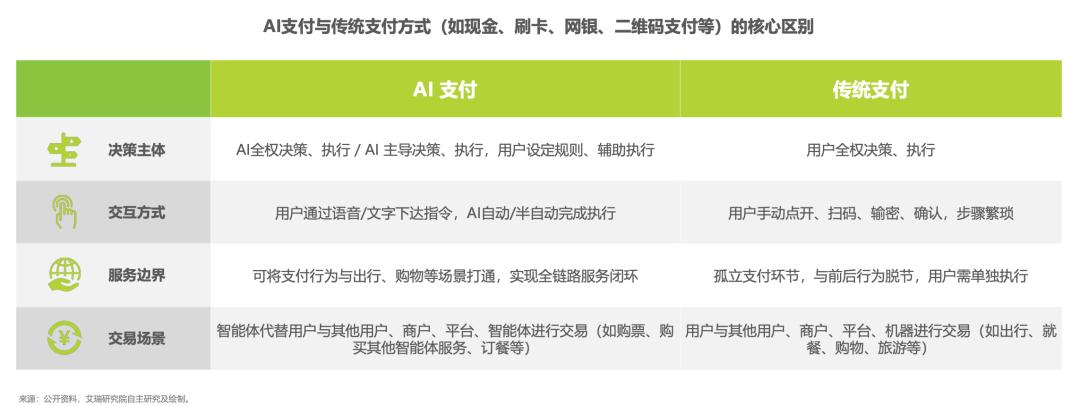
AI is changing the operation mode of payment. In traditional payment, users usually need to actively complete selection, confirmation and payment; while in the AI payment scenario, agents begin to participate in demand identification, scheme selection and transaction execution, and payment has gradually evolved from an independent operation to being embedded in a more complete task workflow.
This change is mainly reflected in four aspects: the decision-making subject expands from users to AI; the interaction mode changes from manual operation to voice or text instructions; the service extends from the isolated payment link to the whole process; the transaction objects also expand from people and merchants to agents, platforms and other machines.
As a result, the payment experience is more streamlined, but payment institutions need to process more information. Whether the agent is trustworthy, what the user's real intention is, how much payment is allowed, and in which scenarios it can be executed must be identified and recorded before the transaction occurs.
· Development Path ·
Three-stage Evolution: Autonomy and Risks Rise Simultaneously
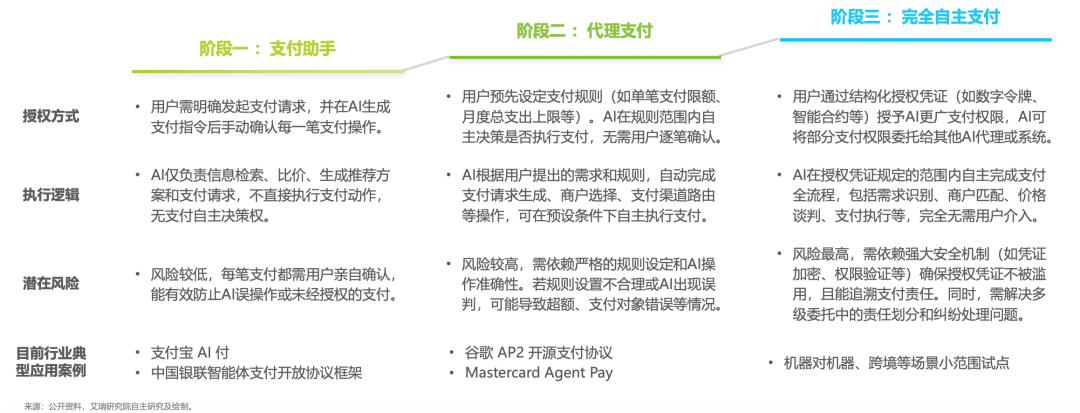
AI payment advances from payment assistants and proxy payments to fully autonomous payment, with the core variable being how much decision-making power humans cede.
- Payment Assistant Stage: Users explicitly initiate requests and manually confirm each payment; AI is responsible for retrieval, price comparison, recommendation and generation of payment requests, and does not directly decide whether to make payment.
- Proxy Payment Stage: Users pre-set rules such as single transaction limit and monthly upper limit; AI can select merchants, plan channels and execute automatically within the scope of the rules, without requesting confirmation for each transaction.
- Fully Autonomous Payment Stage: Users grant broader permissions through structured credentials such as digital tokens and smart contracts, and AI can independently complete demand identification, matching, negotiation and payment, and even delegate part of the permissions to other agents or systems.
At present, the mainstream of the industry is still in the first two stages. Payment assistants have lower risks, while proxy payment relies on strict rules and operation accuracy; fully autonomous payment has the highest risk, which requires credential encryption, permission verification, full-process traceability, and solving the responsibility and dispute handling in multi-level delegation.
· Global Practices ·
Two Types of Exploration Paths Have Taken Shape Overseas and in China
Overseas explorations are more focused on underlying protocols and payment infrastructure, while domestic practices place more emphasis on scenario implementation and strong security control.
Overseas card organizations, payment vendors and technology enterprises have formed multiple technical routes around identity authentication, authorization deposit, token control and multi-track settlement, focusing on connecting agents, merchants and payment systems. Most solutions are still in North American pilots, sandbox verification, developer tests or phased gray release, and large-scale commercial application on the public Internet has not yet taken shape.
The domestic market is simultaneously advancing capabilities such as conversational payment, consumption limits, fund isolation, hierarchical autonomy, identity and intention verification, and integrating user fund security and data privacy into product design. Retail, local life services and industrial supply chains provide verification scenarios, but higher autonomy levels are still mainly in pilots.
The common point of the two paths is very clear: agents must have verifiable identities, user authorization must be recorded in a structured manner, payment credentials need to be isolated from sensitive information, and the transaction process must also retain the basis for audit and dispute handling.
· Risk and Governance ·
The Higher the Degree of Autonomy, the More Control Capabilities Need to Be Pre-positioned
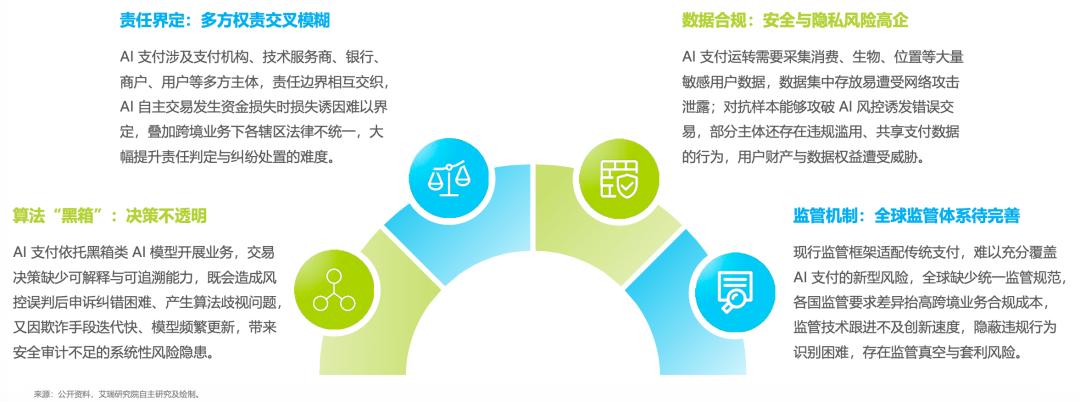
The main risk of AI payment is not a single technical failure, but the superposition of algorithms, multiple parties, data and supervision.
Algorithm Black Box: Transaction decisions lack the ability to be explained and traced, which may cause misjudgment of risk control, difficulty in appeal correction and algorithm discrimination; frequent model updates also increase the pressure on security audits.
Responsibility Definition: Payment institutions, technical service providers, banks, merchants and users participate together, making it more difficult to identify the inducement of fund loss and the boundary of responsibility, and cross-border transactions also face different judicial jurisdictions.
Data Compliance: Sensitive data such as consumption, biometrics and location are processed centrally, which is not only faced with cyber attacks and leakage, but also has the risks of adversarial samples inducing wrong transactions, illegal sharing or abusing data.
Regulation Adaptation: The traditional payment framework cannot fully cover the new risks of AI payment, inconsistent requirements in various countries will increase the cross-border compliance cost, and insufficient follow-up of regulatory technology may leave blind spots in identification.
Non-perceptual experience cannot be achieved at the expense of weakening control. Authorization scope, transaction amount, identity verification, risk circuit breaker and appeal correction need to be written into the process; otherwise, the fewer payment steps, the more difficult it is to restore facts and divide responsibilities after a misjudgment occurs.
· Future Scenarios ·
After Payment Becomes Invisible, Transactions Extend from People to Devices
AI payment will be further embedded in smart homes, smart cockpits and AIoT, becoming a basic link for perceiving demands, allocating resources and completing settlement.
In smart homes, devices can trigger procurement based on inventory and usage habits; in smart cockpits, payment is combined with location, navigation and travel intentions, covering refueling, passage, parking and consumption along the route; in AIoT, smart meters, vending machines and logistics lockers can automatically settle small-value, high-frequency and unattended transactions.
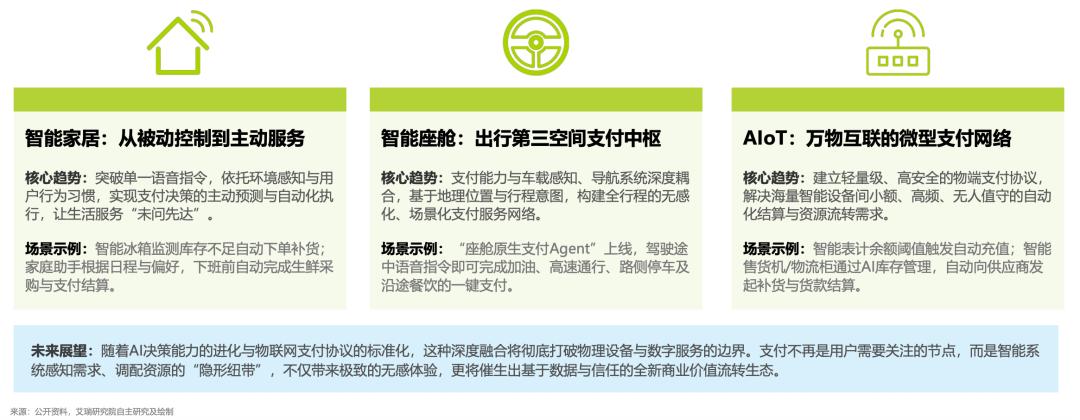
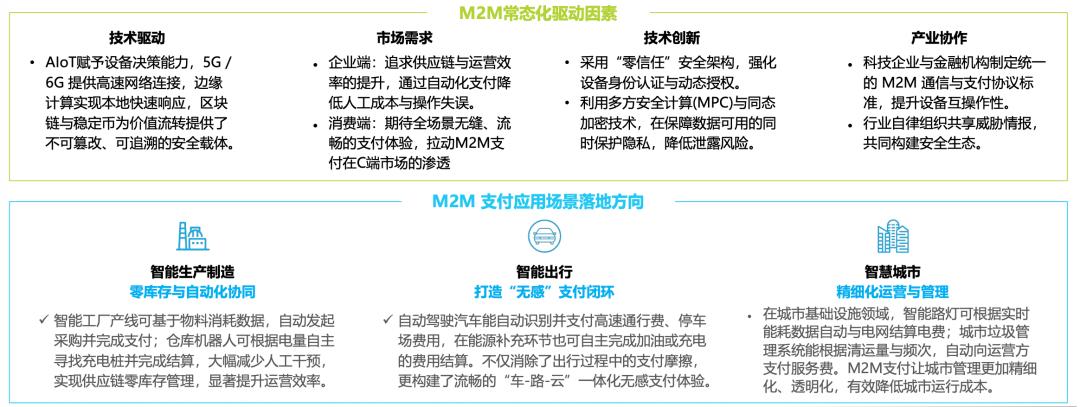
M2M payment further pushes automatic transactions to between devices. Smart factories can automatically purchase according to material consumption, warehouse robots can independently find charging services and settle accounts; autonomous vehicles can pay for passage, parking and energy expenses; urban infrastructure can complete settlement according to energy consumption, clearance volume and service frequency.
Such scenarios rely on connection and decision-making capabilities such as AIoT, 5G or 6G, and edge computing, and also require security technologies such as zero-trust architecture, device identity authentication, dynamic authorization, multi-party secure computation and homomorphic encryption. Unified M2M communication and payment protocols and cross-agency threat intelligence sharing determine whether devices can collaborate across platforms.
Autonomous Payment Must Still Be Based on Controllability
The evolution direction of AI payment is to turn payment from a node that users need to actively complete into a capability that intelligent systems can automatically execute within the scope of authorization.
From payment assistants to proxy payment, and then to fully autonomous payment, the experience continues to be simplified, but the control method cannot be absent, and can only shift from per-transaction confirmation to rules, credentials, identities and audits. Most of the current explorations are still in the stage of pilot and ecological construction, and large-scale implementation depends on whether the industry can solve interoperability, security, responsibility and regulatory adaptation at the same time.
When payment truly becomes an invisible infrastructure in intelligent scenarios, the criteria for measuring system maturity are not only whether transactions can be completed automatically, but also whether each transaction can prove who authorized it, why it was executed, whether the permission is exceeded, and whether it can be fully traced in case of disputes.
This article is from the WeChat Official Account "iResearch" (ID: iresearch-), author: iResearch, published by 36Kr with authorization.