Yuanji Yunjiao does not want to taste the same bitterness that Haidilao has gone through.
Following Mixue and Guming, in September 2026, Yuanji Food, the parent company of Yuanji Cloud Dumpling that is making its second listing attempt on the Hong Kong Stock Exchange, passed the listing hearing of the Hong Kong Stock Exchange[1].
In an era when Luo Yonghao publicly criticized Xibei Catering and Tai Er sparked widespread public anger for serving a fish in sour soup dish in only 6 minutes, Yuanji built its own factories to produce fillings and dumpling wrappers, and adopted the "on-site making demonstration" model in stores to make dumplings, making it the Chinese fast food brand with the largest number of dumpling restaurant outlets across the country.
By the end of May 2025, the total number of global outlets of Yuanji Cloud Dumpling reached 4773, less than 7000 outlets of Yang Guofu Spicy Hot Pot, but more than 2000 outlets of Laoxiangji.
However, the vast majority of these numerous outlets were opened by franchisees. Yuanji Cloud Dumpling only has 23 directly-operated outlets, accounting for less than 0.5% of the 4773 total outlets[2].
In the past three years, at least according to the financial statements, the performance of Yuanji's few directly-operated outlets is far from satisfactory. Its gross profit margin has never turned positive, and the gross profit margin in the five months before submitting the listing application was only -10.1%[2].
Yuanji, which does not run restaurants itself and seems to be not very good at operating restaurants, has developed a unique skill in persuading others to open stores. In 2025, Yuanji's revenue was close to 2.8 billion yuan[2].
How on earth does this leading Chinese fast food enterprise make profits? What kind of existence is Yuanji in the catering industry?
Selling Dumplings With the Same Logic of Selling Milk Tea
In China, what kind of business is the catering industry exactly?
The Chinese character "hui" in the phrase "fennel bean" has more than one way to write, and the catering business also has more than one way to make profits. Haidi Lao, Laoxiangji and Yuanji Cloud Dumpling seem to be peers in the catering industry committed to making people eat and drink well on the surface, but when you open their financial reports, you will find that their ways of making money are completely different.
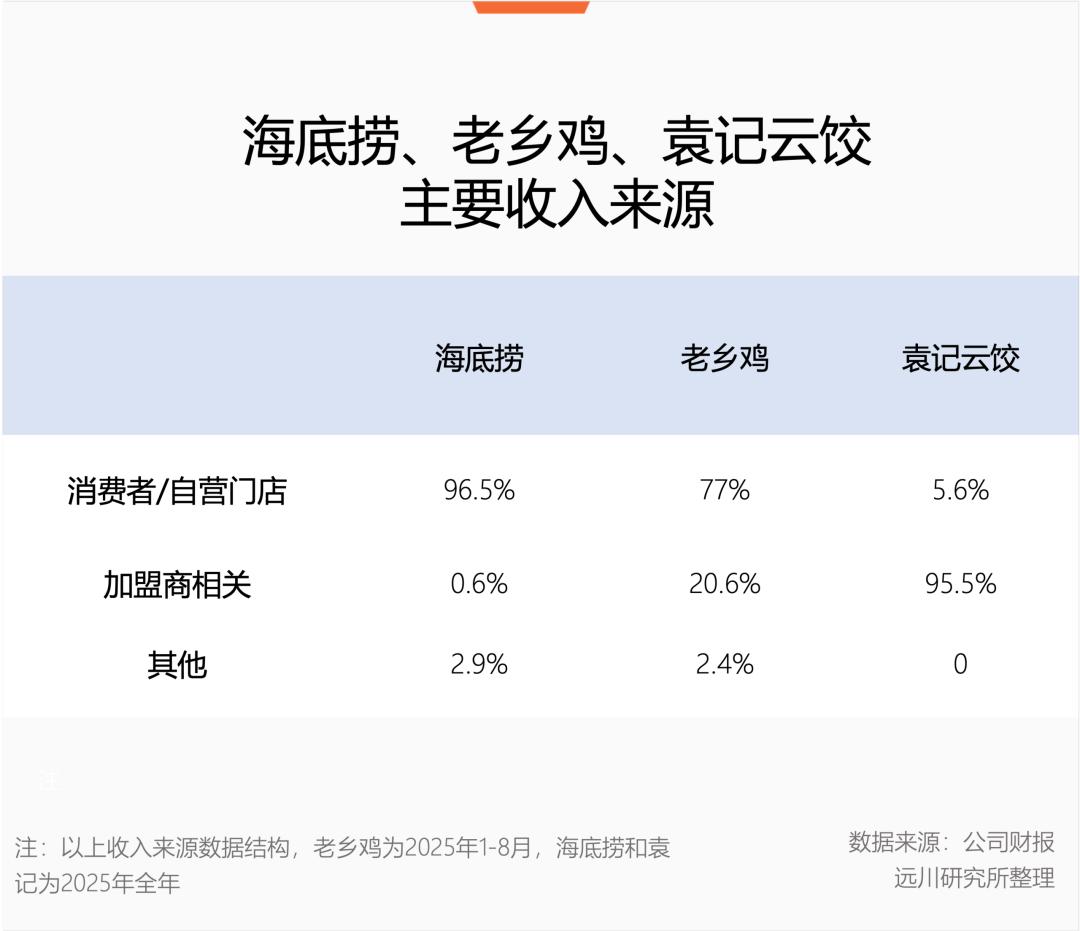
More than 95% of Haidi Lao's revenue comes from its 1304 self-operated restaurants[3]. Each restaurant covers an area of 600 to 1000 square meters with an investment of 8 to 10 million yuan, and every cent of its revenue is earned through the joint effect of per customer consumption and table turnover rate.
But this also means that if Haidi Lao encounters a bad business year, it will lose more than 10 million yuan for each store it closes. In 2021, Haidi Lao closed 276 stores and suffered a loss of 4.1 billion yuan that year, which shocked the entire industry.
Laoxiangji only wants to take half of the hardships Haidi Lao faces, with half of its outlets being franchise stores and the other half being directly-operated stores. The directly-operated stores contribute nearly 80% of the total revenue, and the remaining 20% is the income related to franchisees, which comes from its whole industrial chain layout in the links of chicken raising, processing and distribution.
Yuanji Cloud Dumpling went a step further: nearly 95% of its revenue in 2025 came from franchisees, among which the franchise fee was only a tiny entry fee, and nearly 90% of the revenue came from selling fillings, dumpling wrappers, seasonings and packaging materials to franchisees[2]. Franchisees are responsible for selling dumplings, and continuous supply of goods to franchisees is Yuanji's real business.
The model of franchisees opening stores and the brand making profits from the supply chain is actually very familiar to the senior players in the tea drink industry.
In 2025, more than 96% of Aunt Fu Shang's revenue came from franchisees, among which the revenue from selling raw materials, equipment and packaging materials to franchisees accounted for more than 80%[5].
Mixue pushed this model to another level. At the end of 2025, the total number of global outlets of Mixue Group reached 59,823, but there were only 38 directly-operated stores, accounting for 0.06%.
The total number of its outlets is 10 times that of Yuanji Cloud Dumpling, and the number of its directly-operated stores is only 15 more than that of Yuanji Cloud Dumpling. The wisdom of the Snow King is endless to learn.
Franchisees help the brand open stores, and the brand's supply chain is responsible for generating profits. The strategy adopted by Yuanji has been repeatedly verified by the tea drink industry.
Compared with opening stores by itself, Yuanji, which "persuades others to open stores", bears much less pressure. In 2025, the employee cost of Haidi Lao accounted for 32.6% of its revenue, and depreciation and amortization accounted for 5.0%, with the two items adding up to nearly 38%[3]. In contrast, the employee salary at the group level of Yuanji accounts for about 8.5% of the revenue, and depreciation and amortization accounts for about 2.4%, with the total proportion being about 11%[2].
It's not that making dumplings does not require shop assistants, nor that Yuanji's outlets do not need to pay rent, but that most of these costs are recorded in the accounts of franchisees. The so-called asset-light model essentially means changing the person who bears the burden first.
The Naturally Suitable Category
The premise that Yuanji can apply the logic of selling milk tea to dumpling restaurants lies in the "naturally suitable category" of dumplings.
In China, the catering industry is a broad and profound sector. In 2025, the market size of Chinese fast food reached 867.9 billion yuan, with about 3.5 million outlets. There are numerous cuisines and diverse cooking techniques. Even though Yuanji ranks first in the industry with 4773 outlets, its market share calculated by GMV is only 0.7%[2], which fully demonstrates how difficult the chain operation of Chinese catering is.
Chinese fast food is not unwilling to develop in a chain way, but many categories are difficult to replicate beyond a single store. The chef is the soul of Chinese food, and also the most difficult variable for the chain headquarters to replicate. A seemingly simple rice dish with toppings involves multiple links including cutting and preparing, pickling, seasoning, stir-frying and heat control. If the chef changes, the stove changes, or even a little more salt is added accidentally on that day, the dish served may taste completely different.
However, dumplings are a rare category that is naturally suitable for chain operation.
A dumpling wrapper wraps a kind of filling, and the taste is mainly determined by the filling. As long as the taste of the filling is unified, the thickness of the wrapper, the ratio of wrapper to filling, the weight of a single dumpling, and the cooking time can all be set as clear standards. For the chain headquarters, making dumplings seems to have one more manual process than cooking stir-fries, but in fact, there are far fewer uncontrollable links.
Therefore, as early as the 1990s, when many catering operators were still thinking about how to expand a single store, a number of dumpling brands had already started to consider how to replicate the same store in more locations.
In 1990, Dongfang Dumpling King was founded in Harbin; in 1996, Da Niang Dumpling was founded in Changzhou; in 2002, Xi Jiade was founded in Hegang. These old-established players in the dumpling industry were founded much earlier, but at a certain point in time, their expansion almost all stagnated mysteriously.
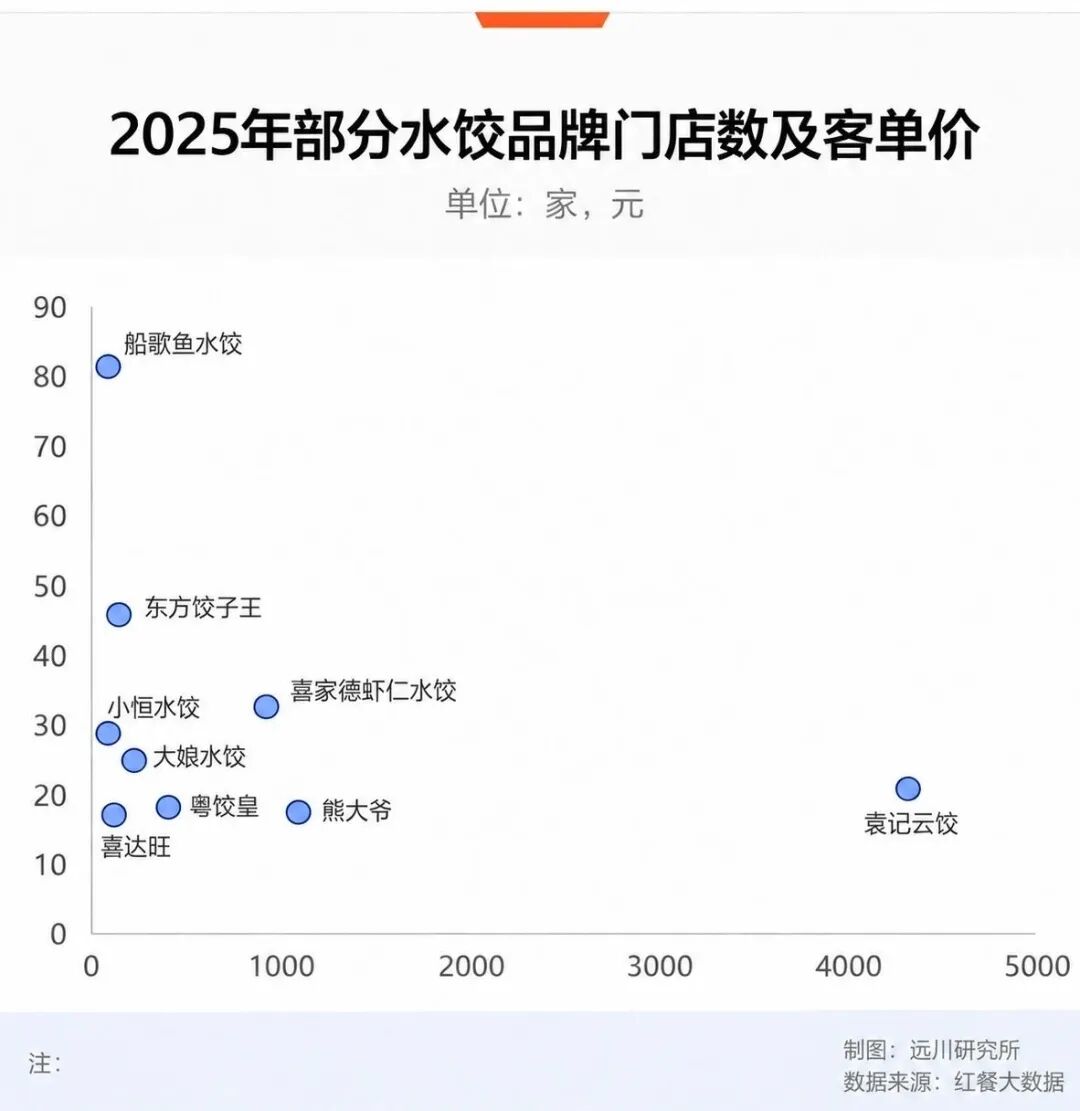
The reason is that for dumplings, the ease of standardization is not only a natural advantage, but also a curse.
Chain dumpling restaurants face a contradiction: the further the factory extends its control over the production process, the higher the efficiency of the outlets will be, but at the same time, the products will be closer to the frozen dumplings in the supermarket freezer.
Consumers have reason to ask: if the dumplings served in the restaurant are frozen dumplings produced by industrial assembly lines, then why don't I cook a pack of Sanquan or Wanchai Ferry frozen dumplings at home by myself?
The premium of dumplings in restaurants does not come from the complexity of cooking, but from making consumers believe that the dumplings are fresh enough. This constitutes the fundamental difficulty of dumpling chain operation: the efficiency should be as high as that of industrial products, but the products should not look too industrialized.
The solution Yuanji put forward is to set up a transparent open kitchen area where aunts make dumplings on site for consumers to see.
In areas invisible to consumers, 6 self-owned factories are used to uniformly produce fillings, dumpling wrappers and core semi-finished products, and 24 warehouses distribute these products to outlets across the country. In the outlets visible to consumers, an open kitchen is adopted, allowing consumers to directly witness the whole process of making dumplings.
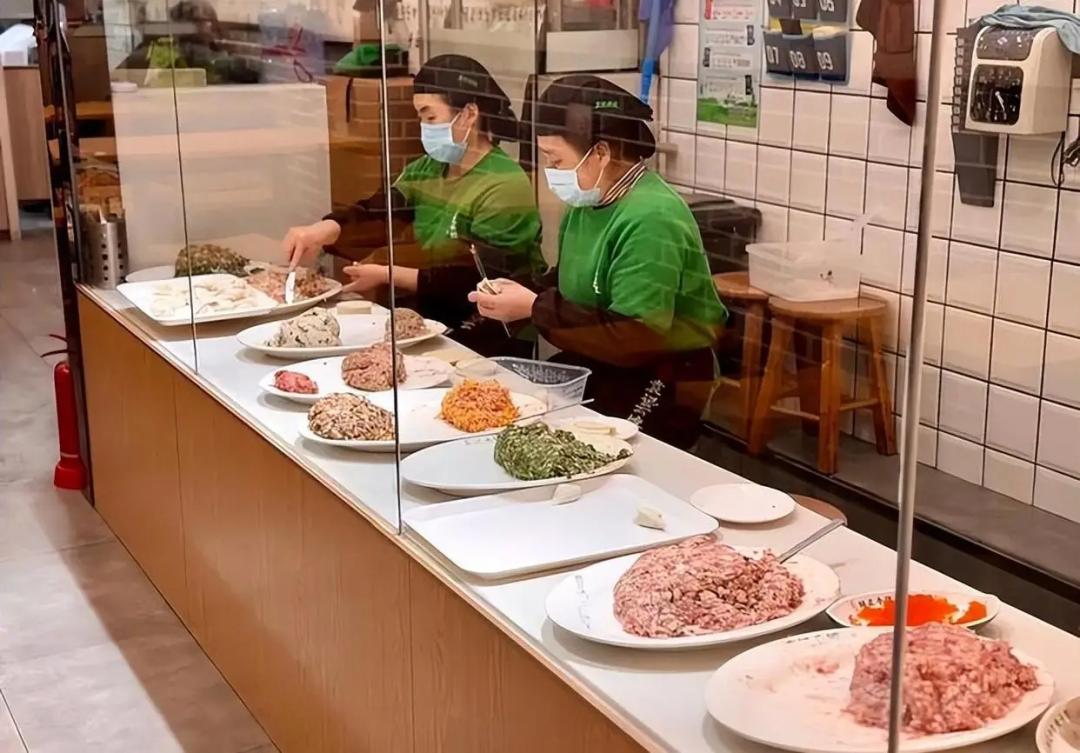
The factory is responsible for ensuring that "every store has the same taste", and the outlet is responsible for proving that "this dumpling is just made". This design solves the problem of why consumers are willing to buy dumplings in physical stores, while another set of design solves the problem of why franchisees are willing to open stores.
In 2017, the company began to try the "raw and cooked integration" model, allowing the same store to sell both raw dumplings and ready-to-eat cooked food. In 2020, the restrictions on dine-in caused by the epidemic made the number of Yuanji's outlets grow against the trend from about 500 to 1000, and then it entered an expansion stage where nearly 1000 new outlets were added every year.
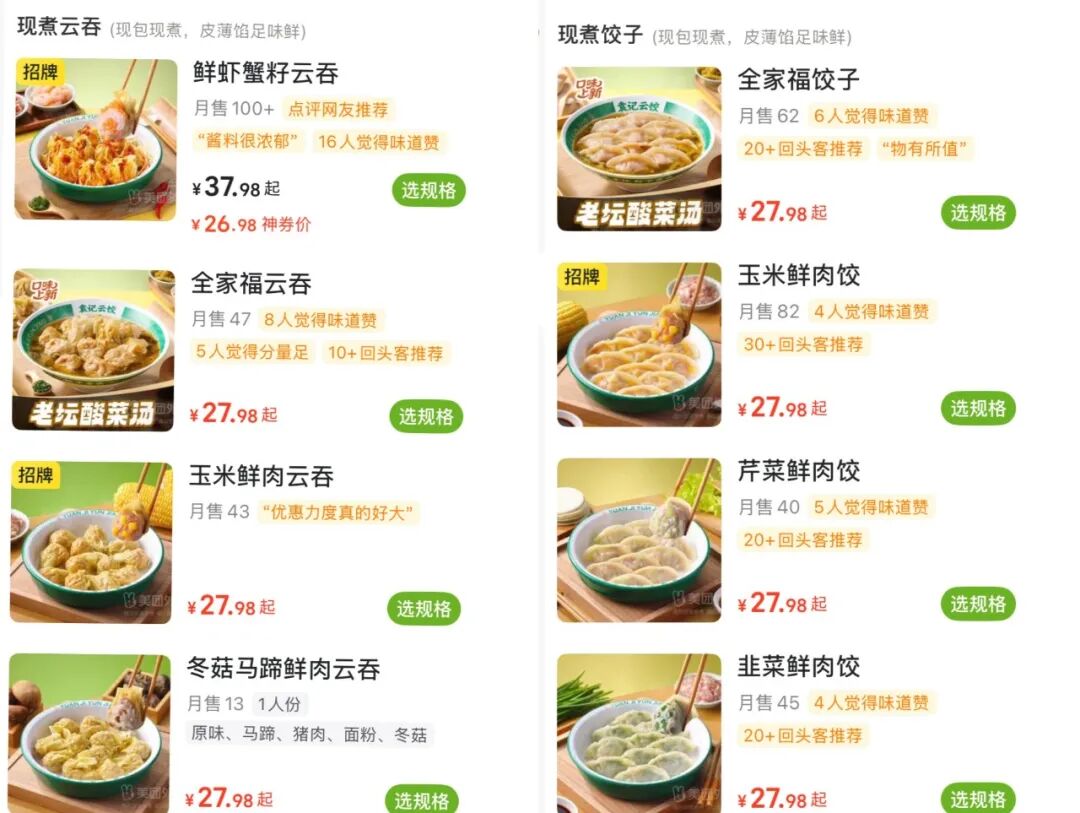
For franchisees, the "raw and cooked integration" model means that the same small store can cover more consumption scenarios. A store does not have to pin all its hopes on a few dining tables: consumers can sit down and have a bowl of dumplings, order a portion of cooked food for takeout, or buy a bag of raw dumplings to take home.
The product structure of dumplings allows Yuanji to incorporate the most difficult-to-control taste into the supply chain. The combination of dine-in, fresh food takeaway and cooked food delivery allows franchisees to use the same small store to cover more consumption scenarios.
The former solves the problem of whether the store model can be replicated, and the latter solves the problem of whether the replicated outlets can survive.
The Business Model of the Tea Drink Industry Is Not Easy to Copy
If you only look at the way of making profits, Yuanji Cloud Dumpling is very much like a tea drink company wrapped in a dumpling skin.
Outlets are invested by franchisees, and the rent, decoration, labor cost and daily operation are borne by franchisees. The headquarters is responsible for brand building, product research and development and supply chain management, and makes profits by continuously selling raw materials. The franchise fee is only the entry fee, and selling goods is the core source of revenue.
This business model has been demonstrated countless times by brands like Mixue and Guming. The problem is that Yuanji has copied the revenue structure of the tea drink industry, but it is difficult to replicate the profit statement of the tea drink industry.
In 2025, 95.3% of Yuanji's revenue came from commodity and other sales, which is quite similar to Mixue's 97.6% proportion of commodity and equipment sales. However, Yuanji's gross profit margin is 6-8 percentage points lower than that of the three tea drink companies. The gap in net profit margin is even more obvious: Yuanji's 9.4% net profit margin is even less than half of Guming's.
In other words, both taking franchisees as customers and taking outlets as channels, tea drink companies operate a highly profitable supply chain, while what Yuanji operates is still a business with the inherent attributes of staple food.
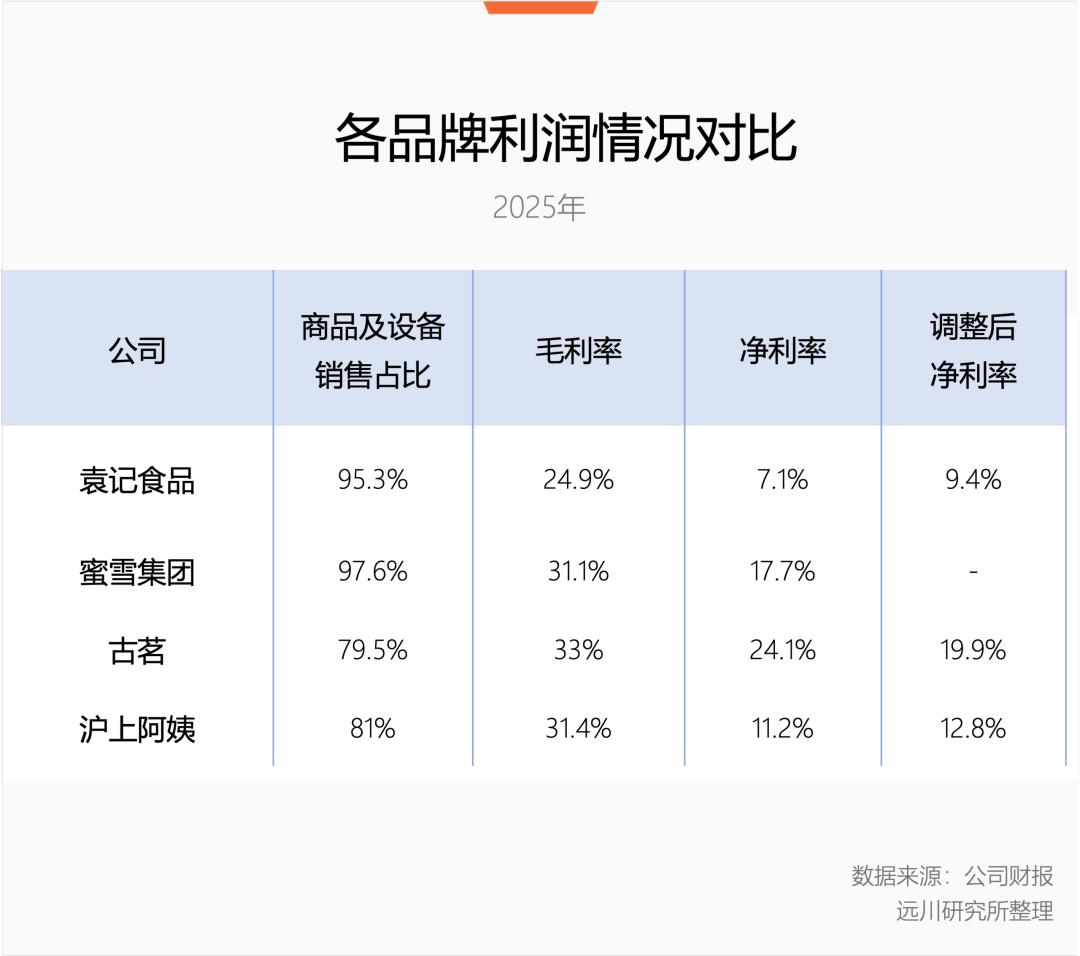
The first reason for the gap lies in the category itself.
Not all of Yuanji's raw material businesses are unprofitable. In 2025, the gross profit margin of Yuanji's filling business reached 29.8%, which is almost equal to Mixue's 29.9% gross profit margin of commodity and equipment sales. What really pulls down the overall profitability is a long list of supporting products with low gross profit that have to be sold.
Yuanji's dumpling wrappers, seasonings and packaging materials together contribute nearly 30% of the revenue, but their gross profit margins are only 21.0%, 6.1% and 8.2% respectively. Finally, the gross profit margin of the entire commodity sales business is only 21.9%[2].
Yuanji sells a full range of necessities for opening stores, but necessities do not equal high gross profit. Some products are responsible for making profits, while some products are only responsible for ensuring that the franchise stores can operate normally.
Compared with the raw materials of tea drinks, the cost structure of dumplings is very transparent. In 2025, Yuanji's raw material cost reached 1.811 billion yuan, accounting for 86.3% of the sales cost; among its top five suppliers, the first four are pork suppliers[2]. The price of pork per catty and the price of flour per bag are accounts that franchisees can easily figure out.
The second difference lies in the depth of the supply chain.
Although Yuanji has 6 self-owned factories, the more upstream products such as pork, flour, seasonings and packaging materials are still mainly purchased from external suppliers. This is easy to understand: after all, when it comes to pig breeding, can your cost be lower than that of Muyuan?
In contrast, Mixue has realized 100% independent production of its core beverage ingredients, owns 5 production bases and 28 domestic warehouses, and its raw materials cover multiple categories such as sugar, dairy products, tea, coffee and fruits.
The core ingredients of Mixue are syrup, lemon, dairy products, tea and other categories, which have much greater potential to dig deeper into the supply chain than pork and flour, making Mixue's supply chain easier to make profits.
It can be said that the rapid expansion of Yuanji Cloud Dumpling's outlets benefits from dumplings, but its