Outshine ChatGPT, another game-changing AI product is taking the world by storm.
An old player with new breakthroughs, Meta has become a dark horse in the global AI industry.

01
Meta's AI R&D Took a Detour
Lagging development in the AI sector used to be Meta's biggest pain point. With billions of social users at hand and massive computing power reserves large enough to run a leasing business, it had no mature products recognized by the market for a long time. Even following the strategy of "stockpiling resources and biding time", it dragged on for several years until all the initial momentum faded. By the first half of this year, Meta's AI services held less than 5% share in the C-end market, and less than 10% in the paid B-end enterprise market. It could not compete with OpenAI's 46.4% and 35%, and even Google's 27.7% and 20% made Meta extremely envious.
It is not that Meta did not work hard on AI. Meta's annual hundreds of billions of dollars in AI investment also ranks among the top among large US tech companies. However, with heavy capital poured in, it still took a long detour. The open-source Llama was a sickly premature product, while the closed-source Muse Spark was a hard-to-deliver project trapped in internal and external difficulties.
At first, Meta placed all its bets on the open-source large model route. It launched Llama in March 2023, and released the commercially applicable Llama2 less than half a year later, with a very fast pace. It was once regarded as a strong competitor of the GPT series, but before this "open-source vs closed-source" route competition went through several rounds, Llama quickly lost the game. It had high hidden costs in technical thresholds and computing power configuration, and its performance was far from satisfactory. The most fatal problem was the internal conflict between prioritizing products and prioritizing technologies, which led to chaotic management. From March 2023 to May 2025, Meta restructured its AI team four times, with internal layoffs, talent outflow, and internal employees exposing that the team brushed rankings. The situation became more dramatic each time, and Llama fell from its status as the highly anticipated light of open source to a market outcast full of flaws.
Since the open-source route did not work, the development focus shifted to closed-source products. In fact, when Llama was accumulating popularity in the developer community, the closed-source Muse Spark had already been launched. However, Muse Spark largely copied OpenAI's successful route, but under the constraints of the "open-source faction", internal security reviews often blocked the progress, and resources were intermittent. The whole development process was full of obstacles, and even at the final stage before the API release in April this year, it was delayed again due to "safety alignment". This caused public outcry and a flood of negative reviews.
In the fiercely competitive AI sector, the most valuable resource is time. For Muse whose implementation was delayed again and again, the outside world was not optimistic, and even the internal team of Meta was in total chaos.
According to the report of US tech media Wired, at the beginning of an internal Meta video conference attended by thousands of employees in early June, one participating employee lost control of his emotion, repeatedly used vulgar words to interrupt his colleague who was speaking, and claimed that "the company treats us like dogs". Some executives also complained to the media that "Muse may not be the best product of its generation".
Under the generally sluggish atmosphere of "cautious and not optimistic", Muse was finally released.
02
Muse: A Pleasant Surprise with Low Start and Steady Growth
On September 8, the personal AI Agent Muse was finally launched. Its performance is at the first echelon of products produced by large tech companies, but not that amazing. Its benchmark scores are at an average level, with obvious advantages and disadvantages. Muse performs excellently when handling simple tasks: sorting emails, sending messages, booking trips, filling out forms, and placing online shopping orders, completing tasks quickly and well. However, when handling complex tasks such as cross-site login and multi-step electronic payment tasks, the performance of Muse is not very stable.
This easy-to-use but imperfect AI product is very popular in the market. Less than two weeks after its launch, Muse topped the free app list of the US Apple App Store, ranking higher than ChatGPT, Gemini and Claude.
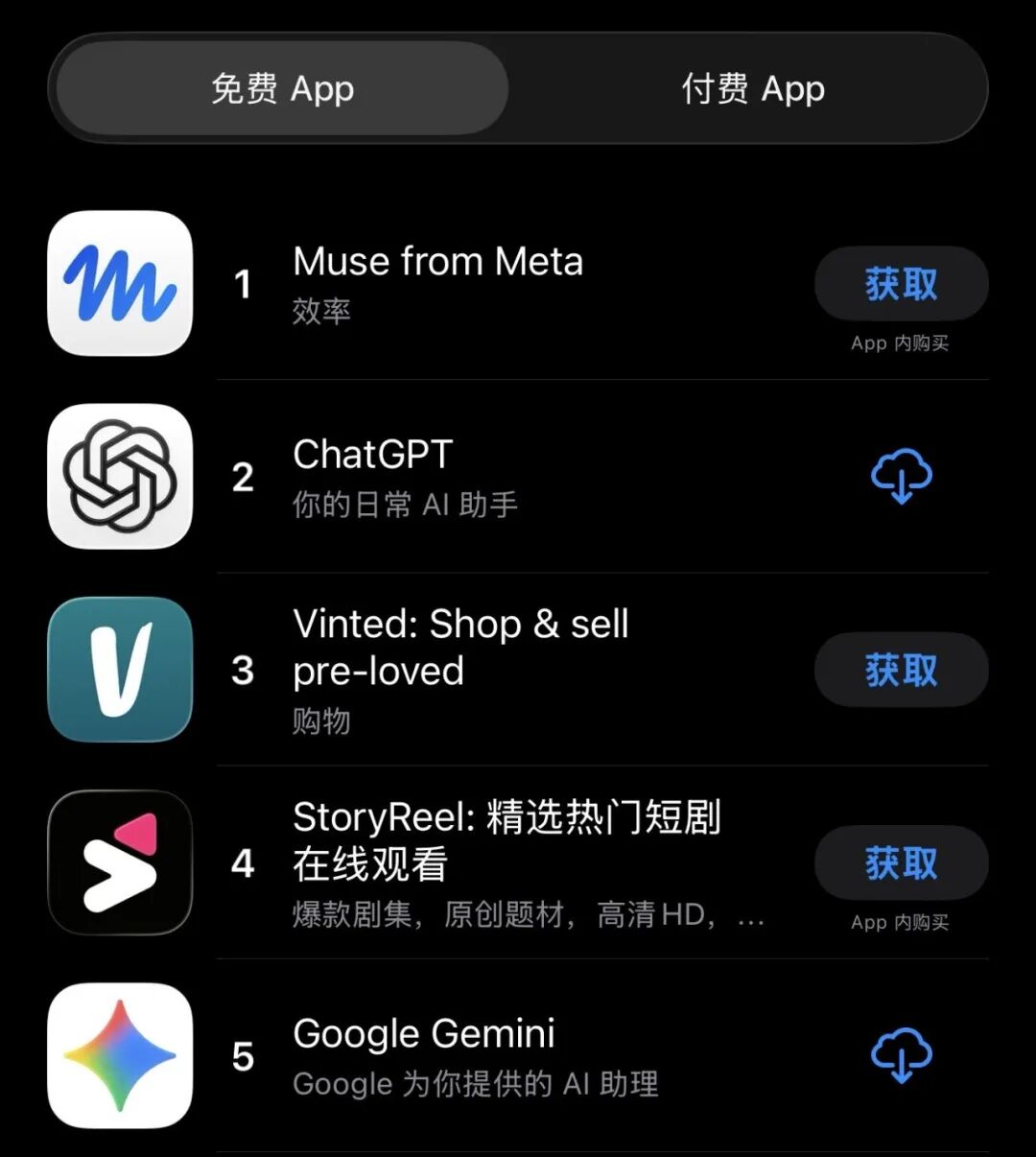
Meta finally realized its long-cherished wish of beating OpenAI. Muse won the phased victory not because its core performance indicators lead the GPT series, but because the personal AI Agent is more usable and user-friendly.
In fact, compared with the "five-step process from AI to AGI" released by OpenAI last July, the current versions of Muse and GPT are both at the same level of "Level 3: Agents, AI can perform some action tasks as a system". However, Muse is backed by the huge Meta ecosystem, and many of its own applications have the advantage of being close to the water, so it has many more practical functions than GPT. Although these practical functions are very daily and simple, and are not worth mentioning compared with the in-depth reasoning analysis that GPT is better at, they focus on daily convenience. Compared with the high-end demand of AI automatically generating PPT, the "low-level demand" of ordering food online is more frequent and more common. As long as the product is useful and easy to use, it will gain popularity, and the logic of the market is so simple.
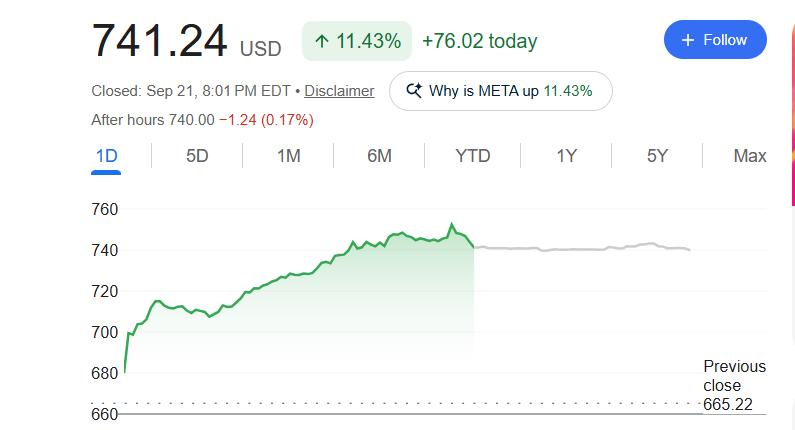
Muse became popular unexpectedly, and Meta's market value rose accordingly. On September 21, Meta's stock price surged by more than 11%, hitting the largest single-day increase since April 2025, and its market value soared by nearly 200 billion US dollars. This immediately drove the chip stocks to rise collectively.
The biggest winner was AMD, whose stock price rose by nearly 10%, and its market value exceeded 1 trillion US dollars for the first time. Although Meta's core supplier is still NVIDIA, the relationship between Meta and AMD warmed up after they signed a five-year 100-billion-dollar agreement in February this year, which is regarded as one of the signs that NVIDIA's "hegemony" is loosening. So when Meta got huge benefits this time, AMD also got a large share of the dividends.
The most unexpected winner was Intel, whose stock price rose by more than 12%. Previously, the main beneficiaries of the "software-hardware linkage" in the AI industry have always been GPUs. After Muse is widely applied, the situation has changed. When AI Agents move from "answering questions" to "performing tasks for users", CPUs are no longer just supporting components in GPU servers, but will become the execution base of the Agent era.
This is because "answering questions" is highly dependent on the large-scale parallel computing of GPUs, and CPUs are just supporting roles. When Agents complete complex tasks, they cannot do without CPUs calling tools and reading files. The more complex the task is, the more prominent the role of CPU in the task chain will be. The shortcomings shown by Muse when performing complex tasks highlight the rising status of CPUs in the Agents era. The capital market captured the new increment of CPUs brought by Agents, and Intel became a highly sought-after stock.
Of course, as the "hardware ration" of AI, storage chips also shared the dividends of Muse's popularity, and the Philadelphia Semiconductor Index also rose significantly.
In short, Muse, which was not favored by the market before, has brought a lot of unexpected gains to the US technology industry and the US stock market.
03
Some Rejoice While Others Sorrow
While most US tech companies are sending congratulatory messages for Muse's "launch celebration", e-commerce giant Amazon issued a strict ban.
On September 21, Amazon officially blocked Muse's access permission. Previously, Amazon tried to persuade Muse to proactively exclude Amazon's e-commerce sites, but the two sides failed to reach an agreement.
When explaining the access ban, Amazon listed Muse's "three major charges":
Meta did not inform Amazon in advance that Muse would access its e-commerce platform;
This agent will not actively identify itself when browsing web pages;
Muse seems to collect and save user account credentials, which Amazon believes will bring privacy and security risks.
Facing the furious Amazon, Meta's reaction was calm. It did not give positive feedback on the first two charges, and did not make any explanation. But for the third charge with the word "seem", Meta responded positively, emphasizing Muse's strict privacy policy and security protection mechanism. Meta, which used to delay releases due to "safety alignment" and carry out strict internal security reviews, has such confidence.
It is worth noting that Amazon is not targeting Meta specifically, but is full of hostility to all uninvited Agents. Last November, Amazon launched the "first Agent lawsuit" to sue the artificial intelligence enterprise Perplexity for its "Comet" infringement, and once obtained an access ban from the court, but it was overturned by the appellate court in March this year. So this time Amazon simply took action by itself, skipped the litigation process, and blocked Muse on its own, showing a firm attitude of sticking to the end.
However, Amazon is not just blindly "resisting enemies outside its territory". This veteran e-commerce company is very clear that the Agent era is unstoppable, and it cannot hold its market position by prohibition, exclusion and closure. In fact, Amazon is stepping up the development of its own online shopping Agent, and the ban on "external enemies" is only to win time for its own independent development. However, considering Amazon's poor performance in the AI sector, it is highly doubtful whether this painstaking effort can achieve the expected effect. The market generally believes that if Amazon loses the competition in Agent applications, it will become a "version abandoned child" in the AI era.
Looking back at the whole development process of Muse and the disputes after its launch, we can clearly find that the competition in the AI industry is not competition of technologies or concepts, but competition of applications. Especially when entering the implementation stage of Agents, the priority of market applications is significantly higher than technical indicators — usability and user-friendliness are more important than benchmark scores.
Meta was recognized as being at a disadvantage in the technical competition with OpenAI. But after Muse was launched and proved to be more user-friendly than GPT, it reversed the situation overnight.
GPU manufacturers have long occupied the C position in the capital market of the AI industry. Muse shows the application growth prospect of CPUs, and old stocks like Intel instantly rebounded.
Even Amazon's extreme vigilance and strict defense against Muse is essentially a competition of applications.
Technology is people-oriented, it is made to be used, not to be boasted. Benchmark scores are not unimportant, but implementation and application are more important. China's Internet industry, relying on its huge market and advanced infrastructure, has always had advantages in developing market applications. However, after the boom of AI, Chinese tech enterprises have had many brilliant moments in technology, but their performance in the application field is mediocre. It can only be said that in terms of general-purpose AI Agent technology, Chinese technology is also in the global first echelon. In March 2025, Manus was launched as "the world's first general-purpose AI Agent", and its invitation code was extremely hard to get. However, after the storm caused by Meta's acquisition, Manus no longer had its former glory. Blocking Meta's acquisition of Manus did not prevent Muse from being launched. Manus announced the official resumption of independent operation on September 1, 2026, but it still cannot enter the Chinese mainland market.
Is the factor restricting the implementation of China's AI applications only the "choke point" of computing power blockade?
This article is from the WeChat official account "Kongfu Finance" (ID: kongfuf), written by Guan Buyu, published with authorization from 36Kr.