The so-called "10,000-hour rule" is utter nonsense, and it is precisely these 10,000 iterations that determine the gap.
Shenyi Translation Bureau is a translation team under 36Kr, focusing on fields including technology, business, workplace and life, with a core focus on introducing new foreign technologies, new perspectives and new trends.
Editor's note: The so-called self-discipline of most people is nothing more than using the diligence of fiddling with tools to cover up the laziness of thinking. Stop collecting useless efficiency templates. The real goal management only involves one extremely boring hard skill, which is to break down goals into non-negotiable actions, and keep pushing through the slowest bottleneck with real feedback. This article is translated.
I once tried all the efficiency tools on the market, watched all related videos, and read most of the books on this topic. After years of tinkering, I didn't even achieve a single goal.
Until I discovered these five words.
Let me state this first to avoid wasting your time:
Most of the advice on how to achieve goals on the market is complex and vague.
Various suggestions online only provide you with a tiny fragment of a huge puzzle.
Everyone is addicted to doing things that are not important at all.
Some advocate deep work, some insist on time-block management, some say paper is better than digital, while others say digital is always better than paper — because there are the latest efficiency apps developed through ambient programming every day. Not to mention Notion templates and morning routines! Wait... morning routines are not necessary either? What on earth is going on here?
Sorry, I digressed a bit.
They are just tiny nodes in a spider web, independent fragments in a huge puzzle, and meaningless when viewed in isolation.
The vast majority of people spend their entire lives doing things that seem efficient but are actually meaningless.
You are already doing it.
You did it today, and you did it yesterday. The number of hours you have wasted is too many to count even with all ten fingers.
All the problems in your life are hidden in ambiguity, because fear and laziness are most afraid of concrete things.
If you don't have a specific plan, you will feel that you are lazy.
If you don't clear the fog in your mind, you will spend your life in fear.
These five words are the lighthouse that cuts through the fog.
Outcome → Activities → Actions → Time → Iterate
I call it the OAATI model, pronounced as "oat-ee".
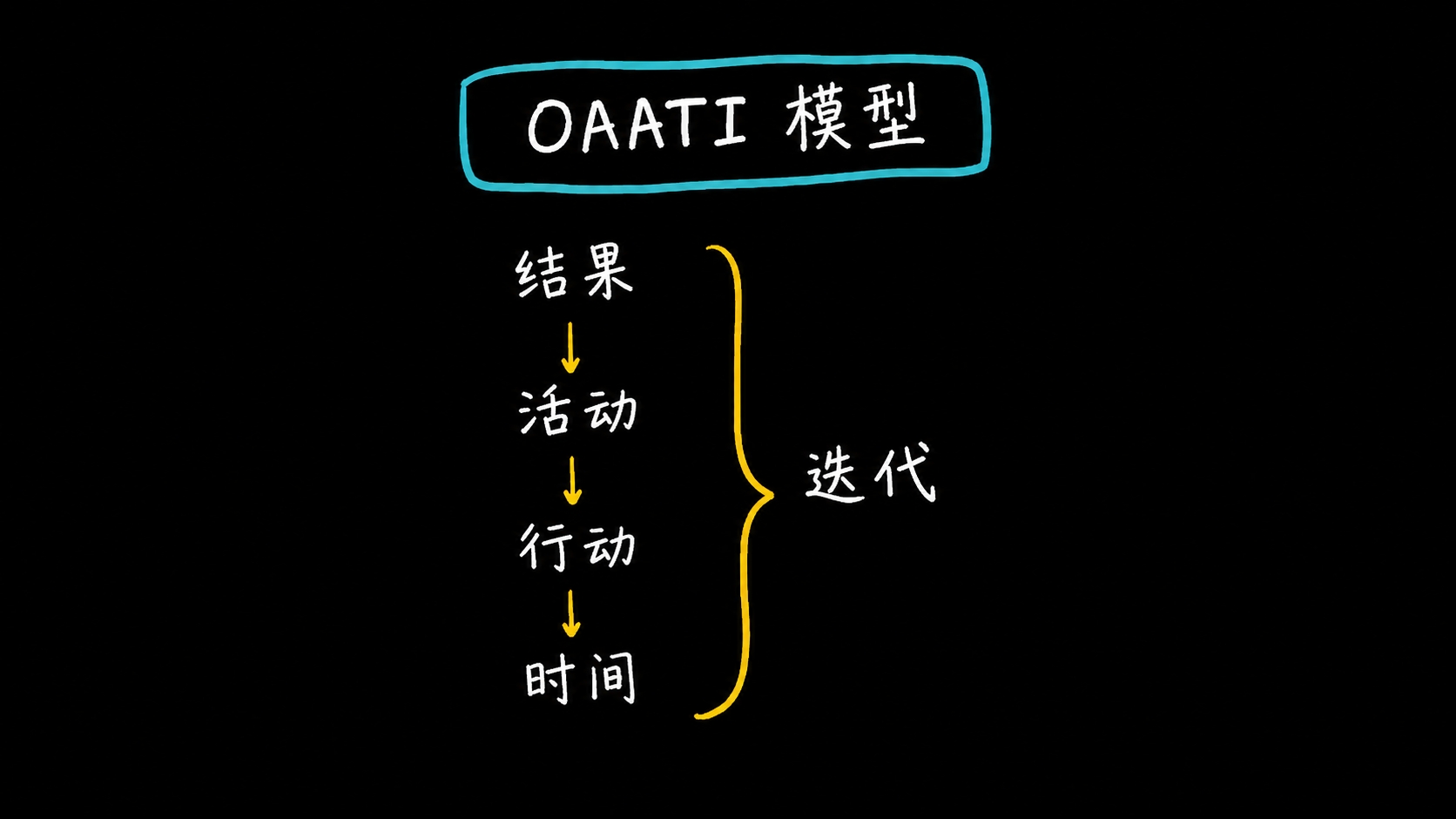
This article has only one purpose:
To let you know exactly what to do when achieving any goal.
I can't guarantee that this article will make you feel high-spirited. There are a lot of logics to sort out here.
For many people, this will be very boring.
And precisely because of this, many people go through their whole lives without achieving a single goal, quietly exhausting 80 years of their time.
The only thing I can guarantee is that you will have everything you need to achieve something great with what I have provided.
The following are the steps to achieve any goal with this model:
Define a clear, measurable outcome
Break down the goal into specific activities, list every single step of action, and estimate the time required to complete each action. In this way, you can arrange time blocks on your calendar.
Test every link, and decisively cut off the parts that don't work.
Find the only bottleneck that restricts you from moving to the next stage of your life.
Systematize all other things.
Iterate continuously, correct deviations at any time, until you get the result you want.
Ready to fully figure out how to achieve any goal?
Me too. :)
Let's think deeply about it together!
1. Goals and outcomes are actually the same
(a) What is a goal?
Let me ask you something.
When you have a goal, what is the first thing that comes to your mind?
In fact, it is a realistic vision.
It presents something specific, tangible and quantifiable.
Have you heard of Stanley Kubrick? He is widely recognized as one of the greatest directors in film history. He once put forward a profound view: as long as you can think clearly in your mind, you can shoot it.
You can also look at your own goals in the same way.
Let me tell you a story.
The other day I chatted with my dad, explained the OAATI model to him, and gave a pertinent example.
Golf.
I haven't been playing golf for very long, so I'll try to keep it short so you don't get bored if you don't know much about the sport.
In fact, I think using something you find boring as an example can explain the principles of goal management more thoroughly.
In golf, if you have a "handicap", you are qualified to be called a golfer.
Simply put, a handicap is a number used to measure your level, allowing people of different abilities to compete fairly on the same starting line.
The outcome (that is, the goal) in this example is 9.9.
Remember this.
This is a clear and tangible outcome.
You can see it, and you can measure it.
See how clear it is? It's more tangible than a brick wall.
Core insight:
You only need one outcome.
It can be anything, such as learning to write high-impact long articles under your personal brand, achieving a single-digit handicap on the golf course, making a more tender filet mignon, or building that level of self-confidence that can last for more than 30 seconds — whatever, just fast-forward as much as possible when watching *Game of Thrones* (especially the last season)...
Anything.
But only one thing. The clearer the outcome is defined, the better. It can iteratively evolve by nature, so you only need to determine a direction at the beginning.
Direction is more important than setting a perfect outcome at the very beginning, but it still has to be a single outcome.
(b) How to choose a goal?
Heard of the guy Sisyphus?
I will never let this content be introduced too late after I talk about other things, I have written about it repeatedly.
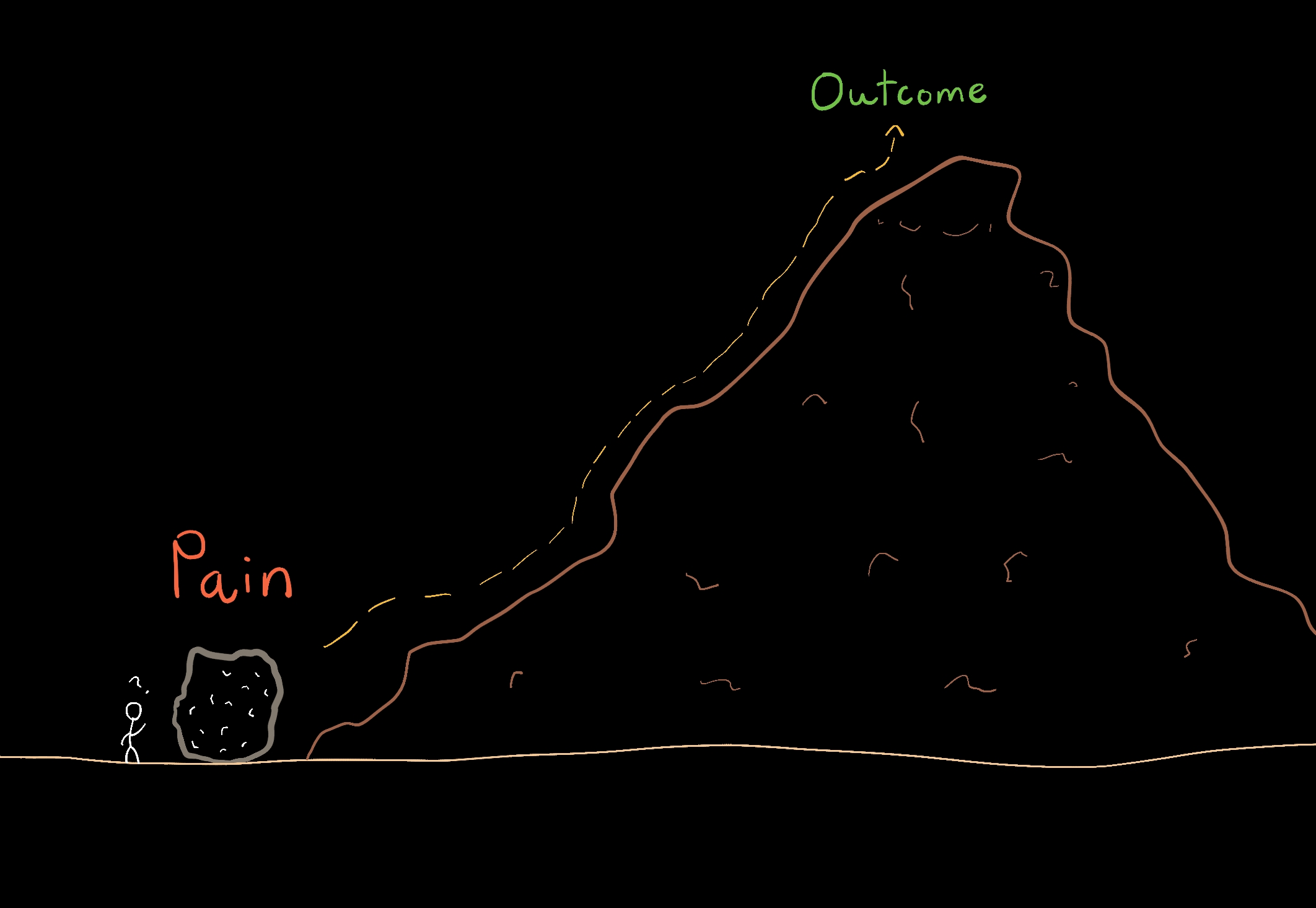
Sisyphus is the guy cursed by the gods (you know, that's their specialty), making him push a boulder up the mountain over and over again. And the moment the boulder is about to reach the top, it will roll down again, every time in this cycle, until... you know what I mean.
Let's take Sisyphus as an example.
You need a mountain.
The top of the mountain is your goal, the peak you want to reach.
The foot of the mountain is your current pain, your baseline. As long as you don't start climbing, you will continue to suffer this torment.
You need to choose a heavy boulder to push, just like Sisyphus.
At the same time, you need to choose your own mountain. It is easy to push the boulder around in circles in place, but going around in circles will only bring you back to the starting point.
Your goal is to push upward, not to go around horizontally.
(c) Define the goal (and the opposite situation)
How do you define the final outcome? That is, the summit of the mountain you are going to climb.
First ask yourself a few questions.
What does it feel like?
What will it look like in a conversation or a specific scenario?
What will you feel, think, say, and do?
This is your mountain top... but where is the baseline?
Turn the mountain top upside down.
Reverse it.
What will it never feel like?
What will it never look like in a conversation or a specific scenario?
What will you never feel, never think, say, or do?
Motivation comes from a sense of urgency. In other words, you have to find an enemy to know where to escape.
To be honest, sometimes the best way to force yourself into a brand new life is to light a fire under your butt and make yourself really sweat.
Figure out exactly what you don't want.
Work backwards, why did you fail that time? What mistakes did you make? Then draw your own version of the mountain. Treat it as a draft, knowing that it will be broken, rebuilt, and continuously evolved.
Be specific enough to take immediate action and start getting feedback from it (you can evolve based on that, just as you keep evolving yourself through iterations).
Our first step is to define an outcome.
Then, define the bottom of the mountain you are climbing away from — the outcome you don't want.
I have lived for 23 years, life has taught me a lot, but also too little. However, I personally believe that there are good and bad problems: some are voluntarily chosen, meaningful and better; some are forced to bear, avoidable and worse.
I would rather pick problems from the first category as much as possible.
You have to choose your own poison, because no matter which one you choose, you have to go all out.
If you don't have a mountain in your mind, if you can't tell the difference between the foot and the top of the mountain, if you can't give a clear goal outcome, good luck to you.
If you can't do this, I don't know what to say. Even if it's just a vaguely defined outcome at the beginning, pick it first.
Pick one, and do it.
2. Break down each outcome into activities, action lists and time
(a) What to do after you have selected your goal
Outcome comes first.
Work backwards from the goal you want to achieve, and find the path step by step.
This will lead you to the next few key parts of this model:
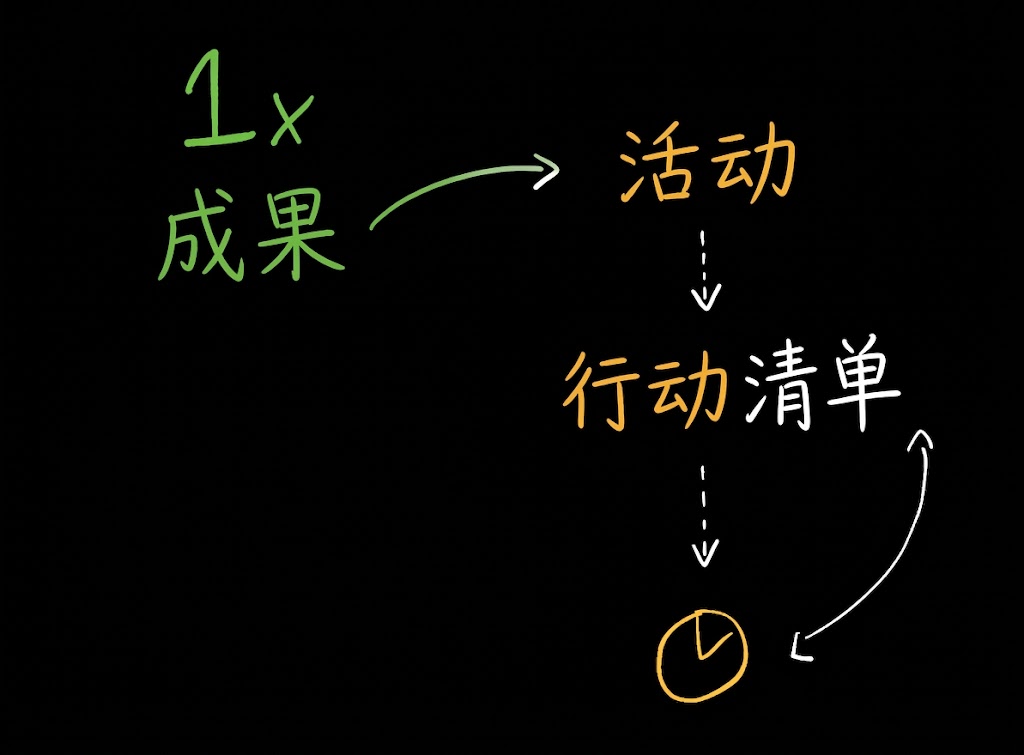
"Activities" are a type of work, consisting of a series of specific actions arranged in sequence.
"Actions" are extremely specific individual tasks in each activity.
Each action requires a clear time investment (you can arrange the time to complete the action through time blocks or calendar).
Finally, note that all other efficiency systems only give you a fragment of the big picture.
No one seems to be willing to clarify that objective grand picture... and I don't know what they are trying to hide. At least no one has ever explained it in a simple and straightforward way.
Back to the previous golf example:
A handicap is the goal, which is 9.9.
To be honest, it's been many years since I played golf, and I don't know much about the sport. But when chatting with my dad, I still broke down the goal of "playing a good round of golf" into three links:
Drive the ball from the tee
Get the ball onto the green
Put the ball into the hole
This breakdown is obviously not perfect.
But it has taken shape.
There is no such thing as iterative optimization without a concrete object.
I will talk about iteration in detail later.
Listen to me.
If I had more experience playing on the course, that is, receiving more real feedback from reality, I would be more confident when breaking down these links. I can also make a more certain judgment on what specific actions are needed for each link. This is very important, please make sure you understand it.
Your ability to break down goals will improve with the growth of age and experience.
And experience is inseparable from feedback.
You have to actually do things.
Live your life, and do reviews. Reflect on your mistakes, and also review what you did well. Then iterate repeatedly among the five key words involved in the OAATI model.
This model is literally all the elements needed to achieve goals.
The only remaining variable is iteration, which allows you to correct deviations in time.
(b) Two types of action steps to achieve any goal
So what about each specific activity itself?
You need a list of specific actions (this is best explained with an example).
Action steps are divided into two categories:
Rigid steps: These actions are mechanical. For example, modifying the to-do list, organizing the schedule, or brushing your teeth — from squeezing the toothpaste to brushing your teeth bright white, the whole process follows the established order.
Flexible steps: These actions are creative. For example, conceiving ideas, painting (note that it does not mean mechanically taking out the paint, brushes and canvas), or sparring in Brazilian jiu-jitsu.
Both types of steps are specific, and both reject ambiguity.
Ambiguity is the enemy, concreteness is the friend.
There are two opposing camps on the Internet. The efficiency camp is obsessed with systematizing everything; the creation camp worries that they will live like an empty shell, and feel shallow inside because they operate like robots. They think the former does not do anything for the sake of the thing itself... As a result, the creation camp often accomplishes nothing, can't even sell the value of their own content, and their actual output is far less than that of the efficiency camp. On the surface, these two camps are competing for success and completeness, as if the two cannot have both.
That's completely wrong.
Understanding the difference between rigid steps and flexible steps is the key to truly connecting these two things.
Productivity and creative freedom