Are opportunities coming for second-tier optical module manufacturers?
Capital is swinging back and forth between tech cycles and defensive sectors, with optical modules remaining the focal point of the tech sector, though the leading players have shifted.
Over the past three years, the "top 3 optical module stocks" have been the most sought-after targets in the optical module track: Innolight's share price has risen by more than 10 times, Eoptolink by over 18 times, and TFC has climbed 8 times.
After being fully priced by the market, the short-term cost-effectiveness of the "top 3" is no longer high. Over the past month, none of the three has seen a price increase exceeding 10%.
At the same time, second-tier optical module players have posted strong upward trends: Dekoli has risen by more than 40%, Cambridge Technology by over 21%, and CEM by over 23%.
The surge of second-tier players stems from two sets of market expectations.
The first is incremental orders brought by generational product switching. The optical module industry is shifting from 800G to 1.6T, and this generational transition has widened the supply-demand gap, prompting cloud vendors to actively introduce second and third suppliers. For second-tier manufacturers, this is an opportunity to break into a hundred-billion-yuan market from scratch.
The second is the opportunity to reshuffle positions in the industrial chain. Technological shifts are underway, and mass production of Nvidia's first CPO switch essentially means dismantling and redeveloping optical modules: adjusting the placement of some components, removing and adding others, to reduce power consumption, cut costs, and improve transmission efficiency. As the optical module industry is restructured, second-tier players gain room to compete for new positions in the value chain.
These expectations do exist. However, after the recent rally, valuations of second-tier players have become extremely stretched: Dekoli's PE (TTM) is as high as 257 times, Cambridge Technology's 170 times, and Changxin Broadcom's 143 times, already exceeding the valuations of the "top 3 leading optical module stocks".
If subsequent expectations fail to materialize, or if the market experiences significant volatility, the second-tier optical module segment will face considerable downward pressure.
01
The expectation of performance growth is arriving
The rise of second-tier optical module manufacturers outpacing the "top 3 leaders" has been interpreted by some investors as a catch-up rally logic at the market level:
The high expectations for the "top 3" have been fully priced in by the market, with their combined market capitalization now exceeding 2 trillion yuan. Further rallies would require massive capital inflows, making their short-term cost-effectiveness low. In contrast, second-tier optical module players only have a total market capitalization of tens of billions of yuan, with much lighter floating chips, so capital inflows can more easily drive a "catch-up rally".
However, the catch-up rally logic only holds under one premise: second-tier optical module players must prove that they can benefit from the AI industrial chain boom just like the "top 3" and achieve high revenue growth.
However, looking at previous industry supply and demand, the mainstream 800G optical module segment has a small supply-demand gap. According to Jefferies' caliber, the effective capacity gap is about 10%, belonging to a tight balance state. A tight balance means the supply pattern has been solidified: Innolight alone held a peak market share of over 40% in the 800G product segment. The dividends that second-tier players can get are very limited.
But now, as the optical module product line is shifting from 800G to 1.6T, it gives second-tier players the opportunity to capture capacity overflow.
From 2026 to 2030, the 1.6T market will record a compound annual growth rate of 57.6%, while the 800G market will only see a CAGR of 2.1%. The generational product transition process is highly likely to create a window gap where "old capacity has just been deployed, while new capacity is not yet fully operational".
For example, the expansion cycle of a single high-end 1.6T packaging production line is 12 to 18 months, and such production lines cannot be replicated quickly within the demand window. According to institutional forecasts, the 1.6T product gap will reach 30% to 40%.
Facing such a large supply-demand gap, North American cloud vendors and chip makers including Meta, Nvidia, and AWS are also looking for second and third suppliers, and some second-tier optical module companies have already sent sample products to North American cloud vendors.
If second-tier optical module players complete the subsequent verification process, they will also obtain considerable performance increments in this round of generational product transition. According to calculations by the self-media "Miaotou", second-tier optical module manufacturers have the opportunity to break into a hundred-billion-yuan market from scratch. Taking Cambridge Technology as an example, if it can obtain 1.5 million units of 1.6T overflow capacity, its incremental revenue will be equivalent to twice its 2025 revenue.
The expectations are promising, but whether they can finally be realized depends on follow-up tracking of North American customers' certification results and second-tier manufacturers' order delivery performance.
02
The opportunity to secure a new position in the industrial chain
Recently, observing the "top 3 leading optical module stocks", we have noticed an interesting phenomenon:
In terms of performance, TFC is the smallest among the three: its net profit in the first half of the year was 1.204 billion yuan, up 33.9% year on year. In the same period, Innolight's net profit reached 13.651 billion yuan, up 241.70% year on year; Eoptolink's net profit hit 7.529 billion yuan, up 90.98% year on year.
However, in the market, TFC has been the most stable performer recently: it has fallen 15% from its June high, while in the same period Innolight dropped 33% from its peak, and Eoptolink fell 26%. In terms of valuation, TFC's PE (TTM) at 129 times is also higher than Innolight's 53 times and Eoptolink's 47 times.
The core reason for this contrast lies in the different business focuses of the three: the core business of Innolight and Eoptolight is the production of pluggable optical module complete machines, while TFC mainly provides upstream optical devices for all module manufacturers.
Under the original industrial trend, all three could benefit from the boom of the optical module sector, but the release of Nvidia's CPO (co-packaged optics) has introduced variables to this trend.
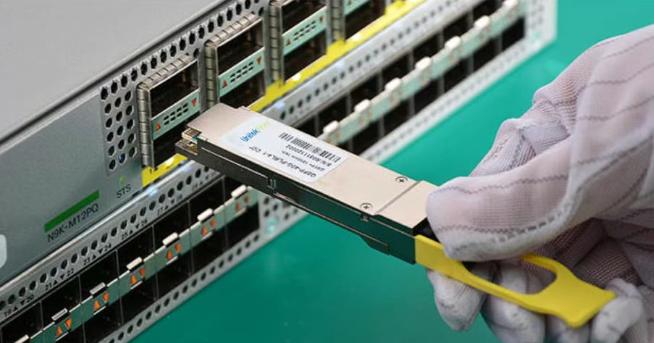
Current mainstream optical modules package various components into pluggable units that are ready for immediate use.
CPO, on the other hand, "dismantles" the optical module again. Roughly speaking, it splits out three core components: the optical engine, DSP chip and laser. The optical engine is moved next to the switch chip, the laser is externally mounted outside the chip, and the DSP chip is reduced in importance.
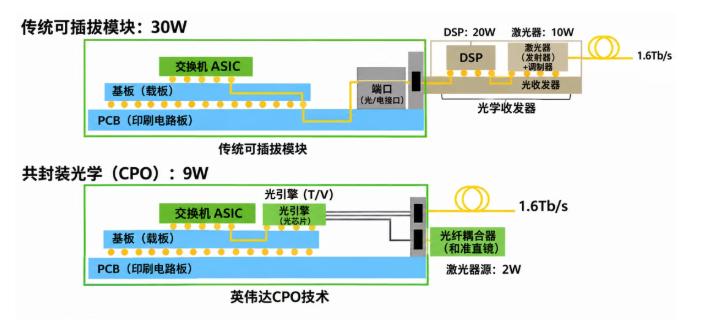
Compared with pluggable modules, the advantage of CPO is that it moves the optical engine from the front panel into the switch chip package, reducing the electrical signal path from 20-30cm to 2-5mm. According to Nvidia's data, electrical signal loss will be reduced from 22dB to about 4dB, energy efficiency will be improved by 3.5 times, and reliability will be increased by 10 times.
The essence of this technical path change is: pluggable optical modules place more emphasis on downstream packaging and delivery capabilities, while the value chain of CPO is clearly shifting upstream to components such as optical engines and lasers. This is also the reason why TFC has outperformed the other two recently: it does not deliver complete machines, but benefits from the incremental upstream device demand brought by high-speed optical interconnection upgrades, so the CPO path change has limited impact on it.
This path change also brings opportunities to second-tier optical module companies: after optical modules are dismantled and redesigned, there are no existing primary suppliers in the industry, every player has new opportunities, and second-tier players thus have the possibility to secure new positions in the industrial chain.
For example, after pluggable optical modules are dismantled, the highest value component, the optical engine, has accumulated silicon optical technology experience at second-tier player Accelink Technologies, which theoretically has independent R&D capabilities and can realize shipments of optical engine related products in the future.
However, it should be noted that CPO is still in the verification stage this year. Given its high cost and complex technology, it will most likely only be applied to a small number of high-end switch sides in the short term; industry forecasts show that CPO penetration will only reach 35% by 2030. This means that pluggable optical modules will remain the mainstream in the next few years, and core leading players will not face order shortages in the coming years.
However, the potential reshuffling brought by new technical path changes does give second-tier players a high-risk, high-return opportunity.
03
Second-tier valuations are not cheap
After a period of expectation-driven rally, the current valuations of second-tier optical module players are actually not low.
Dekoli's PE (TTM) is as high as 257 times, Cambridge Technology's 170 times, and Changxin Broadcom's 143 times. Now the valuations of second-tier players have exceeded those of the "top 3 leading optical module stocks".
However, in terms of revenue scale, production capacity and gross profit margin, second-tier optical module enterprises cannot be compared with the "top 3" that directly benefit from the growth of overseas computing power demand. This is also reflected in corporate performance: for example, the revenue scale of Cambridge Technology, a second-tier player, is only 1/8 of Innolight's, and its performance growth rate is also far lower than the latter.
Of course, the current rally logic of second-tier optical module players does not lie in their current performance, but in the expectations of benefiting from 1.6T capacity overflow in the future and securing new positions under the CPO technical path change. If the future expectations are realized, the high valuations of second-tier optical module players can be digested.
But the problem is that the expectations are facing great realization pressure.
At present, most second-tier manufacturers' 1.6T products are still in the sample delivery stage, and they still need to wait for customer verification to pass. Even if the verification is passed in the future, second-tier production lines also need to prove the sustainability of their performance. Once the phased capacity dividend ends and the supply of first-tier leading players recovers, it is also uncertain whether orders will flow back to first-tier manufacturers with higher yield and more stable delivery.
As for the curve-overtaking opportunity brought by CPO, first-tier leading players also have corresponding technical accumulation. For example, for the aforementioned optical engine products, both Innolight and Eoptolink also have accumulated silicon optical technology experience. The advantage of second-tier players lies more in the high return expectation priced by the market, rather than the leading progress in product transformation.
In addition to the risk of unmet expectations, second-tier optical module manufacturers also face significant market risks.
The biggest risk in technology investment now is not the disappearance of industrial trends, but the excessively crowded trading structure.
The vast majority of institutions acknowledge that AI position concentration, financing leverage and transaction proportion have all reached extreme levels. A not-so-serious piece of news may trigger large-scale profit taking. Once such profit taking occurs, second-tier optical module stocks that lack performance support and whose expectations are hard to realize in the short term will face extremely high risks.
Historically, excessively high valuations and subsequent slower-than-expected progress often turn a potential Davis double-click scenario into a sharp, cliff-like decline.
This article is from the WeChat official account "Read Finance", written by Yang Yang, and published with authorization from 36Kr.