North and South Toyota: Integrated but Not Unified?
The long-rumored restructuring of FAW and GAC has finally seen substantial progress.
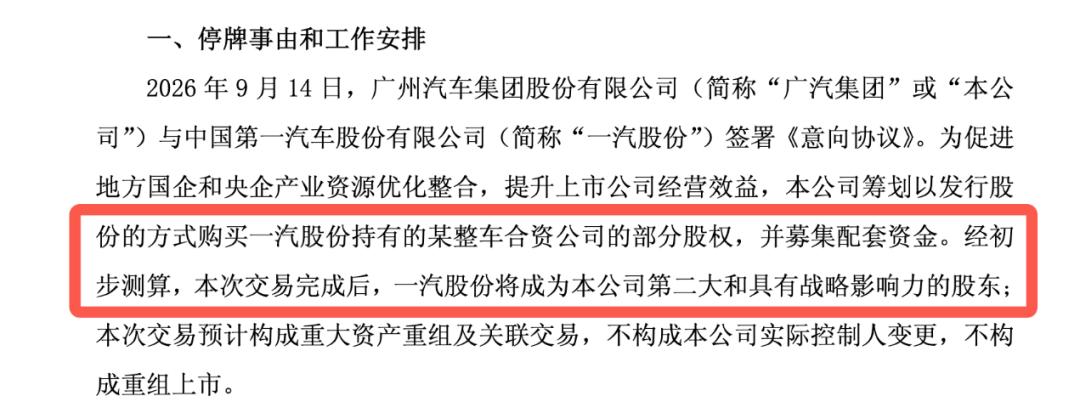
On September 14, GAC Group suddenly announced a trading halt. That same night, GAC Group released an announcement stating that it plans to issue shares to acquire part of the equity of a complete vehicle joint venture held by China First Automotive Co., Ltd., and raise supporting funds. After the transaction is completed, FAW Co., Ltd. will become the second-largest shareholder of GAC with strategic influence.
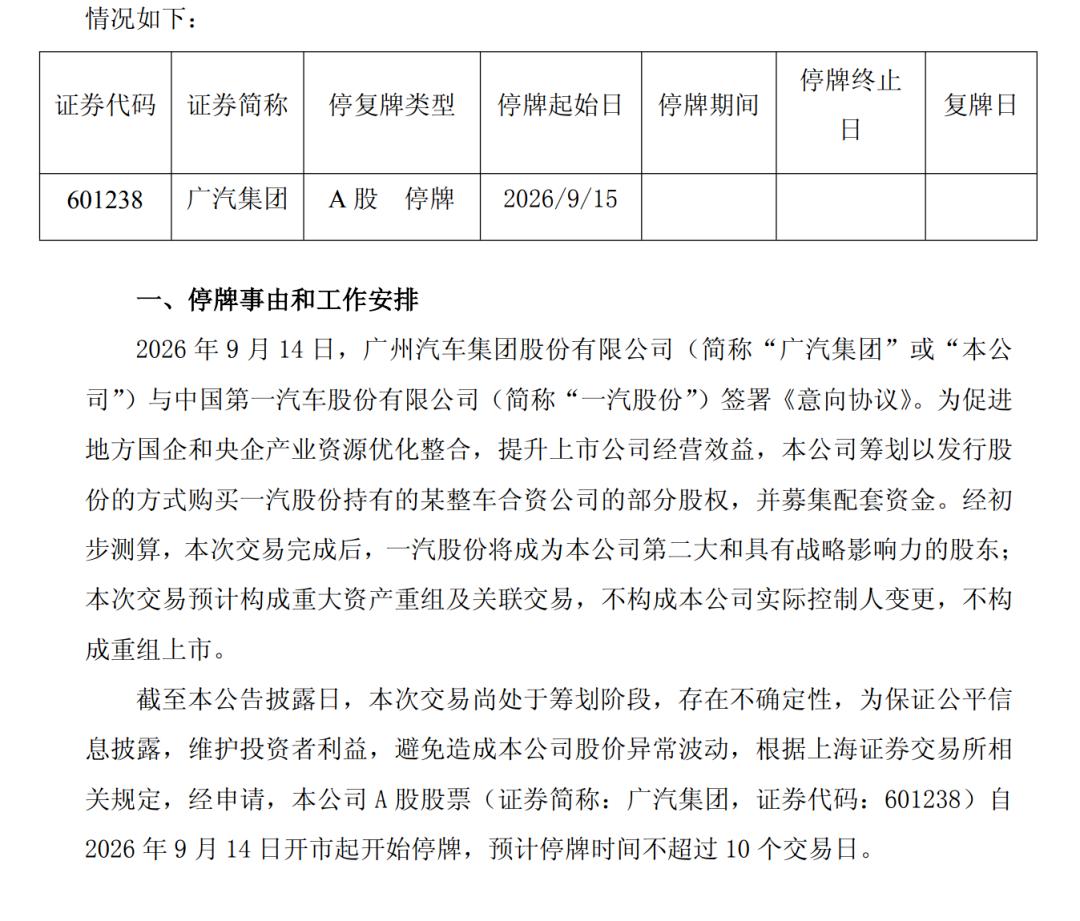
In simple terms, FAW Co., Ltd. uses the equity of a certain joint venture in its hands to exchange for shares of GAC's listed entity. The focus of public attention naturally falls on the "certain complete vehicle joint venture" mentioned in the announcement.
At present, GAC and FAW have not released specific details. However, multiple media outlets cited sources familiar with the matter saying that the transaction target this time is FAW Toyota, but GAC will not acquire all the equity of FAW Toyota held by FAW Co., Ltd., and the main entity of FAW Toyota will continue to operate.
In other words, the widely speculated "merger of North and South Toyota" will not occur directly in this transaction.
However, in recent years, independent Chinese automotive brands have continued to rise, while the aura of joint-venture brands has gradually faded. Whether the two "Toyota" entities can merge has long been a major suspense in the market.
But with the news confirmed, FAW and GAC have chosen a "coordinated but not fully merged" approach. What exactly are the two parties pursuing behind this partnership?
01 FAW and GAC: "Betting on the Future"
An interesting detail is that before GAC's trading halt on September 14, the market had been rife with rumors of a "FAW-GAC merger", and GAC's H-share price jumped 8.64% sharply in the morning session auction, with the capital market reacting even faster than the official announcement.
The logic behind investors' clear preference for the deal is simple: the news of integrating the northern and southern Toyota entities has been circulating for years. If the two parties can successfully merge, the Toyota assets held by FAW and GAC will have the opportunity to be revalued.
However, behind the upside of Toyota's revaluation, there is solid market pressure facing the brands.
For a long period of time, Honda and Toyota have been the "profit cows" among all joint-venture automotive brands.
At its peak in 2021, Toyota's annual sales in China reached 1.944 million units. But in 2025, this figure dropped to 1.5781 million units, of which FAW Toyota sold about 805,500 units and GAC Toyota sold about 772,600 units.
Honda's decline is even more staggering.
In 2020, Honda's sales in China reached a record high of about 1.627 million units. But after that, the figure declined year by year, dropping to only 645,300 units in 2025, of which GAC Honda's sales were 351,900 units, down about 25% year on year.
With the two major growth engines failing at the same time, the pressure is clearly reflected in GAC's financial reports.
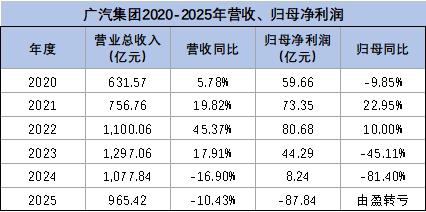
Over the past five years, although GAC's revenue has maintained growth, its growth rate has gradually slowed down. In addition, the company's net profit attributable to shareholders turned from positive to negative in 2025; in the first half of this year, its attributable net loss widened by 75.98% year on year to 44.67 billion yuan.
FAW is also facing considerable operational pressure. In 2025, the sales of FAW's independent brands exceeded 940,000 units, up 15% year on year, but the penetration rate of its independent new energy vehicles was only 13.5%, a figure that highlights the pressure on FAW's new energy transformation.
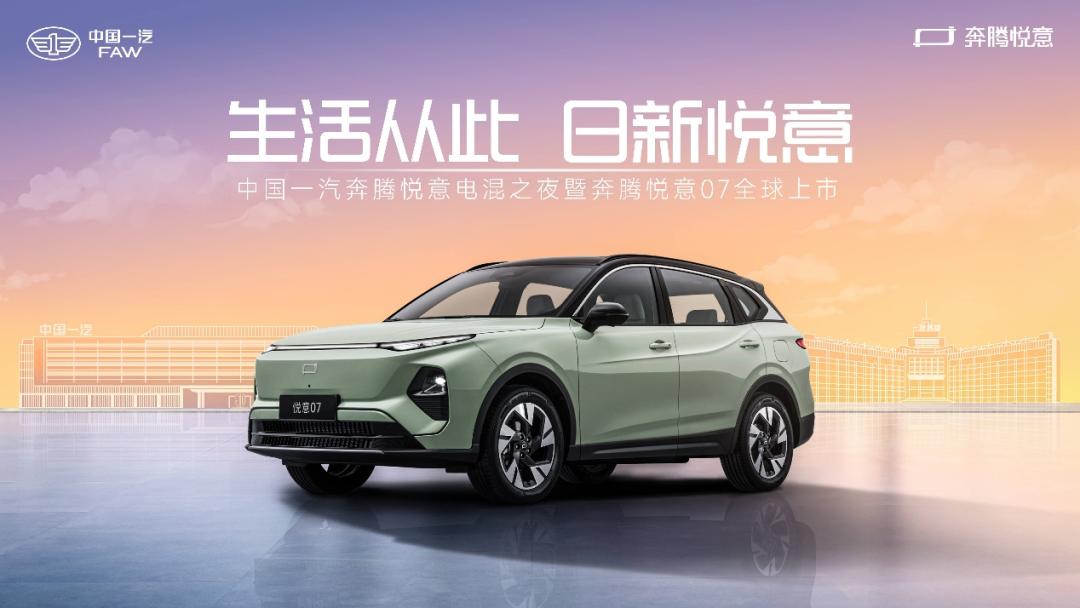
In May this year, FAW established its first independent new energy vehicle brand "FAW Yiyi"; at the same time, the Hongqi New Energy independent department "Hongqi Tiangong Division" was set up separately, with the goal of achieving an annual sales volume of 100,000 units within three years.
For an automotive group that recorded revenue of 541.55 billion yuan and sold 3.302 million units last year, FAW's transformation progress seems to be relatively slow, whether measured by the progress of new energy transformation or the setting of sales targets.
At this point, the reason why GAC and FAW have moved towards this partnership is already very clear.
GAC has the technology and experience in market-oriented new energy operation, but lacks scale and sufficient capital; FAW has large scale and volume, but lacks relevant technology and market touchpoints. The two parties are taking what they need, which is the core logic of this strategic restructuring.
From this perspective, it is not difficult to understand why the northern and southern Toyota entities adopt the "coordinated but not fully merged" model.
First of all, the biggest pain point for FAW and GAC at present is not Toyota. Although Toyota's sales have declined in recent years, the decline has been relatively moderate supported by its hybrid vehicle product matrix.
What the two companies urgently need to solve is the market breakthrough of their independent brands. After all, the penetration rate of the new energy market has exceeded 60%. In the future, what determines the survival of an automaker is not how much sales joint-venture brands can contribute, but whether independent brands can gain a firm foothold in the market.
Secondly, compared with the pains such as personnel changes and channel conflicts that may be caused by the "brutal merger" of the northern and southern Toyota entities, a gentle equity alliance leaves sufficient buffer space for the gradual cooperation between the two parties, and also reserves a listed entity access ticket for FAW.
02 Toyota May Become the Biggest Winner
Although the northern and southern Toyota entities have not been merged into one, the "certain complete vehicle joint venture" has become the biggest variable in this cooperation.
Let's first look at the most intuitive changes.
According to the currently circulated integration plan, the certain complete vehicle joint venture is FAW Toyota. This integration will not change the main entity of FAW Toyota, but its equity structure may be adjusted to 50% for Toyota, 25% for FAW, and 25% for GAC.
With the same "Toyota" brand co-owned by both FAW and GAC, competition and internal friction between the northern and southern markets will inevitably be reduced to a certain extent.
For example, in the past, the northern and southern Toyota entities have always had corresponding sister models, such as Corolla vs. Levin, RAV4 vs. Wildlander. After the restructuring of the two groups, this situation of "competing against our own people" may disappear, avoiding the two entities fighting for the same group of customers in the northern and southern markets.
In addition, taking "Toyota" as a bridge, FAW and GAC can also carry out deeper cooperation in technology research and development, supply chain, sales channels, and even capacity utilization, reducing redundant investment of both parties in the same production chain.
Referring to previous merger and restructuring cases of joint-venture brands: after FAW Mazda was merged into Changan Mazda, the original FAW Mazda dealers were incorporated into Changan Mazda, realizing the unification of the sales network; after GAC Toyota completed the acquisition of the former Dongfeng Honda Engine Co., Ltd., GAC Toyota realized vertical integration in the powertrain link, eliminating the "two separate development for one project" situation.
The deeper change lies in who takes the leading role.
At present, GAC and FAW have not announced the specific equity ratio of the "certain complete vehicle joint venture". However, according to a report by Economic Daily China, Toyota may play a leading role in this integration plan.
The reason why GAC gets the equity of FAW Toyota instead of the reverse operation may be related to GAC's more flexible market-oriented operation mechanism.
In the first half of this year, the cumulative sales of GAC Toyota's Bozhi series reached about 52,000 units, of which the core model Bozhi 3X contributed 41,500 units, up 113% year on year; in the same period, FAW Toyota's pure electric bZ series only sold 11,500 units.
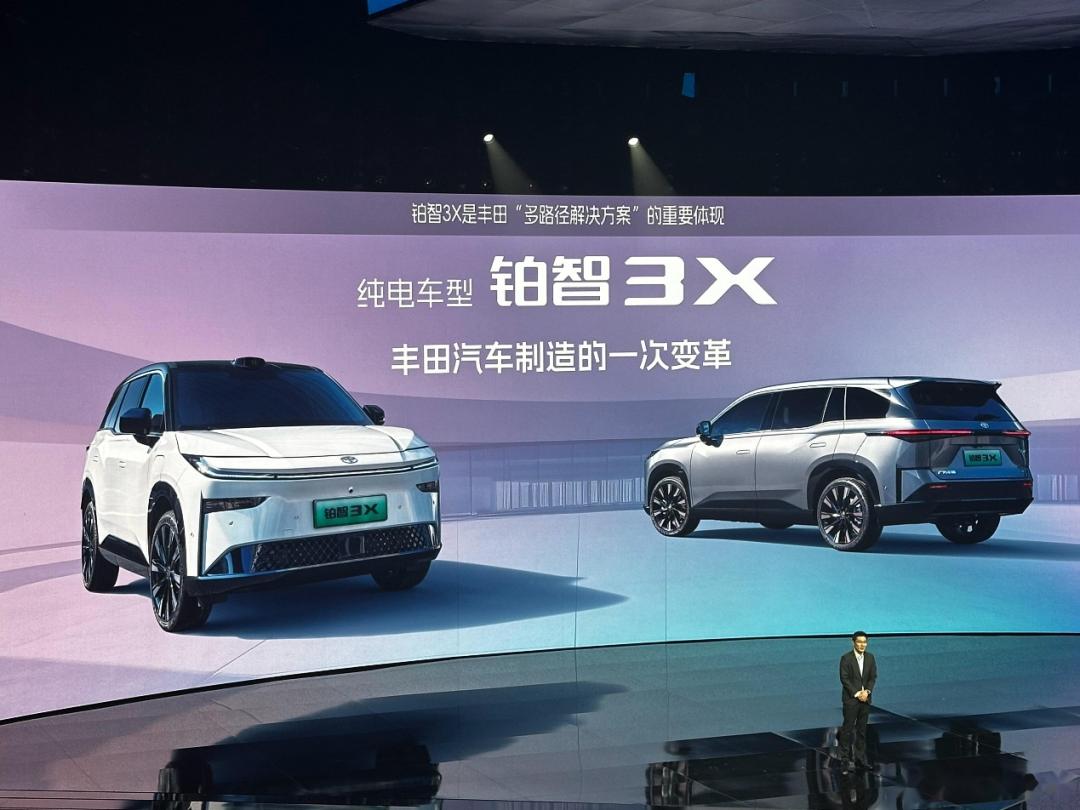
GAC is a local state-owned enterprise located in Guangdong, the region with the highest degree of marketization in China, with a short decision-making chain and high operational flexibility; FAW is a central state-owned enterprise with complex approval processes. For Toyota, handing over the integration baton to GAC is not a preference, but a rational choice.
Therefore, although FAW and GAC each have their own plans, this does not prevent Toyota from becoming the biggest winner.
After all, Toyota has not spent a single cent, but has smoothly promoted the integration of the northern and southern Toyota entities, achieving the unification of sales channels that has never been realized in the past 40 years; it has also taken back the dominant voice in its own hands, and can concentrate more efforts on promoting Toyota's new energy transformation.
Even if Toyota's sales in China may not see a very obvious increase, at least it can maximize cost reduction and efficiency improvement.
However, in the short term, FAW, GAC and Toyota all need to bear the pains of the running-in period.
At present, the synergy of the northern and southern Toyota entities on the sales side is relatively easy to achieve, but the back-end integration involving procurement, supply chain, production and other links may not be accomplished overnight.
Although GAC has temporarily eased its capital pressure through this partnership, in the short term, it still has to bear the downward pressure on GAC Toyota's performance.
Overall, the two Toyota entities still need more time to absorb the integration dividends, but the market window left for them may not be very long. Since the beginning of this year, Toyota's sales in China have continued to decline, with the decline exceeding 25% from April to June.
Although Toyota has encountered new opportunities, to achieve significant results, it still needs to win battles one by one.
03 The Automotive Industry Enters the "Integration Era"
However, while Toyota is pushing forward full integration, other competitors are not slowing down their pace.
In fact, the automotive industry has long entered the "integration era". The essence of this trend is that after the scale effect slows down, the industry's profit pool begins to shrink, forcing automakers to concentrate their resource allocation, shifting from "expanding production capacity to spread costs" to "reducing redundancy to maintain profits".
CUI Dongshu, Secretary-General of the Passenger Car Association under the China Automobile Dealers Association, pointed out that from January to July 2026, the automotive industry recorded a total revenue of 6.078 trillion yuan, up 2.7% year on year; but the total profit was 216.2 billion yuan, down 20% year on year, meaning the automotive industry is getting market attention but no actual profits.
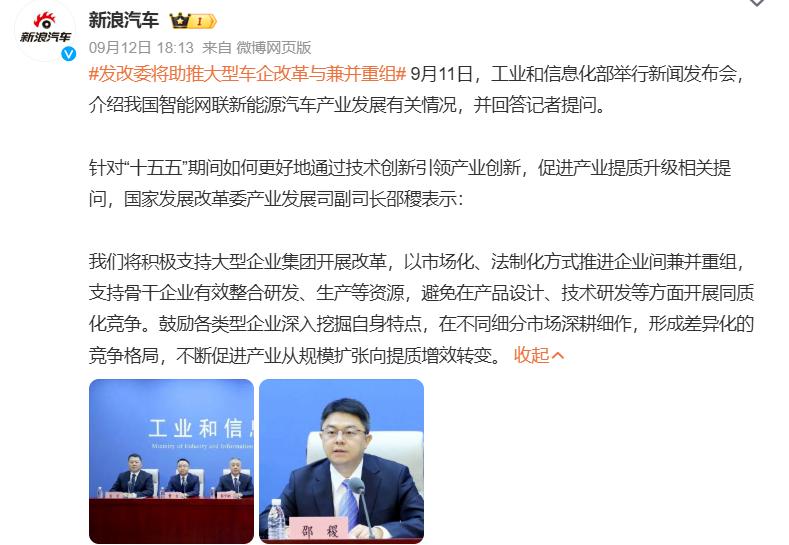
Accordingly, policy orientation is also changing at an accelerated pace. On September 11, nine departments including the Ministry of Industry and Information Technology released the "15th Five-Year Plan for the Development of Intelligent Connected New Energy Vehicle Industry", which clearly proposed to "increase the intensity of legally compliant mergers, reorganizations and cross-regional integration of automotive enterprises"; the National Development and Reform Commission also stated that it will support large enterprise groups to promote mergers and reorganizations between enterprises in a market-oriented and law-based manner.
In the past few years, the automotive industry has been busy with integration:
In 2024, Geely released the "Taizhou Declaration", putting forward the "One Geely" strategy to promote internal resource integration and collaborative strategy within the group;
Earlier last year, Changan Automobile and Dongfeng Motor announced that their indirect controlling shareholders were planning a restructuring; in June this year, BAIC Group signed a strategic cooperation agreement with China Changan Automobile Group...
But the problem is that merger and restructuring is not a "universal panacea". When two automakers that were once dominant players in the market merge into one, practical problems such as who will take the lead, how to distribute profits, and how to balance technical routes are all realistic challenges to be faced.
For example, the restructuring negotiations between Changan and Dongfeng were once highly anticipated, but the two have too high market overlap and serious channel cross-over, plus the fact that both are central state-owned enterprises, which increased the difficulty of negotiations, and eventually the deal fell through.
Looking at the global market, at the end of 2024, Honda and Nissan also launched merger negotiations, but the two have highly homogeneous technologies, markets and products, and eventually failed to reach a compromise on the issue of "who takes the leading position".
These cases all show that if two companies cannot achieve real synergy and efficiency improvement at the business level, a forced merger will only create greater internal friction for both parties, and separation is a better choice than forced integration.
However, the restructuring of FAW and GAC this time may bring new inspiration to the industry:
First of all, the friction coefficient of integration between joint-venture brands is inherently lower.
For example, FAW and GAC have Toyota as a bridge, their vehicle platforms and supply