The end of the tax-free dividend: new survival rules in the semi-annual reports of cross-border e-commerce
According to data from the General Administration of Customs of China, the total value of national foreign trade imports and exports in the first half of the year reached 25.47 trillion yuan, representing a year-on-year increase of 16.9% and marking the first time that the figure has exceeded the 25 trillion yuan threshold in the same period in history. As a new business form of foreign trade, cross-border e-commerce continued its strong development momentum, with 115,000 additional enterprises engaging in import and export businesses in the first half of the year, and cross-border e-commerce exports via overseas warehouses surged by 3.3 times.
Judging from the semi-annual reports of publicly listed cross-border e-commerce enterprises that have been released one after another, on the one hand, companies including Anker Innovations, ZOHome Technology, and Sevendays Interactive maintained double-digit revenue growth; on the other hand, the net profit of Loctek declined by 83.43% year on year, the non-recurring profit and loss deducted net profit of Santai Group turned into loss, and Sevendays Interactive as well as Qian'an Technology recorded revenue growth without corresponding profit increase... The industry as a whole saw rising total revenue while diverging profit performance, with a clear pattern of "head concentration and exit of underperforming players".
01
Rising Revenue and Diverging Profit Performance
In the first half of 2026, China's cross-border e-commerce industry reached a phased inflection point. The sector is undergoing a systematic paradigm shift from "low-price bulk stocking" to "deep brand cultivation", and from "tax-free arbitrage" to "compliant operation".
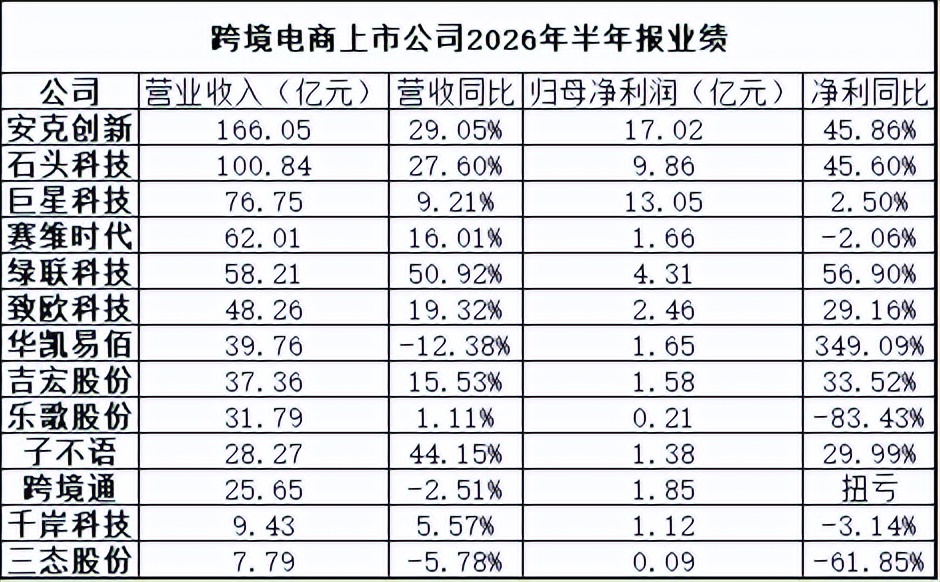
(Source: 2026 semi-annual reports of relevant companies)
According to the 2026 semi-annual reports of publicly listed cross-border e-commerce enterprises compiled by Blue Shark Consumption, several key signals are revealed:
First, from the revenue perspective, the gap between leading brands and bulk-stocking enterprises is widening.
In terms of total revenue, Anker Innovations recorded 16.605 billion yuan, ranking firmly first in the industry. Roborock's half-year revenue also crossed the 10 billion yuan mark (10.084 billion yuan), becoming the only second leading company with revenue exceeding 10 billion yuan.
In terms of revenue growth rate, Ugreen took the lead with a 50.92% year-on-year increase, its overseas main business revenue rose by 69.42% year on year, and revenue from the Amazon channel surged by 71.78% year on year. Yumour followed closely with a 44.15% growth rate, and its revenue from the TikTok channel skyrocketed by 662.1% year on year.
In contrast, the revenue of Santai Group dropped by 5.78% year on year, and its non-recurring profit and loss deducted net profit recorded a loss of 2.4615 million yuan. The bulk-stocking operation model is facing great difficulties amid the increasingly strict platform compliance requirements and intensifying market competition.
Second, the divergence on the profit side is more drastic than that on the revenue side.
In terms of net profit growth rate, Huakai Yibai's attributable net profit to shareholders of the parent company increased by 349.09% year on year, and its non-recurring profit and loss deducted net profit rose by 568.93% year on year, which was mainly driven by the low base effect and the release of expenses after inventory clearance. Anker Innovations' net profit grew by 45.86%, and its net profit in the second quarter alone surged by 83.33% year on year.
However, the attributable net profit of Loctek to shareholders of the parent company dropped by 83.43% year on year, and its non-recurring profit and loss deducted net profit declined by 96.23% year on year, with exchange loss being the core cause. The attributable net profit of Santai Group to shareholders of the parent company decreased by 61.85% year on year, and the company has recorded losses in the second quarter.
Some companies saw their net profit double, while some others' profit dropped to nearly zero, which fully demonstrates the severity of the divergence.
Third, the difference in profitability is also very significant.
In the first half of the year, Anker Innovations' gross profit margin reached 49.82%, up 5.09% year on year, and its gross profit margin in the second quarter climbed to 55.05%, representing a year-on-year increase of 9.05%. The gross profit margin of Great Star rose by 1.37% year on year to 33.32%, and the 35.16% gross profit margin in the second quarter hit a new all-time high. However, the gross profit margin of Sevendays Interactive dropped from 44.47% to 42.71%, which was mainly caused by the increase in platform advertising investment and the intensifying price competition in the apparel sector.
02
Competition Between Short-term Dividends and Long-term Capabilities
Behind the performance divergence of publicly listed cross-border e-commerce enterprises, several driving factors are worth noting:
After the high-level China-US economic and trade talks in May 2025, the US side cancelled multiple additional tariffs. In February this year, the Supreme Court of the United States ruled that the additional tariffs imposed on China under the IEEPA Act were illegal, and the tax refund channel was opened immediately afterwards. Tariff refund has become the most direct catalyst for the profit recovery of cross-border e-commerce enterprises in the first half of 2026.
Taking Anker Innovations as an example, it received 1.447 billion yuan of tax refunds in the first half of 2026, representing a year-on-year increase of 689 million yuan, which directly pushed up its gross profit margin by 5.09%. The same is true for enterprises including ZOHome Technology: as of June 30, ZOHome Technology received a total of 12.6394 million US dollars of US tariff refunds and related interests, which offset its operating costs. Great Star obtained 10 million US dollars of tariff refunds in the second quarter, which effectively hedged the negative impact of RMB appreciation on gross profit margin. Roborock received a total of about 275 million yuan of IEEPA tariff refunds, of which about 192 million yuan was recorded into the current profit and loss.
The profit enhancement effect of tax refunds is remarkable, but it is a clear one-off benefit that is not sustainable. Enterprises still need to rely on their main business to maintain profitability in the future.
Different from tax refunds, efficiency improvement driven by AI is becoming a continuous capability upgrade.
For example, the self-developed "Giikin AI+" global intelligent operation platform of Jihong Co., Ltd. has been officially launched. After the launch, the overall operation efficiency increased by more than 60%, the labor cost decreased by about 30%, the content production capacity grew by 770%, and the automation rate of customer service reached 85%. The attributable net profit of its cross-border social e-commerce business to shareholders of the parent company increased by 80.92% year on year.
ZOHome Technology has also developed more than 70 AI agents, and almost all product copywriting processes have been realized with AI, with the sales expense ratio decreasing by 1.95 percentage points year on year, and the administrative expense ratio dropping by 0.51 percentage points. Leveraging its self-developed "Yizhi Wanxiang" large model and AI Agent infrastructure, Huakai Yibai has realized large-scale AI application in core scenarios such as visual content generation, customer service optimization, and supply chain procurement management, and the storage expense dropped significantly after inventory clearance.

However, it is worth noting that in the first half of 2026, the RMB appreciated by about 3.13% against the US dollar compared with the end of last year, and export-oriented enterprises are generally under pressure.
The attributable net profit of Loctek to shareholders of the parent company dropped by more than 80% year on year, and the sharp increase in financial expenses is the core reason. Exchange loss directly eroded the profit margin, and the financial expenses of ZOHome Technology also increased significantly. The attributable net profit of Great Star to shareholders of the parent company only increased by 2.5% year on year, and its attributable net profit in Q2 dropped by 2.8% year on year, with exchange rate fluctuation being an important drag. The financial expenses of Sevendays Interactive turned from net income in the same period of last year to net expenditure, and its profit performance was disturbed by both exchange rate fluctuation and impairment loss.
At the same time, business model transformation is also reshaping the competition landscape among enterprises.
In the first half of 2026, the B2C revenue of ZOHome Technology decreased by 22.27% year on year, while its B2B revenue increased by 226.60% year on year, and the VC channel has become a new source of growth.
Since the fourth quarter of 2024, Huakai Yibai has actively implemented the inventory clearance plan, and its inventory level has continued to decline from the high point. As of the end of June, its inventory balance dropped by 19.66% compared with the same period of last year. The corresponding reduction in the sales scale of inventory disposal business led to a decline in total revenue, but its high-quality product business turned from loss to profit, and the gross profit margin was restored.
Santai Group is also facing the pressure of transforming its bulk-stocking business model, and the changes in regulatory and tax reform policies in some overseas markets have impacted its cross-border retail business.
03
The Exit of the Old Business Model
Through the data of the semi-annual reports, publicly listed cross-border e-commerce enterprises are experiencing several noteworthy in-depth changes, which can better illustrate the development trend of the industry than the profit figures of a single quarter.
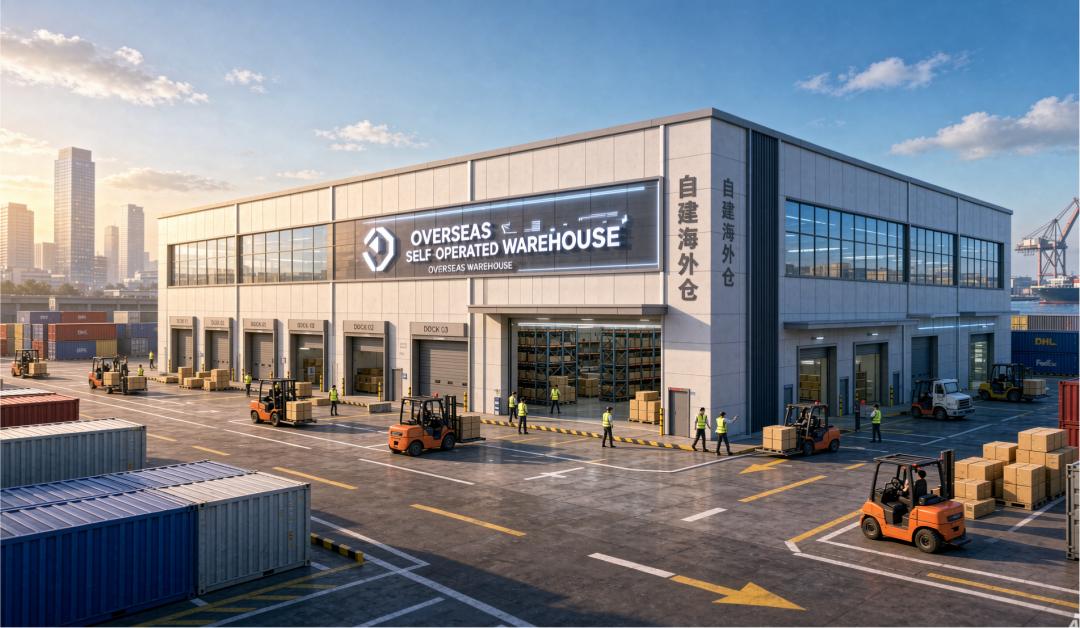
The most notable change is that overseas warehouses have shifted from being an "optional item" to a "mandatory item", and the new tariff policies in Europe and the United States are accelerating the fundamental transformation of cross-border e-commerce logistics modes.
Data from the General Administration of Customs of China shows that cross-border e-commerce exports via overseas warehouses surged by 3.3 times in the first half of the year, and the number of overseas warehouses mainly serving the freight flow of Chinese cross-border e-commerce enterprises has exceeded 6,200. The order volume of AliExpress's official warehouses in Europe reached 25 times of the usual level, and the proportion of orders delivered from local warehouses surpassed that of direct cross-border delivery for the first time. Since the beginning of this year, Cainiao has opened 4 new warehouses in Europe, which are located in the UK, France, Spain and other countries.
The research report of CITIC Construction Investment Securities points out that the core competitiveness of the direct mail mode lies in "small parcels with tax exemption + zero inventory", but the new tariff policies in Europe and the United States directly impact its cost-effectiveness. In the future, end-to-end integrators that have full-chain capabilities covering "China-based direct mail + overseas warehouse + local last-mile delivery" will ultimately win. Shifting from domestic direct mail to local performance is not only an adjustment of cost structure, but an overall transformation of the business model.
Along with this trend, branding and high-quality product operation have become the industry consensus, and leading enterprises are shifting from "selling the cheapest products" to "owning the bargaining power and pricing power of brands".
Taking Ugreen as an example, its overseas revenue increased by 69.42% year on year, and its revenue from the Amazon channel surged by 71.78% year on year. The release of brand momentum has become the core driving force for its growth. Anker Innovations focuses on three core sectors: charging and energy storage, intelligent innovation, and intelligent audio and video. Its gross profit margin in the second quarter climbed to 55.05%, and the product premium capability continued to improve.
When tariffs and compliance costs keep rising, only brand premium can absorb these additional costs, which is the only path for the industry to evolve from disorderly development to maturity.
Diversification of channels is also accelerating, and enterprises are shifting from relying on a single platform to full-channel layout.
Yumour's revenue from the TikTok channel skyrocketed by 662.1% year on year, and its business on the Amazon platform achieved steady growth of 29.6%. Sevendays Interactive's revenue on Amazon reached 5.11 billion yuan, accounting for more than 82% of its total revenue, while its TikTok business has exceeded 100 million yuan in scale. ZOHome Technology has built a layout of "online platforms + independent sites + offline retail", expanding online business from Amazon to e-commerce platforms such as OTTO and Wayfair as well as vertical channels, and simultaneously exploring emerging platforms. Offline, it expands large KA channels, and strengthens brand experience through multiple scenarios such as brand exhibition stores and in-stores.
These changes indicate that the competitive barrier of cross-border e-commerce is shifting from "traffic operation capability" to the comprehensive capability of "supply chain + brand + technology".
04
From Scale Expansion to In-depth Value Cultivation
Tang Min, Chairman of the China Cross-border E-commerce 50 People Forum, pointed out that the cross-border e-commerce industry has now entered a period of quality and efficiency improvement, and the era of extensive growth has come to an end. According to the calculation of Orient Securities, the total market share of leading cross-border e-commerce enterprises only increased from 3.52% to 4.99% from 2021 to 2025, and the market is still highly fragmented. However, leading companies will further consolidate their competitive barriers in the future by optimizing the supply chain, strengthening brand power, and improving digital capabilities.
It can also be seen from the financial data of the first half of 2026 that drastic changes are taking place in the cross-border e-commerce industry. When policy dividends fade away, enterprises that have truly built moats in brand, supply chain and technology will go further in this knockout round.
This article is from the WeChat official account "Blue Shark Consumption", written by Wang Chonghe, edited by Lu Xucheng, and published with authorization from 36Kr.