320,000 vacant primary schools are being frantically snapped up by hotels
Turn rural primary schools that once echoed with children's loud reading voices into viral resort hotels priced at hundreds of yuan; turn overgrown playgrounds into top-selling camping yards... Over the past two decades, more than 320,000 rural primary schools across China have been merged and left idle, reduced to neglected sleeping assets that no one shows interest in.
However, in the past two years, these unwanted old school buildings have become highly sought-after targets scrambled for by hotel brands such as Marriott, Huazhu and Atour.
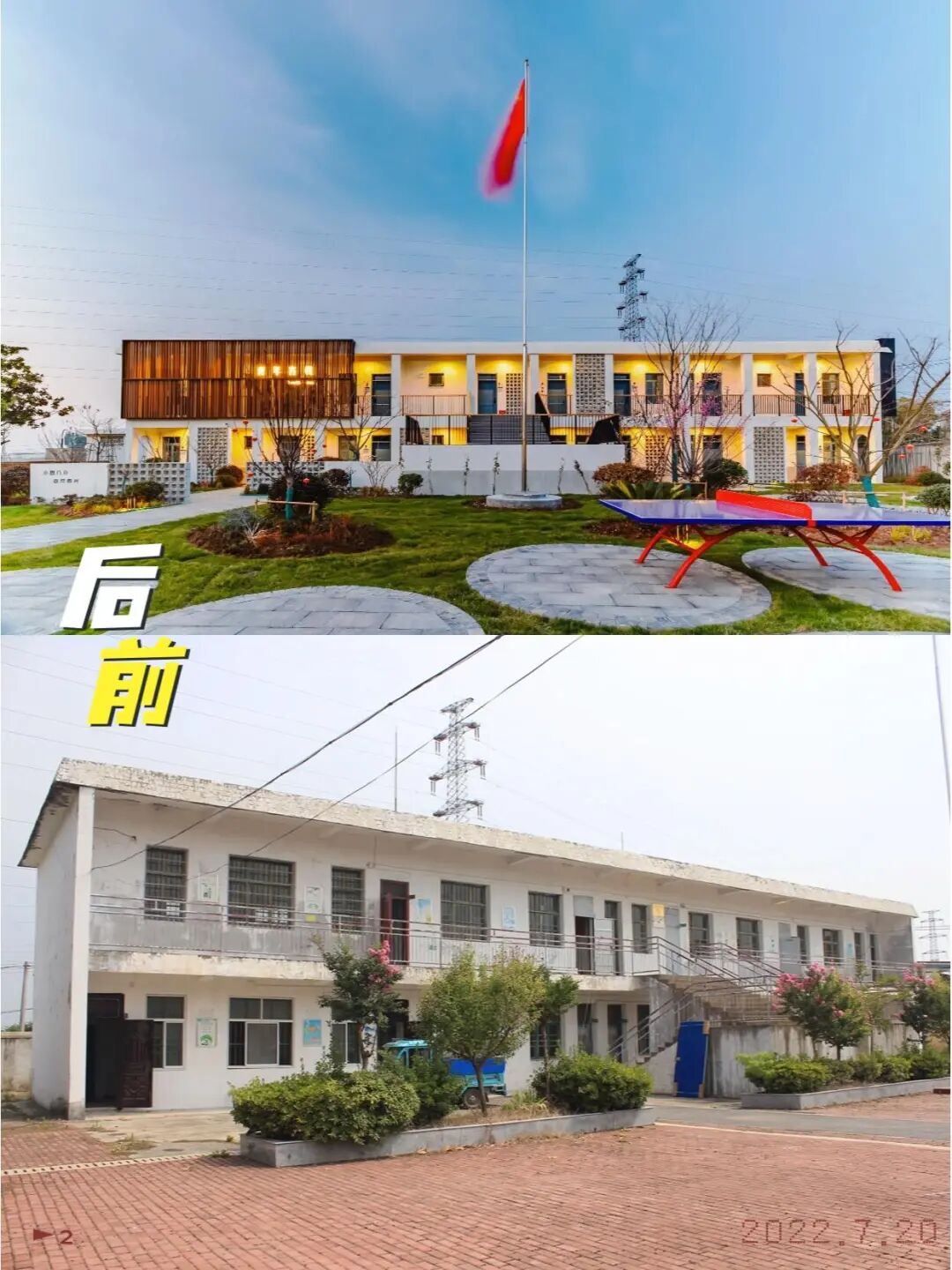
Comparison of Fengqiwu B&B in Chaohu, Anhui before and after renovation Source: Xiaohongshu
Why have abandoned primary schools suddenly become a new outlet in the hospitality and tourism industry? Behind the seemingly widespread dividends, how many traps are invisible to ordinary people?
01
Tens of thousands of empty school buildings are waiting to be revitalized
Why do hotels become the exact party that takes over?
Let's start with a harsh statistic: since 2001, under the policy adjustment of "school merging", the number of rural primary schools and teaching sites across China has dropped from 491,000 to 163,000 in two decades — 329,000 schools have been closed.
In recent years, this process has not slowed down. Compared with 2020, the number of regular primary schools across China has decreased by 29,700 in the past five years.
The once-popular "every village has its own primary school" has become a limited memory for a generation, and the reason behind it is not hard to understand.
In recent years, the advancement of urbanization has led to continuous outflow of rural population, children are sent to study in county seats and cities, and the number of students in village primary schools is severely insufficient. It has long been normal for several village primary schools to merge instead of one primary school in each village as in the past.
In addition, factors such as the declining birth rate have jointly driven some village primary schools and teaching sites to become "hollow houses".
But the problem is that children can leave but the houses cannot. Children can move away, but the ready-made teaching buildings cannot be moved together.
Generally speaking, schools are carefully selected and meticulously laid out no matter in terms of site selection or courtyard integrity. It is a real waste that they are forced to become "sleeping resources" scattered in various villages.
In this context, the insight of hotel groups has given a new look to the merged village primary schools, turning the "last stop" where children left into the "first stop" of cultural tourism reconstruction that attracts tourists to stay.
Turning idle village primary schools into hotels and B&Bs sounds a bit like a last-ditch effort at first, but there is great wisdom behind it after careful consideration.
Just as we mentioned above, old school buildings are rare high-quality renovation prototypes in the sinking market. The school buildings are unified and regular, with almost no irregular structures that cannot be modified. The hardware foundation is excellent, and the fault tolerance rate of decoration and renovation is extremely high.
At the same time, school buildings generally come with a super large playground and open public areas, which undoubtedly has a natural degree of adaptation to the current booming micro-vacation, team building and parent-child travel.
In addition, from the perspective of site selection, most primary schools are rooted in the core circle of villages and towns with superior locations. This advantage, when applied to the hotel industry, forms a natural scenic spot radiation circle with inherent passenger flow base.
Moreover, compared with newly built buildings, the renovation of old school buildings has a shorter cycle, more controllable investment, and relatively lower revitalization cost.
This path exactly fits the direction encouraged by this year's No.1 Central Document — instead of large-scale demolition and construction, we carry out a "small but beautiful" reform based on local conditions.
For counties and townships with tight finances, this is a way to revitalize idle state-owned assets.
For hotel brands, this is a way to obtain new passenger flow with stock assets.
A mutually beneficial business has thus taken shape.
02
Left idle and neglected for more than ten years
Why have they become "highly sought-after" right now?
The idleness of merged village campuses is not a situation that suddenly emerged in recent years, and it is not new for hotel groups to look for incremental markets. The core reason why the two are precisely bound at this point in time and hit it off to become the "best CP" is no more than two points:
One is that the traditional hotel business is getting more and more difficult.
The other is that the new accommodation demand just fills this gap perfectly.
At present, the mid-to-high-end hotel industry has been extremely involuted. Hotels are densely gathered in popular urban business districts, competing for passenger flow through price wars, relying on OTA to support traffic, with high rent and labor costs. Rigid costs have crushed profits, and new stores can hardly get excess profits.
The 2025 China Hotel Investment Operation and Brand Development Report shows that the growth rate of hotel rooms in 2024 was 6.94%, and the scale expansion slowed down. As of the first half of 2025, the national hotel RevPAR decreased by 5% year-on-year, further compressing the industry's profit space.
In addition, B&Bs, short-term rentals, RVs and other forms have become the preferred choice of more young people with the advantages of high cost performance and personalized features, which is bound to impact the competitiveness of the traditional hotel model, directly leading to the diversion of customer groups.
The whole industry is thinking: how to get rid of involution to find a differentiated breakthrough, attract passenger flow from the source instead of relying on price wars?
At this time, the idle old schools merged in the sinking market, with their own courtyards, playgrounds and low-density spaces, just perfectly adapt to the most popular experiential accommodation at present.
The demand on the market side also accurately accepts these non-prime vacant school buildings.
In the past, business hotels relied on rigid demand for business trips, focusing on efficiency, convenience and standardization.
But now the demand of customer groups has completely changed. With the rapid development of China's economy and society, sightseeing tourism has entered the era of leisure vacation. The rural "micro-vacation" that has emerged in recent years has risen in popularity with a small, light and new attitude under this background, becoming a new choice for many people to set off at any time.
Relevant data from Tongcheng Travel shows that short-distance rural micro-vacations continue to heat up, the booking popularity of suburban rural destinations continues to rise, and more tourists are willing to stay overnight, changing from "a quick visit" to an in-depth immersive experience.
The accompanying change is that in the past, when talking about vacation, many people might think of traveling to faraway places and staying in very luxurious hotels.
But now, changes in travel modes, vacation demands and mindsets make people no longer blindly pursue "luxury only" for their travel accommodation. Instead, they truly integrate into daily rural life and feel the relaxation and healing brought by the local environment itself.
In addition to rural micro-vacations, parent-child research trips, silver-haired health preservation and other demands continue to heat up. The inherent educational atmosphere and site conditions of old campuses are naturally suitable for the implementation of research trips. The ecological and cultural resources in villages have inherent health preservation advantages. Even the multi-faceted promotion of enterprise team building, "where to go on weekends" and other demands have completely revitalized the idle old school buildings.
In short, the previous school building properties are a disadvantage for traditional business hotels; but for experiential and scenario-based accommodation, they have become inherent advantages instead.
From another perspective, hotel groups collectively "march into counties" and go to the countryside, which is being positively confirmed by relevant data and front-line cases.
The 2025 Research Report on China's County Tourism Competitiveness clearly points out that mid-to-high-end branded chain hotels are continuously increasing their layout in the sinking market: international brands such as Marriott, Hilton and InterContinental have collectively expanded into county areas, and high-end brands such as Hilton Jiuzhaigou and JW Marriott Anji have entered county areas for the first time; local brands such as All Seasons, Atour and Orange Crystal are also seizing the market synchronously.
Jin Hui, CEO of Huazhu Group, once publicly stated that the goal is to realize "Huazhu has a presence in every county" in the future; Lavande Hotel under Jin Jiang Group covers 324 cities across China, many of which are located in county-level cities.
International hotel brands that used to be high-profile and focus on high-end full-service are now starting to fully lower their stance and compete for the sinking market.
03
Is it a real trend or false dividend?
There is no need for large-scale demolition and reconstruction, no need to rebuild from scratch. As long as the idle school building resources can be revitalized with the lowest cost, turning wasteland into "golden land" — hotel groups entering the market at the right time seems to be a sure-fire bargain business that can make steady profits no matter how you look at it.
But is the fact really the case?
It seems that dividends are everywhere, but in fact traps are buried everywhere.
What outsiders see is: idle village primary schools have low rent, super large sites, renovation projects become viral hits, and opportunities are everywhere.
But hotel practitioners who are deeply engaged in stock renovation are well aware that the fact that these merged and idle empty schools can become popular after being transformed into hotels never means that you can make money as soon as you enter the market.
First of all, it cannot follow the standardized development path.
Ordinary mid-to-high-end hotels can survive relying on business district passenger flow, business travel rigid demand and OTA traffic, but most village primary schools are far away from the core business district, without stable business travel orders on workdays, and the annual revenue is highly dependent on weekends, holidays, research groups and team building orders.
This revenue structure greatly tests the operation capability of hotels. Operators who are only good at or used to the passenger flow in urban business districts will most likely face long-term empty rooms after entering this field.
Secondly, "low cost" is the biggest misunderstanding.
Many hotel practitioners only notice the low rent when entering the market, and some even do not need to pay transfer fees, thinking that they will make a sure profit with no risk.
But the rent is only the superficial cost, and various hidden rectification costs are not small, for example, redoing fire protection, adjusting land planning, reconstructing house types, renovating sound insulation... any of these items requires a considerable expense.
Although many projects save property costs in the early stage, they need to invest double the budget in rectification in the later stage, and the payback period is far out of sight.
The most core sticking point lies in the compliance and resource threshold.
Ordinary urban hotels can be promoted as long as the funds are in place; for school building renovation projects, money is far from enough. The vast majority of village primary schools belong to education allocated land, and the land nature is the first red line. It is not compliant to directly use them for commercial accommodation, and it is necessary to complete land planning adjustment and property right sorting.
In addition, fire protection acceptance, cultural tourism filing, and research qualification approval, each item tests the local resource docking capability.
Outsiders compete for funds, while insiders compete for resources, which is destined that this cannot be a public cake that everyone can share a piece of.
From idle abandoned school buildings to viral hotels, it is not only a way for the hotel industry to break through and save itself, but also the optimal way to revitalize rural stock assets.
Without demolition and unnecessary construction, adapting to local conditions, reviving the sleeping resources in villages, allowing old school buildings to retain memories and create new value, is also a new solution for the development of county-level cultural tourism.
This article is from the WeChat official account "Hotel Management Finance", written by Xue Yang, and released by 36Kr with authorization.