UHT milk, tenaciously clinging to the low-tier market
The superposition of changing consumer demands, channel reform and product homogenization has pushed the industry's growth from scale expansion to an era of refined operation.
It is worth noting that consumer demands have been met by other products, leading to a temporary shift in consumption. Especially in first- and second-tier cities, low-temperature milk has launched a fierce offensive, rapidly attracting users by virtue of its advantages of freshness, nutrition and high protein content.
However, in the huge sinking market, ambient-temperature milk still plays the leading role. Continuously optimizing and adjusting products, channels and marketing pain points to maintain the basic market will be an important path for ambient-temperature milk to achieve breakthroughs.
Ambient-temperature milk has entered the stock era, as well as a critical period of structural upgrading. If enterprises can deeply understand the consumption upgrading trend of "getting access to milk, drinking good milk and drinking the right milk", they will roughly clarify the path to breakthrough.
Ambient-temperature milk sees sluggish sales
For a long time, ambient-temperature milk has been the category with the highest sales proportion in the liquid milk market. After more than 20 years of market cultivation, it has become a national, full-channel basic consumer product, occupying an absolute dominant position in third- and fourth-tier cities and rural channels.
However, the ambient-temperature milk sector has been affected by the downturn of the dairy industry in recent years. According to data from Mai Shangying, the offline retail sales of dairy products in Q2 2026 decreased by 8.48% year on year.
In the past two years, the offline retail scale of dairy products has been in a state of contraction. Except for Q4 2025 and Q1 2026, the sales volume of the dairy product category has declined for 6 consecutive quarters, with a decrease ranging from 8% to 11%.
Judging from the dairy product category price index (with 100 as the baseline), after 2025, especially from H2 2025 to H1 2026, the index has basically stayed in the range of 96-98, and the price level has declined year on year.
Among them, the price indices of ambient-temperature pure milk and ambient-temperature yogurt have rebounded along with holidays, but remain generally weak. After the third quarter of 2025, the price index of ambient-temperature pure milk dropped to around 96, and that of ambient-temperature yogurt moved down at the end of the same year.
In terms of sales, from Q3 2024 to Q2 2026, the declines of ambient-temperature pure milk and ambient-temperature yogurt in multiple quarters both exceeded 10%, with their sales showing a double-digit downward trend at the same time.
The market share has further weakened. In Q2 2026, ambient-temperature pure milk accounted for 35.57% of the sales of key dairy product categories, a slight decrease of 0.65% compared with the same period of the previous year.
According to Boyar Consulting, the overall market size of ambient-temperature pure milk reached 1165.2 billion yuan in 2024, with a year-on-year increase of 2.7%; in 2025, the ambient-temperature pure milk sector went downward, and the overall market size dropped to 1144 billion yuan.
The entire industry is facing such a situation, and the liquid milk business of Yili, the leading enterprise in the industry, continues to face pressure. From 2024 to 2025, the revenue of the company's liquid milk business declined for two consecutive years, and only rebounded slightly in the first half of this year.

The arrival of the stock era
The price of raw milk has entered a downward cycle, the phenomenon of oversupply continues, and products see sluggish end-market sales. The entire liquid milk market has ended its years of high growth and entered the stock era.
Data from Euromonitor shows that from 2022 to 2024, the compound annual growth rate of the liquid milk market was -4.2%. In the past two years, the overall revenue of Yili and Mengniu Dairy has shrunk, indicating that growth has become difficult in the stock market.
Sorting out the facts shows that the root of the problem lies in the intensifying market changes. In 2025, the entire liquid milk market faced weak demand, falling prices and channel reform, and dairy enterprises continued to intensify strategies such as expansion, price wars and channel wars.
At the 2025 financial performance exchange meeting, Gao Fei, President of Mengniu Dairy, publicly stated that the price of the company's products dropped by about 3%; among them, the blockbuster product "Telunsu" also boosted sales by lowering prices.
Telunsu once set a market record with an annual sales volume of over 30 billion yuan, winning the title of "top seller" of domestic ambient-temperature milk, and almost supporting half of Mengniu Dairy's business.
Correspondingly, the star blockbuster product Satine pure milk under Yili once achieved annual sales of over 20 billion yuan at its peak.
The two brands have competed openly and secretly for many years, and even took each other to court over a packaging and decoration dispute in 2025. This is not an ordinary dispute, but a public conflict that leading enterprises do not hesitate to have at the cost of damaging their reputation amid the intensifying competition in the ambient-temperature milk sector.
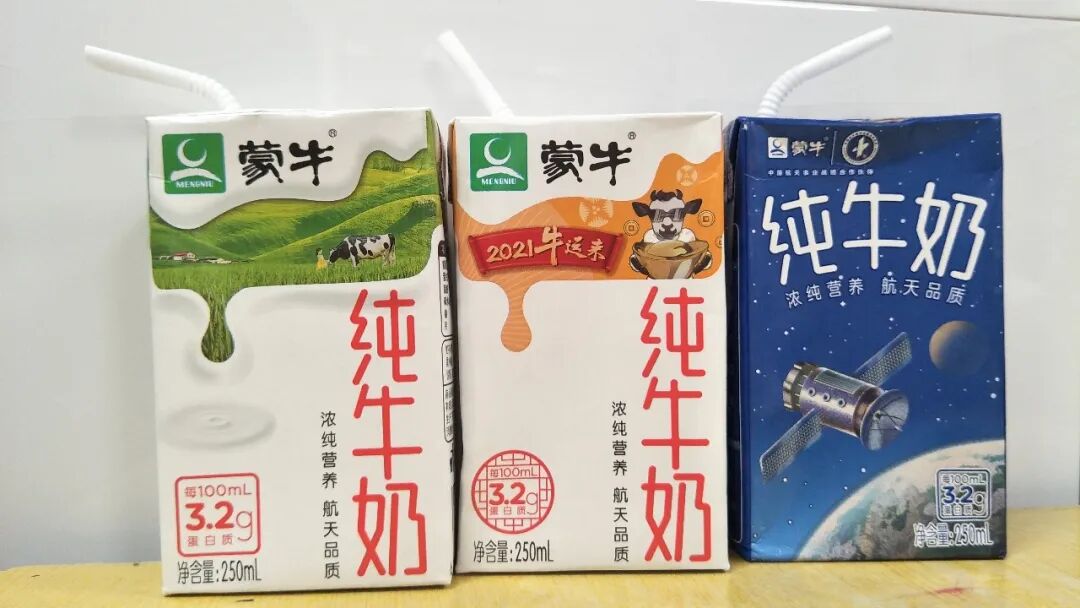
Under the current national competition pattern, the ambient-temperature milk market is still dominated by leading dairy enterprises, which remain the dominant force in the market in terms of brand, channels, milk sources and market share.
According to data from Mai Shangying, as of June this year, the combined CR3 of ambient-temperature pure milk and ambient-temperature yogurt was 84.79% and 88.31% respectively, and the combined CR10 reached 92% and 95% respectively.
The leading enterprises have stable discourse power, but it is not enough to resist the impact of new products on the market.
At present, consumer preferences are rapidly shifting to low-temperature milk. The South and East China regions have high acceptance of such products, leading to loosening of the ambient-temperature milk market. However, in the central, western and northern regions where cold chain network coverage is insufficient and consumers are price-sensitive, ambient-temperature milk is still the mainstream of consumption.
Where is the path to breakthrough?
Low-temperature milk has rapidly expanded its market in recent years and become a key product promoted by dairy enterprises, mainly because it has a 20% higher terminal price space than ambient-temperature milk, bringing higher profit margins and more competitive means to dairy enterprises. Facing the impact of low-temperature milk on the market, ambient-temperature milk seems to lack countermeasures.
A number of industry insiders have put forward solutions: by making efforts in product functions, shelf life and gifting scenarios, ambient-temperature milk still has a chance to achieve breakthroughs.
The *JD 2025 White Milk Report* once pointed out that the two target groups of ambient-temperature milk in the sinking market are town youth and the silver-haired generation.
The two groups have different demands: town youth mainly consume basic white milk, and there is still market space for high-end products; the silver-haired generation needs products with high quality, higher protein content and easy-to-absorb nutrients.
The huge demand of the silver-haired generation reflects the market's expectation for functional products. Existing ambient-temperature milk products mostly only strengthen calcium content, and products for bone and joint care, sleep improvement and digestion promotion have not yet fully met user demands.
In addition, the demands of the middle-aged group aged 40 to 65 in terms of fat control, sugar reduction and intestinal health can only be fully met by milk powder at present, and there are few related products in the liquid milk sector.

Leading dairy enterprises have keenly perceived the market demand, and Mengniu Dairy has launched products such as Three Calves Gu'an and Telunsu with CBP.
In response to the market demand for high protein, ultra-filtered high-protein ambient-temperature milk has been launched to cover consumer groups aged 35 to 60, but it is not specially developed for middle-aged people.
At the same time, the marketing of dairy enterprises is also changing. It no longer only targets children and young groups, but gradually shifts to directions such as family health preservation and bone health.
In addition, through technological upgrading, the shelf life of ambient-temperature milk, which usually lasts for half a year, is shortened to within 30 days to resist the further encroachment of low-temperature milk on the market.
Driven by technology, dairy enterprises have also optimized the nutrient content of ambient-temperature milk.
After the ultra-high temperature sterilization process, the activity of milk protein in common ambient-temperature milk products almost disappears, and this situation is being improved according to the public information of some dairy enterprises.
Among the current short-shelf-life ambient-temperature milk products, it is common to pursue freshness and good taste while retaining active proteins. For example, Sanyuan Food has directly marked the content of α-lactalbumin and β-lactoglobulin on the product packaging, accurately targeting the demanded consumer groups.
This article is from the WeChat official account "Bama Consumption" (ID: banmaxiaofei), written by Chen Xiaojing, and published with authorization from 36Kr.