During this year's National Day holiday, hotels in county towns are unable to take any wedding banquet reservations.
01
Last weekend, my cousin who lives in my hometown in Northeast China told me suddenly that she had got a job at the only five-star hotel in the county-level city where our hometown is located, working as a banquet sales specialist.
I congratulated her over the phone, but she sighed and said the pressure had been extremely high ever since she just started the job.
I comforted my cousin, saying that there were too many orders coming for the National Day holiday and she must be too busy to handle them all, and things would get better once she got used to the pace.
She paused for a moment, laughed at herself and said I had got it completely backwards, then started to complain that she had missed the good old days.
My cousin was told by senior colleagues that in the years before the National Day holiday, new sales staff were never in short supply, and sometimes the hotel could hold two or three wedding banquets a day. Now there are only ten days left before this year's holiday, but the wedding banquet hall packages are still being discounted, especially the slots in the latter days of the National Day holiday are all unbooked, and the hotel leaders lose their temper in the work group chat every day.
The newly recruited cousin is under huge pressure. Every day, besides contacting wedding planning companies, she also has to go through the old customer list, reach out to people who had previously held birthday banquets or full-month baby feasts, and subtly ask if their children are planning to get married.
As she talked, she laughed herself, saying repeatedly that now when she scrolls through WeChat Moments and sees anyone posting couple photos, she can't help clicking in to check if there's any potential business opportunity.
Before hanging up, my cousin added very seriously, "Sis, if you know anyone in our hometown who is going to get married, be sure to tell me, we can negotiate on the price."
To be honest, I thought it was a little funny at that time, but later when I looked into the wedding banquet market during this year's May Day holiday, I found her anxiety was far from unique.
In May this year, Jiu Ye Jia, a vertical media focusing on the alcohol beverage industry, visited more than 20 alcohol dealers in Henan, Shandong, Guangdong, Anhui, Hebei, Hubei and other regions, and nearly 90% of them reported that the number of wedding banquet bookings during the May Day holiday had declined.
A person in charge of catering at a hotel in Wuhan said that except for May 2, which was almost fully booked, there were still a large number of vacant slots on other dates. Even though the hotel launched stored-value discounts and a 20% off promotion for all consumption, it still failed to fill up the banquet halls.

Photo taken by Lvjie
Back during last year's National Day holiday, similar signs had already appeared in some economically developed cities in China.
According to the report from China Ningbo Net, a local wedding hosting team with more than 10 years of working experience saw its orders drop by about 20% year on year in the 2025 National Day holiday. In the past, they could be busy hosting over ten consecutive events during the long holiday, but last year they had idle gaps in their schedule.
Weddings are still concentrated on October 2 and 3, and WeChat Moments look very lively as usual, but if you look at the whole holiday, the hotel business is no longer as fully booked as it used to be.
In this light, the fact that the hotel in my cousin's county only saw a slump in wedding banquets this year is already the result of the strong support from the acquaintance economy and favor-driven local relationships.
02
Wedding banquets at domestic hotels once had their golden days.
Many years ago, I worked at a foreign hotel group based in Hong Kong, and every time I checked the operating data with the PR teams of its individual hotels, wedding banquets were always an unavoidable topic in the hotel's catering revenue.
At that time, domestic star hotels hardly worried about whether there were enough newlyweds, and they cared more about whether the banquet halls could accommodate all the bookings on popular dates. Behind the booming hotel business was the huge population of people of marriageable age.
In 2013, the number of marriage registrations across China reached 13.469 million pairs. The huge number of newlyweds, plus the then prevalent practice of holding grand, lavish wedding ceremonies, brought quite stable banquet business to hotels.
More than a decade has passed, not only has the situation changed completely, but the problems faced by domestic county-level cities are even more severe.
Many young people born in local counties went to work in cities like Guangzhou, Hangzhou, Shanghai after graduating from university. In the past, they earned money in big cities, but most of them would come back to their hometown to hold their weddings.
During the May Day and National Day holidays, hotels in counties usually waited for this group of returning newlyweds.
They would hold dozens of banquet tables in their hometown, which would also drive consumption in wedding planning, photography, accommodation and other sectors. For many counties, this business once played a special role in capital backflow.
Nowadays, even this sum of money is starting to flow out of the counties along with young people.
A while ago, a younger relative of mine got married, and I only found out about it when I scrolled through WeChat Moments.
There was no familiar red carpet at the entrance of the hometown hotel in the photos. The couple went to Jeju Island, South Korea, took photos by the sea, and invited a few friends to have dinner in the evening. The whole process looked more like a travel vacation.
And similar choices are becoming increasingly mainstream. Several years ago, I also held my small wedding ceremony in Bali. Only 20 or so attendees were enough to make the event full of a sense of ritual, and I had enough energy to truly spend time with the friends and relatives who showed up.

Wedding at Tirtha Uluwatu Bali / Photo taken by Lvjie
If the older generation cared more about how many banquet tables to arrange, many young people today do start to think about whether they themselves are happy on their wedding day.
I asked my cousin later, are the newlyweds who come to the hotel to check the venue just unwilling to spend money?
She said that's not the case. They still take wedding photos, and some even fly directly abroad for their honeymoon, but when it comes to the wedding banquet, their budget is really very tight.
For example, in the past, when the parents of both sides arranged the wedding, 30 tables were very common. Now newlyweds will go through the guest list from beginning to end, and consider whether it's necessary to invite relatives they haven't contacted for years.
As a result, 30 tables are reduced to 20, and then further to a dozen or so.
The "2025 Special Research Report on China's Catering Banquet Market" released by NCBD estimates that the scale of China's catering banquet market is about 1.07 trillion yuan, and wedding banquets still occupy an important position.
But the report also mentioned that wedding banquets are facing a structural shrinkage in demand. Young people are starting to turn to small-scale weddings, wedding plus travel arrangements, and the banquet scenarios are also expanding from traditional hotels to other catering venues.
Last year during the May Day holiday, a post-95s couple in Taiyuan even held their wedding at Haidilao Hot Pot.
The 140 friends and relatives spent a total of 22,500 yuan for the meal. The couple had originally booked a hotel, but changed the venue because the hotel was temporarily closed. Unexpectedly, the atmosphere at the wedding was extremely relaxed, and the related video went viral online.

In fact, what really makes hotels distressed is probably not just the price.
Young people have realized that they don't have to sit in a banquet hall covered with white tablecloths, listen to the host for hours, and eat pre-made dishes that have barely changed for years.
The sense of formality that five-star hotels are best at providing now seems rather rigid in the eyes of some young people.
At the end of the day, the trouble encountered by county hotels is more than simple consumption reduction. Young people are still willing to spend money on their weddings, they just want to decide for themselves where the money goes.
03
As the National Day holiday is approaching, I asked my cousin again, are there any wedding banquets booked at the hotel now?
She said that popular dates are still snatched by newlyweds, what makes the sales staff headache is the latter part of the holiday. For example, many people are inquiring about booking the banquet halls on October 2, but the inquiries drop sharply on October 4 and 5.
High demand concentrated on a few lucky dates and most of the rest time left idle is more troublesome for hotels than simply having fewer wedding banquets.
Some time ago, I had afternoon tea with the PR staff of a hotel in Beijing, and the other party also mentioned that similar situation had already appeared last National Day holiday. The demand for wedding banquets is increasingly concentrated on a few popular dates. Top-tier hotels are still very busy, but some old five-star hotels see their daily booking rates drop significantly.
Wedding banquets, which used to be relatively stable holiday business, have now become short-term demand with increasingly sharp peak periods.
In county-level cities, this problem will be further amplified.
The banquet hall itself is a heavy asset for hotels. With thousands of square meters of space occupied, the hotel still has to pay for the air conditioning, lighting, kitchen and service team as usual.
When hotels in Beijing and Shanghai face a decline in wedding banquets, they can compete for brand press conferences, corporate events and large-scale conferences.
But many counties do not have such strong business demand on a daily basis. When the number of wedding banquets decreases, the idle space is very difficult to find alternative uses immediately.
What's more tricky is that more and more businesses in the county are trying to grab the spending money from newlyweds.
Newly opened hot pot restaurants can hold weddings, suburban farms are willing to take full venue bookings, homestays with lawns can also arrange banquet tables, and some independent wedding venues include hosting, photography and venue decoration in their packages. After young people pay, the rest of the work will be handled by the venue's staff.
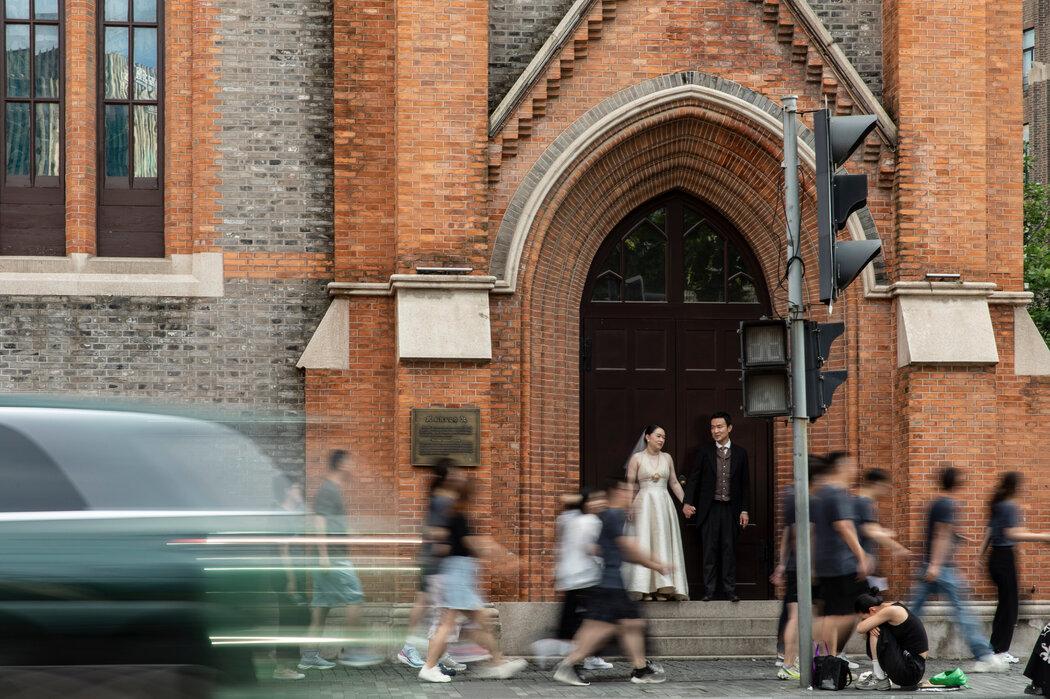
In contrast, if county hotels only focus on cutting the per-person catering price, they are oversimplifying the problem.
My cousin told me that some newlyweds did not show much excitement when they heard the price was cut from 888 yuan to 588 yuan.
Price is of course important, but when the whole way of holding weddings has changed, simply cutting the price by a few hundred yuan is far from enough to attract newlyweds back.
Of course, some hotels have already found another way out.
Harbin provides a very interesting example.
In 2025, the number of marriage registrations in Harbin reached 49106 pairs, up 18.3% year on year. It is worth noting that two local hotels have received more than 100 destination wedding bookings from non-local newlyweds, while the number of local wedding banquets is about 160. Destination weddings account for nearly 40% of the total wedding-related business of the two hotels.
What Harbin relies on to attract non-local newlyweds is obviously not just the banquet halls. The ice and snow season, Central Avenue and the overall tourism experience of the whole city are all part of the wedding products.
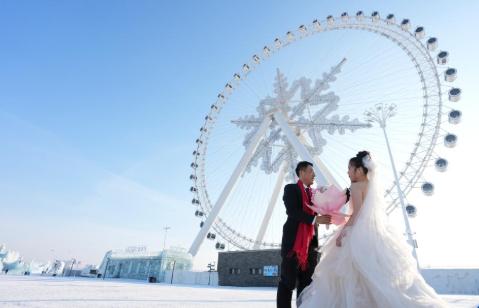
Newlyweds are willing to fly there to get married, so the hotels no longer only target the tens of thousands of local people of marriageable age.
Such opportunities will not be evenly distributed to all counties. Places with tourism resources can find ways to attract non-local newlyweds, and drive accommodation and travel consumption at the same time.
Most ordinary counties still have to face the reality of the continuous outflow of local young people.
In the future, county hotels will probably have to answer a more difficult question: why do young people come back to their hometowns, and if it's not for collecting cash gifts from relatives, why would they hold their wedding in their hometown?
This article is from the WeChat official account "Lvjie", the author is Mommy Who Needs a Birkin, and it is republished with authorization from 36Kr.