Tesla is here! For Ningbo, which is sprinting to secure a spot among the top 10 GDP cities, the odds of success are now much higher.
01
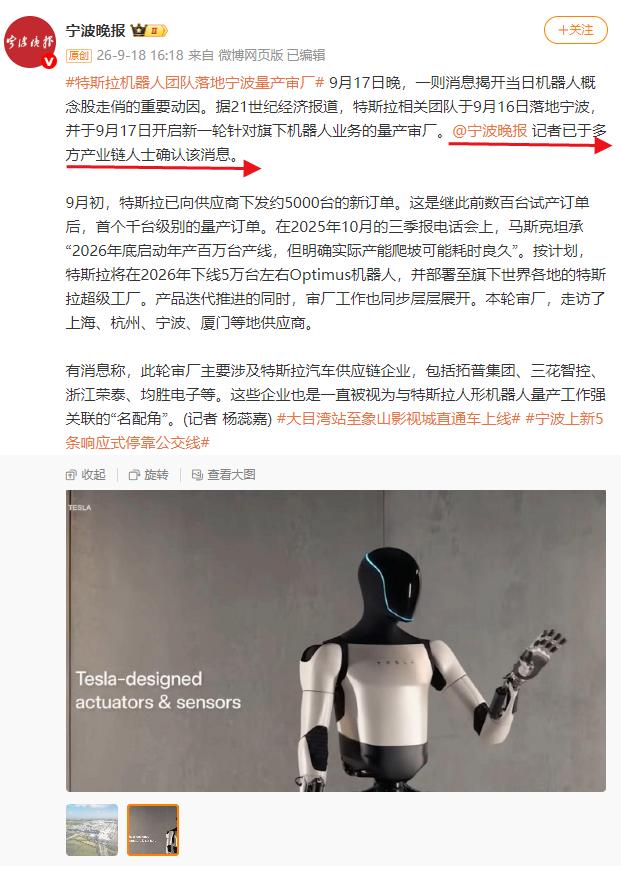
Tesla's Robot Team Has Arrived in Ningbo for Factory Audit
According to exclusive reports from multiple authoritative media outlets including 21st Century Business Herald and Ningbo Daily:
The relevant Tesla team landed in Ningbo on September 16, and launched a new round of mass production factory audits for its robot business on September 17. This round of audits by Tesla is essentially oriented to the mass production of the Optimus robot, and relevant orders have already been issued to supply chain enterprises.
Other sources indicate that Tesla launched a round of robot factory audits in China last September, involving traditional Tesla automotive supply chain enterprises such as Top Group, Sanhua Intelligent Control, Zhejiang Rongtai, Xinquan Co., Ltd., and Joyson Electronics.
Ningbo Evening Post posted on Weibo that its reporters have confirmed the news with multiple sources across the industrial chain.
It is necessary to clarify a concept here: what exactly is a factory audit?
Simply put, a "factory audit" means that Tesla's personnel, carrying drawings, standards and orders, go directly to the supplier's workshop, inspect every piece of equipment, verify every production line, help with debugging, optimize production processes, and push production capacity to a higher level.
This is completely different from the previous cursory inspection visits. The team that came this time consists of personnel from four departments: design, engineering, procurement and supplier management, and they come with real investment behind them — according to industrial chain insiders, Tesla has already issued relevant orders to supply chain enterprises. The purpose of the factory audit can be summed up in one sentence: transplant the manufacturing capabilities of US factories to China's supply chain, and pave the way for the mass production of Optimus.
Although it is only the team that came for the audit, not the official settlement of the robot industrial base, the fact that Ningbo was selected is an unambiguous signal that Tesla's robot industrial chain has set its sights on Ningbo.
The importance of a leading enterprise to a city is self-evident, and examples abound everywhere.
Such as Alibaba to Hangzhou, Tencent, Huawei and BYD to Shenzhen, GAC to Guangzhou, Foxconn to Zhengzhou, CXMT to Hefei, and Tesla Motors to Shanghai.
The settlement of a leading enterprise brings not only capital, technology, employment and tax revenue, but most importantly, the complete industrial chain.
Take the settlement of Foxconn's foundry in Zhengzhou in the past as an example. After Foxconn's arrival, public information shows that it drove a large number of upstream and downstream component manufacturers to settle in Zhengzhou together. There are more than 600 supporting enterprises for Foxconn alone, forming a huge electronic information industrial cluster in Zhengzhou.
What about Tesla's settlement in Shanghai back then?
Data disclosed by the Shanghai municipal government shows that Tesla officially settled in Lingang in 2018 and was put into production in 2019. Since that year, the output value of industries above designated size in Lingang has quadrupled in three years. Leading supporting enterprises such as CATL, Lens Technology, Yanfeng, Magna and Huaqin Technology have also settled in Lingang one after another.
At present, Tesla's Shanghai Gigafactory has achieved an industrial chain localization rate of over 95%. The "Tesla system" suppliers cover all kinds of supporting products including car bodies, chassis, sensors and electronic components, and many of these supporting enterprises are rooted in Lingang.
02
Why Ningbo?
As we all know, the rise of new energy vehicles has had a great impact on traditional fuel vehicle hubs such as Wuhan, Guangzhou, Chongqing, Changchun and Shenyang.
Relatively speaking, Shanghai is very lucky.
Tesla's settlement in Shanghai back then allowed Shanghai, a traditional fuel vehicle hub, to quickly complete the electrification transformation, and offset the decline rate of Shanghai's automotive industry.
It is not an exaggeration to describe it as "saving" the local automotive industry.
A few sets of data can make this clear.
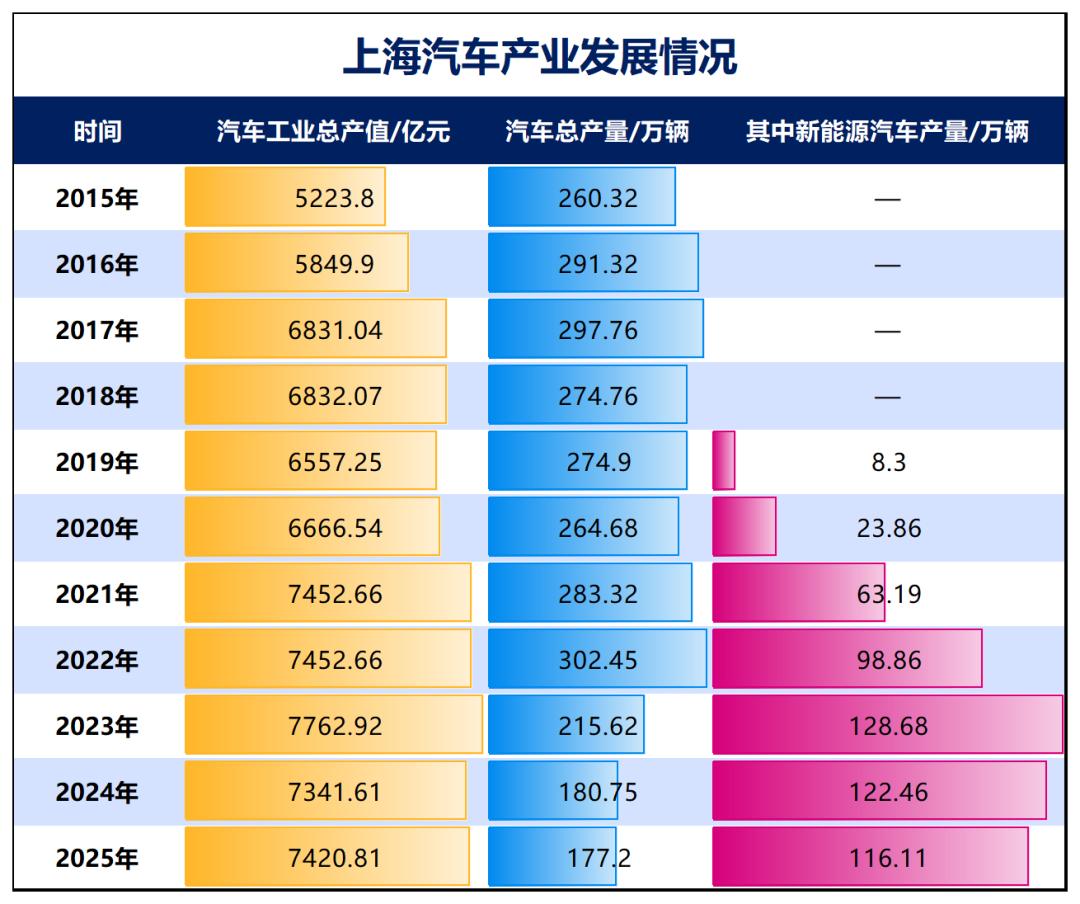
From the perspective of automotive industrial output value, after Shanghai's total automotive industrial output value peaked in 2017, it showed obvious lack of momentum, with stagnant growth in 2018 and a decline in 2019.
After Tesla's arrival, with the rapid increase in new energy vehicle output, Shanghai reversed the downward trend of its automotive industry in 2020, and hit an all-time high of 776.292 billion yuan in 2023.
Graphic by: City Finance; Data from: Shanghai Municipal Bureau of Statistics
In terms of automobile output, before Tesla's arrival, Shanghai's automobile output had already begun to decline. Although it continued to decline afterwards, it was mainly caused by the rapid drop in fuel vehicle output.
Shanghai's new energy vehicle output has shown exponential growth since 2019, the vast majority of which is contributed by Tesla.
Just imagine what the output value and output of Shanghai's automobile industry would be like without Tesla's contribution.
We have emphasized so much to illustrate that Tesla's robot team coming to Ningbo for factory audits is an extremely positive signal for Ningbo.
The wave of artificial intelligence is surging forward, and the robot industry is one of the most promising industries in the future.
The key question is, according to the report of Ningbo Evening Post, Tesla's robot team visited Shanghai, Hangzhou, Ningbo, Xiamen and other cities, and finally chose Ningbo. Why did they choose Ningbo for the factory audit?
Why not Shanghai or Hangzhou?
Shanghai already has a complete industrial chain built by Tesla Motors, and the technical stack of smart cars and embodied robots has an overlap of more than 70%, which is why so many automotive enterprises have started to manufacture robots.
Hangzhou itself is a highland for embodied intelligent robots, and Unitree Robotics has become the first listed company in the embodied intelligent robot sector.
There is no public information available on what preferential policies the Ningbo government has offered to attract Tesla. However, Ningbo's own industrial and manufacturing advantages are definitely the most important factors that Tesla values.
Ningbo currently has 119 national-level manufacturing single champion enterprises, ranking first among all cities in China for 8 consecutive years. The city has nearly 11,000 industrial enterprises above designated size, and 128,000 manufacturing enterprises in total. About 90% of R&D investment, R&D institutions and R&D personnel in the city come from enterprises.
What does this mean?
Ningbo does not yet have humanoid robot complete machine enterprises with huge brand influence such as Hangzhou's Unitree and Shenzhen's UBTech, but Ningbo has a large number of enterprises that can "disassemble and produce" all parts of a robot.
And Optimus is exactly a machine that highly relies on precision manufacturing.
Motors, reducers, bearings, screws, sensors, structural parts, fasteners, molds, plastic parts, aluminum alloy parts, precision transmission parts...
Ningbo has a very deep industrial foundation for all these products.
In the industrial chain direction released by Ningbo in 2026, the intelligent robot industrial chain has been clearly divided: the upstream includes core components such as servo motors, reducers, sensors and special chips, the midstream is robot complete machine manufacturing, and high-end motors, bearings, molds, precision transmission parts are further listed as key development directions.
By the end of 2025, the number of enterprises in Ningbo with complete machine production capacity has increased from 3 at the beginning of the year to 8, and the number of robot industrial chain and supply chain enterprises has increased from 25 to 88; 18 sensor enterprises have basically achieved coverage of special product categories.
Among them, enterprises such as Top Group and Xusheng Group are important players in Ningbo's auto parts industry; Keli Sensing has entered the humanoid robot sensor track, and has sent samples to more than 50 domestic humanoid robot and collaborative robot enterprises.
This is one of the biggest differences between Ningbo and Shanghai and Hangzhou.
Shanghai's advantages lie in complete vehicles, automotive electronics, advanced manufacturing and the complete Tesla automotive supply chain.
Hangzhou's advantages lie in artificial intelligence, algorithms, software and emerging robot complete machine enterprises.
Ningbo's advantage is that it can turn a robot into an industrial product that can be mass produced on a large scale.
There is another more critical indicator: single champion enterprises and "little giant" enterprises.
The characteristic of single champion enterprises is that they achieve extremely deep specialization in a very narrow manufacturing segment. The further the robot industry moves towards the mass production stage, the greater the demand for such enterprises.
Because a robot is a collection of a huge number of parts.
According to Tesla's plan:
Release Gen3 in the first quarter of 2026, and launch a production line with an annual output of 1 million units by the end of 2026.
If Tesla really wants to push Optimus from prototype to million-scale production in the future, the focus of its supply chain inspection will naturally shift from "whether there is a robot enterprise" to "whether a large number of stable, reliable and cost-controlled suppliers can be found".
This is the field that Ningbo is most familiar with.
Ningbo currently has 119 national-level manufacturing single champion enterprises, ranking first in China for 8 consecutive years. At the same time, it has a large number of national-level specialized and sophisticated "little giant" enterprises, forming a manufacturing echelon covering innovative small and medium-sized enterprises, specialized and sophisticated enterprises, little giants and single champions.
More importantly, many of these enterprises are not well-known to the public.
They do not have the huge public popularity of internet companies, but have long been deeply rooted in industrial chains such as automobiles, machinery, electrical equipment, materials, molds, transmission and bearings.
This type of enterprise is exactly the supplier that Tesla needs most.
In my opinion, Ningbo has a huge and complete precision manufacturing and parts supply system, which is the most valued point for Tesla.
03
Ningbo, Sprinting to the Top 10 GDP Cities in China
In 2025, Ningbo issued the humanoid robot industrial policy, clearly proposing to build a national embodied intelligence innovation highland; the 2026 industrial chain plan further lists high-end motors, bearings, molds, precision transmission parts as key development directions for the robot industry.
With the empowerment of Tesla's robot business now, the construction of Ningbo's robot industrial cluster will achieve twice the result with half the effort, and get even more powerful support.
More critically, Tesla will recombine Ningbo's original industrial capabilities hidden in the automobile, machinery, materials and equipment manufacturing industries into a brand new industry.
When Tesla entered Shanghai in the past, one of its greatest values was driving the development of a complete new energy vehicle industrial chain.
This time, if Optimus really enters the mass production supply chain in Ningbo, what Ningbo gets may be the starting point of another new industrial chain:
Upgrading from a city of auto parts to a city of humanoid robot parts.
This is Ningbo's most important chip to impact the top 10 GDP cities in China.
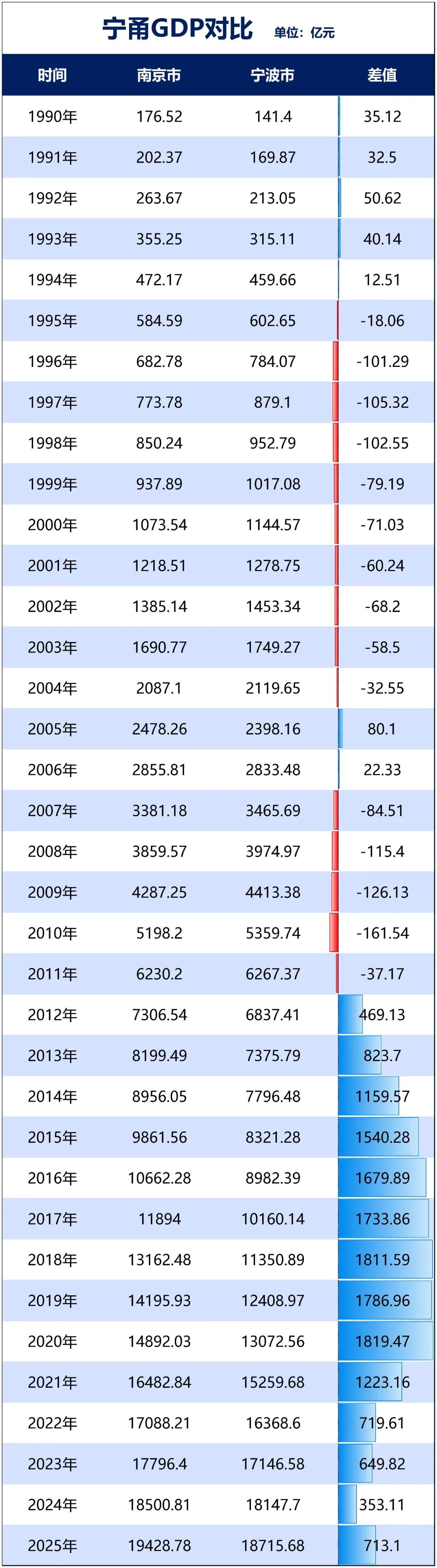
Last year, against the background of slowing industrial growth and pressure on foreign trade, the gap between Ningbo and Nanjing, which had been shrinking, widened slightly.
Graphic by: City Finance; Data from: Nanjing Municipal Bureau of Statistics, Ningbo Municipal Bureau of Statistics
But as I emphasized in the article analyzing the two cities at the beginning of the year, it is still a high probability event that Ningbo will overtake Nanjing in the future.
The logic is that Ningbo's industry is extremely strong, and industrial data contributes significantly to GDP growth.
This is also the fundamental reason why Nanjing's comprehensive strength is stronger than Suzhou, but its GDP is far behind Suzhou, as Suzhou is the second largest industrial city in China.
The same logic also applies to Guangzhou and Shenzhen.
Nanjing is a well-rounded city with top-tier science, education, culture, health care and transportation resources nationwide, and its manufacturing industry is also relatively strong compared with other cities, but Ningbo is a city focusing on manufacturing, so it has stronger advantages in the GDP competition.
In one sentence, Nanjing has strong comprehensive strength, especially in scientific research, while Ningbo has strong industrial strength.
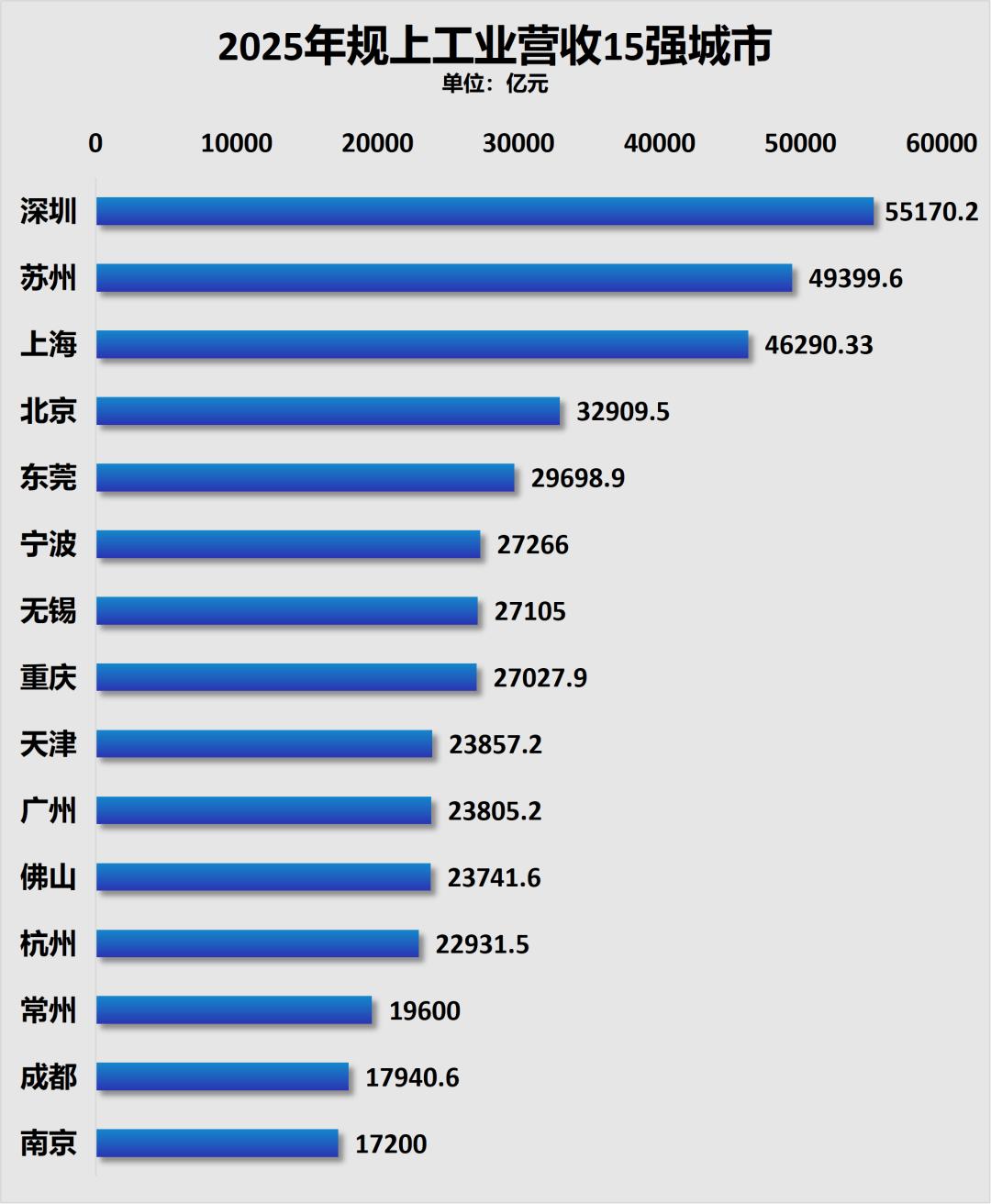
In terms of industrial revenue, Ningbo's industrial revenue of enterprises above designated size reached 2.7266 trillion yuan in 2025, ranking 6th nationwide. Nanjing's industrial revenue of enterprises above designated size in the same period was 1.72 trillion yuan, ranking 15th nationwide.
Graphic by: City Finance; Data from: Bureau of Statistics of various cities
Now, as Ningbo is selected into Tesla's robot supply chain, with the participation of this global leading technology enterprise, Ningbo's competitive advantages have become even more prominent.
Of course, Nanjing is also accelerating the connection between scientific research achievements and industrial implementation, accelerating the layout of emerging industries, and speeding up industrial transformation to increase the proportion of manufacturing industry.
Since 2026, Nanjing has successively released a number of important documents including "Implementation Plan for Nanjing to Further Promote the 'AI+' Action and Build an Upgraded Version of the National Artificial Intelligence Innovation Application Pilot Zone", "Nanjing 6G City Action Plan (2026-2027)" and "Several Policies on Accelerating the Cultivation of New Quality Productive Forces and Promoting High-Quality Development (2026 Version)", almost all of which focus on the same core keyword:
Advanced manufacturing.
In July, Jiangsu Province issued the "Implementation Opinions on Highlighting Market Orientation