Huazhu: The Cyclical Harvester of the Hotel Industry
Over the past year, the core keyword of China's hotel industry has been overcapacity. According to the report from iResearch, nearly 340,000 hotel rooms were closed nationwide in 2025, about 80% of which belonged to independent hotels. With supply clearing and widespread decline in same-store performance, a large number of independent hotels have exited the market. The China Tourism Hotel Association stated its judgment in the annual report: in the next three years, hotels lacking brand competitiveness and efficiency advantages will be phased out at an accelerated pace.
In contrast, Huazhu Group delivered a remarkable performance in the first half of the year: its total revenue reached 131.17 billion yuan, a year-on-year increase of 11%; its attributable net profit reached 23.94 billion yuan, a slight year-on-year decrease of 1.8%, and its adjusted EBITDA rose 21.7% year-on-year to 45.83 billion yuan. Excluding exchange losses and fair value changes, the operating performance of its core business has improved significantly. (The infographic of Huazhu Group is shown below, unit: 100 million yuan, source: Wind, sorted by Financial Chronicle)
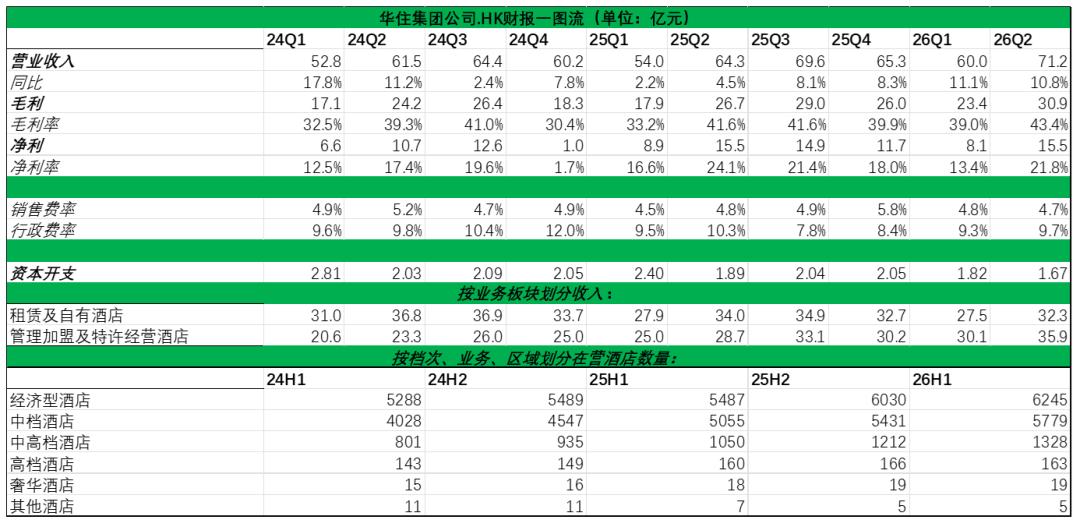
The industry is receding, and leading players are reaping the benefits. As the leading enterprise in the chain hotel sector, Huazhu has formed a growth curve that runs counter to the industry cycle. After reviewing its financial reports, we believe that the secret behind Huazhu's performance essentially lies in leveraging the traffic advantage brought by its membership system to transform the capital-intensive hotel business into an asset-light rent-collection business, which generates a stronger siphon effect during the industry downturn.
Core views are as follows:
1. What Huazhu sells to franchisees is ostensibly a brand sign, but essentially the certainty of traffic.
2. Huazhu does not create cycles, nor does it fight against cycles, but reaps the dividends of cycles. With supply clearing, traffic inflation and asset depreciation, brands and traffic themselves have a strong siphon effect in a downward cycle.
3. This business does not eliminate the cycle, but transfers the cycle from Huazhu's balance sheet to the franchisees' books. The financial statements become more stable, while the risks also become more hidden.
01
Selling the brand sign, collecting the "premium"
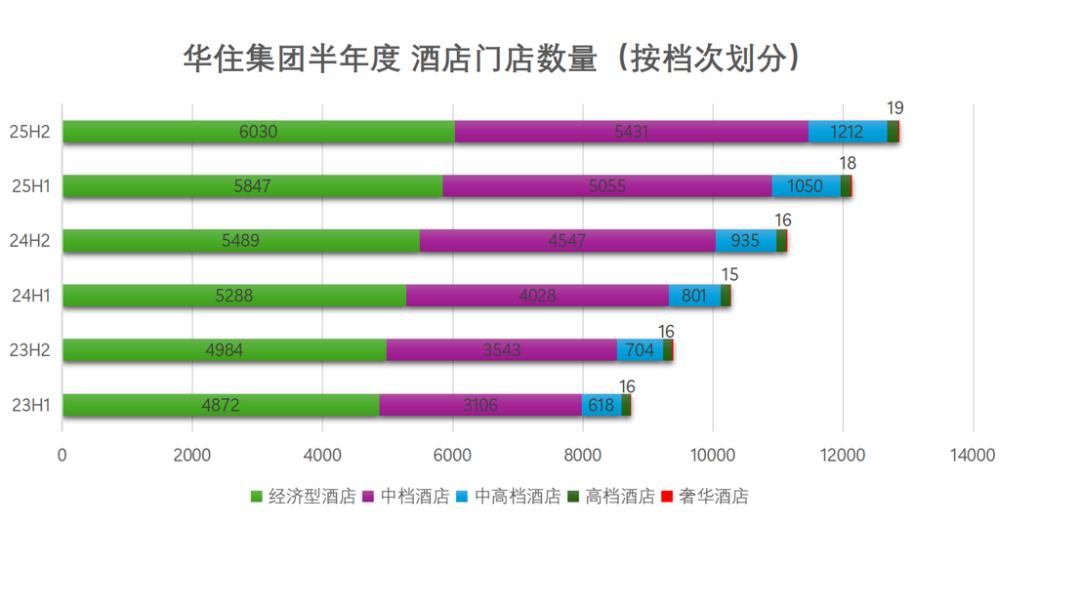
The surge in Huazhu's profits is rooted in the complete transformation of its business model. By the end of 2025, Huazhu had 12,858 operating hotels worldwide, of which 12,285 were franchised and managed stores, accounting for 95.5% of the total; the number of directly operated stores was only 573, and is still shrinking.
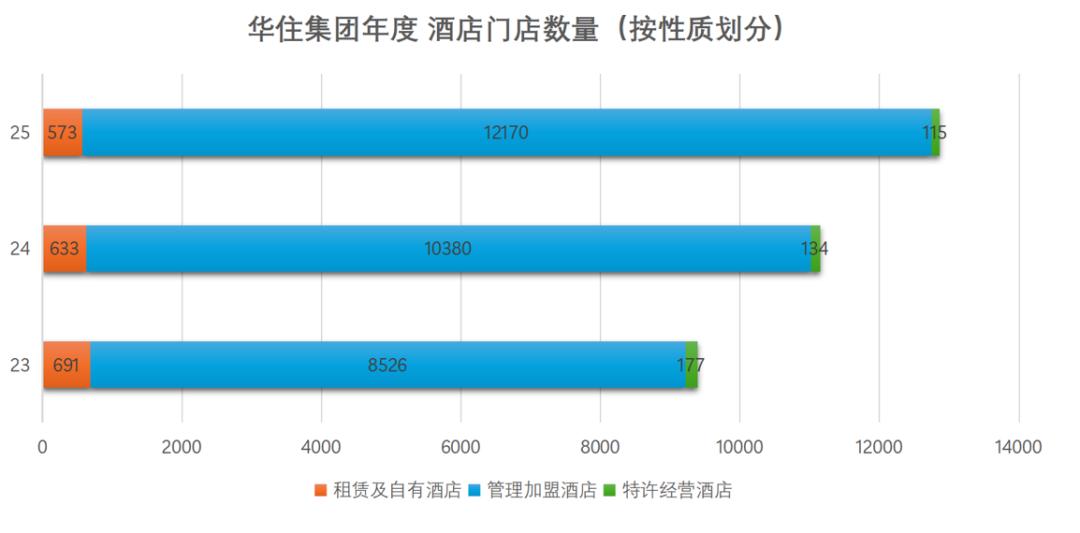
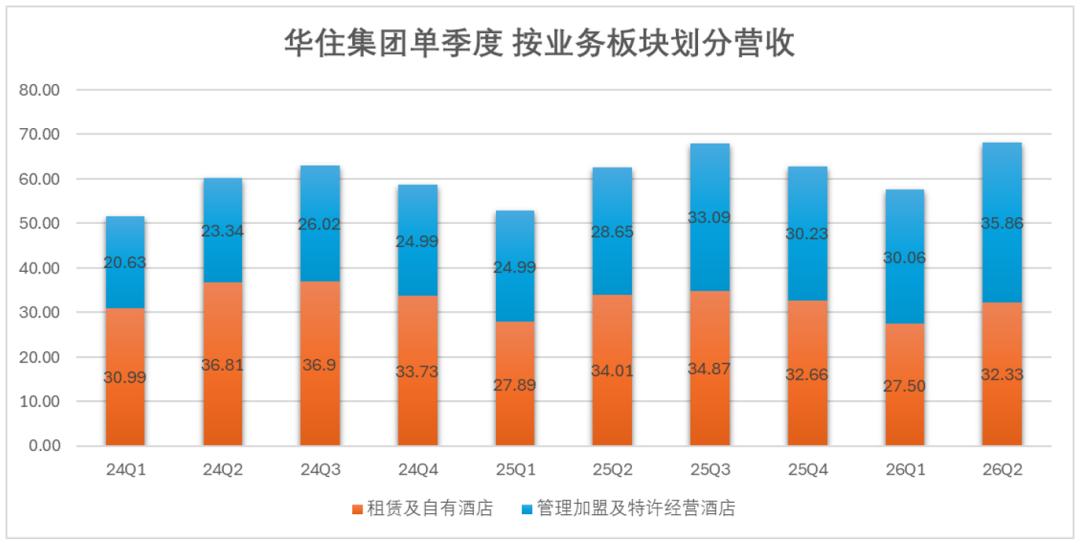
Revenue from management franchising and licensing increased from 9.5 billion yuan in 2024 to 11.7 billion yuan in 2025, representing a year-on-year growth of 23.1%, and its proportion in total revenue rose to 46.2%; in the first half of 2026, this revenue proportion exceeded 50% for the first time, with a year-on-year increase of 22.9%, while the revenue from directly operated stores decreased by 3.3% in the same period.
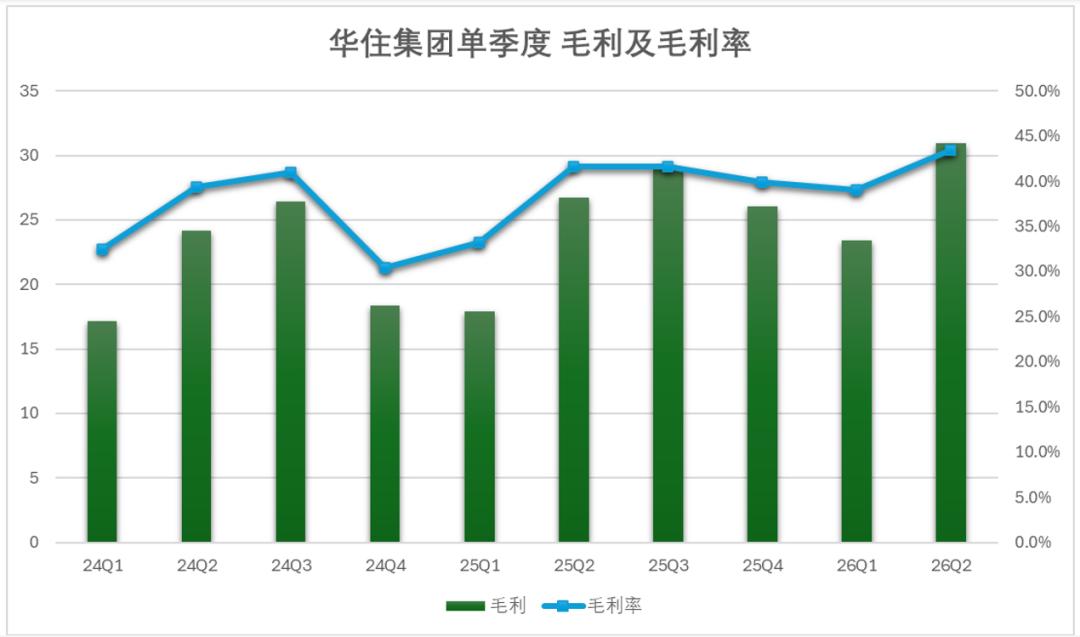
The direct result of the revenue structure transformation is the change in gross margin. Under Huazhu's franchise model, management fees are almost pure profit. The company's gross margin has risen to around 43%, while the average gross margin of the hotel industry in WIND in the first quarter of this year is only 28%.
Huazhu's comprehensive commission on franchisees is about 13%: 5% of the total monthly operating revenue as management fee, up to 3.5% as central channel fee, plus supply chain and various service fees. Market estimates show that the overall rate is higher than the 9.3% commission rate of Ctrip's accommodation booking business (calculated by Guosen Securities).
Why are tenants willing to pay a higher commission than that of OTAs? Because the products they buy are different. OTAs sell traffic and settle by order. Users need to bid for rankings in peak seasons, while orders still drain in off seasons. What Huazhu sells is guaranteed passenger flow, most of the room nights are contributed by members, and all go through its own channels without going through Ctrip.
Therefore, joining Huazhu and bearing a higher commission is essentially equivalent to the hotel buying an insurance. In an upward industry cycle, this "premium" seems expensive; when the industry is in a downturn and traffic becomes increasingly costly, it is the only remaining certain option for franchisees.
In 2025, a large number of independent hotels exited the market. In the same year, Huazhu opened 2,444 new stores, hitting a record high, with a net increase of more than 120,000 rooms, accounting for nearly 20% of the total new rooms nationwide in the same period. The more drastic the supply clearing is, the stronger the willingness of surviving hotels to renew the "insurance". This is the most counter-intuitive part of the rent-collection business: the harder the tenants are hit, the more stable the rent collector's operation is.
02
The traffic advantage brought by the membership system becomes the confidence of rent collection
Then what makes Huazhu qualified to collect rent? Huazhu's core asset is 311 million members.
In 2025, 73% of Huazhu China's room nights were sold to members, and 77% of the room nights were generated through its own channels, both data are from the annual report. Compared with peers, Jin Jiang International has 213 million active members, and BTG Homeinns has about 210 million members, whose scale is comparable, but the proportion of their own channels is far lower than that of Huazhu.
Most orders in the industry are completed through OTAs, and hotels pay 8% to 15% commission per room night to the platform; independent hotels have no membership system, and the conventional commission starts from 15%. Huazhu's channel structure is completely different: it was disclosed at the 2026 Q2 performance conference that the proportion of room nights from OTA channels is only 20% to 25%, and the rest are all from direct sales. Part of the saved channel fees is turned into profits, and part of it is given back to franchisees.
The foundation of high user stickiness is the complete brand echelon. Hanting focuses on cost-effective accommodation, All Seasons targets mid-range business travelers, and Orange Crystal and J Hotel meet the upgraded consumption demand at the higher end. Once a user starts his stay experience from Hanting, Huazhu has paved the whole path for him throughout his consumption lifecycle. The research report of Soochow Securities analyzed this capability: since the pandemic, the RevPAR of Huazhu's mid-to-high-end same stores has significantly outperformed peers, and the same-store occupancy rate is 8 to 10 percentage points higher.
This core asset constitutes the reserve fund for policy redemption: franchisees pay 13% of their revenue as commission, in exchange for passenger flow that independent hotels cannot obtain. This is the real foundation of the whole business.
The foundation is also facing its own challenges. Member traffic is a limited asset, while the supply of stores is almost unlimited: franchisees have collectively reflected on social media that new stores of the same brand are opened within one kilometer, making the 2-kilometer protection radius virtually non-existent.
03
Risks do not disappear, they just transfer
In 1969, Steven N.S. Cheung studied the land tenancy contracts in Taiwan in *The Theory of Share Tenancy*, and overturned a popular misconception: share tenancy contracts are not inherently inefficient. There is no absolute distinction between good and bad contract structures, and the key lies in two points: who bears the risks, and who makes the decisions. For fixed-rent contracts, the harvest in good or bad years all belongs to the tenant; for share tenancy contracts, the landlord and the tenant share the harvest together.
Using this standard to measure Huazhu's franchise contract, we can find it is an exquisite hybrid structure. Decoration fees, franchise fees and deposit are the fixed part; the monthly management fee is 5% of the revenue, which is the share part. The revenue side is linked to the turnover, while the cost side is decoupled from the turnover. For the brand side, this is a textbook-level contract design.
For the brand side, this structure makes it almost impossible to adopt the strategy of "trading price for volume", because the depreciation cost is borne by franchisees, and the cost of price reduction will affect the brand side's share of revenue.
In the first quarter of 2026, Huazhu tried to trade price for volume, pushing the ADR down to 285 yuan, while the occupancy rate dropped to 75.1%. In the second quarter, it turned to price increase: ADR rose to 298 yuan, a year-on-year increase of 2.6%, achieving positive growth for four consecutive quarters; the occupancy rate decreased by 1.2 percentage points year-on-year to 79.8%; RevPAR reached 238 yuan, a year-on-year increase of 1.1%, turning positive for the first time in two years. The management summarized this quarter as a victory of prioritizing price increase over price reduction.
In fact, this view was also mentioned in our previous analysis of Jin Jiang Hotels: the hotel price system will definitely undergo significant changes, the marginal increment brought by last-minute room sales will become lower and lower, and the motivation to reduce ADR to balance RevPAR will weaken. This judgment also applies to Huazhu. Every 1% increase in ADR will drive the 5% share of revenue to rise accordingly, with zero marginal cost.
Of course, for franchisees, the same set of data is interpreted differently. When ADR is at a historically high level, the room rate rises but the number of booking users drops. The rent, depreciation and labor cost of empty rooms are all borne by the franchisees themselves. Huazhu's revenue is locked at the revenue side, while the franchisees' costs are locked at the fixed side. What tenants really want is occupancy rate, which is the denominator to dilute the tens of millions of yuan of investment.
Huazhu pursues higher unit price, while franchisees pursue higher volume. The seed of contradiction is thus sown.
04
The cycle reaper also has natural enemies
Nassim Nicholas Taleb set a rule in *Skin in the Game*: if the decision-maker in the system does not bear the consequences of the decision, the system is efficient in the short term, but will accumulate fragility in the long run. He calls this situation no "skin in the game".
Looking at the past six years as a whole, Huazhu's position as a cycle reaper is clear. During the three years of the pandemic, a large number of independent hotels closed down, and Huazhu achieved a net increase of 892, 1207 and 947 stores respectively against the trend (sorted by Soochow Securities). When peers are shrinking, surviving hotels are more eager to pursue certainty, so the price and volume of the "premium" rise simultaneously.
The second batch of "premium" comes from traffic anxiety. In the years when OTA commission starts from 15% and customer acquisition cost rises year by year, the channel value of 311 million members is passively amplified, and the channel structure itself is a profit statement. The harvesting tools are still iterating: Hanting 4.0 reduces the construction cost per room to 69,900 yuan, and the construction cycle to 30 days; for existing properties, the Hanting Express brand has a minimum half-renovation cost of 35,000 yuan per room.
The traffic pressure brought by the membership system and the comparative cost pressure brought by the strong supply chain make independent hotels unable to compete, so they can only choose to join the system.
However, there is always a boundary for scale growth:
First, expansion in the sinking market is not easy. The chain rate of hotel rooms in China is 41.8%, and compared with the level of over 70% in developed countries, there is much room for growth. Third-tier and lower-tier cities hold 60.96% of the total hotel rooms nationwide, but the chain rate is only 35.34%, far lower than the 59.66% in first-tier cities, so the growth narrative of the sinking market is also valid.
However, the tenants in the sinking market mainly operate properties with 30 to 69 rooms, whose customer groups are price-sensitive and have weaker risk resistance capacity. Continuing to raise commission on the thinnest profit books of tenants is of questionable sustainability.
Second, the harvested objects may also fight back. In May 2026, an All Seasons hotel in Dalian whose contract expired removed the original brand sign, modified the brand character, kept the original font and color scheme. Consumers still stayed there as usual, and the hotel was renamed "Huayu" until it became a trending topic on social media. Later, many similar hotels with similar brand design were found in Nanjing, Jinan, Shanghai, Yushu and other places, with blue doorheads and the same pony logo, almost all of which were former Hanting franchisees whose contracts had expired.
The fact that "they can continue to operate normally with only a tiny modification of the brand sign" is more convincing than any rights protection statement. These stores can still operate well without Huazhu's brand, indicating that the truly valuable parts of the franchise system, including decoration standards, site selection models and service processes, have long been internalized as the tenants' own capabilities, making the brand sign the most replaceable part of the whole transaction.
The capital market prices Huazhu at about 17 times P/E ratio in the Hong Kong stock market. Given Huazhu's current growth rate, this valuation is not expensive. What the capital market cares about is that the reaper also has natural enemies:
The first one is cycle reversal: the reason for the high "premium" is based on the downturn of the industry. Once the industry picks up, the cost-effectiveness of the commission will become glaring again, and the property owners whose contracts expire will vote with their feet.
The other one is that the nature of the infrastructure business is to be responsible for system stability. But after the similar counterfeit brand hotels became trending topics and the store closure guidance rose to 600 to 700, scale is of course important, but the hidden worries about store quality, single-store revenue and franchisee return cannot be ignored.
How stably the