2026 Peak Season Observation | Beverages: Under Pressure, Ready-to-Drink Tea Remains a "Not-So-Bright" Highlight
As September arrives, temperatures have started to drop in parts of the country, and the peak sales season for summer beverages is drawing to a close.
The beverage market this summer was not as hot as the sweltering weather, and the entire broad beverage category came under overall pressure. For beverage brands, this peak season was largely spent navigating headwinds. There is notable pressure in the overall consumption environment, especially on the demand side, which has created challenges for the sales performance of summer beverages this year. However, against the backdrop of broad category pressure, as we mentioned in the Q2 quarterly flash report, some segments still delivered standout performance — such as sugar-free ready-to-drink tea.
This week, MaShangYing will conduct targeted observations of the 2026 peak season, which we define as the high-temperature period from May to August, with comparative reference periods set as 2023, 2024 and 2025. Our peak season observation focuses on the beverage category, with in-depth analysis of ready-to-drink tea, the relatively strong-performing segment within the broader beverage market.
All data in this report comes from MaShangYing Brand CT, and the data models used are marked in the corresponding charts. MaShangYing Brand CT data covers all cities at and above the county level across the country (excluding townships, towns and villages), with deep penetration of core urban agglomerations nationwide. The covered retail formats include hypermarkets, large supermarkets, small supermarkets, convenience stores, and neighborhood grocery stores. MaShangYing Brand CT tracks more than 300,000 brands, over 7 million product SKUs, and approximately 6 billion annual orders. (The above statistics refer to the number of SKUs and manufacturers with actual sales data from August 2025 to July 2026).
01
Market Overview: A Chilly Summer for Beverages
Let's first look at the overall performance of the broad beverage category during this year's peak season. From the three indicators of sales revenue, converted shipment volume and number of units sold, the May-August 2026 period continued the downward trend seen in 2025, with the decline further widening, and the pressure on the demand side is fully reflected in the terminal data.
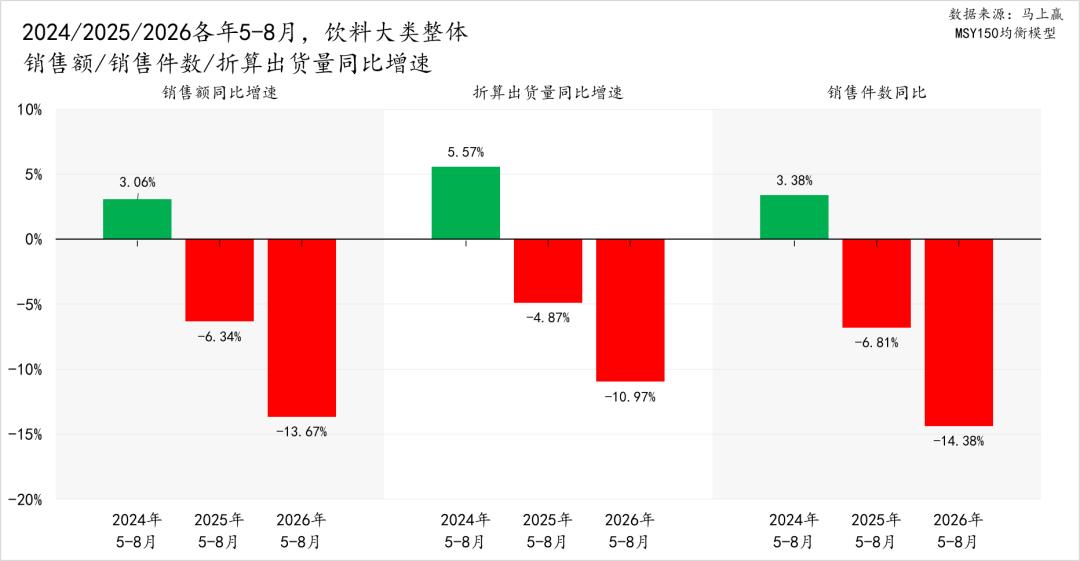
From May to August 2024, the year-on-year growth rates of sales revenue, converted shipment volume and number of units sold for the broad beverage category were 3.06%, 5.57% and 3.38% respectively, all in positive growth territory. But in the same period of 2025, all three indicators turned negative across the board: sales revenue fell 6.34% year on year, converted shipment volume dropped 4.87% year on year, and number of units sold declined 6.81% year on year, showing a significant downward trend. Entering the May-August 2026 period, the downward trend did not stop but deepened further: the year-on-year growth rate of sales revenue fell to -13.67%, the year-on-year growth rate of converted shipment volume dropped to -10.97%, and the year-on-year growth rate of number of units sold slid to -14.38%, marking the largest declines for all three indicators in three years. Notably, the decline in number of units sold is significantly larger than that of converted shipment volume, indicating that consumers' purchase frequency may be decreasing, while the specification of products purchased may be increasing.
Overall, all three indicators for the broad beverage category declined in tandem during this year's peak season, with their declines hitting new three-year highs. The demand-side pressure reflected in terminal sales data is more prominent than in the previous two years.
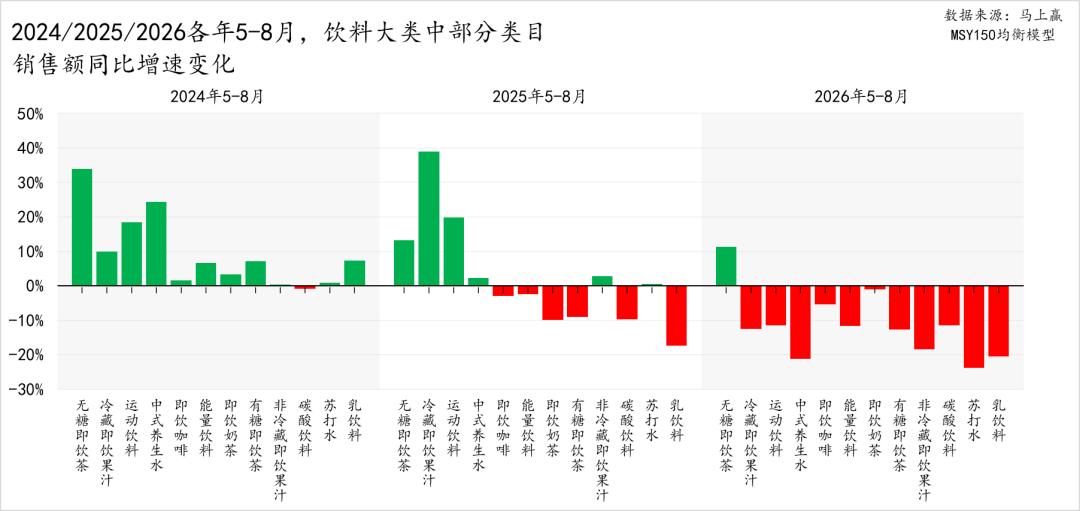
Looking at the year-on-year sales growth rate of each sub-segment, the downward pressure on the broad beverage category from May to August 2026 has spread from a few individual segments to most segments. In the same period of 2024, multiple segments including sugar-free ready-to-drink tea, chilled ready-to-drink juice, and Chinese herbal wellness water maintained double-digit positive growth. By 2025, the scope of growth narrowed significantly, with only a small number of segments such as sugar-free ready-to-drink tea, chilled ready-to-drink juice, and sports drinks maintaining positive growth, while carbonated drinks and dairy drinks had already turned to negative growth.
Entering 2026, the number of positive-growth segments has shrunk further, with only sugar-free ready-to-drink tea in the chart maintaining a positive growth rate of around 10%, while sales of all other segments generally declined year on year. Among them, dairy drinks and soda water saw declines of more than 20%, and non-chilled ready-to-drink juice, sugared ready-to-drink tea, and sports drinks all recorded declines generally between 10% and 20%. It can be seen that the growth momentum of the broad beverage category is highly concentrated in the single segment of sugar-free ready-to-drink tea, while most other segments are in contraction. This further confirms the earlier judgment: in the overall pressured peak season, sugar-free ready-to-drink tea is almost the only segment maintaining positive growth.
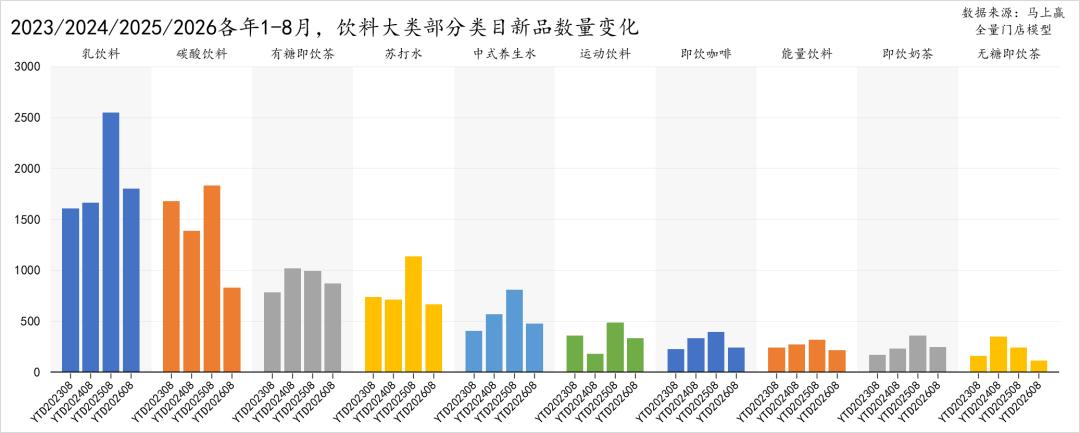
From the perspective of changes in the number of new products, the pace of new product launches for the broad beverage category slowed down overall in 2026, and the number of new products in most sub-segments dropped significantly from their peak levels. Dairy drinks and carbonated drinks, the two segments with the largest new product launch scales, both showed a downward trend. Among them, the number of new carbonated drink products dropped sharply from 1,841 in 2025 to 843 in 2026; the number of new products for soda water, Chinese herbal wellness water, and ready-to-drink coffee also contracted compared to the previous two years, with Chinese herbal wellness water falling from 818 in 2025 to 480. Manufacturers' new product launch strategies are more cautious than in the previous two years, and the overall industry innovation rhythm has entered a converging phase.
However, under the overall pressure on the broad category, the performance of sub-segments is not all bleak. From the structure of new product quantities, ready-to-drink tea remains a relatively active track for new product launches. The launch pace of sugared ready-to-drink tea has been generally stable in the past two years, with a significant increase in 2024 compared to 2023. Although there was a slight decline in 2025 and 2026, the number of new products launched in 2026 is still higher than the level in 2023.
Overall, the broad beverage category is under overall pressure during this year's peak season, with most sub-segments seeing contraction in both sales revenue and new product investment. However, against the backdrop of a weakening overall market, ready-to-drink tea has performed relatively well, becoming a rare bright spot in the peak season. Based on this, we will further focus on the ready-to-drink tea segment, divide it by the highly concerned "sugar content" dimension, and observe its internal structural changes.
02
A Less-Than-Perfect "Bright Spot": Ready-to-Drink Tea
In recent years, product iteration of ready-to-drink tea has always centered on "healthification", and sugar content has accordingly become the most important dimension for observing structural changes in the segment. From sugared to low-sugar and then to sugar-free, consumer choices are constantly segmenting, and the share distribution within the segment is also changing accordingly. Next, we will start with the trend of the proportion of three categories: full-sugar non-low-sugar, low-sugar, and sugar-free, to look at the structural adjustment experienced by ready-to-drink tea driven by the health trend.
In terms of sales share, the sugar content structure within ready-to-drink tea is continuously adjusting. From May to August 2024, the share of sugar-free ready-to-drink tea was 28.2%, low-sugar was 12.5%, and full-sugar non-low-sugar was 59.3%, with the ratio of sugared to non-sugared roughly at 60:40. By the same period of 2025, the share of sugar-free rose to 32.8%, low-sugar dropped to 11.8%, and full-sugar non-low-sugar fell to 55.4%, with the share expansion of sugar-free segment being quite obvious.
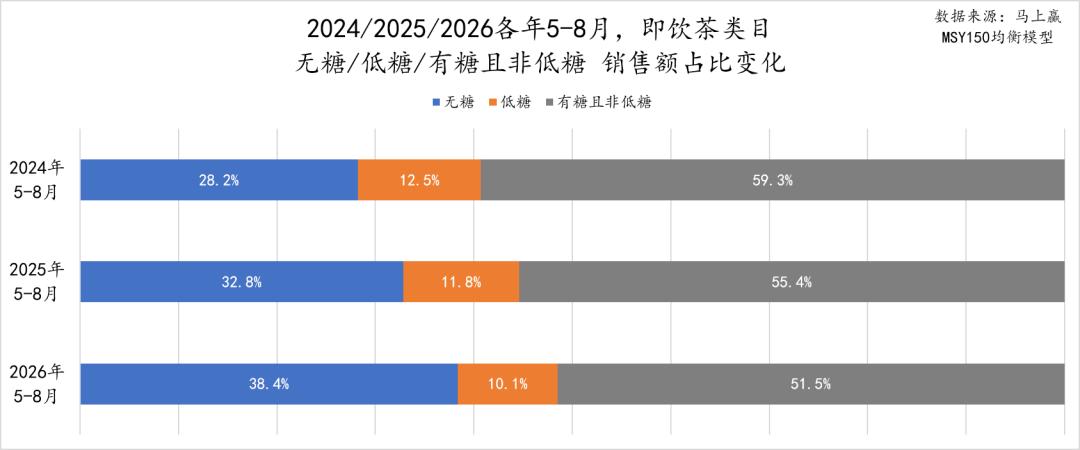
Entering the May-August 2026 period, this trend continues: the share of sugar-free rose to 38.4%, and full-sugar non-low-sugar fell to 51.5%, with the two gradually approaching a 40:50 pattern. It is worth noting the performance of the low-sugar segment: its share dropped from 12.5% in 2024 to 11.8% in 2025, and further fell to 10.1% in 2026. Although its share is contracting, the low-sugar segment has stabilized at around 10%, carving out a relatively independent space from the full-sugar segment, indicating that consumers' choices on sugar content are gradually moving from the binary division of "sugared/sugar-free" to a more segmented gradient structure. Overall, the sugar-free segment continues to seize share, and although the full-sugar base still accounts for the majority, its internal structure has loosened.
In addition to structural changes, there are also some trends and bright spots emerging within the sugared ready-to-drink tea and sugar-free ready-to-drink tea sub-segments.
Sugared Segment: Lemon Tea Stabilizes, Floral & Fruit Tea Breaks Through
Let's first look at the performance of sugared ready-to-drink tea. From the perspective of new product quantities, obvious differentiation is emerging within sugared ready-to-drink tea: traditional lemon tea segments such as iced black tea are gradually becoming solidified, while new segments such as floral and fruit tea are continuously launching innovative products.
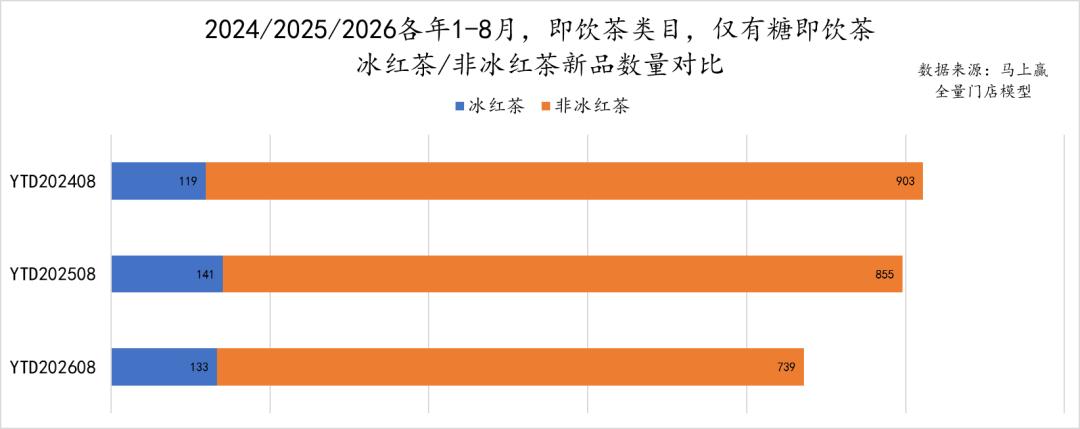
From January to August 2024, there were 119 new iced black tea products and 903 new non-iced black tea products; in the same period of 2025, the number of new iced black tea products slightly increased to 141, while non-iced black tea dropped to 855. From January to August 2026, new iced black tea products fell back to 133, and non-iced black tea further decreased to 739. Overall, the number of new iced black tea products has remained at a low level of over 100, with little fluctuation over the three years, and its new product launch rhythm is relatively solidified; while although the number of new non-iced black tea products is shrinking year by year, its absolute scale is still five to six times that of iced black tea, remaining the main innovation arena for sugared ready-to-drink tea.
This differentiation may reflect the evolution direction of sugared ready-to-drink tea. Traditional lemon tea maintains a relatively fixed product form and new product launch rhythm by virtue of stable consumer awareness and taste inertia; while non-iced black tea segments represented by floral and fruit tea keep trying new product expressions through richer flavor combinations and raw material collocations. The market vitality of sugared ready-to-drink tea is increasingly coming from these non-traditional segments' continuous exploration of taste and consumption scenarios.
Where the market vitality lies is also where brands focus their new product launches, and Suntory's Iced Oolong is a new product born under this line of thinking. Speaking of Suntory, most consumers will immediately think of the brand's classic product — oolong tea. Indeed, oolong tea is the core asset that Suntory has cultivated for many years, and the mental connection between the brand and oolong tea is quite strong. On the one hand, Suntory oolong tea has become the preferred choice for consumers when buying oolong tea; but on the other hand, under the premise of deeply rooted consumer awareness, brands need to strike a better balance between existing cognition and freshness when launching new products. Against this demand, Suntory's "Iced Oolong" series came into being.
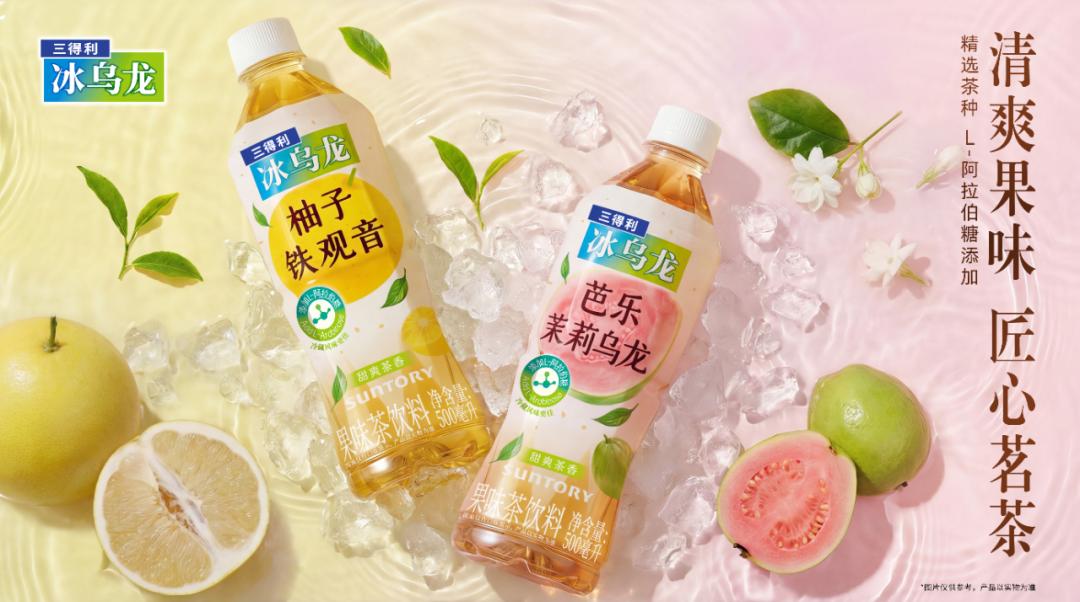
The name "Iced Oolong" borrows the summer heat-relief scenario awareness established by categories such as iced black tea, grafting the cooling feeling carried by the word "iced" onto the oolong tea base, while combining the brand's signature oolong tea to arouse consumers' existing trust in Suntory oolong tea. At the flavor level, innovations are made in the floral and fruit direction: Pomelo Tieguanyin and Guava Jasmine Oolong respectively pair pomelo aroma with the mellow taste of Tieguanyin, and blend guava fruit aroma with the elegance of jasmine oolong. While retaining the recognizability of the tea base, the compound fruit flavor responds to sugared tea consumers' pursuit of "good taste". It is worth mentioning that the Iced Oolong series also uses L-arabinose as one of its sweetener sources, presenting a sweet and fresh taste while reducing the absorption burden of sucrose, which is a direct response to current consumers' health demands. Neither blindly pursuing novelty nor sticking to old flavors can guarantee market favor, and brands need to find a balance between the two. This path of limited innovation within the mature category framework makes Suntory Iced Oolong a noteworthy sample among this year's new sugared tea products.
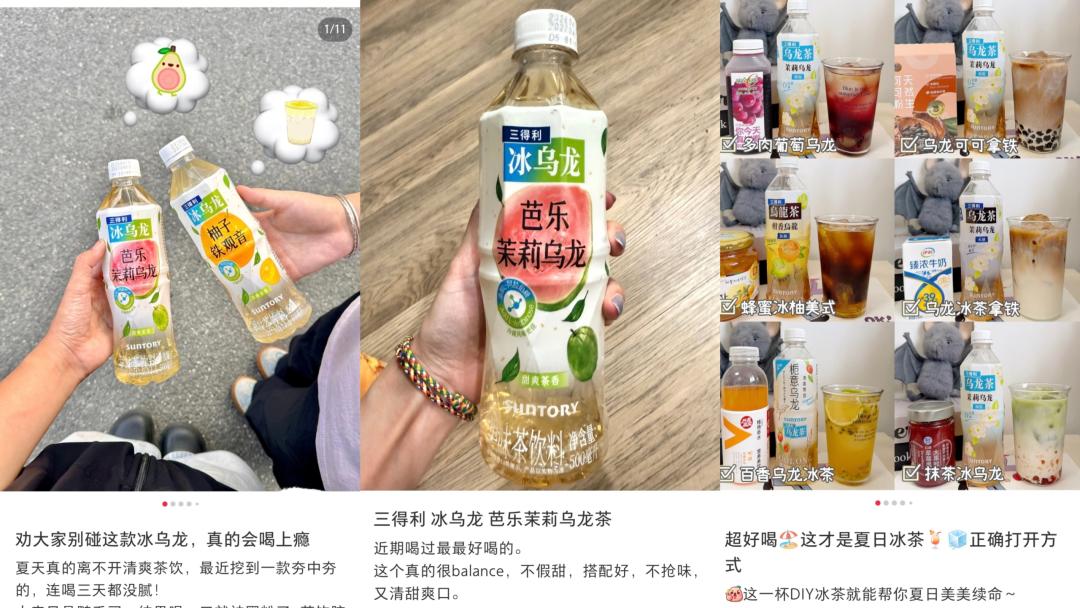
(Consumer reviews of Suntory's Iced Oolong series on social media)
In terms of market performance, Suntory's Iced Oolong series has won market recognition. First, looking at the market share performance after the new product launch, the performance of Suntory's Iced Oolong series is significantly higher than the overall average level of the broad beverage category this year, as well as the respective industry averages of the ready-to-drink tea and sugared ready-to-drink tea segments. From January to August 2026, the average market share of new products in the broad beverage category is at a very low level, and the average level of new products for ready