10 billion yuan, the unicorn backed by Masayoshi Son has been split up and sold off in parts.
Turn the clock back five years.
In September 2021, SoftBank Vision Fund 2 under Masayoshi Son, jointly with Warburg Pincus, led an investment of over 400 million U.S. dollars in Singaporean AI technology company Advance Intelligence Group (AIGL), pushing the company's valuation above the 2 billion U.S. dollar threshold in one move.
Today, five years later, this investment has reached a critical milestone.
Recently, Grab, the local super app in Southeast Asia, announced that it will acquire 60% equity of Atome Financial (hereinafter referred to as "Atome"), the core asset under AIGL and the largest BNPL platform in Southeast Asia, for 1.49 billion U.S. dollars (about 10 billion RMB) in cash, and has agreed to acquire the remaining 40% equity two years later.
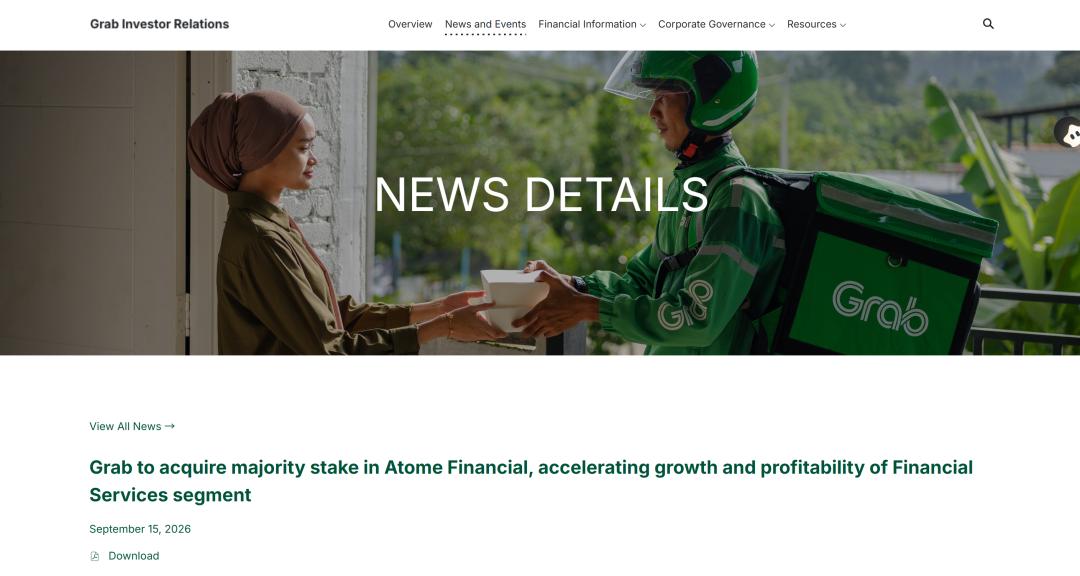
Against the backdrop of SoftBank's successive bad bets on WeWork and Oyo in the past few years, Atome being fully acquired by a regional giant is undoubtedly a good outcome. In contrast, this deal is the largest acquisition Grab has ever made, and it is also one of the few billion-dollar M&A deals in the Southeast Asian fintech sector this year.
The future of Atome still draws widespread public attention.
The Southeast Asian unicorn is being sold off in parts
Atome is by no means an obscure company.
As the consumer finance business segment under AIGL, Atome is widely recognized as the largest BNPL platform in Southeast Asia. Statistics show that its business has covered more than 25 million cumulative transaction users, with a loan portfolio size of about 1 billion U.S. dollars, and the overdue rate has remained stable or even improved in the past few years.
The parent company behind this leading player in the niche track is naturally highly sought after in the capital market. The aforementioned over 400 million U.S. dollar financing round in 2021 was jointly led by SoftBank Vision Fund 2 and Warburg Pincus, with participants including Northstar, Vision Plus Capital, and Gaorong Capital with Chinese background. In 2023, the company raised an additional 80 million U.S. dollars, with investors still being Warburg Pincus and Northstar. Including all rounds over the years, AIGL has raised a total of more than 700 million U.S. dollars so far, and has more than 1 billion U.S. dollars in credit lines to support its lending business.
When AIGL completed its Series D financing and its valuation exceeded 2 billion U.S. dollars, the company had already built three business lines: Atome, the leading BNPL platform in Asia, ADVANCE.AI, an enterprise-level big data risk control service provider, and Kredit Pintar, a digital credit platform in Indonesia.
Greg Moon, Managing Director of SoftBank Investment Advisers, one of the lead investors in its Series D round, stated publicly at the time that what he valued was AIGL's "diversified financial product matrix driven by AI and big data". "Driven by AI and big data, Advance Intelligence Group provides diversified financial products and services for consumers and enterprises in Southeast Asia. The company's AI-first approach enables them to deliver innovative solutions and open up new product paths to create value. We are very pleased to join hands with Jefferson and his team to support their mission of building inclusive and affordable financial services."
At the same time, Saurabh Agarwal, Managing Director of Warburg Pincus, another lead investor, gave a similar judgment, saying that he valued the team's "strong track record in AI-powered digital credit, technology and risk management", and believed that Asia has one of the largest and fastest-growing digital markets in the world, with a huge and highly connected middle class that has unmet demand for flexible and reliable credit solutions.
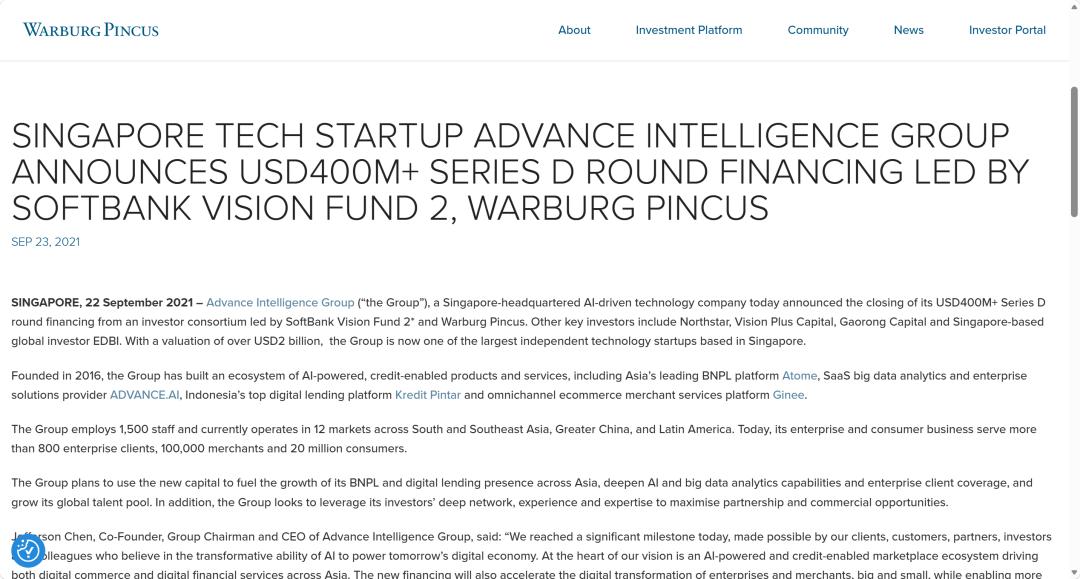
In other words, what SoftBank bet on at the time was not a single product of AIGL, but a complete set of "AI + credit" infrastructure capabilities.
However, it is worth noting that what was sold in the recent transaction was Atome Financial, a business under AIGL, not the entire AIGL Group. In short, the behemoth AIGL is "being sold off in parts". That is to say, AIGL sold its core asset that it expanded with SoftBank's capital five years ago to a downstream industrial buyer at a favorable price. This cash will eventually flow back to AIGL's books, thus indirectly realizing the book value of SoftBank's investment in this round.
After Atome is sold, AIGL still retains two business lines: enterprise-level risk control service provider ADVANCE.AI and e-commerce service platform Ginee. This means that even if Atome is sold to Grab, AIGL itself will continue to operate as an independent company, and SoftBank's equity holdings still exist, only the asset structure of the invested company has changed.
How much is Atome worth?
Since it is an asset sale rather than an equity transfer, "how much is Atome's business worth" has become a widely concerned issue in the public.
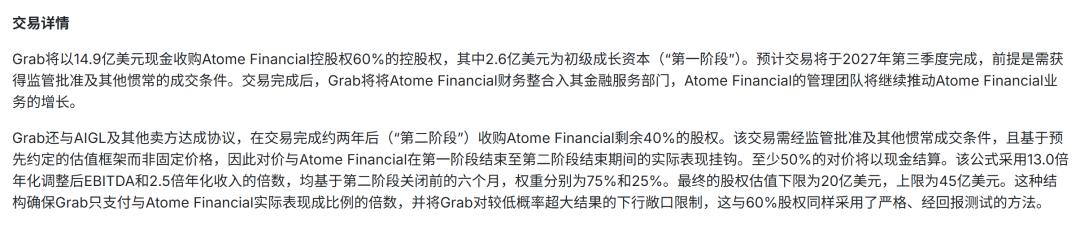
According to the terms of the transaction, Grab will acquire Atome in two steps. In the first phase, it will acquire 60% of the equity for 1.49 billion U.S. dollars in cash, of which 260 million U.S. dollars will be injected into the company as new growth capital. The second phase stipulates that the remaining 40% of the equity will be acquired approximately two years after the transaction is completed, and the final consideration will be linked to the performance indicators (EBITDA and revenue) at that time. According to the framework disclosed in Grab's announcement, the overall valuation range of Atome under this linking mechanism may fall between 2 billion and 4.5 billion U.S. dollars. This span is nearly double, which also shows that the final price of the second phase will largely depend on Atome's actual performance within Grab's system in the next two years. The transaction still needs to pass regulatory approval and is expected to be officially completed in the third quarter of 2027.
In terms of scale, Atome is indeed worthy of this price. As the largest BNPL platform in Southeast Asia at present, Atome has more than 25 million cumulative transaction users, a loan portfolio size of about 1 billion U.S. dollars, and the overdue rate has remained stable or even improved in the past few years. Its business covers five markets: Singapore, Malaysia, the Philippines, Indonesia and Thailand.
Maybank estimated in its research report after the transaction was announced that according to Grab's 2028 operating targets, Atome is expected to generate 200 million to 220 million U.S. dollars in EBITDA by 2028, corresponding to an enterprise value multiple of about 12 times — significantly higher than the valuation multiple of about 7 times for previous acquisitions of similar fintech assets such as Stash, and roughly equivalent to the 12.6 times of U.S. listed company Affirm, but lower than the 30 times of Indian payment company Paytm. In Maybank's words, this valuation is "on the high side but not excessive".
From the perspective of the overall industry, this price is not unreasonable. According to estimates by BNPL industry research institutions, the global BNPL market in 2025 is about 560.1 billion U.S. dollars in terms of total transaction value (GMV), a year-on-year increase of 13.7%, of which the Asia-Pacific region contributes about 36.4% of the global BNPL revenue, making it the largest regional market.
At the same time, the annual "e-Conomy SEA" report jointly released by Google, Temasek and Bain shows that the scale of the Southeast Asian digital economy has exceeded 300 billion U.S. dollars in 2025, and the regional primary market private equity financing has rebounded 15% year-on-year to about 8 billion U.S. dollars, of which about half of the transaction amount flows to the digital financial services segment. That is to say, the track that SoftBank bet on five years ago has not cooled down, but has been expanding all the time.
More notably, Atome has never been the only player on the Southeast Asian BNPL track. There are local Indonesian players Kredivo and Akulaku, GoPayLater backed by Gojek, and SPayLater that comes with Shopee, the e-commerce platform under Sea Group. According to industry data cited by Grab, a large number of adults in Southeast Asia still do not hold credit cards and have never borrowed from formal financial institutions. This "credit gap" is the real battlefield that all BNPL platforms are competing for.
The fact that Atome was first favored and fully acquired by a giant in this scrum to some extent shows that it has indeed outperformed its competitors in risk control data and asset quality.
The financial ambition of the super app
Connecting Grab's actions in the past few years, it is not difficult to see that this acquisition of Atome is not an isolated event.
From the earliest mobility and food delivery services, to the subsequent launch of digital banking and insurance distribution, Grab has always tried to transform itself from a "ride-hailing app" into a "super app" that can carry all users' daily consumption and capital flows.
Grab's path is quite similar to the trajectory taken by Meituan and Alipay in China. It first accumulates users and data through high-frequency consumption scenarios, and then feeds back the low-frequency but higher-margin financial business. The public once compared Grab to "Southeast Asia's Meituan", "Southeast Asia's Didi" and "Southeast Asia's Alipay", and even called it a major integration of "Meituan + Didi + Alipay" in Southeast Asia.
After acquiring Atome, Grab has filled the previously relatively weak puzzle piece of consumer credit at one go, and gained a more complete hidden card in the years-long "super app rivalry" with its biggest rival GoTo Group and Sea Group, which started with e-commerce and games. The three companies have already fought closely for several rounds in mobility, food delivery and payment in recent years, and now the front line has advanced further into the deeper waters of consumer credit.
However, the reaction of the capital market shows that this ambition does not come without a price. On the day the news was announced, Grab's share price on the Nasdaq secondary market showed a downward trend and has continued to fall to this day. Some investors are concerned that 1.49 billion U.S. dollars is a large cash expenditure, and the transaction will not be completed until the third quarter of 2027. The regulatory uncertainty in the middle, as well as the sensitivity of the BNPL industry itself to macro interest rates and household leverage levels, are all risk points that need to be digested.
This concern is not unfounded. In fact, the consumer finance industry has faced similar controversies around the world in recent years. The growth story sounds appealing, but the hidden worries of excessive credit granting and accumulating household debt have always been lingering. That is why Grab and Atome specifically emphasized in their joint statement that they will "expand financial access responsibly" and put risk control and collection compliance on the same important position as business growth.
Furthermore, for China's primary market observers, the reference system provided by this transaction may be more interesting. The Southeast Asian consumer finance market has long been regarded as a "mirror test field" for the Chinese model. Ant Group and Tencent-backed capital have been deeply involved in the construction of digital payment and credit infrastructure in this region, and Chinese-backed institutions such as Gaorong Capital have also taken equity positions in Atome's parent company early on.
Now that Grab has chosen to spend 1.49 billion U.S. dollars in real money to buy out this puzzle piece instead of continuing to be a financial investor, it is to some extent sending a signal to the market that the outcome of the second half of the super app competition in Southeast Asia is shifting from "who has more users" to "who can manage users' money better".
In other words, whether this acquisition can finally deliver the optimistic targets set by the management remains to be tested in the nearly one-year regulatory approval and integration process ahead. But at least based on the current industry data, whether it is the continuous expansion of the global BNPL market or the backdrop of the recovery of digital financial capital in Southeast Asia, it is providing a favorable tailwind for Grab's bet this time.
This article is from the WeChat official account "Rongzhong Finance", written by Feng Xiaoting, and published with authorization from 36Kr.