It is hard to make profits in the hospital-side medical device business, and enterprises including Mindray, United Imaging and Wego are ready to engage in cut-throat competition in the home medical device market.
Medical device practitioners who once made huge profits from the hospital-side market are now feeling the chill of the industry. Under the layered pressures of volume-based procurement, price wars, and difficult payment collection, hospital-side business is becoming increasingly low-margin.
Against this backdrop, leading enterprises are quietly deploying the home-use medical device market.
01
Hospital-side market,
From the golden age to extreme involution
Lao Zhou remembers the winter of 2019 exceptionally clearly.
The annual meeting that year was held at a resort hotel on the outskirts of the city, with more than 30 employees occupying an entire floor. After a few rounds of drinks, Lao Zhou stood on the stage holding a cup, his face flushed. He said, "Guys, work hard, next year we will double our revenue, and everyone will get a big red envelope at the end of the year." The audience burst into warm applause, and some people whistled.
That year, he held the distribution rights for several imported orthopedic products. An imported hip joint prosthesis had an ex-factory price of about 11,000 yuan, and could be sold to hospitals for 40,000 to 60,000 yuan. Sometimes distributors made more profits than manufacturers.
That was the golden age of hospital-side medical devices.
How profitable was it? It sounds like a fantasy. Take a certain domestic coronary stent as an example, its ex-factory price was 3,000 yuan, and the price in hospitals reached 11,500 yuan; a set of domestic artificial joints had an ex-factory price of 3,000 to 4,000 yuan, and the terminal quotation was 15,000 to 60,000 yuan.
Lao Zhou estimated: At that time, the cost for distributors to get goods from manufacturers only accounted for about one-third of the hospital's procurement price. The price difference in between was the profit pool reserved for the circulation chain.
At that time, to run this business, many small and medium-sized distributors relied not on products, but on connections. Whoever was familiar with the hospital's dean, department director, and equipment section chief, and did a good job in customer relationship maintenance, could get their goods admitted, widely distributed, and put into use.
Lao Zhou was one of those distributors. In 2008, he resigned from a sales position at a foreign-funded medical device company, rented a 20-square-meter office with tens of thousands of yuan in savings and an address book, and started his business. In ten years, he transformed from a salesperson running business with a backpack to a boss with 30 employees, bought a house, changed his car, and sent his child to a well-known local private school.
He thought the good days would last forever.
In 2019, the size of China's medical device market exceeded 600 billion yuan, with an annual growth rate of over 10%. That year, after the STAR Market opened, a number of medical device companies such as MicroPort CardioFlow and Nanjing Microtech Medical went public, and their stock prices generally rose in the early stage of listing. Everyone believed that with the three major trends of accelerated aging, consumption upgrading, and import substitution superimposed, medical devices would be the most certain track in the next ten years.
No one expected that a storm had already formed on the sea.
The name of the storm is volume-based procurement.
From 2020 to 2026, in just a few years, volume-based procurement has changed from a new variable in the industry to a normalized policy environment.
From coronary stents to orthopedic joints, from spinal consumables to dental implants, from electrophysiology to biochemical reagents and trauma consumables... more and more high-value medical consumables have been included in the scope of volume-based procurement, with prices generally dropping by an average of 50% to 70%, and some categories even dropping by 90%. Enterprises generally adopt the strategy of trading volume for price, expanding market share by winning bids to hedge against the impact of unit price decline.
However, the downward pressure on prices has indeed been transmitted to the entire industrial chain. The profits of manufacturers are shrinking, and distributors have also transformed from middlemen to distribution service providers, with gross profit margins dropping from dozens of percent in the past to single digits.
If volume-based procurement promoted the overall decline of industry prices, homogeneous competition further escalated the intensity of the price war.
In the medical device industry, the technical threshold is neither extremely high nor extremely low. There are only a handful of domestic enterprises that can produce globally original or truly "stuck neck" high-end products. But for most conventional categories: drug-eluting stents, trauma plates, staplers, low-value catheters... the technology is already very mature, and domestic manufacturers have flocked in.
Products of the same category have similar materials and processes, and there is no significant difference in clinical effects. When doctors have a large choice of options, price often becomes an important competitive factor.
For example, for coronary drug balloons, more than 30 enterprises won the bid in the sixth batch of national volume-based procurement (coronary drug balloon group), and the final price dropped from the previous tens of thousands of yuan to 1677-6015 yuan. In addition, sub-tracks such as staplers, ultrasonic scalpels, and disposable flexible ureteroscopes are all staging such price wars.
Perhaps seeing the harm of involution to the industry, the National Healthcare Security Administration explicitly wrote "anti-involution" into the volume-based procurement principles for the first time in 2025, and introduced the anchor price and revival mechanism in the sixth batch of high-value consumables procurement in 2026 to guide enterprises to make rational quotations.
The fact that policies have begun to "anti-involution" itself shows that involution has become so serious that policy intervention is necessary.
02
High-value consumables,
Profits are getting thinner and thinner
Lao Zhou said: After the storm hit, it is increasingly difficult for medical device enterprises focusing on the hospital market to make money.
Take high-value consumables enterprises as an example. Under multiple factors such as price decline, R&D investment, channel adjustment, and exchange losses, the profits of high-value consumables enterprises continue to shrink.
For example, Wego Ortho achieved a revenue of 2.154 billion yuan and a net profit attributable to shareholders of 690 million yuan in 2021, with an overall gross profit margin as high as 81.17%. In 2022, after the volume-based procurement of trauma and joints was implemented one after another, its revenue first dropped to 2.058 billion yuan; in 2023, when the national volume-based procurement of spinal consumables was fully implemented, superimposed with the one-off impact of channel inventory price compensation, its revenue directly fell to 1.284 billion yuan (-37.63%), the net profit was only 112 million yuan, down 80% (-81.30%), and the gross profit margin was also compressed to 66.5%. In 2024, its revenue (1.453 billion yuan) and net profit (224 million yuan) gradually recovered, but the gross profit margin further dropped to 65.73%. In four years, the gross sales profit margin dropped from 81% to 66%, down by about 15 percentage points.
The 2026 mid-term reporting season pushed this sentiment of "making money getting harder and harder" to the peak.
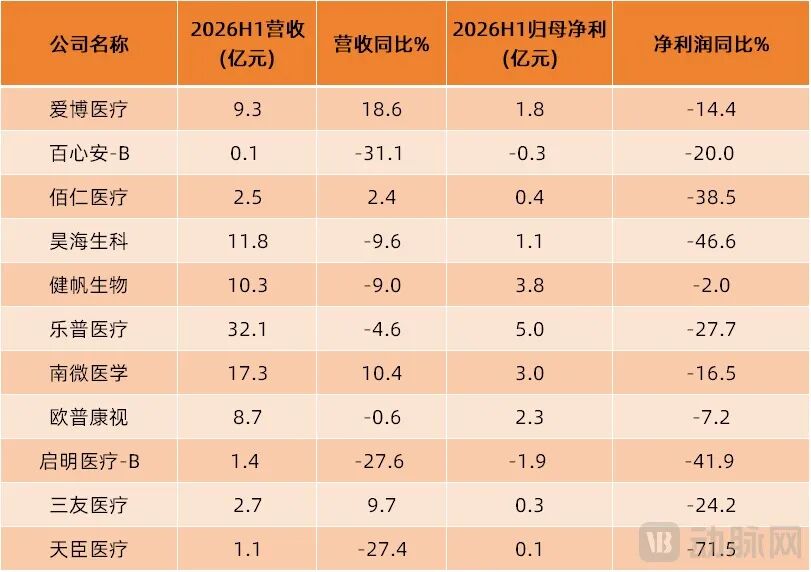
(Data comes from the financial reports of various enterprises)
Tin-Can Medical's net profit fell by 71.5%, Venus Medtech by 41.9%, Haohai Biological Technology by 46.64%, Braun Medical by 38.54%, Lepu Medical by 27.71% (after excluding one-off expenditures, the non-recurring profit and loss deducted profit fell by about 14.8%)... Although the reasons for the decline in net profit are different (price, R&D, channel, exchange rate, etc.), the direction is highly consistent. This means: High-value consumables enterprises can no longer make money as easily as before.
However, there are also some high-value consumables enterprises whose profitability is still growing.
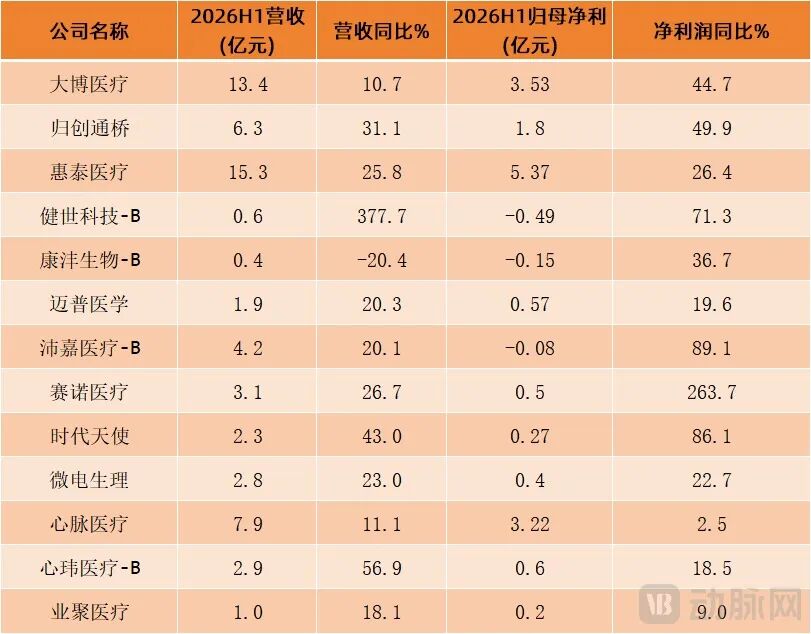
(Note: The financial report currencies of Angelalign and Peregrine Medical are US dollars)
Sino Medical's net profit increased by 263% year-on-year, Hui Tai Medical by 26%, Zhejiang GT Medical by 50%, Dabo Medical by 45%. After excluding the influence of share-based payment, exchange loss and other factors, Sanyou Medical's net profit attributable to shareholders increased by 41.58% year-on-year... The logic behind these outstanding enterprises is roughly the same.
The core point is going global: In the first half of 2026, Hui Tai Medical's overseas revenue was 195 million yuan, a year-on-year increase of 35.9%; MicroPort CardioFlow's overseas revenue increased by more than 21% after excluding the impact of exchange rate. If you can't get more growth in the domestic involution market, you can find incremental space overseas.
In addition to going global, there is another reason: the volume of innovative products increases. For example, Sino Medical's neurointerventional coated dense mesh stent, Hui Tai Medical's pulsed field ablation (PFA), such products have been on the market for a short time, with insufficient competition, and their gross profit margins remain at a high level.
However, these growing enterprises are, after all, a minority in the entire high-value consumables sector. For distributors like Lao Zhou, the profits of most manufacturers are falling, which means their own profits will fall even worse.
03
Another hospital-side business,
Also difficult to make money
Hospital-side business is not only about high-value consumables, medical equipment is also becoming more and more difficult to operate.
According to recent bidding data, the price decline of high-end medical equipment is relatively small, but the price decline of mid-to-low-end medical equipment is more obvious. Taking the bundled procurement of equipment renewal for county-level medical communities as an example, the domestic basic 1.5T magnetic resonance can be as low as 2 million yuan, the basic 64-slice CT is about 1 million yuan, and the basic whole-body ultrasound is less than 500,000 yuan; a few years ago, the price of separate procurement for equipment of the same grade was almost twice this level.
This downward pressure on price can also be traced in the financial reports of listed companies.
Take Wandong Medical as an example. In the first half of 2026, its revenue was 875 million yuan, a year-on-year increase of 3.71%, but the net profit attributable to shareholders was a loss of 91.67 million yuan, turning from profit to loss year-on-year. The overall gross profit margin directly dropped from 35.16% in the same period of last year to 24.94%, down 10.21 percentage points in one year.
It stated: The decline in gross profit margin is mainly due to the strategy of "trading volume for price" in volume-based procurement. Other factors include shrinking hospital procurement, high cost of core components, and the lack of large-scale cost reduction effect. In 2025, Wandong participated in 34 provincial-level volume-based procurement projects, won the bid for 932 sets of equipment, with a winning bid amount of 520 million yuan and an average discount rate of 46%. The annual gross profit margin dropped to 26.56%, nearly 20 percentage points lower than 45.82% in 2021.
The erosion of price on the profits of the medical equipment industry is not at all slight. But price is not the most fatal problem. The most fatal problem is that the payment cannot be recovered.
Lao Zhou has a friend who acts as an agent for imaging equipment. The days were passable in the past two years: although the payment collection was slow and the capital occupation was large, the equipment had a high unit price and thick profits, so it could survive. These two years have become more and more difficult. In the past, the payment collection cycle was three to six months, which was considered normal in the industry. Now the payment collection cycle of many public hospitals has been extended, and the capital occupation has brought huge cash flow pressure to distributors and equipment manufacturers.
This trend of slower payment collection can't even be avoided by industry leaders. United Imaging Healthcare's accounts receivable in 2025 was 5.59 billion yuan, a year-on-year increase of 28%. In the first half of 2026, the accounts receivable turnover days reached 146.2 days, an increase of about 5 days compared with the same period last year.
If the leading enterprise is in such a situation, the pressure on small and medium-sized equipment enterprises and distributors can be imagined.
Slow payment collection superimposed with price reduction, the result of squeezing from both sides is directly written into the 2026 mid-term report. However, the decline in net profit of these enterprises is also affected by comprehensive factors such as R&D expenses, overseas investment, exchange losses, and new business development.
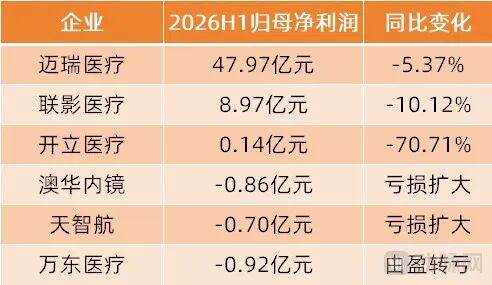
Data source: 2026 semi-annual reports of various companies
This is only the situation of listed companies. Those unlisted small and medium-sized equipment manufacturers have weaker anti-risk capabilities: they have no capital market financing channels, and rely entirely on their own funds to operate. If a large amount of receivables is delayed for a year or half, the cash flow may be cut off.
Inventory occupies the principal, payment collection locks the cash flow, and volume-based procurement and involution further reduce the profit space. Under the pressure of these three mountains, the profits of medical equipment manufacturers continue to decrease. Those bosses who used to act as medical equipment agents are no longer high-spirited. Now they either quietly cancel their companies and exit the market, or lower their status to apply for jobs in manufacturers, taking a fixed salary as provincial managers.
From a boss to an employee. The taste of this experience is hard to understand for those who have not experienced it.
04
Hospital-side leaders are ready to fight hand-to-hand in the home medical device market
Different from the hospital-side market, China's home medical device market has been growing in recent years. From 53.3 billion yuan in 2017 to 102.5 billion yuan in 2021, and then to 168.2 billion yuan in 2023, the size of China's home medical device market has been growing at a double-digit rate almost every year. LeadLeo Research Institute predicts that it will reach 178.4 billion yuan in 2026.
With the overall market growth, most domestic home medical device enterprises have achieved positive growth in revenue and profit. In the first half of 2026, BMC Medical's revenue increased by 40.3%, Cofoe Medical by 38.51%, Sinocare's net profit increased by 22.52%, LifeSense's net profit increased by 41.96%... Compared with the chill of the hospital-side market, most of the home medical device sector is still growing and profitable.
A more noteworthy signal is that the hospital-side leaders have also begun to enter the home market.
As a leading enterprise in China's medical