In the AI era, a two-person team from the United States has covered 174 markets with zero paid user acquisition. Has the "anti-feature" weather app successfully turned subscriptions into sponsorships?
In mid-September 2026, when we reviewed the data of overseas utility apps, we noticed an anomalous sample: a US-based weather app launched in February 2021. In this track where function lists determine success or failure, five years after its initial launch, its download curve is still on the rise. The development team has only two members, and no trace of paid user acquisition can be found through public channels.
At present, the app market is being reshaped by the AI function race. Large model capabilities are being integrated into weather, calendar and note-taking apps one after another. The involution of functions makes the update log directly affect the renewal rate, and the user acquisition cost rises year by year. The default choice for most teams is to continuously increase investment in functions, and then drive users into the growth funnel through paid promotion.
However, the studio behind this app named Not Boring Weather chose the opposite path. According to statistics from DianData's iOS side, as of September 14, 2026, the 6 apps currently on shelves of Not Boring Software studio have accumulated approximately 8.18 million downloads, with total in-app purchase revenue of approximately 2.12 million US dollars.
In the past 30 days, the account has recorded 227,100 downloads, a month-on-month increase of 6.32%; the revenue reached 44,000 US dollars, with 44,100 active users.
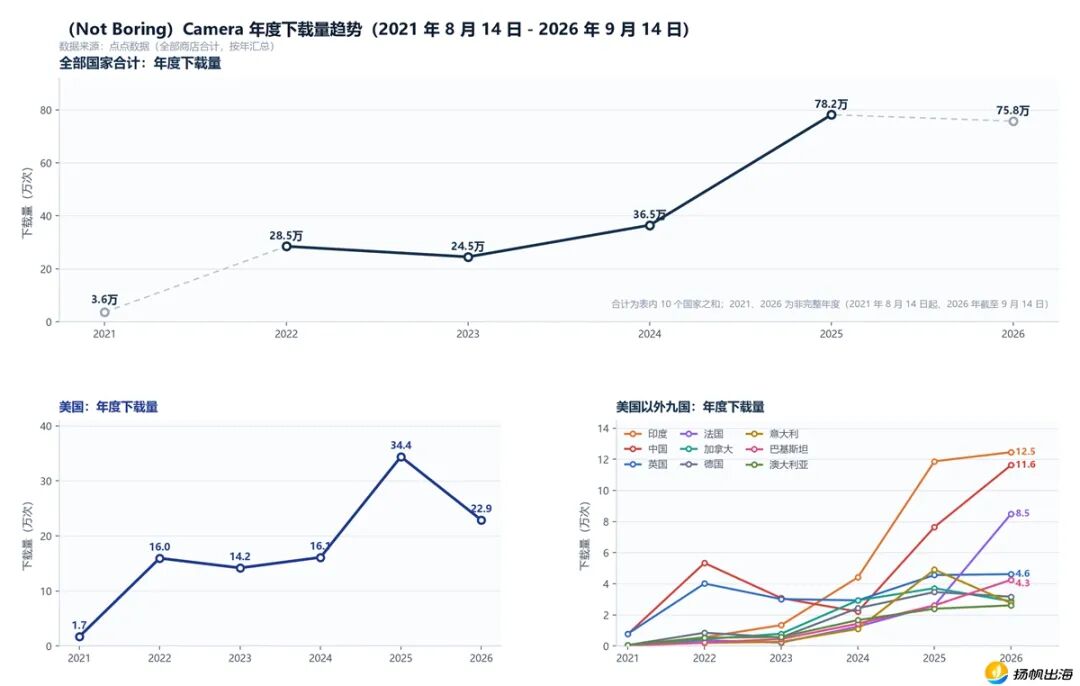
(Annual download trend of Not Boring developer account, 2021 and 2026 are non-full years 丨 Source: DianData, produced by YF Outbound)
Not Boring Weather covers 174 markets, of which 173 regions have been featured as App Store Best Apps, and it has entered the top 10 of the weather category rankings in 38 regions. Its annual download curve is also on the rise: the 2025 download volume more than doubled; 93% of the revenue in the past 30 days came from the weather app alone, and this product contributed approximately 1.97 million US dollars in cumulative terms.
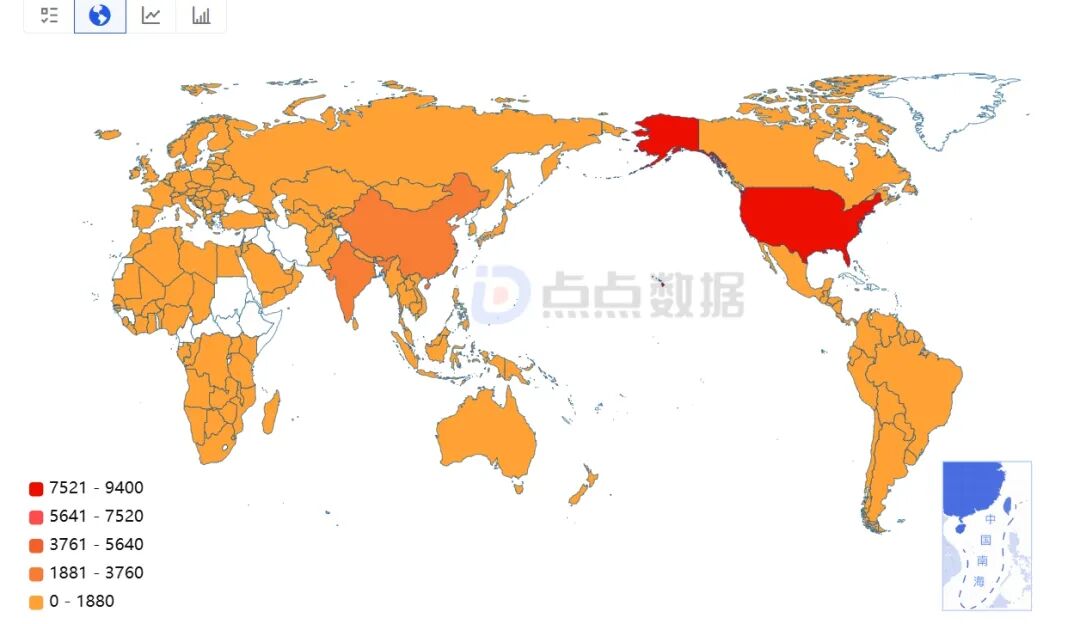
(Distribution of download regions of (Not Boring) Weather in August 丨 Source: DianData)
The studio was founded by Andrew Allen and Mark Dawson in 2020. Cross-verified through the developer interview on Apple's official website and the App Store special page, it is almost confirmed that there are only two founding members, and the team size has not changed to this day.
In February 2021, the first three apps weather, calculator, and timer were launched. After that, the studio launched one new app per year, expanding to habit tracking, ambient music and camera. Currently, there are 6 apps on shelves, covering iPhone, iPad and Vision Pro, all released exclusively in the Apple ecosystem.
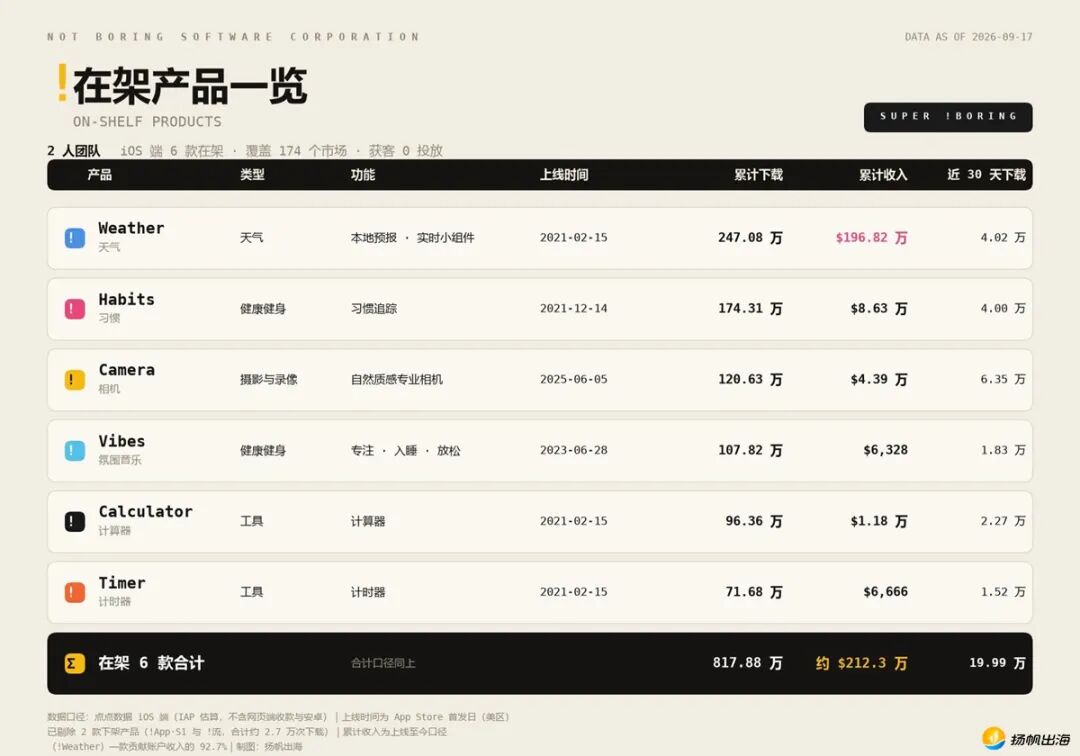
(Overview of the 6 products on shelves 丨 Source: DianData, App Store, produced by YF Outbound)
Judging only from the function list, it is hard to understand why this studio can stand out. The weather subscription can tell stories about data sources, but the calculator and timer have no comparable function upgrades to show. The highest-priced membership tier of the Not Boring series of products is nearly five times more expensive than the standard tier, and the extra benefits once only include a physical card. Why are users willing to pay for it?
Five times the membership fee, turning subscription into sponsorship
The payment structure of Not Boring is divided into two layers. A single app adopts annual subscription to unlock widgets and advanced data; the full-series membership has two current tiers: the Plus tier is 14.99 US dollars per year, and the Super tier is 49.99 US dollars per year, covering all 6 apps. In addition to subscriptions, there are one-time in-app purchases for skins, with unit prices ranging from 4.99 to 9.99 US dollars.
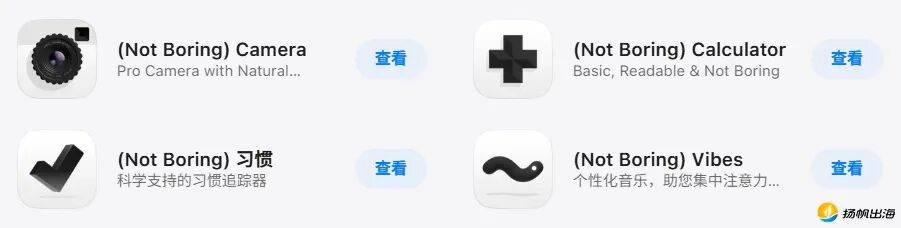
(App Store pages of 4 apps on shelves of the studio 丨 Source: App Store)
The annual fee for the Believer tier of Patron is 14.99 US dollars, and the Patron tier is 69.99 US dollars. The latter only adds artist co-branded skins and a physical collection card sent every quarter.
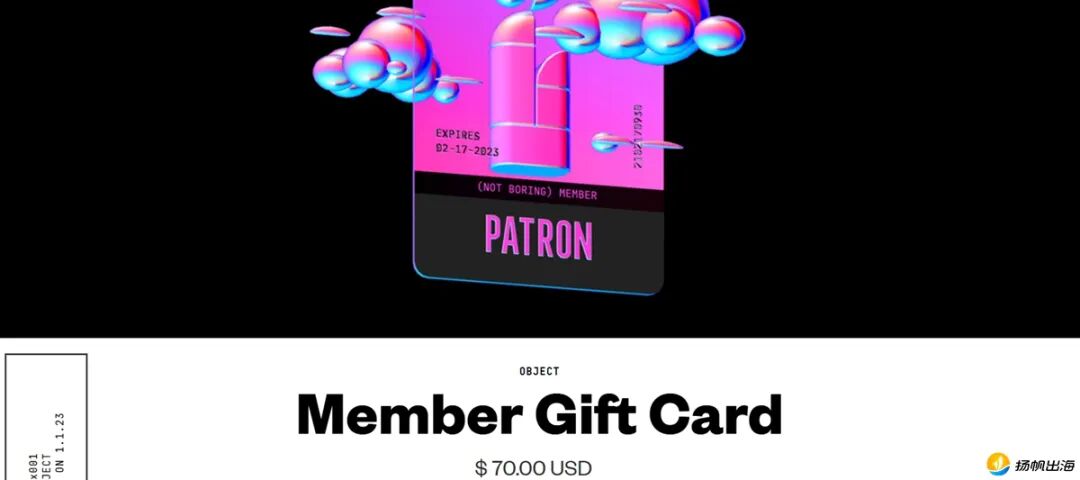
(Physical membership card of the Patron tier, priced at 70 US dollars on the official website store 丨 Source: Not Boring official website)
This card was defined as a universal voucher for membership status in the version note of April 2022. Allen recalled in a 2026 exclusive interview with RevenueCat that the number of people who chose this tier exceeded expectations: "We are not selling functions. People want this project to succeed, see us as warriors against boring software, and are willing to pay for it."
The key to Not Boring's commercial design lies in price locking. The price for long-term subscribed users is permanently locked, and all new apps added in subsequent years will be automatically included in the existing subscription; the team only releases one new product a year, and the version is frozen once delivered. The official website clearly states that the studio has no advertisements, no data tracking, and is 100% supported by members.
Integrate tactile experience into products
How aesthetics and restraint can coexist
The answer still needs to be found in the product itself.
All Not Boring apps are rendered by Apple's own SceneKit 3D engine. The models follow the low-poly style, referencing the video games of the PS1 era. Allen said in the Apple Developer Interview that the team's aesthetic inspiration comes from games, and the measurement standard is the "gamified" experience. Dawson added more directly: Large teams can always develop more functions, but good design cannot be replicated.
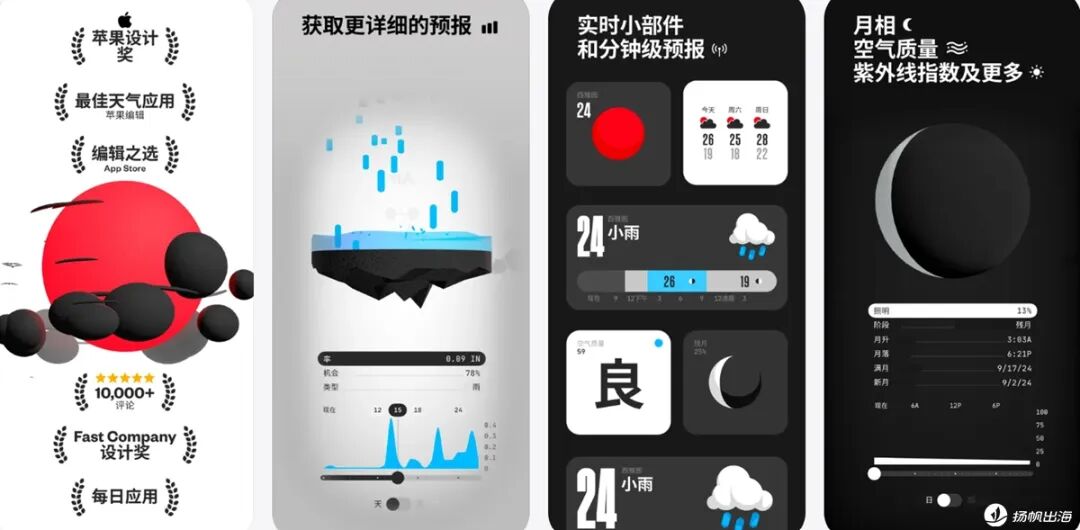
(Apple Design Award logo and interactive interface of (Not Boring) Weather 丨 Source: App Store)
Sound is the first part most users notice. The app still plays sound normally when the iPhone mute switch is turned on, a practice that would lead to bad reviews in other products. It works here because sound itself is part of the experience. When you press a button, the app selects one of more than a dozen audio files to play, recording the subtle differences of the same click sound, and the feedback of each press varies.
The interaction layer is also built in the way of games. The weather app turns temperature, cloud cover, and air quality into operable 3D models one by one. Drag the timeline to see the weather changes throughout the day, and there is also a mini-game called Cloudburst hidden in the interface. Every data point becomes a touchable toy.
Different dragging gestures of your fingers can bring smooth and interesting interface feedback. Coupled with switching skin appearances, pulling the timeline, querying specific weather dimensions and the built-in mini-games, the trivial thing of "checking the weather", which is ordinary and even often forgotten in daily life, suddenly becomes interesting.
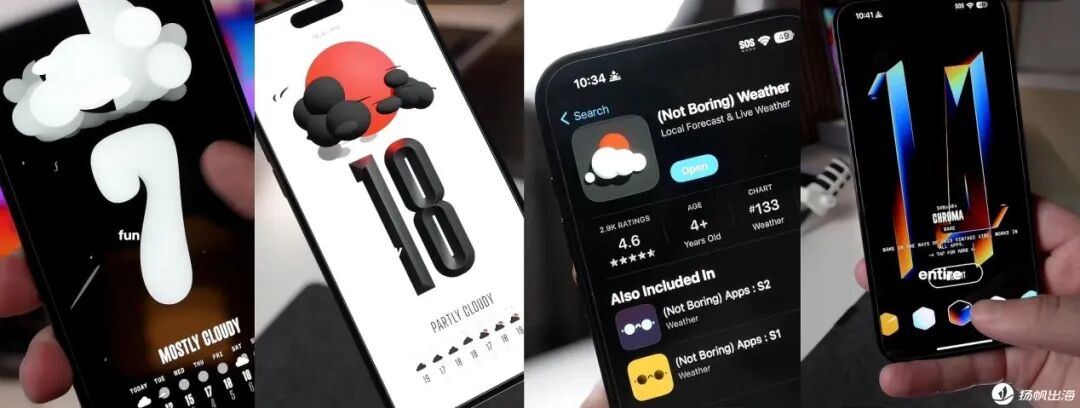
(3D interactive page of the weather app 丨 Source: YouTube)
Allen once disclosed the team's internal roadmap in an interview: the home screen of the first-generation iPhone. Weather, calculator, and camera have been crossed off the list one by one, and the remaining core utilities will be completed at a rate of one per year. The product selection logic can be traced from this: they want to redo all the "high-frequency daily" software related to people on mobile phones.
The latest camera app Not Boring Camera pushes this concept to the farthest point. Every control in the interface is 3D modeled, the knob can be rotated, the slider has a sense of weight, and there is a border around the viewfinder frame, which is close to the viewing experience of an optical viewfinder, giving people the feeling that "there is a physical device inside the mobile phone screen".
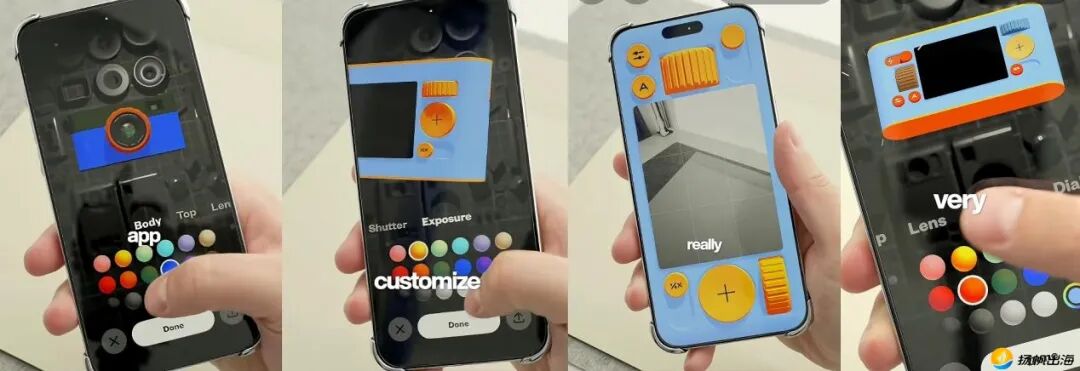
(Customizable 3D controls of the camera app 丨 Source: YouTube)
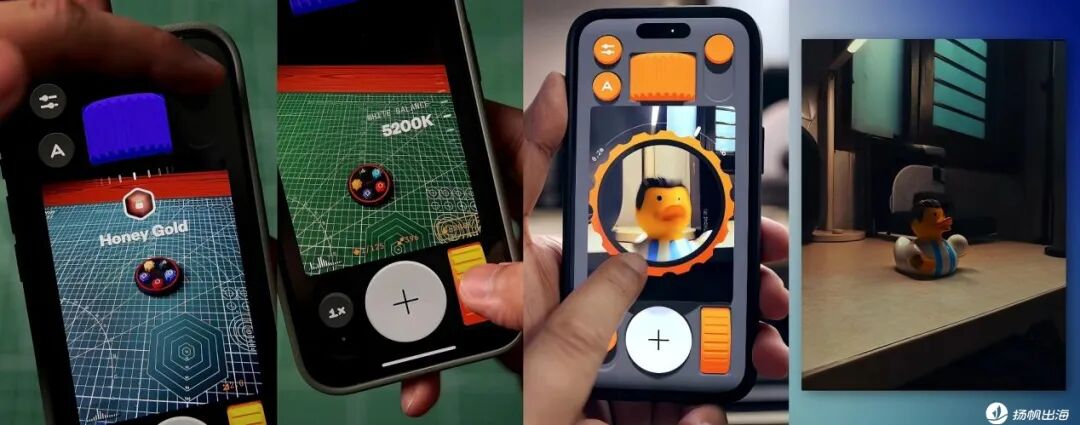
(3D LUT on-site color grading of the camera app 丨 Source: YouTube)
It is also the first camera app in the entire industry that supports 3D LUT on-site color grading, and the color style is determined by co-branded presets of users and creators. This app largely strips off Apple's computational photography pipeline and directly reads the original sensor data. The official name is SuperRAW, with the copywriting saying "no AI processing, no weird artifacts".
At a time when image software is collectively integrating generative models, this function description itself represents a stance.
However, although Allen also described Not Boring Calculator in the exclusive interview: "This is the calculator we made, it is complete, it does the job well. We won't modify it on your hands. It won't suddenly pop up a chatbot in the corner", it doesn't mean he is against AI.
AI has its own place in this system. On December 31, 2025, the habit app Not Boring Habits launched Custom Quests with the annual major version, calling the on-device basic model of iOS 26 to generate task storylines for each habit goal. The official notes that the model runs locally on the device, and data never leaves the device. The update in January 2026 also added a switch that can be turned off at any time.
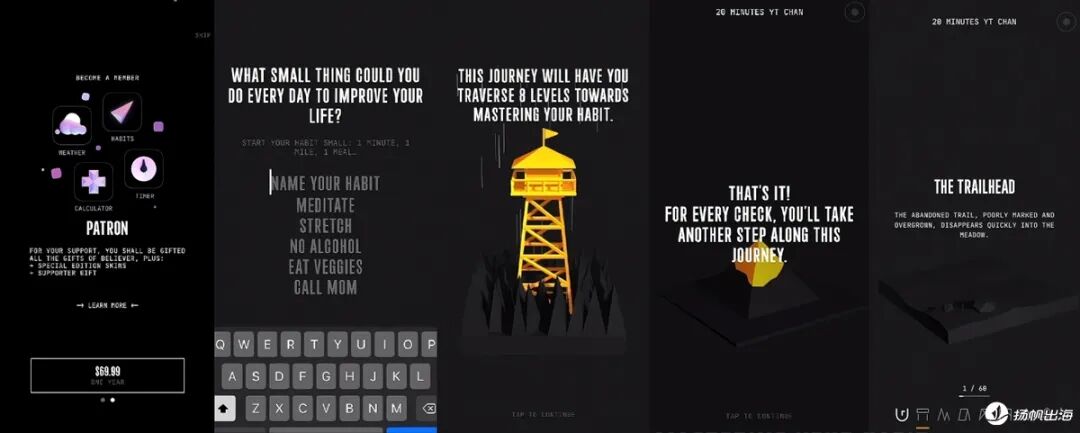
Gamified design of Not Boring Habits: Habit = Building = Level Clearing 丨 Source: YouTube
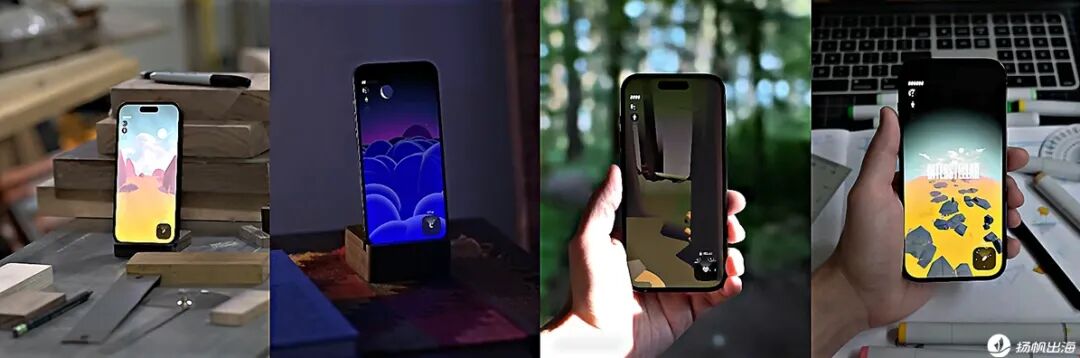
Companion music/interface adapted to different real scenarios with AI in Not Boring Vibes 丨 Source: YouTube
All of these are consistent with the whole product logic: the privacy label of the full series is "No Data Collected", which rules out cloud models. Similar products have formed a small ecosystem: CARROT Weather sells weather subscriptions with anthropomorphic personality, Widgetsmith is maintained by David Smith alone, and its total downloads have exceeded 100 million. Aesthetics and emotional experience are becoming legitimate paid points for utility apps.
An acquisition experience, and the stance of refusing financing
The origin of Not Boring's model, concept and stance comes from Allen's previous experience. As the co-founder of the drawing app Paper, Allen's product once defined the creative experience in the early days of iPad. FiftyThree later raised a total of approximately 45 million US dollars. According to Allen's account, the return model of venture capital requires a billion-dollar exit, and a product that continues to make profits but cannot reach that level will be judged as having limited scale.
The subsequent path of the company was to continuously increase